Which of the following antenna types will be most effective as a near vertical incidence skywave (NVIS) antenna for short-skip communications on 40 meters during the day?
Show the answer and why
Answer A. A horizontal dipole placed between 1/10 and 1/4 wavelength above the ground
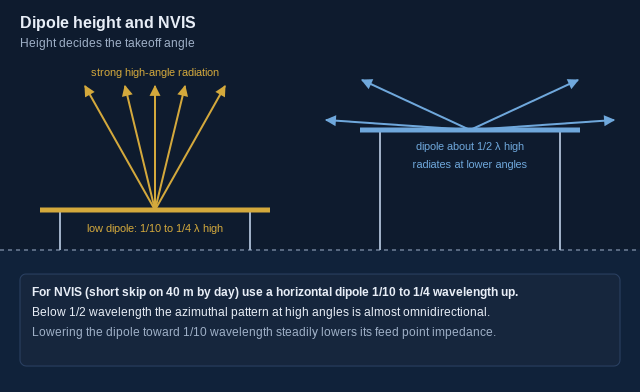
A horizontal dipole placed between 1/10 and 1/4 wavelength above the ground works best for NVIS on 40 meters.
Describe this graphic in words
Two dipoles above the ground. A low one, between 1/10 and 1/4 wavelength high, radiates strongly straight up, which suits near vertical incidence skywave communication. One about half a wavelength high radiates at lower angles. A note says below half a wavelength the azimuthal pattern at high angles is almost omnidirectional, and that lowering the dipole toward 1/10 wavelength steadily lowers its feed point impedance.
This is a teaching note. For near vertical incidence, the signal needs to go almost straight up. A low horizontal dipole radiates strongly upward because the ground reflection adds to the upward signal. Higher than half a wavelength it radiates at lower angles and skips over the nearby area.
Why the other choices are wrong
- B. A vertical antenna radiates at low angles, not straight up.
- C. A dipole at 1/2 wavelength radiates at lower angles than is best for NVIS.
- D. A vertical dipole radiates mostly at low angles.
Rule text checked against the official source on November 17, 2026. This is a study aid; the linked rule is what governs.