
ARSC Tech School

General G1C: Transmitter power regulations

423 questions · pool July 1, 2023 to June 30, 2027 · the exam has 35 questions; 26 to pass

G1 · COMMISSION’S RULES

Transmitter power regulations; data emission standards; 60-meter operation requirements

8 questions in group G1C

One question from this group appears on each exam.

G1C01FCC rule 97.313(c)(1)

What is the maximum transmitter power an amateur station may use on 10.140 MHz?

Show the answer and why

Answer A. 200 watts PEP output

FCC rule 97.313(c)(1)

On the 30 meter band, 10.10 to 10.15 MHz, the limit for every license class is 200 watts PEP.
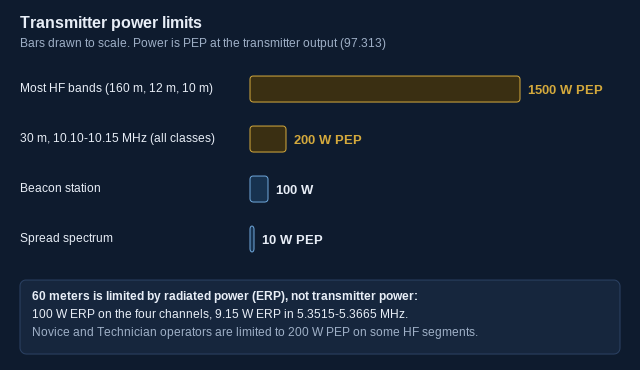
Bar chart of transmitter power limits: 1500 watts PEP general limit, 200 watts on 30 meters, 100 watts for beacons, and 10 watts for spread spectrum.
Describe this graphic in words

Four horizontal bars drawn to scale. The general limit for General class operators, including 160, 12 and 10 meters, is 1500 watts PEP. The 30 meter band, 10.10 to 10.15 MHz, is limited to 200 watts PEP for every class. Beacons are limited to 100 watts and spread spectrum to 10 watts PEP. A note says 60 meters is limited by radiated power: 100 watts ERP on the four channels and 9.15 watts ERP in 5.3515 to 5.3665 MHz.

Section 97.313(c)(1) says no station may transmit with a transmitter power output exceeding 200 W PEP on the 10.10-10.15 MHz segment. 10.140 MHz is inside it, so 200 W PEP is the limit, even though the general limit in 97.313(b) is 1.5 kW PEP.

The 30 meter band is a narrow band shared with other services, and the lower limit is a reminder to use only as much power as you need.

Why the other choices are wrong

  • B. 1000 watts is not a limit that appears in 97.313, and it is above the 200 W limit for 30 m.
  • C. 1500 W PEP is the general limit, but 30 m has a lower limit of 200 W PEP.
  • D. 2000 W exceeds even the general limit of 1.5 kW PEP.

References

Rule text checked against the official source on November 12, 2026. This is a study aid; the linked rule is what governs.
G1C02FCC rule 97.313

What is the maximum transmitter power an amateur station may use on the 12-meter band?

Show the answer and why

Answer C. 1500 watts PEP output

FCC rule 97.313

On 12 meters the limit is the general one, 1.5 kW PEP.

Bar chart of transmitter power limits: 1500 watts PEP general limit, 200 watts on 30 meters, 100 watts for beacons, and 10 watts for spread spectrum.
Describe this graphic in words

Four horizontal bars drawn to scale. The general limit for General class operators, including 160, 12 and 10 meters, is 1500 watts PEP. The 30 meter band, 10.10 to 10.15 MHz, is limited to 200 watts PEP for every class. Beacons are limited to 100 watts and spread spectrum to 10 watts PEP. A note says 60 meters is limited by radiated power: 100 watts ERP on the four channels and 9.15 watts ERP in 5.3515 to 5.3665 MHz.

Section 97.313(b) says no station may transmit with a transmitter power exceeding 1.5 kW PEP. The lower limits in paragraphs (c) and later apply to specific segments, license classes or services, and the 12 meter band is not one of them.

So the answer is 1500 W PEP. The remaining choices are lower numbers or an effective radiated power expression that is not how 97.313 states the limit for 12 m.

Why the other choices are wrong

  • A. 50 W PEP is a limit that applies to some UHF areas near military sites, not to 12 meters.
  • B. 200 W PEP applies to 30 m and to Novice and Technician operators on some HF segments, not to Generals on 12 m.
  • D. ERP equal to 100 W from a half-wave dipole is the 60 meter channel limit, not the 12 meter limit.

References

Rule text checked against the official source on November 12, 2026. This is a study aid; the linked rule is what governs.

G1C03FCC rule 97.303(h)(1)

What is the maximum bandwidth permitted by FCC rules for amateur radio stations transmitting on USB frequencies in the 60-meter band?

Show the answer and why

Answer A. 2.8 kHz

FCC rule 97.303(h)(1)

On 60 meters, an emission may not occupy more than 2.8 kHz.

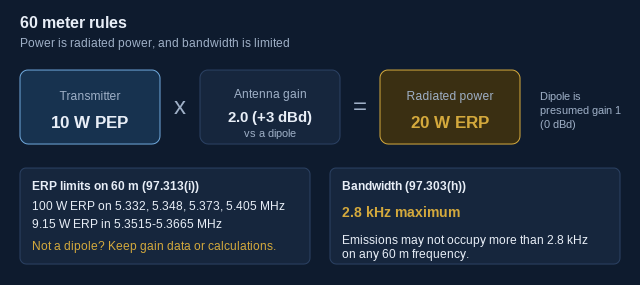
On 60 meters, ERP equals transmitter PEP times antenna gain, with 100 watts ERP on four channels, 9.15 watts in the segment, and a 2.8 kHz bandwidth limit.
Describe this graphic in words

An equation: a 10 watt PEP transmitter times an antenna gain of 2.0, which is 3 dB over a dipole, equals 20 watts ERP. A half-wave dipole is presumed to have a gain of one. Below, two panels. The first gives the ERP limits: 100 watts ERP on 5.332, 5.348, 5.373 and 5.405 MHz and 9.15 watts ERP in 5.3515 to 5.3665 MHz, and says to keep gain data or calculations if the antenna is not a dipole. The second gives the bandwidth limit, 2.8 kHz.

Section 97.303(h) says that for all 60 m spectrum, operators "shall ensure that their emissions do not occupy more than 2.8 kHz." The 2K80 in the emission designators it lists (such as 2K80J3E for upper sideband voice) is the same 2.8 kHz figure.

A normal SSB voice signal is about 2.4 to 3 kHz wide, so on 60 m you must keep your audio bandwidth narrow enough to stay inside the limit.

Why the other choices are wrong

  • B. 5.6 kHz is twice the limit.
  • C. 1.8 kHz is narrower than the limit. The rule allows up to 2.8 kHz.
  • D. 3 kHz is wider than the limit. Emissions may not occupy more than 2.8 kHz.

References

Rule text checked against the official source on November 12, 2026. This is a study aid; the linked rule is what governs.

G1C04FCC rule 97.303(i)

Which of the following is required by the FCC rules when operating in the 60-meter band?

Show the answer and why

Answer A. If you are using an antenna other than a dipole, you must keep a record of the gain of your antenna

FCC rule 97.303(i)

If you use an antenna other than a dipole on 60 meters, you must keep a record of its gain.

On 60 meters, ERP equals transmitter PEP times antenna gain, with 100 watts ERP on four channels, 9.15 watts in the segment, and a 2.8 kHz bandwidth limit.
Describe this graphic in words

An equation: a 10 watt PEP transmitter times an antenna gain of 2.0, which is 3 dB over a dipole, equals 20 watts ERP. A half-wave dipole is presumed to have a gain of one. Below, two panels. The first gives the ERP limits: 100 watts ERP on 5.332, 5.348, 5.373 and 5.405 MHz and 9.15 watts ERP in 5.3515 to 5.3665 MHz, and says to keep gain data or calculations if the antenna is not a dipole. The second gives the bandwidth limit, 2.8 kHz.

On 60 m, power is limited as radiated power (ERP), not just transmitter power. Section 97.313(i) says to compute ERP, you multiply the transmitter PEP by the antenna gain relative to a half-wave dipole, and a half-wave dipole is presumed to have a gain of 1 (0 dBd). "Licensees using other antennas must maintain in their station records either the antenna manufacturer's data on the antenna gain or calculations of the antenna gain."

For example, 10 W PEP into an antenna with 3 dB gain over a dipole is about 20 W ERP. That matters because the limit is 100 W ERP on the four channels and 9.15 W ERP in the 5.3515-5.3665 MHz segment.

Why the other choices are wrong

  • B. There is no 60 m rule requiring a log of date, time, frequency, power and stations worked.
  • C. Third-party traffic record keeping is not part of the 60 m rules.
  • D. There is no requirement to record the manufacturer of your equipment and antenna.

References

Rule text checked against the official source on November 12, 2026. This is a study aid; the linked rule is what governs.

G1C05FCC rule 97.313

What is the limit for transmitter power on the 28 MHz band for a General Class control operator?

Show the answer and why

Answer C. 1500 watts PEP output

FCC rule 97.313

A General class operator may use up to 1500 watts PEP on the 28 MHz band.

Bar chart of transmitter power limits: 1500 watts PEP general limit, 200 watts on 30 meters, 100 watts for beacons, and 10 watts for spread spectrum.
Describe this graphic in words

Four horizontal bars drawn to scale. The general limit for General class operators, including 160, 12 and 10 meters, is 1500 watts PEP. The 30 meter band, 10.10 to 10.15 MHz, is limited to 200 watts PEP for every class. Beacons are limited to 100 watts and spread spectrum to 10 watts PEP. A note says 60 meters is limited by radiated power: 100 watts ERP on the four channels and 9.15 watts ERP in 5.3515 to 5.3665 MHz.

The 200 W PEP limit on 28.0-28.5 MHz in 97.313(c)(2) applies only when the control operator is a Novice or Technician Class operator. A General class control operator is under the general limit in 97.313(b), 1.5 kW PEP.

That is the reason the license class is named in the question.

Why the other choices are wrong

  • A. 100 W is not a limit set for the 28 MHz band for General operators.
  • B. 1000 W is not a limit in 97.313.
  • D. 2000 W is above the maximum of 1.5 kW PEP.

References

Rule text checked against the official source on November 12, 2026. This is a study aid; the linked rule is what governs.

G1C06FCC rule 97.313

What is the limit for transmitter power on the 1.8 MHz band?

Show the answer and why

Answer D. 1500 watts PEP output

FCC rule 97.313

The limit on the 1.8 MHz (160 meter) band is 1500 watts PEP.

Bar chart of transmitter power limits: 1500 watts PEP general limit, 200 watts on 30 meters, 100 watts for beacons, and 10 watts for spread spectrum.
Describe this graphic in words

Four horizontal bars drawn to scale. The general limit for General class operators, including 160, 12 and 10 meters, is 1500 watts PEP. The 30 meter band, 10.10 to 10.15 MHz, is limited to 200 watts PEP for every class. Beacons are limited to 100 watts and spread spectrum to 10 watts PEP. A note says 60 meters is limited by radiated power: 100 watts ERP on the four channels and 9.15 watts ERP in 5.3515 to 5.3665 MHz.

None of the lower limits in 97.313 applies to 160 m, so the general limit in 97.313(b) of 1.5 kW PEP is the one in force.

Remember that 97.313(a) also tells you to use the minimum power needed to carry out the communication, so the legal maximum is a ceiling, not a target.

Why the other choices are wrong

  • A. 200 W PEP is a limit for 30 m and for some Novice and Technician segments, not for 160 m.
  • B. 1000 W is not a limit in 97.313.
  • C. 1200 W is not a limit in 97.313.

References

Rule text checked against the official source on November 12, 2026. This is a study aid; the linked rule is what governs.

G1C07FCC rule 97.309(a)(4)

What must be done before using a new digital protocol on the air?

Show the answer and why

Answer C. Publicly document the technical characteristics of the protocol

FCC rule 97.309(a)(4)

A new digital technique may be used on the air once its technical characteristics have been publicly documented.

Section 97.309(a)(4) allows an amateur station using a digital code from the list in that paragraph to use "any technique whose technical characteristics have been documented publicly, such as CLOVER, G-TOR, or PacTOR." The documentation lets other operators and the FCC decode and monitor the signal.

No type certification, experimental license or rule making is needed to use a documented protocol. The publicly documented requirement exists because amateur signals must not be used to obscure meaning.

Why the other choices are wrong

  • A. Amateur equipment does not have to be type-certified for this purpose.
  • B. No experimental license is required. Documentation is enough.
  • D. You do not need to petition the FCC for a rule change to use a documented technique.

References

Rule text checked against the official source on November 12, 2026. This is a study aid; the linked rule is what governs.

G1C11FCC rule 97.313

What measurement is specified by FCC rules that regulate maximum power?

Show the answer and why

Answer D. PEP output from the transmitter

FCC rule 97.313

FCC power limits are stated as PEP output from the transmitter.

Bar chart of transmitter power limits: 1500 watts PEP general limit, 200 watts on 30 meters, 100 watts for beacons, and 10 watts for spread spectrum.
Describe this graphic in words

Four horizontal bars drawn to scale. The general limit for General class operators, including 160, 12 and 10 meters, is 1500 watts PEP. The 30 meter band, 10.10 to 10.15 MHz, is limited to 200 watts PEP for every class. Beacons are limited to 100 watts and spread spectrum to 10 watts PEP. A note says 60 meters is limited by radiated power: 100 watts ERP on the four channels and 9.15 watts ERP in 5.3515 to 5.3665 MHz.

Section 97.313 expresses its limits as transmitter power or transmitter output in watts PEP, such as "1.5 kW PEP" and "200 W PEP". Peak envelope power is defined in 97.3 as the average power supplied to the antenna transmission line by a transmitter during one RF cycle at the crest of the modulation envelope.

So the rule measures what the transmitter puts out, at its peak, not an RMS value and not input to the antenna. The one exception is 60 m, where radiated power (ERP) is used because the limits there are tighter.

Why the other choices are wrong

  • A. RMS output is not the measurement the rules use. The limit is stated in PEP.
  • B. RMS input to the antenna is not the measurement the rules use.
  • C. The limit is on what the transmitter puts out, not on what reaches the antenna after feed line loss.

References

Rule text checked against the official source on November 12, 2026. This is a study aid; the linked rule is what governs.