
ARSC Tech School

General G6A: Resistors

423 questions · pool July 1, 2023 to June 30, 2027 · the exam has 35 questions; 26 to pass

G6 · CIRCUIT COMPONENTS

Resistors; capacitors; inductors; rectifiers; solid-state diodes and transistors; vacuum tubes; batteries

12 questions in group G6A

One question from this group appears on each exam.

G6A01

What is the minimum allowable discharge voltage for maximum life of a standard 12-volt lead-acid battery?

Show the answer and why

Answer C. 10.5 volts

10.5 volts is the minimum discharge voltage for maximum life of a 12-volt lead-acid battery.
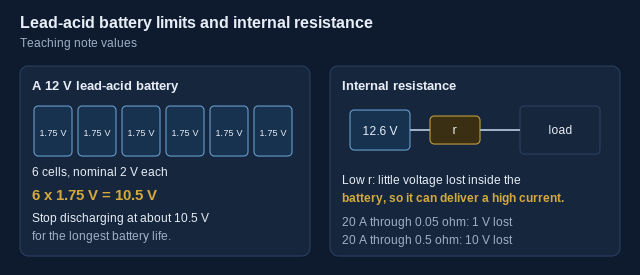
A 12 volt lead-acid battery has six cells; 1.75 volts each gives 10.5 volts, the minimum discharge voltage. Low internal resistance means little voltage lost under load.
Describe this graphic in words

Left: six cells of a 12 volt lead-acid battery, each 1.75 volts at the discharge limit, for a total of 10.5 volts, the point to stop discharging for the longest life. Right: a battery drawn with an internal resistance in series with the load. Low internal resistance loses little voltage, so the battery can deliver a high current. 20 amperes through 0.05 ohm loses 1 volt, and through 0.5 ohm loses 10 volts.

This is a teaching note. A 12 volt lead-acid battery has six cells. Discharging a cell below about 1.75 volts damages it and shortens its life, and six cells at 1.75 volts is 10.5 volts. Many battery guides give this figure, so stop discharging before the voltage drops under it.

Why the other choices are wrong

  • A. 6 volts would be a deep discharge that ruins the battery.
  • B. 8.5 volts is far below the safe limit.
  • D. 12 volts is the nominal voltage, and a battery at 12 volts is only partly discharged.

Rule text checked against the official source on November 17, 2026. This is a study aid; the linked rule is what governs.
G6A02

What is an advantage of batteries with low internal resistance?

Show the answer and why

Answer B. High discharge current

A battery with low internal resistance can deliver a high discharge current.

A 12 volt lead-acid battery has six cells; 1.75 volts each gives 10.5 volts, the minimum discharge voltage. Low internal resistance means little voltage lost under load.
Describe this graphic in words

Left: six cells of a 12 volt lead-acid battery, each 1.75 volts at the discharge limit, for a total of 10.5 volts, the point to stop discharging for the longest life. Right: a battery drawn with an internal resistance in series with the load. Low internal resistance loses little voltage, so the battery can deliver a high current. 20 amperes through 0.05 ohm loses 1 volt, and through 0.5 ohm loses 10 volts.

This is a teaching note. The internal resistance drops some of the battery's voltage when current flows. With low internal resistance the voltage drop is small, so the battery can supply large currents and keep its terminal voltage.

Worked example: a battery with 0.05 ohm internal resistance loses only 1 volt at 20 amperes. One with 0.5 ohm would lose 10 volts.

Why the other choices are wrong

  • A. Life depends on chemistry and use, not just on internal resistance.
  • C. Voltage depends on the cells, not on internal resistance.
  • D. Charge rate depends on other factors as well.

Rule text checked against the official source on November 17, 2026. This is a study aid; the linked rule is what governs.
G6A03

What is the approximate forward threshold voltage of a germanium diode?

Show the answer and why

Answer B. 0.3 volts

The forward threshold voltage of a germanium diode is about 0.3 volts.

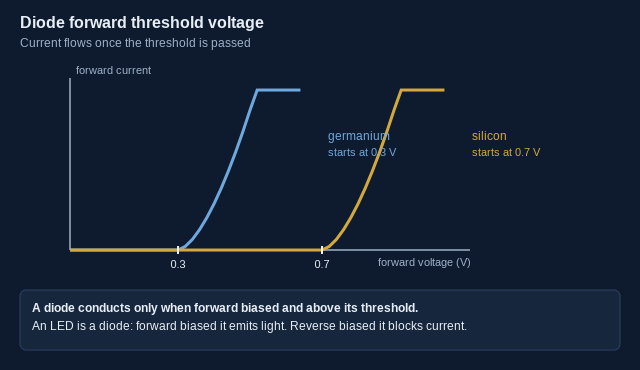
Diode forward current curves: germanium starts conducting at about 0.3 volts and silicon at about 0.7 volts.
Describe this graphic in words

A graph of forward current against forward voltage. The germanium diode curve turns upward at about 0.3 volts. The silicon diode curve turns upward at about 0.7 volts. A note says a diode conducts only when forward biased above its threshold, and that an LED is a diode that emits light when forward biased.

This is a teaching note. A diode starts to conduct once the forward voltage passes its threshold. A germanium diode needs about 0.3 V, a silicon diode about 0.7 V.

The low threshold of germanium is why it was used in early radio detectors, where the signals are weak.

Why the other choices are wrong

  • A. 0.1 volt is lower than the threshold of a germanium diode.
  • C. 0.7 volts is the threshold of a silicon diode.
  • D. 1.0 volt is higher than the threshold of either type.

Rule text checked against the official source on November 17, 2026. This is a study aid; the linked rule is what governs.
G6A04

Which of the following is characteristic of an electrolytic capacitor?

Show the answer and why

Answer C. High capacitance for a given volume

An electrolytic capacitor gives high capacitance for a given volume.

This is a teaching note. An electrolytic capacitor uses a very thin oxide layer as the dielectric, so a lot of capacitance fits in a small can. The price is leakage, wide tolerance, a polarity to observe, and poor performance at RF. They are used in power supply filters.

Why the other choices are wrong

  • A. Tolerance is wide, not tight.
  • B. Electrolytics have more leakage than most other types.
  • D. They are poor at RF because of their internal inductance and resistance.

Rule text checked against the official source on November 17, 2026. This is a study aid; the linked rule is what governs.
G6A05

What is the approximate forward threshold voltage of a silicon junction diode?

Show the answer and why

Answer C. 0.7 volts

The forward threshold voltage of a silicon diode is about 0.7 volts.

Diode forward current curves: germanium starts conducting at about 0.3 volts and silicon at about 0.7 volts.
Describe this graphic in words

A graph of forward current against forward voltage. The germanium diode curve turns upward at about 0.3 volts. The silicon diode curve turns upward at about 0.7 volts. A note says a diode conducts only when forward biased above its threshold, and that an LED is a diode that emits light when forward biased.

This is a teaching note. Silicon junction diodes begin conducting at about 0.6 to 0.7 V. That is why a silicon diode drops about 0.7 V in a power supply rectifier.

Why the other choices are wrong

  • A. 0.1 volt is not a diode threshold.
  • B. 0.3 volts is the threshold of germanium.
  • D. 1.0 volt is higher than the threshold.

Rule text checked against the official source on November 17, 2026. This is a study aid; the linked rule is what governs.

G6A06

Why should wire-wound resistors not be used in RF circuits?

Show the answer and why

Answer B. The resistor’s inductance could make circuit performance unpredictable

Wire-wound resistors should not be used in RF circuits because their inductance can make performance unpredictable.

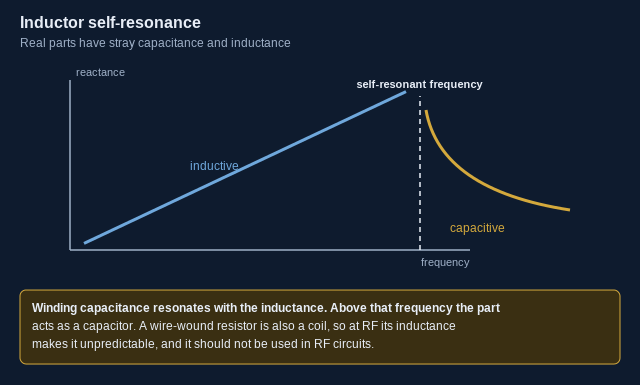
A real inductor looks inductive up to its self-resonant frequency and capacitive above it.
Describe this graphic in words

A graph of reactance against frequency. A rising blue line shows the part behaving as an inductor up to the self-resonant frequency. Above that frequency the curve turns and the part behaves as a capacitor. A note says the winding capacitance resonates with the inductance, and that a wire-wound resistor is also a coil, so its inductance makes it unpredictable at radio frequencies.

This is a teaching note. A wire-wound resistor is a coil of resistance wire, so it is also an inductor. At radio frequencies that inductance can be significant, so the part does not behave like a pure resistance.

Why the other choices are wrong

  • A. Tolerance is not the problem.
  • C. Wire-wound resistors can handle a lot of power.
  • D. Internal capacitance is not the main issue. It is the inductance of the winding.

Rule text checked against the official source on November 17, 2026. This is a study aid; the linked rule is what governs.

G6A07

What are the operating points for a bipolar transistor used as a switch?

Show the answer and why

Answer A. Saturation and cutoff

A bipolar transistor used as a switch operates between saturation and cutoff.

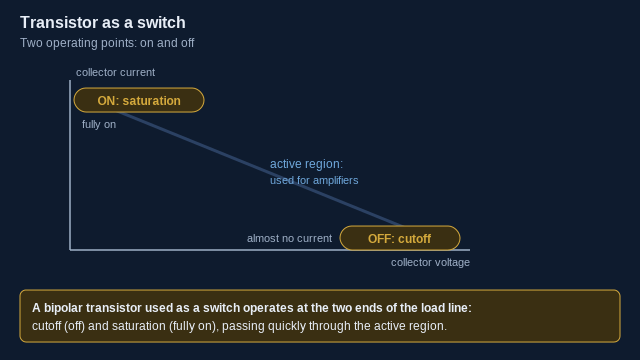
A load line with saturation at one end and cutoff at the other; a transistor switch operates at those two ends and an amplifier in between.
Describe this graphic in words

A load line of collector current against collector voltage. At the top left end is saturation, where the transistor is fully on. At the bottom right end is cutoff, where it is off with almost no current. In between is the active region, used for amplifiers. A bipolar transistor used as a switch operates at saturation and cutoff.

This is a teaching note. In cutoff the transistor is off and passes almost no current. In saturation it is fully on and the voltage across it is very small. A switch spends its time in those two states, and passes quickly through the region between them.

Why the other choices are wrong

  • B. The active region is used for amplifiers.
  • C. Peak and valley points describe tunnel diodes and similar devices.
  • D. Enhancement and depletion are modes of field-effect transistors.

Rule text checked against the official source on November 17, 2026. This is a study aid; the linked rule is what governs.

G6A08

Which of the following is characteristic of low voltage ceramic capacitors?

Show the answer and why

Answer D. Comparatively low cost

Low voltage ceramic capacitors are comparatively low in cost.

This is a teaching note. General-purpose ceramic disc capacitors are cheap and widely used for bypassing and coupling. Their tolerance is loose and their stability is modest, though special types are more stable.

Why the other choices are wrong

  • A. Tolerance is not tight in general-purpose ceramic capacitors.
  • B. Stability is modest in general-purpose ceramic capacitors.
  • C. High capacitance for a given volume describes electrolytics.

Rule text checked against the official source on November 17, 2026. This is a study aid; the linked rule is what governs.

G6A09

Which of the following describes MOSFET construction?

Show the answer and why

Answer B. The gate is separated from the channel by a thin insulating layer

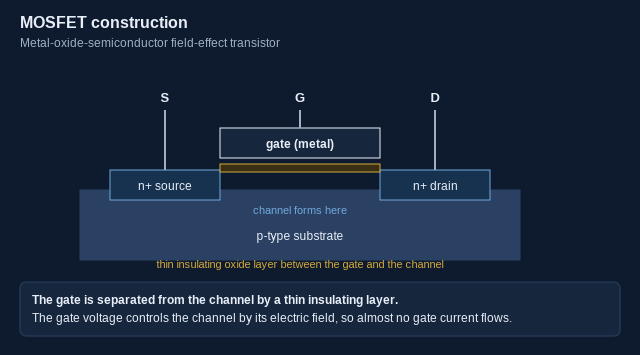
In a MOSFET the gate is separated from the channel by a thin insulating layer.

Cross-section of a MOSFET: the metal gate sits on a thin insulating oxide layer above the channel between the source and drain.
Describe this graphic in words

A cross-section: a p-type substrate with an n-plus source on the left and an n-plus drain on the right. Between them is the channel. A metal gate sits above the channel, separated from it by a thin insulating oxide layer. The gate voltage controls the channel by its electric field, so almost no gate current flows.

This is a teaching note. MOSFET stands for metal-oxide-semiconductor field-effect transistor. The gate is a metal electrode on a thin layer of oxide, which insulates it from the channel. The gate voltage controls the channel through its electric field, so almost no gate current flows.

Why the other choices are wrong

  • A. A back-biased junction forms the gate of a JFET, not a MOSFET.
  • C. It is the gate that is insulated, not the space between source and drain.
  • D. The source is not formed by depositing metal on silicon.

Rule text checked against the official source on November 17, 2026. This is a study aid; the linked rule is what governs.

G6A10

Which element of a vacuum tube regulates the flow of electrons between cathode and plate?

Show the answer and why

Answer A. Control grid

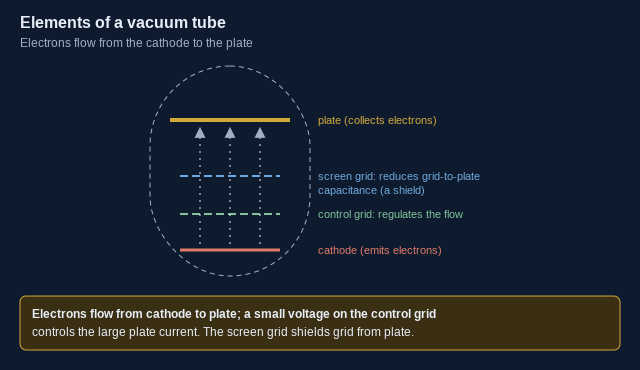
The control grid regulates the flow of electrons between the cathode and plate.

Vacuum tube elements: the cathode emits electrons, the control grid regulates their flow, the screen grid reduces grid-to-plate capacitance, and the plate collects them.
Describe this graphic in words

A tube drawn with its elements in order from the bottom: the cathode that emits electrons, the control grid that regulates the flow of electrons, the screen grid that acts as a shield and reduces grid-to-plate capacitance, and the plate at the top that collects the electrons. Dotted arrows show electrons flowing from cathode to plate.

This is a teaching note. In a vacuum tube the cathode emits electrons, and the plate collects them. The control grid sits between them, and a small voltage on it controls a large plate current.

Why the other choices are wrong

  • B. The suppressor grid suppresses secondary emission from the plate.
  • C. The screen grid shields the control grid from the plate.
  • D. A trigger electrode is found in gas tubes, not in this role.

Rule text checked against the official source on November 17, 2026. This is a study aid; the linked rule is what governs.

G6A11

What happens when an inductor is operated above its self-resonant frequency?

Show the answer and why

Answer C. It becomes capacitive

An inductor operated above its self-resonant frequency becomes capacitive.

A real inductor looks inductive up to its self-resonant frequency and capacitive above it.
Describe this graphic in words

A graph of reactance against frequency. A rising blue line shows the part behaving as an inductor up to the self-resonant frequency. Above that frequency the curve turns and the part behaves as a capacitor. A note says the winding capacitance resonates with the inductance, and that a wire-wound resistor is also a coil, so its inductance makes it unpredictable at radio frequencies.

This is a teaching note. A real inductor has a little capacitance between its turns. That capacitance and the inductance resonate at a frequency called the self-resonant frequency. Above it, the capacitance dominates, so the part acts as a capacitor.

Why the other choices are wrong

  • A. Reactance does not keep rising above self-resonance.
  • B. Operating above self-resonance does not generate harmonics.
  • D. Failure is not the likely result.

Rule text checked against the official source on November 17, 2026. This is a study aid; the linked rule is what governs.

G6A12

What is the primary purpose of a screen grid in a vacuum tube?

Show the answer and why

Answer A. To reduce grid-to-plate capacitance

A screen grid reduces the grid-to-plate capacitance of a vacuum tube.

Vacuum tube elements: the cathode emits electrons, the control grid regulates their flow, the screen grid reduces grid-to-plate capacitance, and the plate collects them.
Describe this graphic in words

A tube drawn with its elements in order from the bottom: the cathode that emits electrons, the control grid that regulates the flow of electrons, the screen grid that acts as a shield and reduces grid-to-plate capacitance, and the plate at the top that collects the electrons. Dotted arrows show electrons flowing from cathode to plate.

This is a teaching note. In a triode the capacitance between the control grid and the plate lets energy feed back and can cause oscillation. A screen grid between them, held at a steady positive voltage, acts as a shield and reduces that capacitance.

Why the other choices are wrong

  • B. Efficiency is not its primary purpose.
  • C. It does not raise the control grid resistance.
  • D. Decreasing plate resistance is not its purpose; a tetrode has a high plate resistance.

Rule text checked against the official source on November 17, 2026. This is a study aid; the linked rule is what governs.