
ARSC Tech School

General G8C: Digital emission modes

423 questions · pool July 1, 2023 to June 30, 2027 · the exam has 35 questions; 26 to pass

G8 · SIGNALS AND EMISSIONS

Digital emission modes

15 questions in group G8C

One question from this group appears on each exam.

G8C02

Which digital mode is used as a low-power beacon for assessing HF propagation?

Show the answer and why

Answer A. WSPR

WSPR is a low-power digital beacon mode for assessing HF propagation.

This is a teaching note. WSPR, the Weak Signal Propagation Reporter, sends a short, slow message with a callsign, grid square and power. Stations decode each other's transmissions and report them on the internet, so you can see which paths are open at a fraction of a watt.

Why the other choices are wrong

  • B. MFSK16 is a keyboard-to-keyboard mode.
  • C. PSK31 is a keyboard-to-keyboard mode.
  • D. SSB-SC is a voice mode.

Rule text checked against the official source on November 17, 2026. This is a study aid; the linked rule is what governs.
G8C03

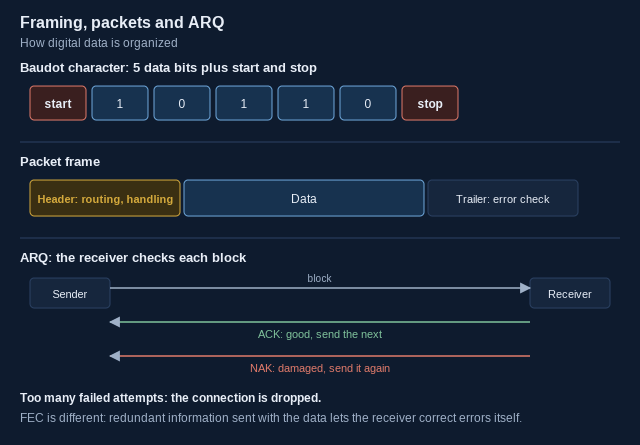
What part of a packet radio frame contains the routing and handling information?

Show the answer and why

Answer C. Header

The header of a packet radio frame contains the routing and handling information.

A Baudot character with start and stop bits, a packet frame with header data and trailer, and the ARQ exchange of ACK and NAK.
Describe this graphic in words

Top: a Baudot character has five data bits with a start bit before and a stop bit after. Middle: a packet frame has a header, which holds the routing and handling information, then the data, then a trailer with the error check. Bottom: in ARQ the sender sends a block, and the receiver answers ACK if it is good and the sender sends the next, or NAK if it is damaged and the sender sends it again. After too many failed attempts the connection is dropped. Forward error correction instead sends redundant information so the receiver corrects errors itself.

This is a teaching note. A packet frame is made of a header, the data, and a trailer. The header has the source and destination addresses and control information. The trailer has an error check.

Why the other choices are wrong

  • A. A directory is not part of a frame.
  • B. A preamble is a sync pattern before the frame.
  • D. The trailer contains the error check, not the routing information.

Rule text checked against the official source on November 17, 2026. This is a study aid; the linked rule is what governs.
G8C04

Which of the following describes Baudot code?

Show the answer and why

Answer C. A 5-bit code with additional start and stop bits

Baudot code is a 5-bit code with additional start and stop bits.

A Baudot character with start and stop bits, a packet frame with header data and trailer, and the ARQ exchange of ACK and NAK.
Describe this graphic in words

Top: a Baudot character has five data bits with a start bit before and a stop bit after. Middle: a packet frame has a header, which holds the routing and handling information, then the data, then a trailer with the error check. Bottom: in ARQ the sender sends a block, and the receiver answers ACK if it is good and the sender sends the next, or NAK if it is damaged and the sender sends it again. After too many failed attempts the connection is dropped. Forward error correction instead sends redundant information so the receiver corrects errors itself.

This is a teaching note. Each character in Baudot is five data bits. For a start-stop teleprinter, each character is framed with a start bit and a stop bit, so the receiver can find the beginning of each character.

Why the other choices are wrong

  • A. A 7-bit code with start, stop and parity bits describes ASCII.
  • B. Baudot has no error detection and correction.
  • D. SELCAL and LISTEN are used in AMTOR.

Rule text checked against the official source on November 17, 2026. This is a study aid; the linked rule is what governs.
G8C05

In an ARQ mode, what is meant by a NAK response to a transmitted packet?

Show the answer and why

Answer A. Request retransmission of the packet

A NAK in an ARQ mode is a request to retransmit the packet.

A Baudot character with start and stop bits, a packet frame with header data and trailer, and the ARQ exchange of ACK and NAK.
Describe this graphic in words

Top: a Baudot character has five data bits with a start bit before and a stop bit after. Middle: a packet frame has a header, which holds the routing and handling information, then the data, then a trailer with the error check. Bottom: in ARQ the sender sends a block, and the receiver answers ACK if it is good and the sender sends the next, or NAK if it is damaged and the sender sends it again. After too many failed attempts the connection is dropped. Forward error correction instead sends redundant information so the receiver corrects errors itself.

This is a teaching note. In an automatic repeat request mode, the receiver checks each block. If it is good, it sends an ACK, and if it is damaged, it sends a NAK, which means not acknowledged. The sender then sends the block again.

Why the other choices are wrong

  • B. A packet received without error is acknowledged with an ACK.
  • C. A connected and ready station sends a different signal.
  • D. A file received correctly is not what NAK means.

Rule text checked against the official source on November 17, 2026. This is a study aid; the linked rule is what governs.
G8C06

What action results from a failure to exchange information due to excessive transmission attempts when using an ARQ mode?

Show the answer and why

Answer B. The connection is dropped

Failing to exchange information after too many attempts in an ARQ mode causes the connection to be dropped.

A Baudot character with start and stop bits, a packet frame with header data and trailer, and the ARQ exchange of ACK and NAK.
Describe this graphic in words

Top: a Baudot character has five data bits with a start bit before and a stop bit after. Middle: a packet frame has a header, which holds the routing and handling information, then the data, then a trailer with the error check. Bottom: in ARQ the sender sends a block, and the receiver answers ACK if it is good and the sender sends the next, or NAK if it is damaged and the sender sends it again. After too many failed attempts the connection is dropped. Forward error correction instead sends redundant information so the receiver corrects errors itself.

This is a teaching note. The mode retries a limited number of times. If the other station never acknowledges, it assumes the link is gone and disconnects.

Why the other choices are wrong

  • A. A checksum overflow is not what happens.
  • C. Packets are not routed incorrectly because of this.
  • D. The character set does not change.

Rule text checked against the official source on November 17, 2026. This is a study aid; the linked rule is what governs.

G8C07

Which of the following narrow-band digital modes can receive signals with very low signal-to-noise ratios?

Show the answer and why

Answer B. FT8

FT8 can receive signals with very low signal-to-noise ratios.

This is a teaching note. FT8 uses strong error correction and a narrow signal, so it can decode signals that are below the noise, down to roughly -20 dB signal-to-noise ratio in a 2.5 kHz bandwidth. The others in the list need stronger signals.

Why the other choices are wrong

  • A. MSK144 is a meteor scatter mode that needs a stronger signal.
  • C. AMTOR needs a stronger signal.
  • D. MFSK32 needs a stronger signal.

Rule text checked against the official source on November 17, 2026. This is a study aid; the linked rule is what governs.

G8C08

Which of the following statements is true about PSK31?

Show the answer and why

Answer B. Upper case letters use longer Varicode bit sequences and thus slow down transmission

In PSK31, upper case letters use longer Varicode bit sequences and so slow down transmission.

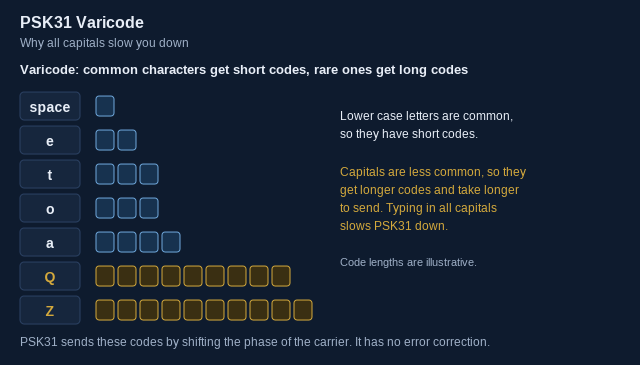
Varicode gives short bit sequences to common characters and longer ones to rare characters such as capital letters.
Describe this graphic in words

Rows of characters with bars showing code length: space, e, t, o and a have short codes, while the capital letters Q and Z have much longer codes. A note says lower case letters are common so their codes are short, and capitals get longer codes and slow PSK31 down. The code lengths are illustrative.

This is a teaching note. Varicode gives short codes to common letters, such as lower case letters, and longer codes to rare ones. Capital letters are less common, so their codes are longer and take more time. Typing in all capitals therefore slows the message.

Why the other choices are wrong

  • A. Upper case letters are not sent with more power.
  • C. PSK31 does not use error correction.
  • D. PSK31 needs less power than RTTY for similar error rates.

Rule text checked against the official source on November 17, 2026. This is a study aid; the linked rule is what governs.

G8C09

Which is true of mesh network microwave nodes?

Show the answer and why

Answer B. If one node fails, a packet may still reach its target station via an alternate node

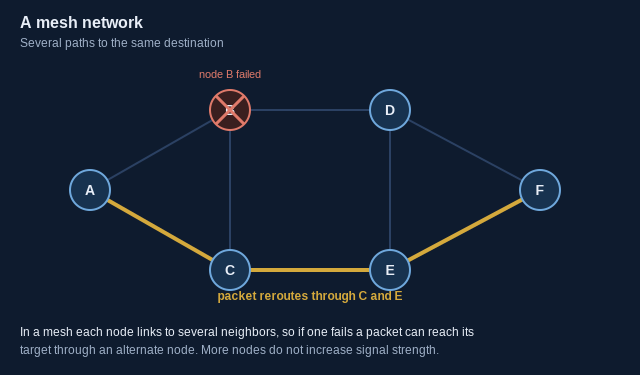
In a mesh network, if one node fails a packet may reach its target via an alternate node.

A mesh network of six nodes where a packet reroutes around a failed node through alternate nodes.
Describe this graphic in words

Six nodes connected in a mesh. Node B has failed. A gold path shows a packet from A going through C and E to F, around the failed node. In a mesh each node links to several neighbors, so a packet can reach its target through an alternate node if one fails.

This is a teaching note. Nodes in a mesh are linked to several neighbors, so the network can route around a failed node or link. That is the main benefit of a mesh.

Why the other choices are wrong

  • A. More nodes do not increase signal strengths.
  • C. Links between two nodes do not have different frequencies in the sense of this question.
  • D. More nodes do not reduce interference.

Rule text checked against the official source on November 17, 2026. This is a study aid; the linked rule is what governs.

G8C10

How does forward error correction (FEC) allow the receiver to correct data errors?

Show the answer and why

Answer C. By transmitting redundant information with the data

Forward error correction transmits redundant information with the data.

A Baudot character with start and stop bits, a packet frame with header data and trailer, and the ARQ exchange of ACK and NAK.
Describe this graphic in words

Top: a Baudot character has five data bits with a start bit before and a stop bit after. Middle: a packet frame has a header, which holds the routing and handling information, then the data, then a trailer with the error check. Bottom: in ARQ the sender sends a block, and the receiver answers ACK if it is good and the sender sends the next, or NAK if it is damaged and the sender sends it again. After too many failed attempts the connection is dropped. Forward error correction instead sends redundant information so the receiver corrects errors itself.

This is a teaching note. The sender adds extra bits calculated from the data. The receiver uses them to find and fix errors without asking for a repeat. This is useful on one-way or weak-signal links.

Why the other choices are wrong

  • A. FEC does not control the transmitter power.
  • B. Varicode is a character set, not error correction.
  • D. A parity bit only detects an error. It does not correct it.

Rule text checked against the official source on November 17, 2026. This is a study aid; the linked rule is what governs.

G8C11

How are the two separate frequencies of a Frequency Shift Keyed (FSK) signal identified?

Show the answer and why

Answer D. Mark and space

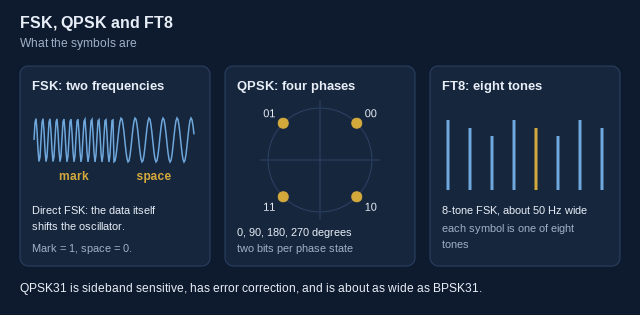
The two frequencies of an FSK signal are called mark and space.

FSK uses two frequencies called mark and space, QPSK uses four phase states carrying two bits each, and FT8 uses eight tones.
Describe this graphic in words

Three panels. FSK: a wave that changes between two frequencies, called mark for one and space for zero; direct FSK shifts the oscillator with the data. QPSK: a circle with four points at 0, 90, 180 and 270 degrees, each standing for a pair of bits. FT8: eight tones in a band about 50 hertz wide. A note says QPSK31 is sideband sensitive, has error correction, and has about the same bandwidth as BPSK31.

This is a teaching note. The mark frequency stands for a one and the space frequency for a zero. The names come from teleprinter days.

Why the other choices are wrong

  • A. Dot and dash are the elements of Morse code.
  • B. On and off describes keying, not FSK.
  • C. High and low are not the standard names.

Rule text checked against the official source on November 17, 2026. This is a study aid; the linked rule is what governs.

G8C12

Which type of code is used for sending characters in a PSK31 signal?

Show the answer and why

Answer A. Varicode

PSK31 uses Varicode to send characters.

Varicode gives short bit sequences to common characters and longer ones to rare characters such as capital letters.
Describe this graphic in words

Rows of characters with bars showing code length: space, e, t, o and a have short codes, while the capital letters Q and Z have much longer codes. A note says lower case letters are common so their codes are short, and capitals get longer codes and slow PSK31 down. The code lengths are illustrative.

This is a teaching note. Varicode is a variable-length code in which the most common characters have the shortest codes. That makes PSK31 efficient for typing.

Why the other choices are wrong

  • B. Viterbi is an error-correction decoder, not a character code.
  • C. Volumetric is not a code used in PSK31.
  • D. Binary alone does not describe the PSK31 character code.

Rule text checked against the official source on November 17, 2026. This is a study aid; the linked rule is what governs.

G8C13

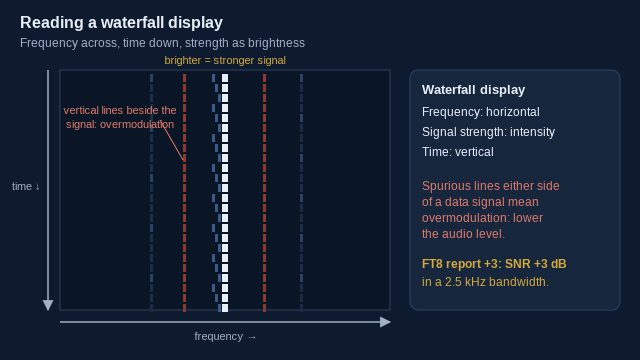
What is indicated on a waterfall display by one or more vertical lines on either side of a data mode or RTTY signal?

Show the answer and why

Answer D. Overmodulation

Vertical lines on either side of a data signal on a waterfall indicate overmodulation.

A waterfall display with frequency horizontal, time vertical and brightness for strength, and faint vertical lines beside a signal showing overmodulation.
Describe this graphic in words

A waterfall display. Frequency runs horizontally, time runs down the screen, and brightness shows signal strength. A bright central signal has fainter vertical lines on both sides, which show overmodulation, so the audio level should be lowered. A note says an FT8 report of plus 3 means a signal-to-noise ratio of plus 3 decibels in a 2.5 kilohertz bandwidth.

This is a teaching note. If the audio drive is too high, the transmitter makes spurious signals, or splatter, on both sides of the signal. On a waterfall display they show as extra vertical lines. The cure is to reduce the audio level.

Why the other choices are wrong

  • A. Long path propagation does not show as lines beside a signal.
  • B. Backscatter propagation does not show as lines beside a signal.
  • C. Insufficient modulation would show a weak signal, not extra lines.

Rule text checked against the official source on November 17, 2026. This is a study aid; the linked rule is what governs.

G8C14

Which of the following describes a waterfall display?

Show the answer and why

Answer C. Frequency is horizontal, signal strength is intensity, time is vertical

On a waterfall display, frequency is horizontal, signal strength is shown by intensity, and time is vertical.

A waterfall display with frequency horizontal, time vertical and brightness for strength, and faint vertical lines beside a signal showing overmodulation.
Describe this graphic in words

A waterfall display. Frequency runs horizontally, time runs down the screen, and brightness shows signal strength. A bright central signal has fainter vertical lines on both sides, which show overmodulation, so the audio level should be lowered. A note says an FT8 report of plus 3 means a signal-to-noise ratio of plus 3 decibels in a 2.5 kilohertz bandwidth.

This is a teaching note. The trace is drawn a line at a time. Each new line is added at the top and the earlier ones scroll down, so time runs down the screen. Brighter or warmer colors mean stronger signals.

Why the other choices are wrong

  • A. Time is not shown by intensity.
  • B. Frequency is horizontal, not vertical.
  • D. Frequency is horizontal, not vertical.

Rule text checked against the official source on November 17, 2026. This is a study aid; the linked rule is what governs.

G8C15

What does an FT8 signal report of +3 mean?

Show the answer and why

Answer C. The signal-to-noise ratio is equivalent to +3dB in a 2.5 kHz bandwidth

An FT8 signal report of +3 means a signal-to-noise ratio of +3 dB in a 2.5 kHz bandwidth.

A waterfall display with frequency horizontal, time vertical and brightness for strength, and faint vertical lines beside a signal showing overmodulation.
Describe this graphic in words

A waterfall display. Frequency runs horizontally, time runs down the screen, and brightness shows signal strength. A bright central signal has fainter vertical lines on both sides, which show overmodulation, so the audio level should be lowered. A note says an FT8 report of plus 3 means a signal-to-noise ratio of plus 3 decibels in a 2.5 kilohertz bandwidth.

This is a teaching note. FT8 reports are in decibels relative to the noise in a standard 2.5 kHz bandwidth. A report of +3 means the signal is 3 dB above the noise in that bandwidth. FT8 can decode signals down to about -20.

Why the other choices are wrong

  • A. The report is not a multiple of the noise level of an SSB signal.
  • B. The report is not an S meter reading.
  • D. The report is not relative to S9.

Rule text checked against the official source on November 17, 2026. This is a study aid; the linked rule is what governs.

G8C16

Which of the following provide digital voice modes?

Show the answer and why

Answer D. DMR, D-STAR, and SystemFusion

DMR, D-STAR and System Fusion are digital voice modes.

This is a teaching note. They convert speech into digital data with a vocoder and send it using digital modulation. The other groups listed are keyboard modes, weak signal modes and messaging modes.

Why the other choices are wrong

  • A. WSPR, MFSK16 and EasyPAL are beacon, keyboard and image modes.
  • B. FT8, FT4 and FST4 are weak-signal text modes.
  • C. Winlink and the PACTOR modes are for messaging.

Rule text checked against the official source on November 17, 2026. This is a study aid; the linked rule is what governs.