
ARSC Tech School

General G5B: The decibel

423 questions · pool July 1, 2023 to June 30, 2027 · the exam has 35 questions; 26 to pass

G5 · ELECTRICAL PRINCIPLES

The decibel; current and voltage dividers; electrical power calculations; sine wave root-mean-square (RMS) values; PEP calculations

14 questions in group G5B

One question from this group appears on each exam.

G5B01

What dB change represents a factor of two increase or decrease in power?

Show the answer and why

Answer B. Approximately 3 dB

A change of about 3 dB represents a factor of two in power.
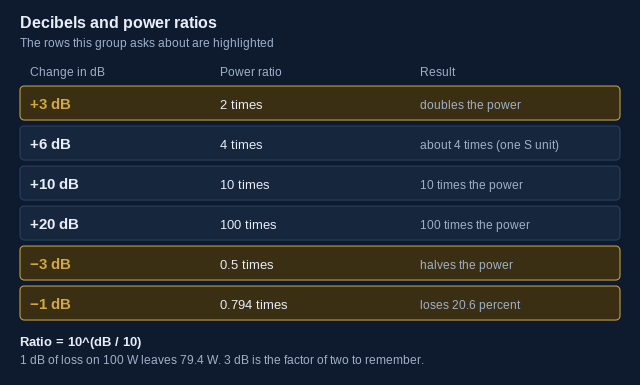
Table of decibel changes and power ratios: 3 dB is a factor of 2, 6 dB is 4, 10 dB is 10, 20 dB is 100, and a 1 dB loss leaves 79.4 percent.
Describe this graphic in words

Six rows. Plus 3 dB doubles the power. Plus 6 dB is about 4 times. Plus 10 dB is 10 times. Plus 20 dB is 100 times. Minus 3 dB halves the power. Minus 1 dB leaves 0.794 of the power, a loss of 20.6 percent. The formula is ratio equals 10 to the power of dB over 10.

This is a teaching note. The ratio is 10^(dB / 10). For 3 dB that is 10^0.3, which is 1.995, or about 2. An increase of 3 dB doubles the power and a decrease of 3 dB halves it.

Why the other choices are wrong

  • A. 2 dB is a factor of about 1.6.
  • C. 6 dB is a factor of about 4.
  • D. 9 dB is a factor of about 8.

Rule text checked against the official source on November 17, 2026. This is a study aid; the linked rule is what governs.
G5B02

How does the total current relate to the individual currents in a circuit of parallel resistors?

Show the answer and why

Answer C. It equals the sum of the currents through each branch

In parallel resistors, the total current is the sum of the currents through each branch.

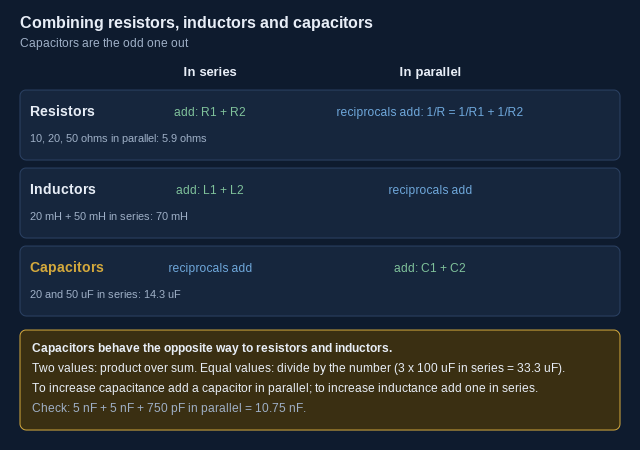
Table of how resistors, inductors and capacitors combine in series and in parallel.
Describe this graphic in words

A table. Resistors add in series and combine by reciprocals in parallel. Inductors do the same as resistors. Capacitors are the opposite: they combine by reciprocals in series and add in parallel. Worked examples include 10, 20 and 50 ohms in parallel giving 5.9 ohms, 20 and 50 millihenries in series giving 70, and 20 and 50 microfarads in series giving 14.3. Notes say to use product over sum for two values, to divide by the number for equal values, and that adding a capacitor in parallel or an inductor in series increases the value.

This is a teaching note. Each branch is connected across the same voltage and draws its own current. By Kirchhoff's current law the total is the sum. Adding branches therefore increases the total current, and the total resistance falls.

Why the other choices are wrong

  • A. The total is the sum, not the average.
  • B. Adding branches increases the current, not decreases it.
  • D. The total current is not a sum of reciprocals of voltage drops.

Rule text checked against the official source on November 17, 2026. This is a study aid; the linked rule is what governs.
G5B03

How many watts of electrical power are consumed if 400 VDC is supplied to an 800-ohm load?

Show the answer and why

Answer B. 200 watts

400 volts across an 800 ohm load dissipates 200 watts.

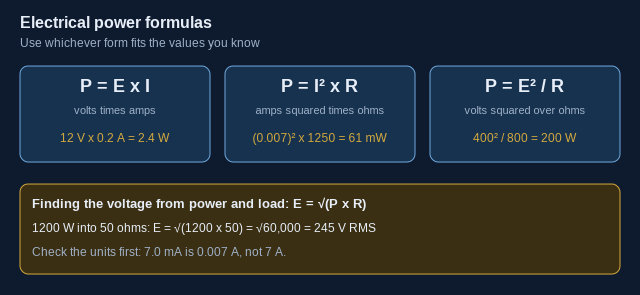
Three power formulas, P equals E times I, I squared times R, and E squared over R, each with a worked example.
Describe this graphic in words

Three panels. P equals E times I, for example 12 volts times 0.2 amperes is 2.4 watts. P equals I squared times R, for example 7 milliamperes through 1250 ohms is 61 milliwatts. P equals E squared over R, for example 400 volts across 800 ohms is 200 watts. A fourth panel gives E equals the square root of P times R, for example 245 volts RMS for 1200 watts into 50 ohms, and reminds you to convert milliamperes to amperes first.

This is a teaching note. P = E squared / R = 400 x 400 / 800 = 160,000 / 800 = 200 W. Equivalently the current is 400 / 800 = 0.5 A, and 400 V x 0.5 A = 200 W.

Why the other choices are wrong

  • A. 0.5 is the current in amperes, not the power.
  • C. 400 is the voltage.
  • D. 3200 W is not the result of any correct power formula here.

Rule text checked against the official source on November 17, 2026. This is a study aid; the linked rule is what governs.

G5B04

How many watts of electrical power are consumed by a 12 VDC light bulb that draws 0.2 amperes?

Show the answer and why

Answer A. 2.4 watts

A 12 volt bulb that draws 0.2 amperes consumes 2.4 watts.

Three power formulas, P equals E times I, I squared times R, and E squared over R, each with a worked example.
Describe this graphic in words

Three panels. P equals E times I, for example 12 volts times 0.2 amperes is 2.4 watts. P equals I squared times R, for example 7 milliamperes through 1250 ohms is 61 milliwatts. P equals E squared over R, for example 400 volts across 800 ohms is 200 watts. A fourth panel gives E equals the square root of P times R, for example 245 volts RMS for 1200 watts into 50 ohms, and reminds you to convert milliamperes to amperes first.

This is a teaching note. P = E x I = 12 x 0.2 = 2.4 W.

Why the other choices are wrong

  • B. 24 W would be 12 V at 2 A.
  • C. 6 W would be 12 V at 0.5 A.
  • D. 60 W would be 12 V at 5 A.

Rule text checked against the official source on November 17, 2026. This is a study aid; the linked rule is what governs.

G5B05

How many watts are consumed when a current of 7.0 milliamperes flows through a 1,250-ohm resistance?

Show the answer and why

Answer A. Approximately 61 milliwatts

7.0 mA through 1,250 ohms dissipates about 61 milliwatts.

Three power formulas, P equals E times I, I squared times R, and E squared over R, each with a worked example.
Describe this graphic in words

Three panels. P equals E times I, for example 12 volts times 0.2 amperes is 2.4 watts. P equals I squared times R, for example 7 milliamperes through 1250 ohms is 61 milliwatts. P equals E squared over R, for example 400 volts across 800 ohms is 200 watts. A fourth panel gives E equals the square root of P times R, for example 245 volts RMS for 1200 watts into 50 ohms, and reminds you to convert milliamperes to amperes first.

This is a teaching note. P = I squared x R. With I = 0.007 A, I squared is 0.000049, and times 1250 is 0.06125 W, or about 61 mW.

Why the other choices are wrong

  • B. 61 W would be a thousand times larger. Watch the milliamperes.
  • C. 11 mW is not the result of the calculation.
  • D. 11 W is not the result of the calculation.

Rule text checked against the official source on November 17, 2026. This is a study aid; the linked rule is what governs.

G5B06

What is the PEP produced by 200 volts peak-to-peak across a 50-ohm dummy load?

Show the answer and why

Answer B. 100 watts

200 volts peak-to-peak across a 50 ohm load is 100 watts PEP.

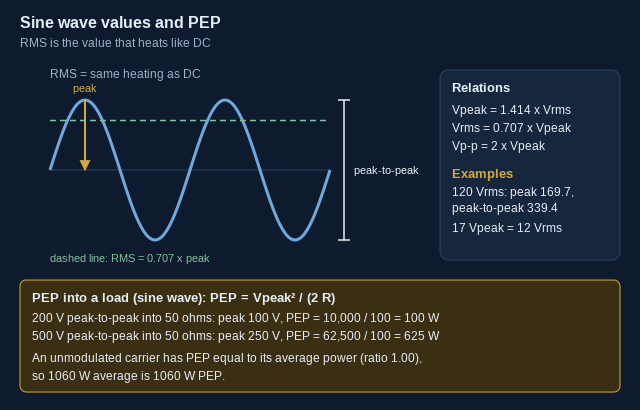
A sine wave showing peak, peak-to-peak and RMS values, with PEP examples of 100 watts and 625 watts into 50 ohms.
Describe this graphic in words

A sine wave with its peak value, its peak-to-peak value, and the RMS level at 0.707 of peak marked. Relations: peak is 1.414 times RMS, RMS is 0.707 times peak, peak-to-peak is twice peak. Examples: 120 volts RMS has a peak of 169.7 and a peak-to-peak of 339.4 volts, and 17 volts peak is 12 volts RMS. PEP equals peak voltage squared over twice the load: 200 volts peak-to-peak into 50 ohms is 100 watts, and 500 volts peak-to-peak is 625 watts. An unmodulated carrier has PEP equal to average power.

This is a teaching note. Peak-to-peak is twice the peak, so the peak voltage is 100 V. For a sine wave, PEP = Vpeak squared / (2 R) = 10,000 / 100 = 100 W. Equivalently the RMS voltage is 100 x 0.707 = 70.7 V, and 70.7 squared / 50 = 100 W.

Why the other choices are wrong

  • A. 1.4 W is not the result.
  • C. 353.5 W is not the result of the calculation.
  • D. 400 W would come from treating 200 V as the peak voltage.

Rule text checked against the official source on November 17, 2026. This is a study aid; the linked rule is what governs.

G5B07

What value of an AC signal produces the same power dissipation in a resistor as a DC voltage of the same value?

Show the answer and why

Answer C. The RMS value

The RMS value of an AC signal produces the same heating as the same DC value.

A sine wave showing peak, peak-to-peak and RMS values, with PEP examples of 100 watts and 625 watts into 50 ohms.
Describe this graphic in words

A sine wave with its peak value, its peak-to-peak value, and the RMS level at 0.707 of peak marked. Relations: peak is 1.414 times RMS, RMS is 0.707 times peak, peak-to-peak is twice peak. Examples: 120 volts RMS has a peak of 169.7 and a peak-to-peak of 339.4 volts, and 17 volts peak is 12 volts RMS. PEP equals peak voltage squared over twice the load: 200 volts peak-to-peak into 50 ohms is 100 watts, and 500 volts peak-to-peak is 625 watts. An unmodulated carrier has PEP equal to average power.

This is a teaching note. RMS stands for root mean square. It is defined as the DC value that would dissipate the same power in a resistor as the AC signal.

Why the other choices are wrong

  • A. Peak-to-peak is twice the peak, and is larger than the RMS value.
  • B. The peak value is higher than the equivalent DC value for a sine wave.
  • D. The reciprocal of RMS is not a defined value.

Rule text checked against the official source on November 17, 2026. This is a study aid; the linked rule is what governs.

G5B08

What is the peak-to-peak voltage of a sine wave with an RMS voltage of 120 volts?

Show the answer and why

Answer D. 339.4 volts

A sine wave of 120 volts RMS has a peak-to-peak voltage of 339.4 volts.

A sine wave showing peak, peak-to-peak and RMS values, with PEP examples of 100 watts and 625 watts into 50 ohms.
Describe this graphic in words

A sine wave with its peak value, its peak-to-peak value, and the RMS level at 0.707 of peak marked. Relations: peak is 1.414 times RMS, RMS is 0.707 times peak, peak-to-peak is twice peak. Examples: 120 volts RMS has a peak of 169.7 and a peak-to-peak of 339.4 volts, and 17 volts peak is 12 volts RMS. PEP equals peak voltage squared over twice the load: 200 volts peak-to-peak into 50 ohms is 100 watts, and 500 volts peak-to-peak is 625 watts. An unmodulated carrier has PEP equal to average power.

This is a teaching note. Peak = RMS x 1.414 = 120 x 1.414 = 169.7 V. Peak-to-peak is twice the peak, so 2 x 169.7 = 339.4 V.

Why the other choices are wrong

  • A. 84.8 V is the RMS value divided by 1.414.
  • B. 169.7 V is the peak voltage, not the peak-to-peak.
  • C. 240 V is twice the RMS value.

Rule text checked against the official source on November 17, 2026. This is a study aid; the linked rule is what governs.

G5B09

What is the RMS voltage of a sine wave with a value of 17 volts peak?

Show the answer and why

Answer B. 12 volts

A sine wave of 17 volts peak has an RMS value of 12 volts.

A sine wave showing peak, peak-to-peak and RMS values, with PEP examples of 100 watts and 625 watts into 50 ohms.
Describe this graphic in words

A sine wave with its peak value, its peak-to-peak value, and the RMS level at 0.707 of peak marked. Relations: peak is 1.414 times RMS, RMS is 0.707 times peak, peak-to-peak is twice peak. Examples: 120 volts RMS has a peak of 169.7 and a peak-to-peak of 339.4 volts, and 17 volts peak is 12 volts RMS. PEP equals peak voltage squared over twice the load: 200 volts peak-to-peak into 50 ohms is 100 watts, and 500 volts peak-to-peak is 625 watts. An unmodulated carrier has PEP equal to average power.

This is a teaching note. RMS = peak x 0.707 = 17 x 0.707 = 12.0 V.

Why the other choices are wrong

  • A. 8.5 V is half the peak.
  • C. 24 V is the peak multiplied by 1.414.
  • D. 34 V is twice the peak.

Rule text checked against the official source on November 17, 2026. This is a study aid; the linked rule is what governs.

G5B10

What percentage of power loss is equivalent to a loss of 1 dB?

Show the answer and why

Answer C. 20.6 percent

A loss of 1 dB is equivalent to a power loss of about 20.6 percent.

Table of decibel changes and power ratios: 3 dB is a factor of 2, 6 dB is 4, 10 dB is 10, 20 dB is 100, and a 1 dB loss leaves 79.4 percent.
Describe this graphic in words

Six rows. Plus 3 dB doubles the power. Plus 6 dB is about 4 times. Plus 10 dB is 10 times. Plus 20 dB is 100 times. Minus 3 dB halves the power. Minus 1 dB leaves 0.794 of the power, a loss of 20.6 percent. The formula is ratio equals 10 to the power of dB over 10.

This is a teaching note. A loss of 1 dB leaves 10^(-1/10) = 0.794 of the power, so 20.6 percent is lost.

Worked example: with 100 W in, 1 dB of loss leaves 79.4 W.

Why the other choices are wrong

  • A. 10.9 percent is about 0.5 dB.
  • B. 12.2 percent is about 0.6 dB.
  • D. 25.9 percent is about 1.3 dB.

Rule text checked against the official source on November 17, 2026. This is a study aid; the linked rule is what governs.

G5B11

What is the ratio of PEP to average power for an unmodulated carrier?

Show the answer and why

Answer B. 1.00

For an unmodulated carrier the ratio of PEP to average power is 1.00.

A sine wave showing peak, peak-to-peak and RMS values, with PEP examples of 100 watts and 625 watts into 50 ohms.
Describe this graphic in words

A sine wave with its peak value, its peak-to-peak value, and the RMS level at 0.707 of peak marked. Relations: peak is 1.414 times RMS, RMS is 0.707 times peak, peak-to-peak is twice peak. Examples: 120 volts RMS has a peak of 169.7 and a peak-to-peak of 339.4 volts, and 17 volts peak is 12 volts RMS. PEP equals peak voltage squared over twice the load: 200 volts peak-to-peak into 50 ohms is 100 watts, and 500 volts peak-to-peak is 625 watts. An unmodulated carrier has PEP equal to average power.

This is a teaching note. An unmodulated carrier is a steady sine wave. Its power does not change, so the peak envelope power is the same as the average power.

With voice modulation the average falls well below the peak, so the ratio rises above one.

Why the other choices are wrong

  • A. 0.707 is the ratio of RMS to peak voltage, not of power.
  • C. 1.414 is the ratio of peak to RMS voltage, not of power.
  • D. 2.00 is the ratio of peak power to average power for a sine wave, based on instantaneous peak, not PEP.

Rule text checked against the official source on November 17, 2026. This is a study aid; the linked rule is what governs.

G5B12

What is the RMS voltage across a 50-ohm dummy load dissipating 1200 watts?

Show the answer and why

Answer B. 245 volts

A 50 ohm dummy load dissipating 1200 watts has an RMS voltage of about 245 volts.

Three power formulas, P equals E times I, I squared times R, and E squared over R, each with a worked example.
Describe this graphic in words

Three panels. P equals E times I, for example 12 volts times 0.2 amperes is 2.4 watts. P equals I squared times R, for example 7 milliamperes through 1250 ohms is 61 milliwatts. P equals E squared over R, for example 400 volts across 800 ohms is 200 watts. A fourth panel gives E equals the square root of P times R, for example 245 volts RMS for 1200 watts into 50 ohms, and reminds you to convert milliamperes to amperes first.

This is a teaching note. P = E squared / R, so E = square root of (P x R) = square root of (1200 x 50) = square root of 60,000 = 245 V.

Why the other choices are wrong

  • A. 173 V is the result for 600 W.
  • C. 346 V would give 2400 W.
  • D. 692 V would give about 9,600 W.

Rule text checked against the official source on November 17, 2026. This is a study aid; the linked rule is what governs.

G5B13

What is the output PEP of an unmodulated carrier if the average power is 1060 watts?

Show the answer and why

Answer B. 1060 watts

The PEP of an unmodulated carrier equals its average power: 1060 watts.

A sine wave showing peak, peak-to-peak and RMS values, with PEP examples of 100 watts and 625 watts into 50 ohms.
Describe this graphic in words

A sine wave with its peak value, its peak-to-peak value, and the RMS level at 0.707 of peak marked. Relations: peak is 1.414 times RMS, RMS is 0.707 times peak, peak-to-peak is twice peak. Examples: 120 volts RMS has a peak of 169.7 and a peak-to-peak of 339.4 volts, and 17 volts peak is 12 volts RMS. PEP equals peak voltage squared over twice the load: 200 volts peak-to-peak into 50 ohms is 100 watts, and 500 volts peak-to-peak is 625 watts. An unmodulated carrier has PEP equal to average power.

This is a teaching note. A steady carrier has the same power at every instant, so the peak envelope power equals the average power.

Why the other choices are wrong

  • A. Halving the power is not correct for a steady carrier.
  • C. 1500 is not related to 1060.
  • D. Doubling applies only to the ratio of instantaneous peak power to average power, not PEP.

Rule text checked against the official source on November 17, 2026. This is a study aid; the linked rule is what governs.

G5B14

What is the output PEP of 500 volts peak-to-peak across a 50-ohm load?

Show the answer and why

Answer B. 625 watts

500 volts peak-to-peak across a 50 ohm load is 625 watts PEP.

A sine wave showing peak, peak-to-peak and RMS values, with PEP examples of 100 watts and 625 watts into 50 ohms.
Describe this graphic in words

A sine wave with its peak value, its peak-to-peak value, and the RMS level at 0.707 of peak marked. Relations: peak is 1.414 times RMS, RMS is 0.707 times peak, peak-to-peak is twice peak. Examples: 120 volts RMS has a peak of 169.7 and a peak-to-peak of 339.4 volts, and 17 volts peak is 12 volts RMS. PEP equals peak voltage squared over twice the load: 200 volts peak-to-peak into 50 ohms is 100 watts, and 500 volts peak-to-peak is 625 watts. An unmodulated carrier has PEP equal to average power.

This is a teaching note. The peak voltage is half of 500, which is 250 V. PEP = Vpeak squared / (2 R) = 62,500 / 100 = 625 W.

Why the other choices are wrong

  • A. 8.75 W is not the result.
  • C. 2500 W would be 250 V squared / 25, using the wrong divisor.
  • D. 5000 W would be 500 V squared / 50, using peak-to-peak as the peak.

Rule text checked against the official source on November 17, 2026. This is a study aid; the linked rule is what governs.