
ARSC Tech School

General G2B: Operating effectively

423 questions · pool July 1, 2023 to June 30, 2027 · the exam has 35 questions; 26 to pass

G2 · OPERATING PROCEDURES

Operating effectively; band plans; drills and emergencies; RACES operation

11 questions in group G2B

One question from this group appears on each exam.

G2B01FCC rule 97.101(b), (c)

Which of the following is true concerning access to frequencies?

Show the answer and why

Answer C. Except during emergencies, no amateur station has priority access to any frequency

FCC rule 97.101(b), (c)

Except in emergencies, no amateur station has priority access to any frequency.

Section 97.101(b) says each licensee and control operator must cooperate in selecting transmitting channels, and that no frequency will be assigned for the exclusive use of any station. Paragraph (c) adds one exception: at all times control operators must give priority to stations providing emergency communications.

So nets, contacts already in progress and contests have no legal claim on a frequency. Courtesy and the band plan guide who yields.

Why the other choices are wrong

  • A. Nets do not have priority. No frequency is assigned for exclusive use.
  • B. A QSO in progress does not have priority. Courtesy is good practice, not a rule.
  • D. Nothing in Part 97 says contest operations must yield to non-contest use.

References

  • FCC rule47 CFR § 97.101, General standards — Paragraph (b) requires cooperation in selecting frequencies and says no frequency is assigned for exclusive use; (c) gives priority to emergency communications.

Rule text checked against the official source on November 13, 2026. This is a study aid; the linked rule is what governs.
G2B02

What is the first thing you should do if you are communicating with another amateur station and hear a station in distress break in?

Show the answer and why

Answer B. Acknowledge the station in distress and determine what assistance may be needed

Acknowledge the station in distress and find out what assistance is needed.

Section 97.101(c) requires control operators to give priority to stations providing emergency communications, and 97.405 allows any station to use any means to assist a station in distress. The first step is to acknowledge the call and find out what help is needed.

Other steps, like notifying the emergency coordinator, can follow once you know what the problem is.

Why the other choices are wrong

  • A. Notifying a coordinator comes after you know what the emergency is.
  • C. Reducing power does not help the station in distress.
  • D. Ceasing all transmissions would leave the distress call unanswered. Stop only to yield the frequency to the emergency.

References

  • FCC rule47 CFR § 97.101, General standards — Paragraph (b) requires cooperation in selecting frequencies and says no frequency is assigned for exclusive use; (c) gives priority to emergency communications.
  • FCC rule47 CFR § 97.405, Station in distress — Allows any means to attract attention, make known condition and obtain assistance, and to assist a station in distress.

Rule text checked against the official source on November 13, 2026. This is a study aid; the linked rule is what governs.

G2B03

What is good amateur practice if propagation changes during a contact creating interference from other stations using the frequency?

Show the answer and why

Answer C. Attempt to resolve the interference problem with the other stations in a mutually acceptable manner

Try to resolve the interference with the other stations in a mutually acceptable manner.

Propagation changes can bring in stations that could not hear you before. Section 97.101(b) requires cooperation in the use of frequencies, and no one has exclusive rights to a frequency, so the right approach is to talk it out and find a solution, such as moving.

Why the other choices are wrong

  • A. Claiming priority is wrong because no station has priority on a frequency.
  • B. Lowering power does not resolve the conflict and may make your signal weaker.
  • D. Switching sideband would not remove the interference.

References

  • FCC rule47 CFR § 97.101, General standards — Paragraph (b) requires cooperation in selecting frequencies and says no frequency is assigned for exclusive use; (c) gives priority to emergency communications.

Rule text checked against the official source on November 13, 2026. This is a study aid; the linked rule is what governs.

G2B04

When selecting a CW transmitting frequency, what minimum separation from other stations should be used to minimize interference to stations on adjacent frequencies?

Show the answer and why

Answer B. 150 Hz to 500 Hz

Use about 150 to 500 Hz of separation between CW signals.

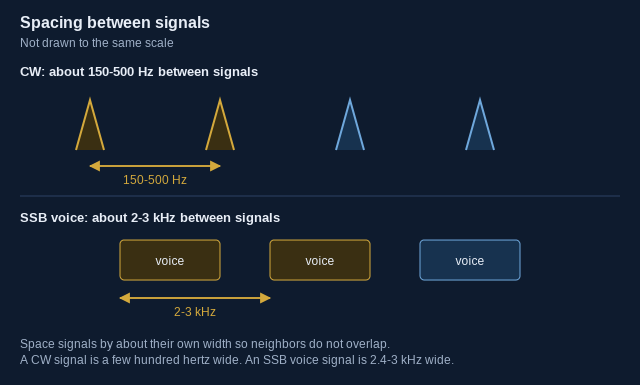
CW signals are spaced 150 to 500 hertz apart; SSB voice signals are spaced 2 to 3 kilohertz apart.
Describe this graphic in words

The top half shows four narrow CW signals with the gap between two of them marked 150 to 500 hertz. The bottom half shows three wider SSB voice signals with the gap between two marked 2 to 3 kilohertz. The point is that spacing follows the width of the signal: a CW signal is a few hundred hertz wide, and an SSB voice signal is about 2.4 to 3 kHz wide.

This is a teaching note. A CW signal occupies a narrow bandwidth, often a few hundred hertz, depending on speed and filtering. A separation of 150 to 500 Hz keeps neighboring signals from overlapping and is the usual practice.

Why the other choices are wrong

  • A. 5 to 50 Hz is too close, so the signals would overlap.
  • C. 1 to 3 kHz is more than necessary for CW.
  • D. 3 to 6 kHz is far more than needed for CW.

Rule text checked against the official source on November 13, 2026. This is a study aid; the linked rule is what governs.

G2B05

When selecting an SSB transmitting frequency, what minimum separation should be used to minimize interference to stations on adjacent frequencies?

Show the answer and why

Answer C. 2 kHz to 3 kHz

Use about 2 to 3 kHz of separation between SSB signals.

CW signals are spaced 150 to 500 hertz apart; SSB voice signals are spaced 2 to 3 kilohertz apart.
Describe this graphic in words

The top half shows four narrow CW signals with the gap between two of them marked 150 to 500 hertz. The bottom half shows three wider SSB voice signals with the gap between two marked 2 to 3 kilohertz. The point is that spacing follows the width of the signal: a CW signal is a few hundred hertz wide, and an SSB voice signal is about 2.4 to 3 kHz wide.

This is a teaching note. A voice SSB signal is about 2.4 to 3 kHz wide, so stations spaced 2 to 3 kHz apart do not overlap significantly.

Why the other choices are wrong

  • A. 5 to 50 Hz is much narrower than an SSB signal.
  • B. 150 to 500 Hz is the range for CW and is too narrow for SSB.
  • D. About 6 kHz is the width of an AM signal, more than SSB needs.

Rule text checked against the official source on November 13, 2026. This is a study aid; the linked rule is what governs.

G2B06

How can you avoid harmful interference on an apparently clear frequency before calling CQ on CW or phone?

Show the answer and why

Answer A. Send “QRL?” on CW, followed by your call sign; or, if using phone, ask if the frequency is in use, followed by your call sign

Send "QRL?" on CW with your call sign, or ask on phone whether the frequency is in use, then give your call sign.

This is a teaching note. A frequency can sound clear because you cannot hear the other station of a contact. Asking whether it is in use lets a station that you cannot hear answer. "QRL?" means "is this frequency in use?"

The V sent several times and "test" are used for tuning, which is a different purpose, and "QSY" means to change frequency.

Why the other choices are wrong

  • B. Listening is good, but two minutes is not a rule, and listening alone cannot detect stations you cannot hear.
  • C. Sending V or "test" is for tuning and does not ask whether the frequency is in use.
  • D. "QSY" means to change frequency. It does not ask if the frequency is in use.

Rule text checked against the official source on November 13, 2026. This is a study aid; the linked rule is what governs.

G2B07

Which of the following complies with commonly accepted amateur practice when choosing a frequency on which to initiate a call?

Show the answer and why

Answer C. Follow the voluntary band plan

Following the voluntary band plan is commonly accepted practice when choosing a frequency.

Band plans suggest where different modes and activities should be, so operators of different modes do not interfere. They are voluntary, but they reflect cooperation as required by 97.101(b).

Listening for two minutes and sending a call sign three times are not standard requirements, so "all of these" is wrong.

Why the other choices are wrong

  • A. Listening is good practice, but two minutes is not a standard.
  • B. There is no practice of identifying three times to choose a frequency.
  • D. "All these choices" fails because A and B are not the practice.

References

  • FCC rule47 CFR § 97.101, General standards — Paragraph (b) requires cooperation in selecting frequencies and says no frequency is assigned for exclusive use; (c) gives priority to emergency communications.

Rule text checked against the official source on November 13, 2026. This is a study aid; the linked rule is what governs.

G2B08

What is the voluntary band plan restriction for US stations transmitting within the 48 contiguous states in the 50.1 MHz to 50.125 MHz band segment?

Show the answer and why

Answer A. Only contacts with stations not within the 48 contiguous states

On 50.1 to 50.125 MHz, the band plan asks stations in the contiguous 48 states to make contacts only with stations outside it.

This is a teaching note. The segment is the 6 meter DX window. By common agreement, it is kept for long-distance, intercontinental contacts so that weak DX signals can be heard without being swamped by local stations.

Why the other choices are wrong

  • B. It is the opposite. The segment is reserved for stations outside the lower 48.
  • C. The segment is not a digital-only segment.
  • D. The segment is not an SSTV segment.

Rule text checked against the official source on November 13, 2026. This is a study aid; the linked rule is what governs.

G2B09FCC rule 97.407(a)

Who may be the control operator of an amateur station transmitting in RACES to assist relief operations during a disaster?

Show the answer and why

Answer A. Only a person holding an FCC-issued amateur operator license

FCC rule 97.407(a)

A RACES control operator must hold an FCC amateur license, and must also be enrolled with a civil defense organization.

Section 97.407(a) says no person may be the control operator of a station transmitting in RACES unless that person holds an FCC-issued amateur operator license and is certified by a civil defense organization as enrolled in it. The question's best answer is the one that requires an FCC license. A government official without one cannot be the control operator.

Why the other choices are wrong

  • B. Net control is a role in a net, not a requirement for the control operator.
  • C. A government official without an amateur license cannot be the control operator.
  • D. Normal communications being up does not authorize anyone. The license and enrollment are required.

References

Rule text checked against the official source on November 13, 2026. This is a study aid; the linked rule is what governs.

G2B10

Which of the following is good amateur practice for net management?

Show the answer and why

Answer B. Have a backup frequency in case of interference or poor conditions

Having a backup frequency is good net management practice.

This is a teaching note. Interference or poor propagation can make the net frequency unusable. A backup frequency announced in advance lets the net move without losing check-ins.

Using several sets of phonetics for every check-in slows a net, and reading the full roster at the beginning of every session wastes time.

Why the other choices are wrong

  • A. Multiple sets of phonetics for every check-in slow the net and are not standard practice.
  • C. Transmitting the full roster at the start of every session wastes time.
  • D. "All these choices" fails because A and C are not good practice.

Rule text checked against the official source on November 13, 2026. This is a study aid; the linked rule is what governs.

G2B11FCC rule 97.407(d)(4)

How often may RACES training drills and tests be routinely conducted without special authorization?

Show the answer and why

Answer C. No more than 1 hour per week

FCC rule 97.407(d)(4)

RACES drills and tests may be conducted routinely for no more than one hour per week.

Section 97.407(d)(4) says drills and tests for RACES may not exceed a total time of 1 hour per week. With the approval of the state's chief officer for emergency planning, they may run up to 72 hours, no more than twice in a calendar year.

Why the other choices are wrong

  • A. The limit is per week, not per month, and it is one hour.
  • B. The limit is per week, not per month.
  • D. The limit is one hour, not two.

References

Rule text checked against the official source on November 13, 2026. This is a study aid; the linked rule is what governs.