
ARSC Tech School

General G1A: General class control operator frequency privileges

423 questions · pool July 1, 2023 to June 30, 2027 · the exam has 35 questions; 26 to pass

G1 · COMMISSION’S RULES

General class control operator frequency privileges; primary and secondary allocations

10 questions in group G1A

One question from this group appears on each exam.

G1A01FCC rule 97.301(d)

On which HF and/or MF amateur bands are there portions where General class licensees cannot transmit?

Show the answer and why

Answer C. 80 meters, 40 meters, 20 meters, and 15 meters

FCC rule 97.301(d)

On 80, 40, 20 and 15 meters, part of the band is reserved for Amateur Extra licensees, so General class operators cannot use all of it.
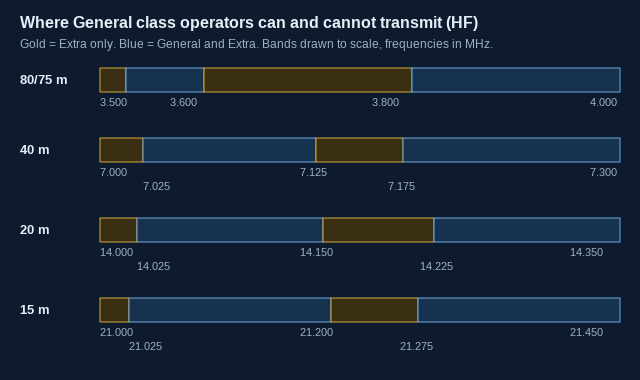
Chart of the 80, 40, 20 and 15 meter bands showing which segments are Extra only and which a General class operator may use.
Describe this graphic in words

Four horizontal bars, one each for 80 m (3.500-4.000 MHz), 40 m (7.000-7.300 MHz), 20 m (14.000-14.350 MHz) and 15 m (21.000-21.450 MHz). Each bar is split into segments marked either Extra only or General and Extra. On every one of these four bands, General class operators are excluded from the bottom of the band and from one block in the middle, which is why these are the bands with portions General licensees cannot use.

Section 97.301(d) lists the segments a General class control operator may use. On 160 m, 60 m, 30 m, 17 m, 12 m and 10 m the General list covers the whole amateur allocation, apart from sharing rules. On 80/75 m, 40 m, 20 m and 15 m it has gaps: the Extra class list in 97.301(b) starts lower and also includes a block in the middle of the band.

For example, on 20 m a General may use 14.025-14.150 MHz and 14.225-14.350 MHz. The 14.000-14.025 and 14.150-14.225 MHz segments are Extra only. The same pattern repeats on 80, 40 and 15 m.

Why the other choices are wrong

  • A. General class operators have the whole allocation on 60, 17 and 12 m, and on 30 m the General list matches the Extra list (10.100-10.150 MHz).
  • B. 160, 60 and 12 m are open to Generals in full. Only 15 m in that list has Extra-only segments.
  • D. 10 m is open to Generals in full (28.000-29.700 MHz). Only 80, 20 and 15 m in that list have Extra-only segments.

References

Rule text checked against the official source on November 12, 2026. This is a study aid; the linked rule is what governs.
G1A02FCC rule 97.305

On which of the following bands is phone operation prohibited?

Show the answer and why

Answer B. 30 meters

FCC rule 97.305

The 30 meter band allows only CW, RTTY and data. Phone is not authorized anywhere on it.

Section 97.305(c) lists which emission types may be used on which frequencies. For the entire 30 m band it shows only "RTTY, data", and CW is separately allowed on any authorized frequency by 97.305(a). Phone does not appear for 30 m, so voice is prohibited there for every license class.

The other bands in the question have phone segments: all of 160 m, 18.110-18.168 MHz on 17 m, and 24.93-24.99 MHz on 12 m. 30 m is the one band where no part of it permits voice.

Why the other choices are wrong

  • A. 160 m is listed for "Phone, image" across the entire band.
  • C. 17 m has a phone segment at 18.110-18.168 MHz. Only its lower part, 18.068-18.110 MHz, is limited to RTTY and data.
  • D. 12 m has a phone segment at 24.93-24.99 MHz. Only its lower part, 24.89-24.93 MHz, is limited to RTTY and data.

References

Rule text checked against the official source on November 12, 2026. This is a study aid; the linked rule is what governs.

G1A03FCC rule 97.305

On which of the following bands is image transmission prohibited?

Show the answer and why

Answer B. 30 meters

FCC rule 97.305

Image transmissions are prohibited on the whole 30 meter band, which is limited to CW, RTTY and data.

The emission table in 97.305(c) allows "Phone, image" only in certain segments. The 30 m band appears just once, as "RTTY, data" for the entire band, so image (such as slow-scan or fast-scan television) is not allowed anywhere on it.

On 20 m and 12 m, image is permitted in the upper phone segments (14.15-14.35 MHz and 24.93-24.99 MHz) and prohibited in the lower data segments. 160 m allows image across the whole band. Only 30 m bans it completely.

Why the other choices are wrong

  • A. 160 m is listed for "Phone, image" across the entire band.
  • C. 20 m allows image at 14.15-14.35 MHz. It is prohibited only in the lower, data-only part of the band.
  • D. 12 m allows image at 24.93-24.99 MHz. It is prohibited only in the lower, data-only part of the band.

References

Rule text checked against the official source on November 12, 2026. This is a study aid; the linked rule is what governs.

G1A05FCC rule 97.301(d)

On which of the following frequencies are General class licensees prohibited from operating as control operator?

Show the answer and why

Answer A. 7.125 MHz to 7.175 MHz

FCC rule 97.301(d)

Only 7.125 to 7.175 MHz is closed to General class control operators. The other two segments are inside General privileges.

Chart of the 80, 40, 20 and 15 meter bands showing which segments are Extra only and which a General class operator may use.
Describe this graphic in words

Four horizontal bars, one each for 80 m, 40 m, 20 m and 15 m, each split into Extra only and General and Extra segments. The 40 m bar shows 7.125-7.175 MHz as Extra only, which is the answer to this question; the 15 m bar shows 21.275 MHz and above as available to General.

On 40 m, the General class list in 97.301(d) covers 7.025-7.125 MHz and 7.175-7.300 MHz. The 50 kHz between 7.125 and 7.175 MHz is reserved for Amateur Extra licensees, so a General may not be the control operator there.

On 10 m, a General may operate on the entire band (28.000-29.700 MHz), so 28.000-28.025 MHz is allowed. On 15 m, General privileges include 21.275-21.450 MHz, so 21.275-21.300 MHz is allowed too.

Why the other choices are wrong

  • B. General class privileges on 10 m start at 28.000 MHz, so this segment is allowed.
  • C. General class privileges on 15 m include 21.275-21.450 MHz, so this segment is allowed. The Extra-only segment on 15 m is 21.200-21.275 MHz.
  • D. "All these choices are correct" fails because only the 40 m segment is prohibited.

References

Rule text checked against the official source on November 12, 2026. This is a study aid; the linked rule is what governs.

G1A06FCC rule 97.303

Which of the following applies when the FCC rules designate the amateur service as a secondary user on a band?

Show the answer and why

Answer C. Amateur stations must not cause harmful interference to primary users and must accept interference from primary users

FCC rule 97.303

A secondary user must not cause harmful interference to primary users and must accept interference from them.

Section 97.303 says each amateur band is designated either a primary or a secondary service, and "a station in a secondary service must not cause harmful interference to, and must accept interference from, stations in a primary service."

In practice that means if you are on a band where amateurs are secondary and a primary station, such as a government radiolocation system on 70 cm, is affected by your signal, it is up to you to stop. You cannot complain when that station interferes with you.

Why the other choices are wrong

  • A. Part 97 has no rule requiring you to record a primary station's call sign before operating. Secondary status is about interference, not paperwork.
  • B. Secondary status does not limit amateurs to emergencies. Amateurs may operate normally, provided they do not interfere with primary users.
  • D. Part 97 sets no hours-of-day limit for secondary users. The duty is to avoid harmful interference at any time.

References

Rule text checked against the official source on November 12, 2026. This is a study aid; the linked rule is what governs.

G1A07FCC rule 97.305(a)

On which amateur frequencies in the 10-meter band may stations with a General class control operator transmit CW emissions?

Show the answer and why

Answer D. The entire band

FCC rule 97.305(a)

CW may be sent on any frequency the control operator is authorized to use, so a General can use CW on the entire 10 meter band.

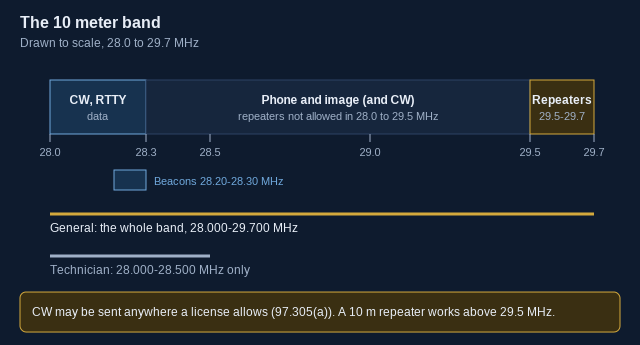
Map of the 10 meter band showing CW and data from 28.0 to 28.3 MHz, phone above that, and repeaters allowed only from 29.5 to 29.7 MHz.
Describe this graphic in words

A band bar from 28.0 to 29.7 MHz drawn to scale. 28.0 to 28.3 MHz is CW, RTTY and data. 28.3 to 29.5 MHz is phone and image, with CW still allowed, and repeaters are not allowed from 28.0 to 29.5 MHz. 29.5 to 29.7 MHz is highlighted as the repeater segment. Beacons are at 28.20 to 28.30 MHz. A General class operator may use the entire band, while a Technician may use only 28.000 to 28.500 MHz.

Section 97.305(a) says that, except where Part 97 says otherwise, an amateur station may transmit a CW emission on any frequency authorized to the control operator. General class privileges on 10 m cover the entire band, 28.000-29.700 MHz, so CW is allowed everywhere in it.

Do not confuse this with the RTTY and data segment (28.0-28.3 MHz) or the phone segments. Those limit other emission types. CW is the exception that works across the whole of a license class's frequencies.

Why the other choices are wrong

  • A. The 28.000-28.025 MHz limit is invented. CW is allowed above 28.025 MHz as well.
  • B. 28.300 MHz is where phone begins, not where CW stops. CW is permitted above it.
  • C. CW is also authorized from 28.000 to 28.025 MHz, so this range is too narrow.

References

Rule text checked against the official source on November 12, 2026. This is a study aid; the linked rule is what governs.

G1A08FCC rule 97.301(b)

Which HF bands have segments exclusively allocated to Amateur Extra licensees?

Show the answer and why

Answer B. 80 meters, 40 meters, 20 meters, and 15 meters

FCC rule 97.301(b)

Segments reserved exclusively for Amateur Extra licensees are on 80, 40, 20 and 15 meters.

Chart of the 80, 40, 20 and 15 meter bands showing which segments are Extra only and which a General class operator may use.
Describe this graphic in words

Four horizontal bars, one each for 80 m, 40 m, 20 m and 15 m, each split into Extra only and General and Extra segments. These four bars are the only HF bands with Extra-only segments.

Comparing the Extra list in 97.301(b) with the General list in 97.301(d) shows the difference. Extra operators get the bottom of 80 m (3.500-3.525 MHz), the lower part of the 75 m phone band (3.600-3.800 MHz), and the bottom plus one block in the middle of 40 m, 20 m and 15 m. Those are the Extra-only segments.

On 160, 60, 30, 17, 12 and 10 m the General list covers the same frequencies as the Extra list, so nothing there is reserved to Extra. That is why only four bands appear in the answer.

Why the other choices are wrong

  • A. Several HF bands (160, 60, 30, 17, 12 and 10 m) have no Extra-only segments.
  • C. 60, 30, 17 and 12 m also have no Extra-only segments, so "all except 160 and 10" is too many bands.
  • D. These are the HF bands where Generals already have the entire allocation.

References

Rule text checked against the official source on November 12, 2026. This is a study aid; the linked rule is what governs.

G1A09FCC rule 97.301(d)

Which of the following frequencies is within the General class portion of the 15-meter band?

Show the answer and why

Answer C. 21300 kHz

FCC rule 97.301(d)

21300 kHz (21.300 MHz) is on 15 meters, inside the 21.275-21.450 MHz segment open to General class operators.

Chart of the 80, 40, 20 and 15 meter bands showing which segments are Extra only and which a General class operator may use.
Describe this graphic in words

Four horizontal bars, one each for 80 m, 40 m, 20 m and 15 m, each split into Extra only and General and Extra segments. On the 15 m bar, 21.275-21.450 MHz is General and Extra, so 21.300 MHz falls in the General portion.

First find the band. 14250 kHz is 14.250 MHz, which is 20 m. 18155 kHz is 17 m. 21300 kHz is 15 m. 24900 kHz is 12 m. Only 21300 kHz is on 15 m, which is what the question asks.

General class privileges on 15 m are 21.025-21.200 MHz and 21.275-21.450 MHz. 21.300 MHz is in the second segment. The Extra-only block between them is 21.200-21.275 MHz.

Why the other choices are wrong

  • A. 14250 kHz is on 20 m, not 15 m (though it is within the General 20 m segment).
  • B. 18155 kHz is on 17 m, not 15 m.
  • D. 24900 kHz is on 12 m, not 15 m.

References

Rule text checked against the official source on November 12, 2026. This is a study aid; the linked rule is what governs.

G1A10FCC rule 97.205(b)

What portion of the 10-meter band is available for repeater use?

Show the answer and why

Answer D. The portion above 29.5 MHz

FCC rule 97.205(b)

On 10 meters, repeaters are permitted only above 29.5 MHz.

Map of the 10 meter band showing CW and data from 28.0 to 28.3 MHz, phone above that, and repeaters allowed only from 29.5 to 29.7 MHz.
Describe this graphic in words

A band bar from 28.0 to 29.7 MHz drawn to scale. 28.0 to 28.3 MHz is CW, RTTY and data. 28.3 to 29.5 MHz is phone and image, with CW still allowed, and repeaters are not allowed from 28.0 to 29.5 MHz. 29.5 to 29.7 MHz is highlighted as the repeater segment. Beacons are at 28.20 to 28.30 MHz. A General class operator may use the entire band, while a Technician may use only 28.000 to 28.500 MHz.

Section 97.205(b) says a repeater may receive and retransmit only on the 10 m and shorter wavelength bands, except for certain segments. The excluded segments include 28.0-29.5 MHz. That leaves 29.5-29.7 MHz as the repeater portion of 10 m.

This is where the 10 m FM repeaters are found. The rest of the band is kept for CW, data and phone work such as SSB.

Why the other choices are wrong

  • A. The rule excludes 28.0-29.5 MHz, so repeaters cannot be on the entire band.
  • B. 28.1-28.2 MHz is inside the excluded 28.0-29.5 MHz range.
  • C. 28.3-28.5 MHz is also inside the excluded 28.0-29.5 MHz range.

References

Rule text checked against the official source on November 12, 2026. This is a study aid; the linked rule is what governs.

G1A11FCC rule 97.301

When General class licensees are not permitted to use the entire voice portion of a band, which portion of the voice segment is available to them?

Show the answer and why

Answer B. The upper frequency portion

FCC rule 97.301

Where a General cannot use the whole phone segment, the part available is the upper frequency portion.

Chart of the 80, 40, 20 and 15 meter bands showing which segments are Extra only and which a General class operator may use.
Describe this graphic in words

Four horizontal bars, one each for 80 m, 40 m, 20 m and 15 m, each split into Extra only and General and Extra segments. In each phone portion of the bar, the General segment is at the high-frequency end.

On 75 m, 40 m, 20 m and 15 m the Extra class list gives phone privileges beginning lower in the band. The General class list starts the phone privilege higher. For example, 20 m phone is 14.150-14.350 MHz for Extra but only 14.225-14.350 MHz for General, and 40 m phone is 7.125-7.300 MHz for Extra but 7.175-7.300 MHz for General.

Generals therefore always get the upper end of the voice segment. The lower end of the phone segment is part of the Extra-only block.

Why the other choices are wrong

  • A. It is the lower portion that is reserved to Extra, so the lower portion is not available to General.
  • C. There is no break at 7.3 MHz or 14.150 MHz that flips the rule. General phone privileges are the upper portion on every band.
  • D. There is no band where Generals get the lower part of the phone segment.

References

Rule text checked against the official source on November 12, 2026. This is a study aid; the linked rule is what governs.