
ARSC Tech School

General G1E: Control categories

423 questions · pool July 1, 2023 to June 30, 2027 · the exam has 35 questions; 26 to pass

G1 · COMMISSION’S RULES

Control categories; repeater regulations; third-party rules; ITU regions; automatically controlled digital station

11 questions in group G1E

One question from this group appears on each exam.

G1E01FCC rule 97.115(b)(2)

Which of the following would disqualify a third party from participating in sending a message via an amateur station?

Show the answer and why

Answer A. The third party’s amateur license has been revoked and not reinstated

FCC rule 97.115(b)(2)

A third party whose amateur license was revoked and not reinstated may not take part in sending a message.

Section 97.115(b) lets a third party help state a message while the control operator is at the control point monitoring them, but not if the third party is a prior amateur licensee whose license was revoked or not renewed after a hearing and has not been re-licensed. Suspension still in effect, surrender after a notice of revocation, and an active cease and desist order also disqualify them.

Citizenship and language are not on the list. A non-US citizen can be a third party, and the language spoken does not matter for this rule.

Why the other choices are wrong

  • B. Citizenship is not a disqualifier in 97.115(b).
  • C. The language spoken is not a disqualifier in 97.115(b).
  • D. "All these choices are correct" fails because B and C do not disqualify a third party.

References

Rule text checked against the official source on November 12, 2026. This is a study aid; the linked rule is what governs.
G1E02FCC rule 97.205(b)

When may a 10-meter repeater retransmit the 2-meter signal from a station that has a Technician class control operator?

Show the answer and why

Answer D. Only if the 10-meter repeater control operator holds at least a General class license

FCC rule 97.205(b)

A 10 meter repeater can retransmit a Technician's 2 meter signal only if its own control operator holds a General class license or higher.

Under 97.205(b) a repeater may not operate between 28.0 and 29.5 MHz, so a 10 m repeater works in 29.5-29.7 MHz. A repeater's control operator is "subject to the privileges of the class of operator license held" (97.205(a)), and Technician privileges on 10 m stop at 28.5 MHz.

Someone who holds at least a General license has the 10 m privileges needed to be control operator on 29.5-29.7 MHz. The Technician who uses the repeater from 2 m is not the repeater's control operator and does not need General.

Why the other choices are wrong

  • A. Nothing in Part 97 bars such a repeater. It is allowed when the repeater's own control operator is qualified.
  • B. No special temporary authorization is needed to do this.
  • C. A communications emergency declaration is not required. The control operator's license class is what matters.

References

  • FCC rule47 CFR § 97.205, Repeater station — Paragraph (a) ties the control operator to the privileges of the license held; paragraph (b) limits where repeaters may operate.

Rule text checked against the official source on November 12, 2026. This is a study aid; the linked rule is what governs.
G1E03FCC rule 97.221

What is required to conduct communications with a digital station operating under automatic control outside the automatic control band segments?

Show the answer and why

Answer A. The station initiating the contact must be under local or remote control

FCC rule 97.221

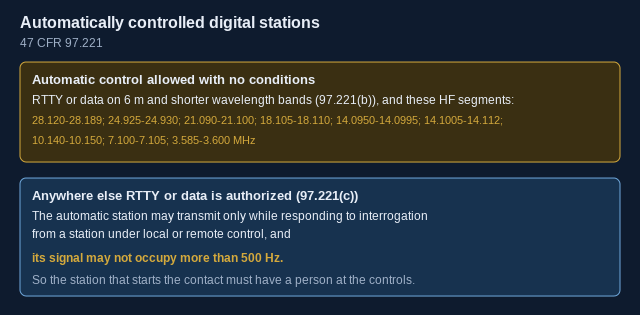
Outside the automatic control segments, the station that starts the contact must be under local or remote control, so a person is in the loop.

Where automatically controlled digital stations may operate freely, and the conditions that apply elsewhere.
Describe this graphic in words

The top box lists where automatic control of RTTY or data is allowed with no conditions: the 6 meter and shorter bands and nine HF segments from 3.585 to 28.189 MHz. The bottom box says that elsewhere the automatic station may transmit only in response to a station under local or remote control, with a bandwidth of no more than 500 Hz, so the station that starts the contact must be under human control.

Section 97.221(b) lists the segments where a digital station may be automatically controlled with no further conditions. Under 97.221(c), on other frequencies authorized for RTTY and data, an automatically controlled station may transmit only when it is "responding to interrogation by a station under local or remote control," and its transmissions may not occupy more than 500 Hz.

That is how a mailbox or gateway can operate on a normal digital segment without becoming an unattended source of interference.

Why the other choices are wrong

  • B. The rule requires the interrogating station to be under local or remote control, which means another automatic station cannot start the contact.
  • C. 97.221 does not ban third-party traffic. Third-party rules for automatic control are in 97.115(c).
  • D. No Extra class license is needed to interrogate such a station.

References

Rule text checked against the official source on November 12, 2026. This is a study aid; the linked rule is what governs.

G1E04FCC rule 97.13(b), 97.303, 97.311(b)

Which of the following conditions require a licensed amateur radio operator to take specific steps to avoid harmful interference to other users or facilities?

Show the answer and why

Answer D. All these choices are correct

FCC rule 97.13(b), 97.303, 97.311(b)

All three conditions require you to take steps to avoid harmful interference.

Within 1600 m (1 mile) of an FCC monitoring facility, 97.13(b) says you must protect that facility from harmful interference. On a band where amateurs are secondary, 97.303 says you must not cause harmful interference to primary users. A station transmitting spread spectrum must not cause harmful interference to stations using other emissions, under 97.311(b).

Since each of the three conditions is a duty to avoid interference, all of the choices are correct.

Why the other choices are wrong

  • A. Correct, but not the only condition. The others also apply.
  • B. Correct, but not the only condition. The others also apply.
  • C. Correct, but not the only condition. The others also apply.

References

Rule text checked against the official source on November 12, 2026. This is a study aid; the linked rule is what governs.

G1E05FCC rule 97.115(a)(2), 97.117

What are the restrictions on messages sent to a third party in a country with which there is a Third-Party Agreement?

Show the answer and why

Answer C. They must relate to amateur radio, or remarks of a personal character, or messages relating to emergencies or disaster relief

FCC rule 97.115(a)(2), 97.117

Messages to a third party abroad must relate to amateur radio or be personal remarks, or relate to emergencies or disaster relief.

Section 97.117 limits transmissions to a different country to "communications incidental to the purposes of the amateur service and to remarks of a personal character." Section 97.115(a)(2) allows third-party messages to a country with a third-party arrangement, and to any country for emergency or disaster relief communications.

Together, the allowed content is amateur radio matters, personal remarks, and emergency or disaster relief messages. It is not limited to emergencies, and it is not limited to messages for other licensees.

Why the other choices are wrong

  • A. Emergency messages are allowed, but so are amateur radio topics and personal remarks.
  • B. A third party is by definition someone who may not be a licensed amateur, so the message need not be for another licensee.
  • D. Part 97 sets no one minute limit and no requirement to log the third party's name in these rules.

References

Rule text checked against the official source on November 12, 2026. This is a study aid; the linked rule is what governs.

G1E06FCC rule 97.301, ITU Radio Regulations

The frequency allocations of which ITU region apply to radio amateurs operating in North and South America?

Show the answer and why

Answer C. Region 2

FCC rule 97.301, ITU Radio Regulations

Amateurs in North and South America operate under the ITU Region 2 allocations.

The ITU divides the world into three regions for frequency allocation, and Part 97's band table in 97.301 has a separate column for each of Regions 1, 2 and 3. The United States and the rest of the Americas are in Region 2. That is why the General class table lists, for example, 40 m phone as 7.175-7.300 MHz in Region 2 but 7.175-7.200 MHz in Regions 1 and 3.

This is a teaching note on the geography: the region boundaries come from the ITU Radio Regulations, which are not reproduced in Part 97. There is no Region 4.

Why the other choices are wrong

  • A. There is no ITU Region 4. The amateur table has columns for Regions 1, 2 and 3.
  • B. Region 3 covers most of Asia and the Pacific.
  • D. Region 1 covers Europe, Africa and parts of northern Asia.

References

Rule text checked against the official source on November 12, 2026. This is a study aid; the linked rule is what governs.

G1E07FCC rule 97.111

In what part of the 2.4 GHz band may an amateur station communicate with non-licensed Wi-Fi stations?

Show the answer and why

Answer D. No part

FCC rule 97.111

An amateur station may not communicate with unlicensed Wi-Fi stations anywhere in the 2.4 GHz band.

Section 97.111(a) lists the two-way communications an amateur station may make: with other amateur stations, in emergencies, with certain government stations, and with stations of services the FCC has authorized to communicate with amateurs. Ordinary Wi-Fi devices operate under Part 15 as unlicensed devices and are not among them.

Amateur rules and Wi-Fi rules can share the same spectrum, with amateur mesh networks reusing Wi-Fi hardware. But the amateur side may only talk to other amateur stations, and no Wi-Fi channel is open for traffic with the public.

Why the other choices are wrong

  • A. No part of the band allows it.
  • B. Channels 1 through 4 are not an exception. No part of the band allows it.
  • C. Channels 42 through 45 are not an exception. No part of the band allows it.

References

Rule text checked against the official source on November 12, 2026. This is a study aid; the linked rule is what governs.

G1E08FCC rule 97.313(j)

What is the maximum PEP output allowed for spread spectrum transmissions?

Show the answer and why

Answer B. 10 watts

FCC rule 97.313(j)

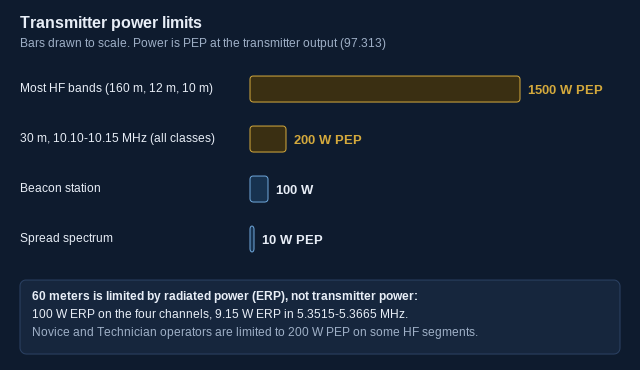
Spread spectrum transmissions are limited to 10 watts PEP output.

Bar chart of transmitter power limits: 1500 watts PEP general limit, 200 watts on 30 meters, 100 watts for beacons, and 10 watts for spread spectrum.
Describe this graphic in words

Four horizontal bars drawn to scale. The general limit for General class operators, including 160, 12 and 10 meters, is 1500 watts PEP. The 30 meter band, 10.10 to 10.15 MHz, is limited to 200 watts PEP for every class. Beacons are limited to 100 watts and spread spectrum to 10 watts PEP. A note says 60 meters is limited by radiated power: 100 watts ERP on the four channels and 9.15 watts ERP in 5.3515 to 5.3665 MHz.

Section 97.313(j) says "No station may transmit with a transmitter output exceeding 10 W PEP when the station is transmitting a SS emission type." The limit is far below the 1.5 kW PEP general limit, because spread spectrum signals are spread over a wide bandwidth and are meant to run at low power.

Spread spectrum must also not be used to obscure meaning, and it must accept interference from other emissions (97.311).

Why the other choices are wrong

  • A. 100 milliwatts is far below the limit. The rule allows up to 10 W PEP.
  • C. 100 W is ten times the limit for spread spectrum.
  • D. 1500 W is the general limit, not the spread spectrum limit.

References

Rule text checked against the official source on November 12, 2026. This is a study aid; the linked rule is what governs.

G1E10FCC rule 97.101

Why should an amateur operator normally avoid transmitting on 14.100, 18.110, 21.150, 24.930 and 28.200 MHz?

Show the answer and why

Answer A. A system of propagation beacon stations operates on those frequencies

FCC rule 97.101

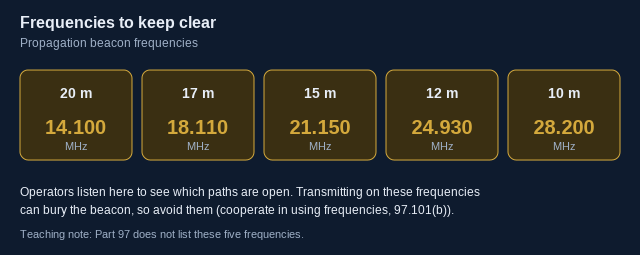
Those are the frequencies of a worldwide system of propagation beacon stations, so transmitting there would interfere with the beacons.

Five HF propagation beacon frequencies: 14.100, 18.110, 21.150, 24.930 and 28.200 MHz.
Describe this graphic in words

Five boxes, one per band, show the beacon frequencies to avoid: 20 meters at 14.100 MHz, 17 meters at 18.110 MHz, 15 meters at 21.150 MHz, 12 meters at 24.930 MHz and 10 meters at 28.200 MHz. Operators listen to the beacons to learn which paths are open, so transmitting on them should be avoided.

This is a teaching note. A coordinated network of beacons runs on 14.100, 18.110, 21.150, 24.930 and 28.200 MHz. Operators listen to the beacons to see which paths are open on each band. A voice or data signal on one of those frequencies can bury the beacon.

Part 97 does not list these five frequencies. The reason to keep clear of them comes from 97.101(b), which says each operator must cooperate in selecting transmitting channels and making the most effective use of the amateur service frequencies. Beacons themselves are defined in 97.3 as stations observing propagation and reception.

Why the other choices are wrong

  • B. Automatic digital stations use different segments, such as those listed in 97.221(b).
  • C. Emergency operations are not assigned these frequencies by Part 97.
  • D. The FCC does not set these frequencies aside for bulletins.

Rule text checked against the official source on November 12, 2026. This is a study aid; the linked rule is what governs.

G1E11FCC rule 97.221, 97.305

On what bands may automatically controlled stations transmitting RTTY or data emissions communicate with other automatically controlled digital stations?

Show the answer and why

Answer D. Anywhere in the 6-meter or shorter wavelength bands, and in limited segments of some of the HF bands

FCC rule 97.221, 97.305

Automatically controlled digital stations may communicate with each other on the 6 meter and shorter bands, and in limited segments of some HF bands.

Where automatically controlled digital stations may operate freely, and the conditions that apply elsewhere.
Describe this graphic in words

The top box lists where automatic control of RTTY or data is allowed with no conditions: the 6 meter and shorter bands and nine HF segments from 3.585 to 28.189 MHz. The bottom box says that elsewhere the automatic station may transmit only in response to a station under local or remote control, with a bandwidth of no more than 500 Hz, so the station that starts the contact must be under human control.

Section 97.221(b) allows automatic control while transmitting RTTY or data "on the 6 m or shorter wavelength bands" and in listed segments including 28.120-28.189 MHz, 24.925-24.930 MHz, 21.090-21.100 MHz, 18.105-18.110 MHz, 14.0950-14.0995 MHz, 14.1005-14.112 MHz, 10.140-10.150 MHz, 7.100-7.105 MHz and 3.585-3.600 MHz.

Elsewhere, an automatic station may respond only to a station under local or remote control, as in 97.221(c).

Why the other choices are wrong

  • A. Digital operation being permitted in a segment is not enough. Only the listed segments allow automatic stations to work each other.
  • B. The rule covers 6 m and shorter bands and a few HF segments, not the non-phone parts of 10 m only.
  • C. The segments are not limited to Extra class portions.

References

Rule text checked against the official source on November 12, 2026. This is a study aid; the linked rule is what governs.

G1E12FCC rule 97.115

When may third-party messages be transmitted via remote control?

Show the answer and why

Answer A. Under any circumstances in which third party messages are permitted by FCC rules

FCC rule 97.115

Third-party messages may be sent via remote control in any circumstances where the FCC rules permit third-party messages.

Section 97.115 sets the conditions for third-party communications, such as agreements with foreign countries, the control operator monitoring at the control point, and who may be a third party. It does not add any extra restriction because a station is remotely controlled.

So if a message would be allowed from a locally controlled station, it can also be sent through a remotely controlled one. The special limit in 97.115(c) concerns automatic control, which is a different thing.

Why the other choices are wrong

  • B. Remote control does not limit third-party messages to emergencies.
  • C. Third-party messages are not limited to licensed amateurs.
  • D. Third-party messages may also go to foreign countries that have a third-party arrangement, and for emergencies.

References

Rule text checked against the official source on November 12, 2026. This is a study aid; the linked rule is what governs.