
ARSC Tech School

General G4E: Mobile and portable HF stations

423 questions · pool July 1, 2023 to June 30, 2027 · the exam has 35 questions; 26 to pass

G4 · AMATEUR RADIO PRACTICES

Mobile and portable HF stations; alternative energy source operation

11 questions in group G4E

One question from this group appears on each exam.

G4E01

What is the purpose of a capacitance hat on a mobile antenna?

Show the answer and why

Answer C. To electrically lengthen a physically short antenna

A capacitance hat electrically lengthens a physically short antenna.
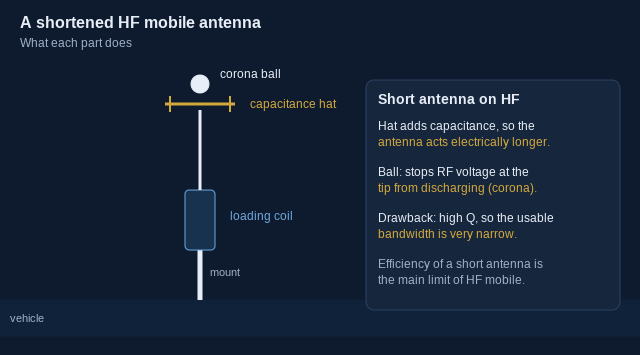
A shortened HF mobile antenna with a loading coil, a capacitance hat and a corona ball, and notes on what each does.
Describe this graphic in words

A whip on a vehicle mount with a loading coil, a capacitance hat near the top and a corona ball at the tip. The hat adds capacitance so the antenna acts electrically longer. The ball stops RF voltage at the tip from discharging as a corona. A shortened antenna has high Q so its usable bandwidth is very narrow, and its efficiency is the main limit of HF mobile operation.

This is a teaching note. A mobile whip is much shorter than a quarter wave on HF. A hat of wire or metal at the top adds capacitance and makes the antenna behave as if it were longer, which improves current distribution and radiation.

Why the other choices are wrong

  • A. It does not increase power handling.
  • B. It increases radiation resistance, which is a benefit.
  • D. It does not lower the radiation angle.

Rule text checked against the official source on November 17, 2026. This is a study aid; the linked rule is what governs.
G4E02

What is the purpose of a corona ball on an HF mobile antenna?

Show the answer and why

Answer D. To reduce RF voltage discharge from the tip of the antenna while transmitting

A corona ball reduces RF voltage discharge from the tip of the antenna while transmitting.

A shortened HF mobile antenna with a loading coil, a capacitance hat and a corona ball, and notes on what each does.
Describe this graphic in words

A whip on a vehicle mount with a loading coil, a capacitance hat near the top and a corona ball at the tip. The hat adds capacitance so the antenna acts electrically longer. The ball stops RF voltage at the tip from discharging as a corona. A shortened antenna has high Q so its usable bandwidth is very narrow, and its efficiency is the main limit of HF mobile operation.

This is a teaching note. The tip of a short HF whip has a high RF voltage. A sharp end can discharge in a glow or corona, which wastes power and causes noise. A rounded ball spreads the field and prevents that. It is also safer if the antenna hits something.

Why the other choices are wrong

  • A. A corona ball does not narrow the bandwidth.
  • B. It does not raise the Q.
  • C. Reducing damage when it strikes an object is a side benefit, not the purpose.

Rule text checked against the official source on November 17, 2026. This is a study aid; the linked rule is what governs.

G4E03

Which of the following direct, fused power connections would be the best for a 100-watt HF mobile installation?

Show the answer and why

Answer A. To the battery using heavy-gauge wire

Connect directly to the battery with heavy-gauge fused wire for a 100-watt HF mobile installation.

This is a teaching note. A 100 watt radio draws about 20 amperes when transmitting. The battery is the one source that can supply that without a voltage drop, and thick wire carries it without heating. A fuse near the battery protects the wire. Balanced transmission line is for RF, not DC power.

Why the other choices are wrong

  • B. The alternator connection is noisy and not meant for high current.
  • C. Balanced transmission line is for RF, not for DC.
  • D. Balanced transmission line is for RF, not for DC.

Rule text checked against the official source on November 17, 2026. This is a study aid; the linked rule is what governs.

G4E04

Why should DC power for a 100-watt HF transceiver not be supplied by a vehicle’s auxiliary power socket?

Show the answer and why

Answer B. The socket’s wiring may be inadequate for the current drawn by the transceiver

A vehicle auxiliary power socket may not be wired for the current a 100-watt transceiver draws.

This is a teaching note. A 100 watt HF radio draws around 20 amperes on transmit. The sockets are usually wired with thin wire and fused for much less, so the wiring may overheat or the fuse blow.

Why the other choices are wrong

  • A. The shielding of the cable is not the main issue.
  • C. The polarity of the socket is correct for modern radios.
  • D. Drawing more than 50 watts does not make the engine overheat.

Rule text checked against the official source on November 17, 2026. This is a study aid; the linked rule is what governs.

G4E05

Which of the following most limits an HF mobile installation?

Show the answer and why

Answer C. Efficiency of the electrically short antenna

The efficiency of the electrically short antenna is the main limit in an HF mobile installation.

A shortened HF mobile antenna with a loading coil, a capacitance hat and a corona ball, and notes on what each does.
Describe this graphic in words

A whip on a vehicle mount with a loading coil, a capacitance hat near the top and a corona ball at the tip. The hat adds capacitance so the antenna acts electrically longer. The ball stops RF voltage at the tip from discharging as a corona. A shortened antenna has high Q so its usable bandwidth is very narrow, and its efficiency is the main limit of HF mobile operation.

This is a teaching note. A short whip has low radiation resistance and loses a good part of the power in the loading coil and ground. Even with a perfect power connection, the antenna radiates only a fraction of the power.

Why the other choices are wrong

  • A. Picket fencing is a fading effect, not a limit of the installation.
  • B. Wire gauge can be solved with heavy wire.
  • D. There is no FCC rule limiting mobile output power on 75 m.

Rule text checked against the official source on November 17, 2026. This is a study aid; the linked rule is what governs.

G4E06

What is one disadvantage of using a shortened mobile antenna as opposed to a full-size antenna?

Show the answer and why

Answer C. Operating bandwidth may be very limited

A shortened mobile antenna may have a very limited operating bandwidth.

A shortened HF mobile antenna with a loading coil, a capacitance hat and a corona ball, and notes on what each does.
Describe this graphic in words

A whip on a vehicle mount with a loading coil, a capacitance hat near the top and a corona ball at the tip. The hat adds capacitance so the antenna acts electrically longer. The ball stops RF voltage at the tip from discharging as a corona. A shortened antenna has high Q so its usable bandwidth is very narrow, and its efficiency is the main limit of HF mobile operation.

This is a teaching note. A loaded short antenna has high Q, so the SWR rises quickly when you move away from its resonant frequency. You may need to retune it to move across a band.

Why the other choices are wrong

  • A. Short antennas do not cause distortion of the signal.
  • B. The Q is high, not low.
  • D. Harmonic radiation does not necessarily increase.

Rule text checked against the official source on November 17, 2026. This is a study aid; the linked rule is what governs.

G4E07

Which of the following may cause receive interference to an HF transceiver installed in a vehicle?

Show the answer and why

Answer D. All these choices are correct

The charging system, the fuel system and the control computers can all cause receive interference.

This is a teaching note. A vehicle is full of electrical noise sources: the alternator and its regulator, fuel pumps and injectors, and the engine and body computers. Any of them can put noise in an HF receiver.

Why the other choices are wrong

  • A. The charging system is one source but not the only one.
  • B. The fuel system is one source but not the only one.
  • C. The computers are one source but not the only one.

Rule text checked against the official source on November 17, 2026. This is a study aid; the linked rule is what governs.

G4E08

In what configuration are the individual cells in a solar panel connected together?

Show the answer and why

Answer A. Series-parallel

The cells in a solar panel are connected in series-parallel.

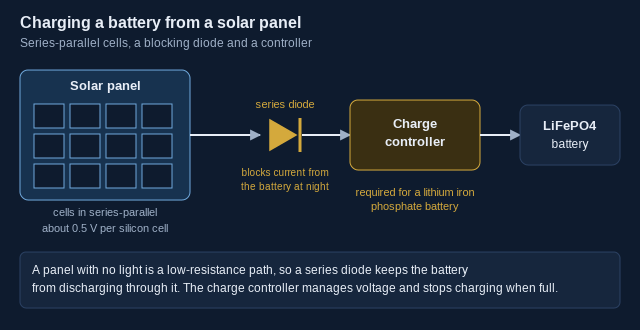
A solar panel of cells in series-parallel feeds a series diode, a charge controller and a lithium iron phosphate battery.
Describe this graphic in words

A chain from left to right. A solar panel made of cells connected in series-parallel, each silicon cell giving about 0.5 volt. A series diode that blocks the battery from discharging through the panel when there is no light. A charge controller, required for a lithium iron phosphate battery. The battery itself.

This is a teaching note. One silicon cell gives only about half a volt. Cells are connected in series to add their voltages and in parallel to add current, so the panel gives a usable voltage and current.

Why the other choices are wrong

  • B. Shunt is not an arrangement of cells.
  • C. Bypass is a diode function, not a cell arrangement.
  • D. A full-wave bridge is a rectifier circuit.

Rule text checked against the official source on November 17, 2026. This is a study aid; the linked rule is what governs.

G4E09

What is the approximate open-circuit voltage from a fully illuminated silicon photovoltaic cell?

Show the answer and why

Answer B. 0.5 VDC

A fully illuminated silicon photovoltaic cell has an open-circuit voltage of about 0.5 volt.

A solar panel of cells in series-parallel feeds a series diode, a charge controller and a lithium iron phosphate battery.
Describe this graphic in words

A chain from left to right. A solar panel made of cells connected in series-parallel, each silicon cell giving about 0.5 volt. A series diode that blocks the battery from discharging through the panel when there is no light. A charge controller, required for a lithium iron phosphate battery. The battery itself.

This is a teaching note. A silicon cell makes about 0.5 to 0.6 volt regardless of its size. A larger cell gives more current, not more voltage. A panel with 36 cells in series gives about 18 volts open circuit.

Why the other choices are wrong

  • A. 0.02 V is far too low.
  • C. 0.2 V is lower than a silicon cell makes.
  • D. 1.38 V is far more than a single silicon cell makes.

Rule text checked against the official source on November 17, 2026. This is a study aid; the linked rule is what governs.

G4E10

Why should a series diode be connected between a solar panel and a storage battery that is being charged by the panel?

Show the answer and why

Answer B. To prevent discharge of the battery through the panel during times of low or no illumination

A series diode prevents the battery from discharging through the panel when there is little or no light.

A solar panel of cells in series-parallel feeds a series diode, a charge controller and a lithium iron phosphate battery.
Describe this graphic in words

A chain from left to right. A solar panel made of cells connected in series-parallel, each silicon cell giving about 0.5 volt. A series diode that blocks the battery from discharging through the panel when there is no light. A charge controller, required for a lithium iron phosphate battery. The battery itself.

This is a teaching note. A panel with no light is a low-resistance path, and the battery would drive current back through it. The blocking diode allows current only toward the battery.

Why the other choices are wrong

  • A. A diode does not regulate the charging voltage.
  • C. A diode does not limit the current to a safe value.
  • D. A diode does not prevent overvoltage at high light levels.

Rule text checked against the official source on November 17, 2026. This is a study aid; the linked rule is what governs.

G4E11

What precaution should be taken when connecting a solar panel to a lithium iron phosphate battery?

Show the answer and why

Answer D. The solar panel must have a charge controller

A solar panel must have a charge controller when connected to a lithium iron phosphate battery.

A solar panel of cells in series-parallel feeds a series diode, a charge controller and a lithium iron phosphate battery.
Describe this graphic in words

A chain from left to right. A solar panel made of cells connected in series-parallel, each silicon cell giving about 0.5 volt. A series diode that blocks the battery from discharging through the panel when there is no light. A charge controller, required for a lithium iron phosphate battery. The battery itself.

This is a teaching note. This battery chemistry needs the charging voltage and current to be controlled, and the charge to stop when it is full. A panel can produce more voltage than the battery should see in bright light, so a charge controller sits between them.

Why the other choices are wrong

  • A. Grounding the frame is good practice but not the precaution for this battery.
  • B. The battery orientation is not the precaution.
  • C. A series resistor cannot regulate the charge.

Rule text checked against the official source on November 17, 2026. This is a study aid; the linked rule is what governs.