
ARSC Tech School

General G2E: Digital mode operating procedures

423 questions · pool July 1, 2023 to June 30, 2027 · the exam has 35 questions; 26 to pass

G2 · OPERATING PROCEDURES

Digital mode operating procedures

15 questions in group G2E

One question from this group appears on each exam.

G2E01

Which mode is normally used when sending RTTY signals via AFSK with an SSB transmitter?

Show the answer and why

Answer D. LSB

RTTY with AFSK on an SSB transmitter is normally sent on LSB.
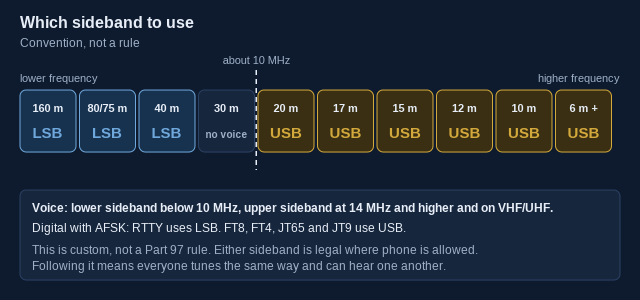
Chart of the usual sideband by band: lower sideband on 160, 80 and 40 meters, no voice on 30 meters, upper sideband on 20 meters and above.
Describe this graphic in words

A row of band boxes in frequency order. 160, 80/75 and 40 meters are marked lower sideband. 30 meters is marked no voice. 20, 17, 15, 12 and 10 meters and 6 meters and up are marked upper sideband. A dashed line at about 10 MHz separates the two. Below, a note says digital RTTY with AFSK uses LSB while FT8, FT4, JT65 and JT9 use USB, and that this is custom, not a Part 97 rule.

This is a teaching note. By long convention, RTTY is sent on lower sideband. The audio tones are generated by a sound card or modem, and the radio sets the mark and space frequencies relative to the dial frequency. Using the other sideband reverses the mark and space tones, so the signal cannot be decoded.

Why the other choices are wrong

  • A. USB is the usual choice for most other digital modes, not for RTTY.
  • B. DSB is not used for AFSK RTTY.
  • C. CW is a different emission.

Rule text checked against the official source on November 13, 2026. This is a study aid; the linked rule is what governs.
G2E02

What is VARA?

Show the answer and why

Answer B. A digital protocol used with Winlink

VARA is a digital protocol used with Winlink.

This is a teaching note. VARA is a high-speed HF and VHF modem protocol that many Winlink gateways and users run on a computer sound card. It transfers email messages faster than older protocols such as PACTOR 1 or 2.

Why the other choices are wrong

  • A. EME work uses other weak-signal modes.
  • C. VARA is not a direction finding system.
  • D. It is not a DX spotting system.

Rule text checked against the official source on November 13, 2026. This is a study aid; the linked rule is what governs.

G2E03

What symptoms may result from other signals interfering with a PACTOR or VARA transmission?

Show the answer and why

Answer D. All these choices are correct

Interference to a PACTOR or VARA signal can cause retries, timeouts, pauses and failure to connect.

This is a teaching note. These protocols check each block of data and ask for it again if it is damaged. Other signals on the frequency damage blocks, so you see repeated retries and timeouts, slow throughput and sometimes a link that cannot be established.

Why the other choices are wrong

  • A. Retries and timeouts are one symptom, but not the only one.
  • B. Pauses are one symptom, but not the only one.
  • C. A failed connection is one symptom, but not the only one.

Rule text checked against the official source on November 13, 2026. This is a study aid; the linked rule is what governs.

G2E04

Which of the following is good practice when choosing a transmitting frequency to answer a station calling CQ using FT8?

Show the answer and why

Answer D. Find a clear frequency during the alternate time slot to the calling station

Answer an FT8 CQ by finding a clear frequency during the alternate time slot to the calling station.

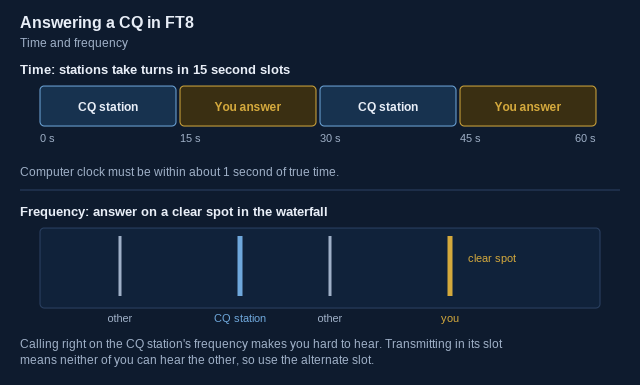
FT8 timing and frequency: stations alternate in 15 second slots, and you answer in the alternate slot on a clear frequency in the waterfall.
Describe this graphic in words

The top half shows four 15 second slots alternating between the CQ station and you, with a note that the computer clock must be within about 1 second. The bottom half shows a waterfall with vertical tones for other stations, the CQ station and you, with your tone placed in a clear spot. The advice is to answer in the alternate time slot on a clear frequency.

This is a teaching note. FT8 stations take turns in fixed 15 second slots. The station calling CQ transmits in one slot, so you answer in the other, on a clear spot in the waterfall. Calling on top of the other station's frequency causes interference, and transmitting in the same slot means neither of you can hear the other.

Why the other choices are wrong

  • A. Calling on the other station's frequency causes interference to their reception of other callers.
  • B. Any frequency in the waterfall may be in use by others. You need a clear one.
  • C. The same time slot means you transmit when the other station does and cannot hear it.

Rule text checked against the official source on November 13, 2026. This is a study aid; the linked rule is what governs.

G2E05

What is the standard sideband for JT65, JT9, FT4, or FT8 digital signal when using AFSK?

Show the answer and why

Answer B. USB

The standard sideband for JT65, JT9, FT4 and FT8 using AFSK is USB.

Chart of the usual sideband by band: lower sideband on 160, 80 and 40 meters, no voice on 30 meters, upper sideband on 20 meters and above.
Describe this graphic in words

A row of band boxes in frequency order. 160, 80/75 and 40 meters are marked lower sideband. 30 meters is marked no voice. 20, 17, 15, 12 and 10 meters and 6 meters and up are marked upper sideband. A dashed line at about 10 MHz separates the two. Below, a note says digital RTTY with AFSK uses LSB while FT8, FT4, JT65 and JT9 use USB, and that this is custom, not a Part 97 rule.

This is a teaching note. These modes use audio tones generated by a computer, and by convention the radio is set to upper sideband with the dial at the listed frequency. Operators then place their audio tone within the 3 kHz passband.

Why the other choices are wrong

  • A. LSB is the convention for RTTY, not for these weak-signal modes.
  • C. DSB is not used for these modes.
  • D. SSB is the general mode. The sideband to use is upper.

Rule text checked against the official source on November 13, 2026. This is a study aid; the linked rule is what governs.

G2E06

What is the most common frequency shift for RTTY emissions in the amateur HF bands?

Show the answer and why

Answer B. 170 Hz

The most common frequency shift for RTTY on the amateur HF bands is 170 Hz.

This is a teaching note. RTTY uses two tones, mark and space. The standard amateur shift is 170 Hz. Wider shifts such as 425 and 850 Hz are also used, but mostly by non-amateur services.

Why the other choices are wrong

  • A. 85 Hz is narrower than the standard 170 Hz shift.
  • C. 425 Hz is wider than the standard amateur shift.
  • D. 850 Hz is wider than the standard amateur shift.

Rule text checked against the official source on November 13, 2026. This is a study aid; the linked rule is what governs.

G2E07

Which of the following is required when using FT8?

Show the answer and why

Answer B. Computer time accurate to within approximately 1 second

FT8 requires computer time accurate to within approximately 1 second.

FT8 timing and frequency: stations alternate in 15 second slots, and you answer in the alternate slot on a clear frequency in the waterfall.
Describe this graphic in words

The top half shows four 15 second slots alternating between the CQ station and you, with a note that the computer clock must be within about 1 second. The bottom half shows a waterfall with vertical tones for other stations, the CQ station and you, with your tone placed in a clear spot. The advice is to answer in the alternate time slot on a clear frequency.

This is a teaching note. FT8 transmissions start at set times, in 15 second cycles. A decoder expects the signal to begin within about a second of the right time, so a computer clock that is off by more than that cannot decode signals. Operators synchronize with an internet time server or GPS.

Why the other choices are wrong

  • A. FT8 runs with a normal sound card interface. No special modem is needed.
  • C. No specific attenuator setting is required.
  • D. The mode does not need a vertically polarized antenna.

Rule text checked against the official source on November 13, 2026. This is a study aid; the linked rule is what governs.

G2E08

In what segment of the 20-meter band are most digital mode operations commonly found?

Show the answer and why

Answer D. Between 14.070 MHz and 14.100 MHz

Most digital operation on 20 meters is between 14.070 and 14.100 MHz.

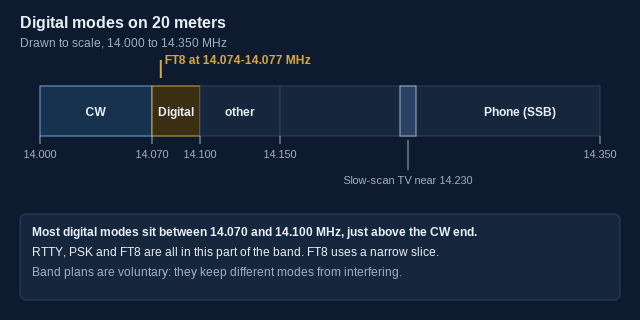
Map of the 20 meter band showing CW at the bottom, digital modes from 14.070 to 14.100 MHz, FT8 at 14.074 to 14.077 MHz, and phone above 14.150 MHz.
Describe this graphic in words

A band bar from 14.000 to 14.350 MHz drawn to scale. CW is at the bottom to 14.070 MHz. Digital modes occupy 14.070 to 14.100 MHz, highlighted. FT8 is a narrow slice at 14.074 to 14.077 MHz. The band between 14.100 and 14.150 is marked other, and phone occupies 14.150 to 14.350 MHz, with slow-scan TV near 14.230 MHz.

This is a teaching note. The band plans place narrowband digital modes in the part of 20 m just above the CW segment, from about 14.070 to 14.100 MHz. FT8 is in the 14.074 to 14.077 MHz portion, and RTTY and PSK are nearby.

Why the other choices are wrong

  • A. 14.230 MHz is the slow-scan television area.
  • B. 14.325 MHz is in the phone segment.
  • C. 14.100 MHz is the location of a beacon frequency, not the middle of a digital segment.

Rule text checked against the official source on November 13, 2026. This is a study aid; the linked rule is what governs.

G2E09

How do you join a contact between two stations using the PACTOR protocol?

Show the answer and why

Answer C. Joining an existing contact is not possible, PACTOR connections are limited to two stations

Joining a contact between two stations using PACTOR is not possible. PACTOR connections are limited to two stations.

This is a teaching note. PACTOR is a connected protocol. Two stations link up, exchange acknowledgments and share a session that no third station can enter. A third station must wait for the link to end.

Why the other choices are wrong

  • A. Broadcast packets in monitor mode do not join a PACTOR link.
  • B. A steady carrier does not join a link. It only causes interference.
  • D. Sending a NAK does not join a link.

Rule text checked against the official source on November 13, 2026. This is a study aid; the linked rule is what governs.

G2E10

Which of the following is a way to establish contact with a digital messaging system gateway station?

Show the answer and why

Answer D. Transmit a connect message on the station’s published frequency

To contact a digital messaging gateway, transmit a connect message on the station's published frequency.

This is a teaching note. Gateways list their frequencies and their call signs. You send a connect request on a published frequency, and the gateway answers and opens a session.

Why the other choices are wrong

  • A. Email to the control operator will not connect you to the gateway.
  • B. Sending QRL asks whether a frequency is in use. It does not connect.
  • C. An SSID is part of the call sign. Gateways do not need to broadcast it to be reached.

Rule text checked against the official source on November 13, 2026. This is a study aid; the linked rule is what governs.

G2E11

What is the primary purpose of an Amateur Radio Emergency Data Network (AREDN) mesh network?

Show the answer and why

Answer C. To provide high-speed data services during an emergency or community event

AREDN mesh networks provide high-speed data services during an emergency or community event.

This is a teaching note. AREDN stands for Amateur Radio Emergency Data Network. Nodes link to each other in a mesh on microwave bands, using modified commercial hardware, and carry computer network traffic such as video, voice and web pages.

Why the other choices are wrong

  • A. AREDN is not a repeater system.
  • B. It does not provide propagation data.
  • D. It does not provide DX spotting reports.

Rule text checked against the official source on November 13, 2026. This is a study aid; the linked rule is what governs.

G2E12

Which of the following describes Winlink?

Show the answer and why

Answer D. All these choices are correct

Winlink is a wireless network for email, it is a form of packet radio, and it works on VHF and HF.

This is a teaching note. Winlink is a worldwide radio messaging system for email. It uses packet radio and other data modes, and it has gateways on HF and on VHF, so every statement in the question describes it.

Why the other choices are wrong

  • A. Correct, but the other statements are also true.
  • B. Correct, but the other statements are also true.
  • C. Correct, but the other statements are also true.

Rule text checked against the official source on November 13, 2026. This is a study aid; the linked rule is what governs.

G2E13

What is another name for a Winlink Remote Message Server?

Show the answer and why

Answer B. Gateway

Another name for a Winlink Remote Message Server is a gateway.

This is a teaching note. A Remote Message Server (RMS) is a station that links the radio side of Winlink to the internet side. Operators call it a gateway.

Why the other choices are wrong

  • A. A terminal node controller is a modem.
  • C. An RJ-45 is a network connector.
  • D. It is not called a printer/server.

Rule text checked against the official source on November 13, 2026. This is a study aid; the linked rule is what governs.

G2E14

What could be wrong if you cannot decode an RTTY or other FSK signal even though it is apparently tuned in properly?

Show the answer and why

Answer D. All these choices are correct

All of the listed problems could keep you from decoding an RTTY or FSK signal.

This is a teaching note. A mark and space that are reversed, a wrong baud rate and the wrong sideband can each make the output unreadable. Check them one at a time.

Why the other choices are wrong

  • A. Reversed mark and space is a possible cause, but not the only one.
  • B. A wrong baud rate is a possible cause, but not the only one.
  • C. The wrong sideband is a possible cause, but not the only one.

Rule text checked against the official source on November 13, 2026. This is a study aid; the linked rule is what governs.

G2E15

Which of the following is a common location for FT8?

Show the answer and why

Answer C. Approximately 14.074 MHz to 14.077 MHz

FT8 is commonly found at approximately 14.074 to 14.077 MHz on 20 meters.

Map of the 20 meter band showing CW at the bottom, digital modes from 14.070 to 14.100 MHz, FT8 at 14.074 to 14.077 MHz, and phone above 14.150 MHz.
Describe this graphic in words

A band bar from 14.000 to 14.350 MHz drawn to scale. CW is at the bottom to 14.070 MHz. Digital modes occupy 14.070 to 14.100 MHz, highlighted. FT8 is a narrow slice at 14.074 to 14.077 MHz. The band between 14.100 and 14.150 is marked other, and phone occupies 14.150 to 14.350 MHz, with slow-scan TV near 14.230 MHz.

This is a teaching note. The FT8 calling frequency on 20 m is 14.074 MHz, and activity sits in a narrow range around it. Each band has its own FT8 frequency within the digital segment.

Why the other choices are wrong

  • A. FT8 is not in the voice portion of the band.
  • B. FT8 is not in the CW portion.
  • D. 14.110 to 14.113 MHz is not an FT8 frequency.

Rule text checked against the official source on November 13, 2026. This is a study aid; the linked rule is what governs.