
ARSC Tech School

General G1D: Volunteer Examiners and Volunteer Examiner Coordinators

423 questions · pool July 1, 2023 to June 30, 2027 · the exam has 35 questions; 26 to pass

G1 · COMMISSION’S RULES

Volunteer Examiners and Volunteer Examiner Coordinators; temporary identification; element credit; remote operation

12 questions in group G1D

One question from this group appears on each exam.

G1D01FCC rule 97.501, 97.505(a)

Who may receive partial credit for the elements represented by an expired amateur radio license?

Show the answer and why

Answer A. Any person who can demonstrate that they once held an FCC-issued General, Advanced, or Amateur Extra class license that was not revoked by the FCC

FCC rule 97.501, 97.505(a)

Someone who once held an FCC General, Advanced or Amateur Extra license can still get element credit after it has expired beyond its grace period.
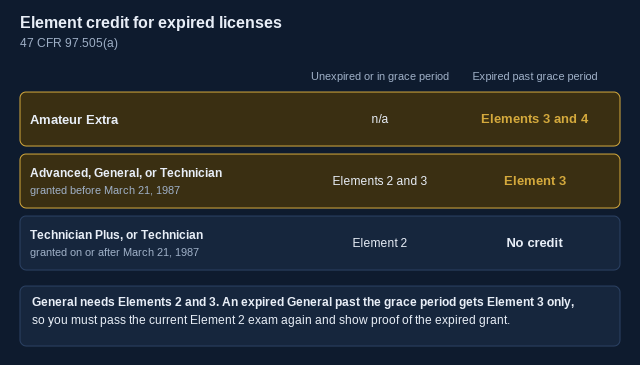
Table of exam element credit for unexpired and expired licenses, from 47 CFR 97.505.
Describe this graphic in words

A table with two columns, unexpired or within the grace period, and expired beyond the grace period. Amateur Extra: not applicable, then Elements 3 and 4. Advanced, General, or Technician granted before March 21, 1987: Elements 2 and 3, then Element 3. Technician Plus or Technician granted on or after March 21, 1987: Element 2, then no credit. A note says a General license needs Elements 2 and 3, so an expired General past the grace period must pass Element 2 again.

Section 97.505(a) is a table of credit for current and expired license grants. For a license that is expired and beyond the renewal grace period, an Extra gets credit for Elements 3 and 4, and a General, an Advanced, or a Technician granted before March 21, 1987 gets credit for Element 3. Choice A describes this group of former General, Advanced and Extra licensees.

Technician licenses granted on or after March 21, 1987 (and Technician Plus) get no credit once expired and past the grace period. The credit is for an expired FCC license, not a foreign license, and it does not depend on a window of 5 to 15 years.

Why the other choices are wrong

  • B. The table has no 5 to 15 year window. Credit depends on the class of the expired license.
  • C. Credit for expired licenses under 97.505 is for FCC license grants, not licenses from other countries.
  • D. Expired Technician, Technician Plus and Novice licenses get no credit, so this describes the people who do not qualify.

References

Rule text checked against the official source on November 12, 2026. This is a study aid; the linked rule is what governs.
G1D02FCC rule 97.509(b)(3)(i)

What license examinations may you administer as an accredited Volunteer Examiner holding a General class operator license?

Show the answer and why

Answer C. Technician only

FCC rule 97.509(b)(3)(i)

A General class VE may administer only Technician class examinations.

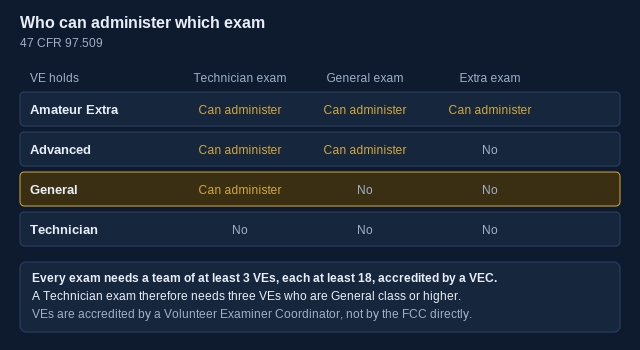
Table of which VE license classes can administer Technician, General and Extra exams, plus the team size and age rules.
Describe this graphic in words

A table with rows for the VE license class. An Amateur Extra VE can administer all three exams. An Advanced VE can administer Technician and General exams. A General VE can administer only Technician exams, and that row is highlighted. A Technician VE can administer none. Below, the rules: a team of at least three VEs, each at least 18 years old and accredited by a Volunteer Examiner Coordinator.

Section 97.509(b)(3) says a VE must hold a license of a certain class to administer each exam. A Technician exam can be given by a VE who is Amateur Extra, Advanced or General. A General exam requires Amateur Extra or Advanced, and an Extra exam requires Amateur Extra.

So a General class VE can help with Technician (Element 2) sessions only. To help test for General or Extra you must hold a higher license class.

Why the other choices are wrong

  • A. General exams need an Extra or Advanced VE, so a General class VE cannot give them.
  • B. General class licensees can be accredited. The rule allows them to administer Technician exams.
  • D. A General class VE cannot administer General or Extra exams.

References

Rule text checked against the official source on November 12, 2026. This is a study aid; the linked rule is what governs.

G1D03FCC rule 97.9(b)

On which of the following band segments may you operate if you are a Technician class operator and have an unexpired Certificate of Successful Completion of Examination (CSCE) for General class privileges?

Show the answer and why

Answer C. On any General or Technician class band segment

FCC rule 97.9(b)

With a valid CSCE for General, you may use any General or Technician band segment while your upgrade is processed.

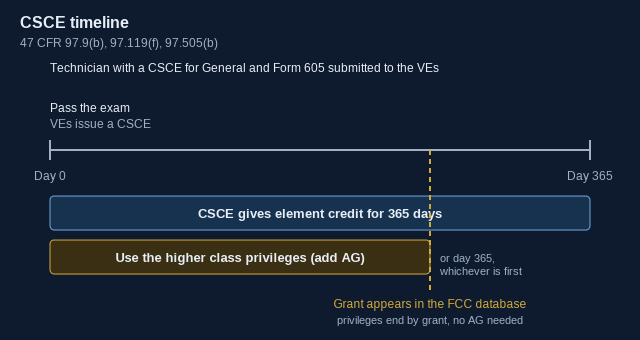
Timeline of a CSCE: credit for 365 days, and General privileges with the AG indicator until the grant appears in the FCC database or day 365.
Describe this graphic in words

A timeline from the day you pass the exam, when the VEs issue a CSCE, to day 365. A blue bar shows the CSCE gives element credit for 365 days. A gold bar shows that for a Technician with a CSCE for General, the higher class privileges can be used, adding AG after the call sign, until the grant appears in the FCC database or 365 days pass, whichever comes first.

Section 97.9(b) says a Technician holder who has submitted FCC Form 605 to the administering VEs and holds a CSCE showing the exams were passed in the previous 365 days "is authorized to exercise the rights and privileges of the higher operator class until final disposition of the application or until 365 days following the passing of the examination, whichever comes first."

Nothing in 97.9(b) excludes 30 m or 60 m, and there is no requirement to wait for the database or to show a fee receipt. While operating that way, you must add the indicator AG after your call sign.

Why the other choices are wrong

  • A. 97.9(b) does not make you wait for the upgrade to appear in the database. The CSCE gives the privileges immediately.
  • B. A fee receipt is not a condition in 97.9(b).
  • D. The rule does not exclude any band from the higher class privileges.

References

Rule text checked against the official source on November 12, 2026. This is a study aid; the linked rule is what governs.

G1D04FCC rule 97.509(3)(i)(c)

Who must observe the administration of a Technician class license examination?

Show the answer and why

Answer A. At least three Volunteer Examiners of General class or higher

FCC rule 97.509(3)(i)(c)

A Technician exam is given by a team of at least three VEs who hold General class or higher.

Table of which VE license classes can administer Technician, General and Extra exams, plus the team size and age rules.
Describe this graphic in words

A table with rows for the VE license class. An Amateur Extra VE can administer all three exams. An Advanced VE can administer Technician and General exams. A General VE can administer only Technician exams, and that row is highlighted. A Technician VE can administer none. Below, the rules: a team of at least three VEs, each at least 18 years old and accredited by a Volunteer Examiner Coordinator.

Section 97.509(a) requires each exam to be administered by a team of at least 3 VEs at a session coordinated by a VEC. Paragraph (b)(3)(i) says that to administer a Technician exam, each VE must hold Amateur Extra, Advanced or General class.

Both conditions together give "at least three Volunteer Examiners of General class or higher." Technician class VEs cannot administer any exam.

Why the other choices are wrong

  • B. The minimum team is three VEs, not two.
  • C. The minimum is three, and Technician class licensees cannot administer exams.
  • D. Technician class licensees cannot be administering VEs for any exam.

References

Rule text checked against the official source on November 12, 2026. This is a study aid; the linked rule is what governs.

G1D05FCC rule 97.7

When operating a US station by remote control from outside the country, what license is required of the control operator?

Show the answer and why

Answer A. A US operator/primary station license

FCC rule 97.7

The control operator of a US station needs a US amateur operator/primary station license grant that appears in the FCC database, wherever the control operator is located.

Section 97.7 says when transmitting, each amateur station must have a control operator, who must be a person for whom an amateur operator/primary station license grant appears on the ULS database, or who is authorized for alien reciprocal operation under 97.107.

The reciprocal route in 97.107 is for non-citizens operating at places where the FCC regulates the service. A remote control operator outside the US is not covered by it. Part 97 has no special remote station permit.

Why the other choices are wrong

  • B. The rules do not require a special remote station permit.
  • C. A foreign license alone does not make someone a control operator for a US station. 97.7 requires a US grant or reciprocal authority under 97.107.
  • D. A foreign license plus a permit is not one of the options in 97.7, and no remote station permit exists.

References

Rule text checked against the official source on November 12, 2026. This is a study aid; the linked rule is what governs.

G1D06FCC rule 97.119(f)(2)

Until an upgrade to General class is shown in the FCC database, when must a Technician licensee identify with “AG” after their call sign?

Show the answer and why

Answer A. Whenever they operate using General class frequency privileges

FCC rule 97.119(f)(2)

A Technician who has upgraded by exam but is not yet in the database must add AG after the call sign whenever using General class privileges.

Timeline of a CSCE: credit for 365 days, and General privileges with the AG indicator until the grant appears in the FCC database or day 365.
Describe this graphic in words

A timeline from the day you pass the exam, when the VEs issue a CSCE, to day 365. A blue bar shows the CSCE gives element credit for 365 days. A gold bar shows that for a Technician with a CSCE for General, the higher class privileges can be used, adding AG after the call sign, until the grant appears in the FCC database or 365 days pass, whichever comes first.

Section 97.119(f)(2) says that when the control operator is exercising the privileges allowed by 97.9(b) and has requested a modification from Novice or Technician to General, the indicator AG must be included after the call sign.

That indicator tells listeners that you are operating on General privileges based on a CSCE. If you stay on Technician frequencies, you are operating on your existing license and do not need it.

Why the other choices are wrong

  • B. The indicator is needed only when you use the higher class privileges, not whenever you transmit.
  • C. Operating on Technician privileges is operating under your existing license, which needs no indicator.
  • D. Filing the application is not enough to excuse the indicator. It is required while you are exercising 97.9(b) privileges.

References

Rule text checked against the official source on November 12, 2026. This is a study aid; the linked rule is what governs.

G1D07FCC rule 97.509(b)(1)

Volunteer Examiners are accredited by what organization?

Show the answer and why

Answer C. A Volunteer Examiner Coordinator

FCC rule 97.509(b)(1)

Volunteer Examiners are accredited by a Volunteer Examiner Coordinator (VEC).

Table of which VE license classes can administer Technician, General and Extra exams, plus the team size and age rules.
Describe this graphic in words

A table with rows for the VE license class. An Amateur Extra VE can administer all three exams. An Advanced VE can administer Technician and General exams. A General VE can administer only Technician exams, and that row is highlighted. A Technician VE can administer none. Below, the rules: a team of at least three VEs, each at least 18 years old and accredited by a Volunteer Examiner Coordinator.

Section 97.509(b)(1) says each administering VE must "be accredited by the coordinating VEC." The VEC also coordinates the exam sessions under 97.509(a).

The FCC does not accredit individual VEs. It works through the VECs, and the exam session is recorded with the VEC that coordinated it.

Why the other choices are wrong

  • A. The FCC works through VECs rather than accrediting individual VEs.
  • B. The Universal Licensing System is a database, not an organization that accredits people.
  • D. The Wireless Telecommunications Bureau is part of the FCC and does not accredit VEs.

References

Rule text checked against the official source on November 12, 2026. This is a study aid; the linked rule is what governs.

G1D08FCC rule 97.509(b)(3)

Which of the following criteria must be met for a non-US citizen to be an accredited Volunteer Examiner?

Show the answer and why

Answer B. The person must hold an FCC granted amateur radio license of General class or above

FCC rule 97.509(b)(3)

A non-US citizen can be a VE if they hold an FCC amateur license of the class needed to administer the exam, which means General or above for a Technician exam.

Part 97 does not put citizenship or residency requirements on VEs. Section 97.509(b)(3) requires each administering VE to hold an amateur operator license of the class specified for the exam, and the lowest class that can administer anything is General (for Technician exams).

So a non-citizen can qualify by holding an FCC-granted license of General class or above, and by meeting the other conditions such as being at least 18 and accredited by the VEC.

Why the other choices are wrong

  • A. There is no five year residency requirement in the rule.
  • C. Citizenship in ITU Region 2 is not a condition in Part 97.
  • D. The rules do not exclude non-citizens. They require an FCC-granted license of the right class.

References

Rule text checked against the official source on November 12, 2026. This is a study aid; the linked rule is what governs.

G1D09FCC rule 97.9(b)

How long is a Certificate of Successful Completion of Examination (CSCE) valid for exam element credit?

Show the answer and why

Answer C. 365 days

FCC rule 97.9(b)

A CSCE gives exam element credit for 365 days.

Timeline of a CSCE: credit for 365 days, and General privileges with the AG indicator until the grant appears in the FCC database or day 365.
Describe this graphic in words

A timeline from the day you pass the exam, when the VEs issue a CSCE, to day 365. A blue bar shows the CSCE gives element credit for 365 days. A gold bar shows that for a Technician with a CSCE for General, the higher class privileges can be used, adding AG after the call sign, until the grant appears in the FCC database or 365 days pass, whichever comes first.

Section 97.505(b) says VEs must give credit to an examinee holding a CSCE "for each element the CSCE indicates the examinee passed within the previous 365 days." After that, the element must be passed again.

The same 365 days appears in 97.9(b), which limits how long you can use the higher class privileges on the strength of the CSCE while the application is pending.

Why the other choices are wrong

  • A. 30 days is not the period in the rule.
  • B. 180 days is not the period in the rule.
  • D. A CSCE does not last as long as your license. It is good for 365 days.

References

Rule text checked against the official source on November 12, 2026. This is a study aid; the linked rule is what governs.

G1D10FCC rule 97.509(b)(2)

What is the minimum age that one must be to qualify as an accredited Volunteer Examiner?

Show the answer and why

Answer B. 18 years

FCC rule 97.509(b)(2)

A VE must be at least 18 years old.

Table of which VE license classes can administer Technician, General and Extra exams, plus the team size and age rules.
Describe this graphic in words

A table with rows for the VE license class. An Amateur Extra VE can administer all three exams. An Advanced VE can administer Technician and General exams. A General VE can administer only Technician exams, and that row is highlighted. A Technician VE can administer none. Below, the rules: a team of at least three VEs, each at least 18 years old and accredited by a Volunteer Examiner Coordinator.

Section 97.509(b)(2) states that each administering VE must be at least 18 years of age. The other requirements in that paragraph are accreditation by the VEC, holding a license of the right class, and never having had an amateur license revoked or suspended.

Why the other choices are wrong

  • A. 16 is younger than the minimum age in the rule.
  • C. 21 is older than the minimum age in the rule.
  • D. There is an age limit: 18.

References

Rule text checked against the official source on November 12, 2026. This is a study aid; the linked rule is what governs.

G1D11FCC rule 97.505

What action is required to obtain a new General class license after a previously held license has expired and the two-year grace period has passed?

Show the answer and why

Answer D. The applicant must show proof of the appropriate expired license grant and pass the current Element 2 exam

FCC rule 97.505

After the grace period, you must show proof of the old license grant and pass the current Element 2 exam to be re-licensed as a General.

Table of exam element credit for unexpired and expired licenses, from 47 CFR 97.505.
Describe this graphic in words

A table with two columns, unexpired or within the grace period, and expired beyond the grace period. Amateur Extra: not applicable, then Elements 3 and 4. Advanced, General, or Technician granted before March 21, 1987: Elements 2 and 3, then Element 3. Technician Plus or Technician granted on or after March 21, 1987: Element 2, then no credit. A note says a General license needs Elements 2 and 3, so an expired General past the grace period must pass Element 2 again.

To qualify for General, an applicant needs credit for Elements 2 and 3 under 97.501(b). For an expired General license beyond the grace period, the table in 97.505(a) gives credit for Element 3 only. Element 2, the Technician exam, has to be passed again.

Credit is given when the examinee can show proof of the expired license grant. A copy of the expired license alone is not a license, and the FCC does not reinstate a license after the grace period.

Why the other choices are wrong

  • A. A letter showing you once held a license is not the requirement. You must show proof of the expired grant and pass Element 2.
  • B. Showing a copy of the expired license is not enough, because Element 2 must be passed again.
  • C. After the grace period the license cannot be reinstated, so you must apply for a new one.

References

Rule text checked against the official source on November 12, 2026. This is a study aid; the linked rule is what governs.

G1D12FCC rule 97.507

When operating a station in South America by remote control over the internet from the US, what regulations apply?

Show the answer and why

Answer C. Only those of the remote station’s country

FCC rule 97.507

Operating a station located in another country by remote control means that country's rules apply to that station.

This is a teaching note. A station is regulated by the country where it is located. FCC rules apply to stations in places where the FCC regulates the amateur service, so a station in South America is under the rules of the country where it sits, and you must hold whatever authorization that country requires to operate it.

Part 97 does not address remote operation of foreign stations, and the rule cited by the pool, 97.507, is about preparing exams, so this entry cannot be confirmed from it. Check the licensing authority of the country that hosts the station before operating one.

Why the other choices are wrong

  • A. The FCC's rules govern stations it regulates, not a transmitter located in another country.
  • B. There is no FCC third-party regulation that makes a foreign station subject to FCC rules.
  • D. The FCC does not regulate the station's operation just because the control operator is in the US.

Rule text checked against the official source on November 12, 2026. This is a study aid; the linked rule is what governs.