How is direct binary FSK modulation generated?
Show the answer and why
Answer B. By changing an oscillator’s frequency directly with a digital control signal
Direct binary FSK is generated by changing an oscillator's frequency directly with a digital control signal.
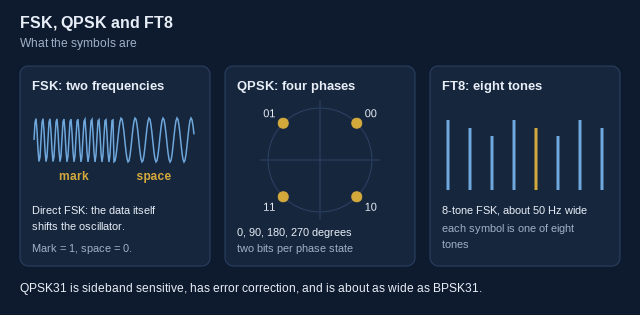
Describe this graphic in words
Three panels. FSK: a wave that changes between two frequencies, called mark for one and space for zero; direct FSK shifts the oscillator with the data. QPSK: a circle with four points at 0, 90, 180 and 270 degrees, each standing for a pair of bits. FT8: eight tones in a band about 50 hertz wide. A note says QPSK31 is sideband sensitive, has error correction, and has about the same bandwidth as BPSK31.
This is a teaching note. In frequency shift keying the carrier frequency jumps between two values to send a one or a zero. In direct FSK the digital data itself shifts the oscillator, with no audio tone in between. That is different from AFSK, where an audio tone is shifted and fed to a transmitter.
Why the other choices are wrong
- A. Keying an FM transmitter with a sub-audible tone is a tone-squelch technique, not FSK.
- C. A computer data interface protocol is not the way direct FSK is made.
- D. Using the CW keying input as a tone generator is not direct FSK.
Rule text checked against the official source on November 17, 2026. This is a study aid; the linked rule is what governs.