
ARSC Tech School

General G2D: Volunteer Monitor Program

423 questions · pool July 1, 2023 to June 30, 2027 · the exam has 35 questions; 26 to pass

G2 · OPERATING PROCEDURES

Volunteer Monitor Program; HF operations

11 questions in group G2D

One question from this group appears on each exam.

G2D01

What is the Volunteer Monitor Program?

Show the answer and why

Answer A. Amateur volunteers who are formally enlisted to monitor the airwaves for rules violations

The Volunteer Monitor Program uses formally enlisted amateur volunteers to monitor the airwaves for rules violations.

This is a teaching note. The program is a volunteer effort to help keep the amateur bands orderly. Volunteers listen for violations and report what they observe, and they do not have enforcement authority themselves.

Why the other choices are wrong

  • B. Conducting exams is the work of Volunteer Examiners.
  • C. Frequency coordination is the work of frequency coordinators.
  • D. Helping civil defense organizations is the work of emergency communications groups such as RACES.

Rule text checked against the official source on November 13, 2026. This is a study aid; the linked rule is what governs.
G2D02

Which of the following are objectives of the Volunteer Monitor Program?

Show the answer and why

Answer D. To encourage amateur radio operators to self-regulate and comply with the rules

An objective of the Volunteer Monitor Program is to encourage amateur operators to self-regulate and comply with the rules.

This is a teaching note. The aim is to encourage compliance within the amateur community, so that good operating practice is the norm and the FCC is not the first resort.

Why the other choices are wrong

  • A. Conducting exams is the role of Volunteer Examiners.
  • B. Emergency and public safety communications are not what the monitoring program does.
  • C. Coordinating repeaters is done by frequency coordinators.

Rule text checked against the official source on November 13, 2026. This is a study aid; the linked rule is what governs.

G2D03

What procedure may be used by Volunteer Monitors to localize a station whose continuous carrier is holding a repeater on in their area?

Show the answer and why

Answer B. Compare beam headings on the repeater input from their home locations with that of other Volunteer Monitors

Volunteer Monitors can compare beam headings on the repeater input from their home locations to localize a stuck carrier.

This is a teaching note. A carrier holding a repeater on comes from a station on the repeater's input frequency. Each monitor points a beam at the loudest signal. Where the bearing lines from several locations cross is where the transmitter is.

Comparing signal strengths on the repeater's input and output, or vertical against horizontal strength, does not give a direction.

Why the other choices are wrong

  • A. Vertical and horizontal strength on the input does not give a direction.
  • C. Input and output signal strengths at one point do not locate the source.
  • D. "All these choices" fails because A and C do not locate it.

Rule text checked against the official source on November 13, 2026. This is a study aid; the linked rule is what governs.

G2D04

Which of the following describes an azimuthal projection map?

Show the answer and why

Answer B. A map that shows true bearings and distances from a specific location

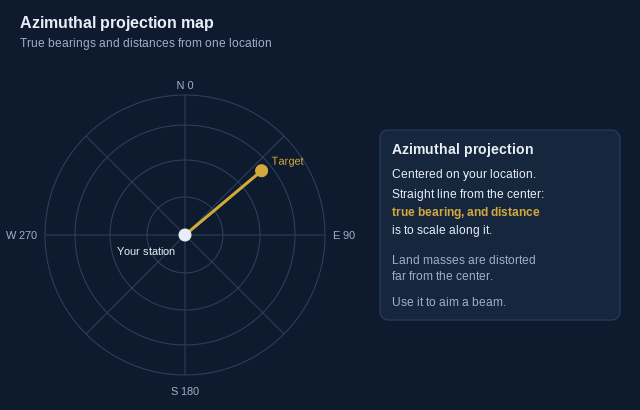
An azimuthal projection map shows true bearings and distances from a specific location.

An azimuthal map centered on a station with distance rings and bearing lines; a straight line from the center gives the true bearing and distance to a target.
Describe this graphic in words

Concentric distance rings and bearing lines radiate from a station at the center. A gold line from the center to a target shows the true bearing and the distance along it. A note explains that an azimuthal projection shows true bearings and distances from a specific location, while land masses are distorted far from the center.

This is a teaching note. An azimuthal map is centered on your location. Every direction from the center is a true bearing, and distances from the center are to scale, so a beam pointed along a line on the map points at the place. Land masses are distorted far from the center.

Why the other choices are wrong

  • A. Azimuthal maps distort land masses far from the center.
  • C. Satellite equator crossing angles are shown on other charts.
  • D. Westward movement per orbit describes satellite orbit spacing, not a map projection.

Rule text checked against the official source on November 13, 2026. This is a study aid; the linked rule is what governs.

G2D05

Which of the following indicates that you are looking for an HF contact with any station?

Show the answer and why

Answer C. Repeat “CQ” a few times, followed by “this is,” then your call sign a few times, then pause to listen, repeat as necessary

To look for an HF contact with any station, repeat "CQ" a few times, say "this is" and your call sign a few times, then listen.

This is a teaching note. A general call is "CQ CQ CQ, this is" followed by your call sign repeated, then a pause to listen. If there is no answer, repeat the call as needed.

Why the other choices are wrong

  • A. Giving your call sign and "listening for a call" is not the standard general call.
  • B. "QTC" means "I have messages for you".
  • D. Sending a carrier for ten seconds is a tuning practice, not a general call.

Rule text checked against the official source on November 13, 2026. This is a study aid; the linked rule is what governs.

G2D06

How is a directional antenna pointed when making a “long-path” contact with another station?

Show the answer and why

Answer C. 180 degrees from the station’s short-path heading

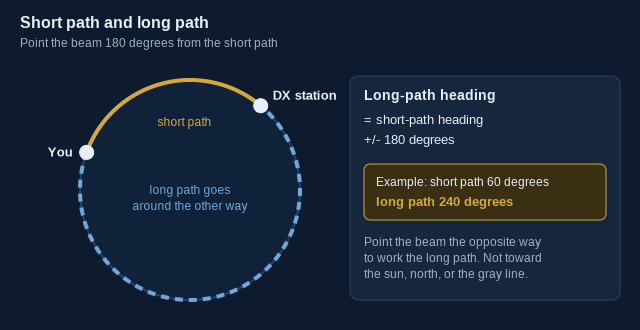
For a long-path contact, point the antenna 180 degrees from the short-path heading.

A globe showing the short path and the long path around the Earth between two stations; the long-path heading is 180 degrees from the short-path heading.
Describe this graphic in words

A circle represents the Earth with two stations marked. A gold arc shows the short path between them. A dashed blue arc shows the long path the other way around. A panel says the long-path heading equals the short-path heading plus or minus 180 degrees, for example 60 degrees short path and 240 degrees long path.

This is a teaching note. The signal can travel either way around the Earth. The short path is the direct route, and the long path is the other way around the globe. The two headings are opposite, so the long-path heading is the short-path heading plus or minus 180 degrees.

Worked example: if a station is at 60 degrees short path, the long-path heading is 240 degrees.

Why the other choices are wrong

  • A. Pointing toward the rising sun is not a rule for long path.
  • B. Gray line propagation relates to the sunrise or sunset line, which is a different thing.
  • D. North is not related to long path.

Rule text checked against the official source on November 13, 2026. This is a study aid; the linked rule is what governs.

G2D07

Which of the following are examples of the NATO Phonetic Alphabet?

Show the answer and why

Answer D. Alpha, Bravo, Charlie, Delta

The NATO phonetic alphabet is Alpha, Bravo, Charlie, Delta.

This is a teaching note. This is the international spelling alphabet used worldwide. The other lists are older or domestic sets: Able, Baker, Charlie, Dog is a World War II alphabet, Adam, Boy, Charles, David is a police-style list, and America, Boston, Canada, Denmark is a list of place names.

Why the other choices are wrong

  • A. Able, Baker, Charlie, Dog is an old military alphabet.
  • B. Adam, Boy, Charles, David is a police-style alphabet.
  • C. America, Boston, Canada, Denmark is a list of place names, not the NATO alphabet.

Rule text checked against the official source on November 13, 2026. This is a study aid; the linked rule is what governs.

G2D08

Why do many amateurs keep a station log?

Show the answer and why

Answer D. To help with a reply if the FCC requests information about your station

Many amateurs keep a log to help with a reply if the FCC asks for information about the station.

Part 97 does not require a general station log for amateur stations. Section 97.103(c) does require the licensee to make the station and its records available for inspection by an FCC representative, so having a log helps you answer questions.

The FCC does not require logs of international contacts or third-party traffic, and a log is not used to renew a license without a retest.

Why the other choices are wrong

  • A. There is no log requirement for international contacts.
  • B. There is no log requirement for international third-party traffic.
  • C. A log does not substitute for an exam when renewing a license.

References

Rule text checked against the official source on November 13, 2026. This is a study aid; the linked rule is what governs.

G2D09

Which of the following is required when participating in a contest on HF frequencies?

Show the answer and why

Answer C. Identify your station according to normal FCC regulations

Identifying your station according to normal FCC regulations is required in a contest.

Section 97.119 applies in a contest just as at any other time: give your call sign at the end of each communication and at least every 10 minutes. Sending a log to the sponsor and exchanging QSL cards are voluntary parts of a contest, not FCC requirements.

Why the other choices are wrong

  • A. Submitting a log is a contest rule, not an FCC rule, and many operators never submit one.
  • B. Sending QSLs is optional.
  • D. "All these choices" fails because A and B are not required.

References

Rule text checked against the official source on November 13, 2026. This is a study aid; the linked rule is what governs.

G2D10

What is QRP operation?

Show the answer and why

Answer B. Low-power transmit operation

QRP is low power transmit operation.

This is a teaching note. QRP is the Q signal for reducing power. In practice, QRP operation means very low power, commonly 5 watts or less on CW and 10 watts PEP on SSB. Contacts at low power depend on good conditions and good antennas.

Why the other choices are wrong

  • A. Remote piloted models are not QRP.
  • C. "Quick Response Protocol" is not a term used in amateur radio.
  • D. Traffic relay net operation is not QRP.

Rule text checked against the official source on November 13, 2026. This is a study aid; the linked rule is what governs.

G2D11

Why are signal reports typically exchanged at the beginning of an HF contact?

Show the answer and why

Answer A. To allow each station to operate according to conditions

Signal reports are exchanged at the start of an HF contact so each station can operate according to conditions.

This is a teaching note. Knowing how well you are heard tells the other operator whether to adjust power, speed or mode, or to try another band. It is the first thing exchanged because everything else depends on it.

Why the other choices are wrong

  • B. Award programs do not need a report at the start.
  • C. Radiograms have their own structure, and signal reports are not part of it.
  • D. A signal report does not calibrate a frequency display.

Rule text checked against the official source on November 13, 2026. This is a study aid; the linked rule is what governs.