
ARSC Tech School

General G5C: Resistors, capacitors, and inductors in series and parallel

423 questions · pool July 1, 2023 to June 30, 2027 · the exam has 35 questions; 26 to pass

G5 · ELECTRICAL PRINCIPLES

Resistors, capacitors, and inductors in series and parallel; transformers

14 questions in group G5C

One question from this group appears on each exam.

G5C01

What causes a voltage to appear across the secondary winding of a transformer when an AC voltage source is connected across its primary winding?

Show the answer and why

Answer C. Mutual inductance

Mutual inductance causes a voltage in the secondary winding of a transformer.
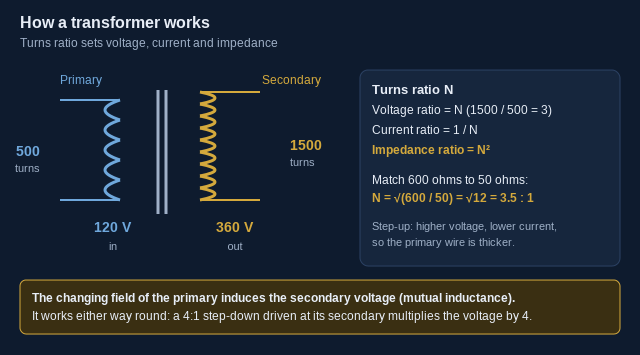
A transformer with 500 primary turns and 1500 secondary turns turning 120 volts into 360 volts, with the voltage, current and impedance ratios.
Describe this graphic in words

A transformer drawn with a 500 turn primary and a 1500 turn secondary, taking 120 volts in and giving 360 volts out. The voltage ratio equals the turns ratio, the current ratio is the inverse, and the impedance ratio is the turns ratio squared. Matching 600 ohms to 50 ohms needs a turns ratio of the square root of 12, about 3.5 to 1. A step-up transformer has more current in the primary, so the primary wire is thicker. The voltage in the secondary comes from mutual inductance, and a transformer works in either direction.

This is a teaching note. The alternating current in the primary makes a changing magnetic field. That field passes through the secondary winding and induces a voltage in it. The linking of the two coils by the magnetic field is called mutual inductance.

Why the other choices are wrong

  • A. Capacitive coupling is not how a transformer works.
  • B. Displacement current coupling is not how a transformer works.
  • D. Mutual capacitance is not how a transformer works.

Rule text checked against the official source on November 17, 2026. This is a study aid; the linked rule is what governs.
G5C02

What is the output voltage if an input signal is applied to the secondary winding of a 4:1 voltage step-down transformer instead of the primary winding?

Show the answer and why

Answer A. The input voltage is multiplied by 4

Applying a signal to the secondary of a 4:1 step-down transformer multiplies the voltage by 4.

A transformer with 500 primary turns and 1500 secondary turns turning 120 volts into 360 volts, with the voltage, current and impedance ratios.
Describe this graphic in words

A transformer drawn with a 500 turn primary and a 1500 turn secondary, taking 120 volts in and giving 360 volts out. The voltage ratio equals the turns ratio, the current ratio is the inverse, and the impedance ratio is the turns ratio squared. Matching 600 ohms to 50 ohms needs a turns ratio of the square root of 12, about 3.5 to 1. A step-up transformer has more current in the primary, so the primary wire is thicker. The voltage in the secondary comes from mutual inductance, and a transformer works in either direction.

This is a teaching note. A transformer works the same way in either direction. A 4:1 step-down transformer divides the voltage by 4 when driven at the primary, so driving the secondary multiplies the voltage by 4.

Why the other choices are wrong

  • B. The voltage is multiplied, not divided.
  • C. No extra resistance is needed in this case.
  • D. No extra resistance is needed in this case.

Rule text checked against the official source on November 17, 2026. This is a study aid; the linked rule is what governs.

G5C03

What is the total resistance of a 10-, a 20-, and a 50-ohm resistor connected in parallel?

Show the answer and why

Answer A. 5.9 ohms

A 10, a 20 and a 50 ohm resistor in parallel make about 5.9 ohms.

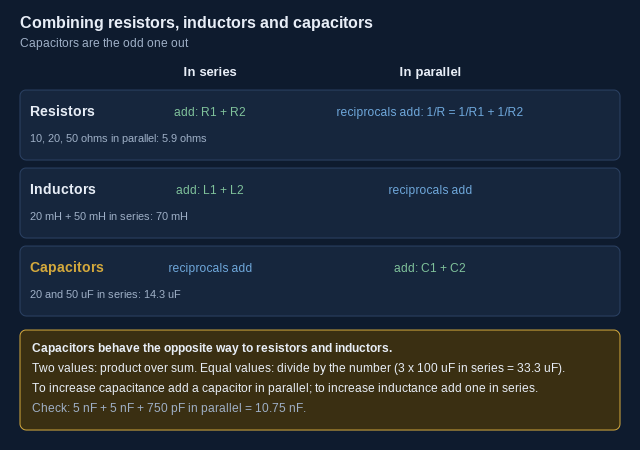
Table of how resistors, inductors and capacitors combine in series and in parallel.
Describe this graphic in words

A table. Resistors add in series and combine by reciprocals in parallel. Inductors do the same as resistors. Capacitors are the opposite: they combine by reciprocals in series and add in parallel. Worked examples include 10, 20 and 50 ohms in parallel giving 5.9 ohms, 20 and 50 millihenries in series giving 70, and 20 and 50 microfarads in series giving 14.3. Notes say to use product over sum for two values, to divide by the number for equal values, and that adding a capacitor in parallel or an inductor in series increases the value.

This is a teaching note. For parallel resistors, 1 / R = 1 / 10 + 1 / 20 + 1 / 50 = 0.1 + 0.05 + 0.02 = 0.17, so R = 1 / 0.17 = 5.88 ohms. The total is always smaller than the smallest resistor.

Why the other choices are wrong

  • B. 0.17 is the sum of the reciprocals, not the resistance.
  • C. 17 ohms is larger than the smallest resistor, which is impossible for a parallel circuit.
  • D. 80 ohms is the sum, which is the series result.

Rule text checked against the official source on November 17, 2026. This is a study aid; the linked rule is what governs.

G5C04

What is the approximate total resistance of a 100- and a 200-ohm resistor in parallel?

Show the answer and why

Answer D. 67 ohms

A 100 and a 200 ohm resistor in parallel make about 67 ohms.

Table of how resistors, inductors and capacitors combine in series and in parallel.
Describe this graphic in words

A table. Resistors add in series and combine by reciprocals in parallel. Inductors do the same as resistors. Capacitors are the opposite: they combine by reciprocals in series and add in parallel. Worked examples include 10, 20 and 50 ohms in parallel giving 5.9 ohms, 20 and 50 millihenries in series giving 70, and 20 and 50 microfarads in series giving 14.3. Notes say to use product over sum for two values, to divide by the number for equal values, and that adding a capacitor in parallel or an inductor in series increases the value.

This is a teaching note. For two resistors, R = (R1 x R2) / (R1 + R2) = 20,000 / 300 = 66.7 ohms.

Why the other choices are wrong

  • A. 300 ohms is the series result.
  • B. 150 ohms is the average of the two.
  • C. 75 ohms is not the result.

Rule text checked against the official source on November 17, 2026. This is a study aid; the linked rule is what governs.

G5C05

Why is the primary winding wire of a voltage step-up transformer usually a larger size than that of the secondary winding?

Show the answer and why

Answer B. To accommodate the higher current of the primary

The primary of a step-up transformer is usually wound with larger wire because it carries the higher current.

A transformer with 500 primary turns and 1500 secondary turns turning 120 volts into 360 volts, with the voltage, current and impedance ratios.
Describe this graphic in words

A transformer drawn with a 500 turn primary and a 1500 turn secondary, taking 120 volts in and giving 360 volts out. The voltage ratio equals the turns ratio, the current ratio is the inverse, and the impedance ratio is the turns ratio squared. Matching 600 ohms to 50 ohms needs a turns ratio of the square root of 12, about 3.5 to 1. A step-up transformer has more current in the primary, so the primary wire is thicker. The voltage in the secondary comes from mutual inductance, and a transformer works in either direction.

This is a teaching note. A step-up transformer raises the voltage and so lowers the current. The power in is about equal to the power out, so the primary side has the lower voltage and the higher current. It needs thicker wire to carry that current without overheating.

Why the other choices are wrong

  • A. The wire size is not chosen to improve coupling.
  • C. It is not chosen to prevent oscillations.
  • D. It is not chosen to match the volume of the windings.

Rule text checked against the official source on November 17, 2026. This is a study aid; the linked rule is what governs.

G5C06

What is the voltage output of a transformer with a 500-turn primary and a 1500-turn secondary when 120 VAC is applied to the primary?

Show the answer and why

Answer A. 360 volts

A 500 turn primary and 1500 turn secondary give 360 volts from 120 volts.

A transformer with 500 primary turns and 1500 secondary turns turning 120 volts into 360 volts, with the voltage, current and impedance ratios.
Describe this graphic in words

A transformer drawn with a 500 turn primary and a 1500 turn secondary, taking 120 volts in and giving 360 volts out. The voltage ratio equals the turns ratio, the current ratio is the inverse, and the impedance ratio is the turns ratio squared. Matching 600 ohms to 50 ohms needs a turns ratio of the square root of 12, about 3.5 to 1. A step-up transformer has more current in the primary, so the primary wire is thicker. The voltage in the secondary comes from mutual inductance, and a transformer works in either direction.

This is a teaching note. The voltage ratio equals the turns ratio. 1500 / 500 = 3, and 120 V x 3 = 360 V.

Why the other choices are wrong

  • B. 120 V would be a 1:1 transformer.
  • C. 40 V would be the primary divided by 3.
  • D. 25.5 V is not the result.

Rule text checked against the official source on November 17, 2026. This is a study aid; the linked rule is what governs.

G5C07

What transformer turns ratio matches an antenna’s 600-ohm feed point impedance to a 50-ohm coaxial cable?

Show the answer and why

Answer A. 3.5 to 1

A transformer with a turns ratio of about 3.5 to 1 matches 600 ohms to 50 ohms.

A transformer with 500 primary turns and 1500 secondary turns turning 120 volts into 360 volts, with the voltage, current and impedance ratios.
Describe this graphic in words

A transformer drawn with a 500 turn primary and a 1500 turn secondary, taking 120 volts in and giving 360 volts out. The voltage ratio equals the turns ratio, the current ratio is the inverse, and the impedance ratio is the turns ratio squared. Matching 600 ohms to 50 ohms needs a turns ratio of the square root of 12, about 3.5 to 1. A step-up transformer has more current in the primary, so the primary wire is thicker. The voltage in the secondary comes from mutual inductance, and a transformer works in either direction.

This is a teaching note. The impedance ratio equals the square of the turns ratio. 600 / 50 = 12, and the square root of 12 is 3.46, about 3.5 to 1.

Why the other choices are wrong

  • B. 12 to 1 is the impedance ratio, not the turns ratio.
  • C. 24 to 1 is not the result.
  • D. 144 to 1 would be the impedance ratio for a 12 to 1 turns ratio.

Rule text checked against the official source on November 17, 2026. This is a study aid; the linked rule is what governs.

G5C08

What is the equivalent capacitance of two 5.0-nanofarad capacitors and one 750-picofarad capacitor connected in parallel?

Show the answer and why

Answer D. 10.750 nanofarads

Two 5.0 nF capacitors and one 750 pF capacitor in parallel make 10.750 nanofarads.

Table of how resistors, inductors and capacitors combine in series and in parallel.
Describe this graphic in words

A table. Resistors add in series and combine by reciprocals in parallel. Inductors do the same as resistors. Capacitors are the opposite: they combine by reciprocals in series and add in parallel. Worked examples include 10, 20 and 50 ohms in parallel giving 5.9 ohms, 20 and 50 millihenries in series giving 70, and 20 and 50 microfarads in series giving 14.3. Notes say to use product over sum for two values, to divide by the number for equal values, and that adding a capacitor in parallel or an inductor in series increases the value.

This is a teaching note. Parallel capacitances add. Convert 750 pF to 0.75 nF, then 5.0 + 5.0 + 0.75 = 10.75 nF.

Why the other choices are wrong

  • A. 576.9 nF is not the result.
  • B. 1,733 pF is the series result with the wrong units.
  • C. 3,583 pF is not the result.

Rule text checked against the official source on November 17, 2026. This is a study aid; the linked rule is what governs.

G5C09

What is the capacitance of three 100-microfarad capacitors connected in series?

Show the answer and why

Answer C. 33.3 microfarads

Three 100 microfarad capacitors in series make 33.3 microfarads.

Table of how resistors, inductors and capacitors combine in series and in parallel.
Describe this graphic in words

A table. Resistors add in series and combine by reciprocals in parallel. Inductors do the same as resistors. Capacitors are the opposite: they combine by reciprocals in series and add in parallel. Worked examples include 10, 20 and 50 ohms in parallel giving 5.9 ohms, 20 and 50 millihenries in series giving 70, and 20 and 50 microfarads in series giving 14.3. Notes say to use product over sum for two values, to divide by the number for equal values, and that adding a capacitor in parallel or an inductor in series increases the value.

This is a teaching note. For equal capacitors in series, divide by the number: 100 / 3 = 33.3 microfarads. Capacitors in series always give less than the smallest one.

Why the other choices are wrong

  • A. 0.33 microfarads is not the result.
  • B. 3.0 microfarads is not the result.
  • D. 300 microfarads is the parallel result.

Rule text checked against the official source on November 17, 2026. This is a study aid; the linked rule is what governs.

G5C10

What is the inductance of three 10-millihenry inductors connected in parallel?

Show the answer and why

Answer C. 3.3 millihenries

Three 10 millihenry inductors in parallel make 3.3 millihenries.

Table of how resistors, inductors and capacitors combine in series and in parallel.
Describe this graphic in words

A table. Resistors add in series and combine by reciprocals in parallel. Inductors do the same as resistors. Capacitors are the opposite: they combine by reciprocals in series and add in parallel. Worked examples include 10, 20 and 50 ohms in parallel giving 5.9 ohms, 20 and 50 millihenries in series giving 70, and 20 and 50 microfarads in series giving 14.3. Notes say to use product over sum for two values, to divide by the number for equal values, and that adding a capacitor in parallel or an inductor in series increases the value.

This is a teaching note. Parallel inductors combine like parallel resistors. For equal inductors divide by the number: 10 / 3 = 3.3 mH.

Why the other choices are wrong

  • A. 0.30 henries is not the result.
  • B. 3.3 henries is a thousand times too large.
  • D. 30 millihenries is the series result.

Rule text checked against the official source on November 17, 2026. This is a study aid; the linked rule is what governs.

G5C11

What is the inductance of a circuit with a 20-millihenry inductor connected in series with a 50-millihenry inductor?

Show the answer and why

Answer C. 70 millihenries

A 20 mH inductor in series with a 50 mH inductor make 70 millihenries.

Table of how resistors, inductors and capacitors combine in series and in parallel.
Describe this graphic in words

A table. Resistors add in series and combine by reciprocals in parallel. Inductors do the same as resistors. Capacitors are the opposite: they combine by reciprocals in series and add in parallel. Worked examples include 10, 20 and 50 ohms in parallel giving 5.9 ohms, 20 and 50 millihenries in series giving 70, and 20 and 50 microfarads in series giving 14.3. Notes say to use product over sum for two values, to divide by the number for equal values, and that adding a capacitor in parallel or an inductor in series increases the value.

This is a teaching note. Series inductors add, like series resistors: 20 + 50 = 70 mH.

Why the other choices are wrong

  • A. 7 millihenries is not the result.
  • B. 14.3 mH is the parallel result.
  • D. 1,000 mH is the product, which is not used.

Rule text checked against the official source on November 17, 2026. This is a study aid; the linked rule is what governs.

G5C12

What is the capacitance of a 20-microfarad capacitor connected in series with a 50-microfarad capacitor?

Show the answer and why

Answer B. 14.3 microfarads

A 20 microfarad capacitor in series with a 50 microfarad capacitor makes 14.3 microfarads.

Table of how resistors, inductors and capacitors combine in series and in parallel.
Describe this graphic in words

A table. Resistors add in series and combine by reciprocals in parallel. Inductors do the same as resistors. Capacitors are the opposite: they combine by reciprocals in series and add in parallel. Worked examples include 10, 20 and 50 ohms in parallel giving 5.9 ohms, 20 and 50 millihenries in series giving 70, and 20 and 50 microfarads in series giving 14.3. Notes say to use product over sum for two values, to divide by the number for equal values, and that adding a capacitor in parallel or an inductor in series increases the value.

This is a teaching note. For two capacitors in series, C = (C1 x C2) / (C1 + C2) = 1000 / 70 = 14.3 microfarads.

Why the other choices are wrong

  • A. 0.07 microfarads is not the result.
  • C. 70 microfarads is the parallel result.
  • D. 1,000 microfarads is the product.

Rule text checked against the official source on November 17, 2026. This is a study aid; the linked rule is what governs.

G5C13

Which of the following components should be added to a capacitor to increase the capacitance?

Show the answer and why

Answer C. A capacitor in parallel

Adding a capacitor in parallel increases capacitance.

Table of how resistors, inductors and capacitors combine in series and in parallel.
Describe this graphic in words

A table. Resistors add in series and combine by reciprocals in parallel. Inductors do the same as resistors. Capacitors are the opposite: they combine by reciprocals in series and add in parallel. Worked examples include 10, 20 and 50 ohms in parallel giving 5.9 ohms, 20 and 50 millihenries in series giving 70, and 20 and 50 microfarads in series giving 14.3. Notes say to use product over sum for two values, to divide by the number for equal values, and that adding a capacitor in parallel or an inductor in series increases the value.

This is a teaching note. Capacitors in parallel add, because the plate areas add. Adding a capacitor in series reduces the total.

Why the other choices are wrong

  • A. An inductor in series does not change the capacitance.
  • B. An inductor in parallel does not change the capacitance.
  • D. A capacitor in series decreases the capacitance.

Rule text checked against the official source on November 17, 2026. This is a study aid; the linked rule is what governs.

G5C14

Which of the following components should be added to an inductor to increase the inductance?

Show the answer and why

Answer D. An inductor in series

Adding an inductor in series increases inductance.

Table of how resistors, inductors and capacitors combine in series and in parallel.
Describe this graphic in words

A table. Resistors add in series and combine by reciprocals in parallel. Inductors do the same as resistors. Capacitors are the opposite: they combine by reciprocals in series and add in parallel. Worked examples include 10, 20 and 50 ohms in parallel giving 5.9 ohms, 20 and 50 millihenries in series giving 70, and 20 and 50 microfarads in series giving 14.3. Notes say to use product over sum for two values, to divide by the number for equal values, and that adding a capacitor in parallel or an inductor in series increases the value.

This is a teaching note. Inductors in series add. Adding one in parallel reduces the total, the opposite of capacitors.

Why the other choices are wrong

  • A. A capacitor in series does not change the inductance.
  • B. A capacitor in parallel does not change the inductance.
  • C. An inductor in parallel decreases the inductance.

Rule text checked against the official source on November 17, 2026. This is a study aid; the linked rule is what governs.