Which mixer input is varied or tuned to convert signals of different frequencies to an intermediate frequency (IF)?
Show the answer and why
Answer B. Local oscillator
The local oscillator input of the mixer is tuned to convert different signals to the intermediate frequency.
Describe this graphic in words
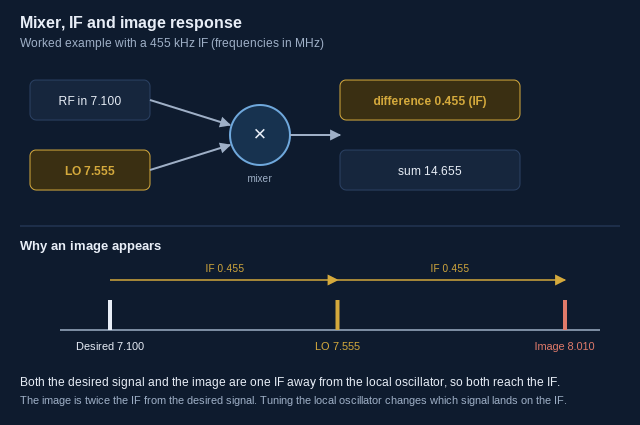
A mixer takes the RF input at 7.100 MHz and the local oscillator at 7.555 MHz and produces the difference, 0.455 MHz, which is the IF, and the sum, 14.655 MHz. Below, a frequency line shows the desired signal at 7.100, the oscillator at 7.555 and the image at 8.010 MHz. Both are 0.455 MHz from the oscillator, so both reach the IF. The image is twice the IF from the desired signal. Mixing is also called heterodyning, and tuning the local oscillator selects which signal lands on the IF.
This is a teaching note. A receiver mixes the incoming signal with the local oscillator to make an output at a fixed IF. When you tune to a different station, the local oscillator changes so that the difference between it and the signal stays equal to the IF.
Worked example: with a 455 kHz IF, to receive 7.100 MHz the oscillator is set to 7.555 MHz.
Why the other choices are wrong
- A. The image frequency is an unwanted response, not an input that is tuned.
- C. The RF input is the signal from the antenna.
- D. The beat frequency oscillator is used for CW and SSB detection, not to convert to the IF.
Rule text checked against the official source on November 17, 2026. This is a study aid; the linked rule is what governs.