
ARSC Tech School

General G2C: CW operating procedures and procedural signals

423 questions · pool July 1, 2023 to June 30, 2027 · the exam has 35 questions; 26 to pass

G2 · OPERATING PROCEDURES

CW operating procedures and procedural signals; Q signals; full break-in

11 questions in group G2C

One question from this group appears on each exam.

G2C01

Which of the following describes full break-in CW operation (QSK)?

Show the answer and why

Answer D. Transmitting stations can receive between code characters and elements

In full break-in (QSK) operation, the transmitting station can hear between code characters and elements.
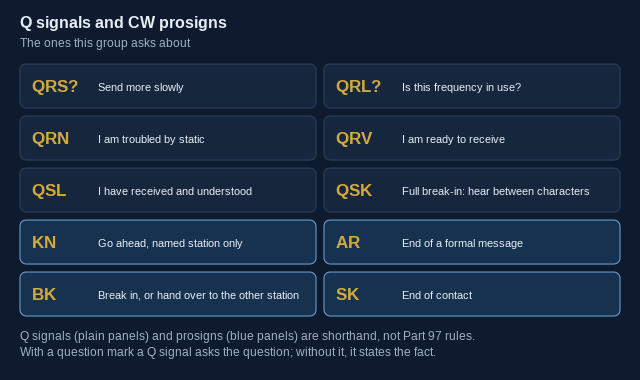
Cheat sheet of Q signals and CW prosigns: QRS, QRL, QRN, QRV, QSL, QSK, KN, AR, BK and SK with their meanings.
Describe this graphic in words

Ten panels. Q signals: QRS means send more slowly; QRL with a question mark asks whether the frequency is in use; QRN means I am troubled by static; QRV means I am ready to receive; QSL means I have received and understood; QSK is full break-in, hearing between characters. Prosigns: KN means go ahead, named station only; AR ends a formal message; BK means break in or hand over to the other station; SK ends the contact.

This is a teaching note. With full break-in the receiver is active during the spaces between dits and dahs, so the other operator can interrupt you at any moment, even in the middle of a word.

The prosign BK is a different thing: it is sent to hand the contact over to the other station. A manual send/receive switch is the opposite of full break-in.

Why the other choices are wrong

  • A. BK is a prosign used to break in or hand over, not the definition of QSK.
  • B. The type of key does not decide break-in. Automatic keyers can be used with or without it.
  • C. Needing to switch by hand is semi break-in or manual operation, not full break-in.

Rule text checked against the official source on November 13, 2026. This is a study aid; the linked rule is what governs.

G2C02

What should you do if a CW station sends “QRS?”

Show the answer and why

Answer A. Send slower

If a CW station sends "QRS?" you should send slower.

Cheat sheet of Q signals and CW prosigns: QRS, QRL, QRN, QRV, QSL, QSK, KN, AR, BK and SK with their meanings.
Describe this graphic in words

Ten panels. Q signals: QRS means send more slowly; QRL with a question mark asks whether the frequency is in use; QRN means I am troubled by static; QRV means I am ready to receive; QSL means I have received and understood; QSK is full break-in, hearing between characters. Prosigns: KN means go ahead, named station only; AR ends a formal message; BK means break in or hand over to the other station; SK ends the contact.

This is a teaching note. "QRS" is the Q signal for "send more slowly". With the question mark, the other station is asking whether you can send slower. Slowing down is the courteous response.

Why the other choices are wrong

  • B. Changing frequency is "QSY".
  • C. Increasing power is "QRO". It is not what QRS asks for.
  • D. "QRS" is not a request to repeat.

Rule text checked against the official source on November 13, 2026. This is a study aid; the linked rule is what governs.

G2C03

What does it mean when a CW operator sends “KN” at the end of a transmission?

Show the answer and why

Answer C. Listening only for a specific station or stations

"KN" means you are listening only for a specific station or stations.

Cheat sheet of Q signals and CW prosigns: QRS, QRL, QRN, QRV, QSL, QSK, KN, AR, BK and SK with their meanings.
Describe this graphic in words

Ten panels. Q signals: QRS means send more slowly; QRL with a question mark asks whether the frequency is in use; QRN means I am troubled by static; QRV means I am ready to receive; QSL means I have received and understood; QSK is full break-in, hearing between characters. Prosigns: KN means go ahead, named station only; AR ends a formal message; BK means break in or hand over to the other station; SK ends the contact.

This is a teaching note. KN is a prosign meaning "go ahead, named station only". Sending it at the end of a transmission tells other stations not to call, because you are waiting for the station you are working.

Why the other choices are wrong

  • A. KN has nothing to do with US stations.
  • B. Full break-in is "QSK".
  • D. Closing the station is "CL".

Rule text checked against the official source on November 13, 2026. This is a study aid; the linked rule is what governs.

G2C04

What does the Q signal “QRL?” mean?

Show the answer and why

Answer D. “Are you busy?” or “Is this frequency in use?”

"QRL?" means "Are you busy?" or "Is this frequency in use?"

Cheat sheet of Q signals and CW prosigns: QRS, QRL, QRN, QRV, QSL, QSK, KN, AR, BK and SK with their meanings.
Describe this graphic in words

Ten panels. Q signals: QRS means send more slowly; QRL with a question mark asks whether the frequency is in use; QRN means I am troubled by static; QRV means I am ready to receive; QSL means I have received and understood; QSK is full break-in, hearing between characters. Prosigns: KN means go ahead, named station only; AR ends a formal message; BK means break in or hand over to the other station; SK ends the contact.

This is a teaching note. A station sends "QRL?" before calling CQ to check that the frequency is free. If someone answers "QRL" or "C", the frequency is in use.

Why the other choices are wrong

  • A. "QRL?" does not ask you to keep the frequency clear.
  • B. Full break-in is "QSK".
  • C. Listening only for a specific station is "KN".

Rule text checked against the official source on November 13, 2026. This is a study aid; the linked rule is what governs.

G2C05

What is the best speed to use when answering a CQ in Morse code?

Show the answer and why

Answer B. The fastest speed at which you are comfortable copying, but no faster than the CQ

Answer a CQ at the fastest speed you can comfortably copy, but no faster than the CQ.

This is a teaching note. An operator calling CQ at a speed usually expects to receive at that speed. Replying at or below the CQ speed lets them copy you, while a faster reply could be missed.

Why the other choices are wrong

  • A. Answering faster than the CQ can leave the caller unable to copy you.
  • C. There is no standard calling speed of 10 wpm.
  • D. There is no standard calling speed of 5 wpm.

Rule text checked against the official source on November 13, 2026. This is a study aid; the linked rule is what governs.

G2C06

What does the term “zero beat” mean in CW operation?

Show the answer and why

Answer D. Matching the transmit frequency to the frequency of a received signal

"Zero beat" means matching your transmit frequency to the frequency of a received signal.

This is a teaching note. When two signals are on exactly the same frequency, the beat note between them falls to zero. Tuning until you hear no beat means you are on the other station's frequency, which is how operators answer a CW call.

Why the other choices are wrong

  • A. Matching speed is not zero beat.
  • B. Operating split is a different practice.
  • C. Sending without errors is not what the term means.

Rule text checked against the official source on November 13, 2026. This is a study aid; the linked rule is what governs.

G2C07

When sending CW, what does a “C” mean when added to the RST report?

Show the answer and why

Answer A. Chirpy or unstable signal

A "C" added to an RST report means the signal is chirpy or unstable.

This is a teaching note. The RST system has a tone digit, and on CW some operators add a letter after the report to describe a flaw: C for chirp, K for key clicks, and X for a crystal-controlled, pure tone. A report of 579C, for example, tells the sender their signal chirps.

Why the other choices are wrong

  • B. It does not mean the report was read from an S meter.
  • C. It does not mean 100 percent copy.
  • D. Key clicks are reported with a "K".

Rule text checked against the official source on November 13, 2026. This is a study aid; the linked rule is what governs.

G2C08

What prosign is sent to indicate the end of a formal message when using CW?

Show the answer and why

Answer C. AR

"AR" is sent to indicate the end of a formal message.

Cheat sheet of Q signals and CW prosigns: QRS, QRL, QRN, QRV, QSL, QSK, KN, AR, BK and SK with their meanings.
Describe this graphic in words

Ten panels. Q signals: QRS means send more slowly; QRL with a question mark asks whether the frequency is in use; QRN means I am troubled by static; QRV means I am ready to receive; QSL means I have received and understood; QSK is full break-in, hearing between characters. Prosigns: KN means go ahead, named station only; AR ends a formal message; BK means break in or hand over to the other station; SK ends the contact.

This is a teaching note. AR is a prosign formed by sending A and R as one character, and it marks the end of a message in formal traffic handling.

Why the other choices are wrong

  • A. "SK" ends a contact.
  • B. "BK" is used to break in or hand over a transmission.
  • D. "KN" means go ahead, named station only.

Rule text checked against the official source on November 13, 2026. This is a study aid; the linked rule is what governs.

G2C09

What does the Q signal “QSL” mean?

Show the answer and why

Answer C. I have received and understood

"QSL" means "I have received and understood."

Cheat sheet of Q signals and CW prosigns: QRS, QRL, QRN, QRV, QSL, QSK, KN, AR, BK and SK with their meanings.
Describe this graphic in words

Ten panels. Q signals: QRS means send more slowly; QRL with a question mark asks whether the frequency is in use; QRN means I am troubled by static; QRV means I am ready to receive; QSL means I have received and understood; QSK is full break-in, hearing between characters. Prosigns: KN means go ahead, named station only; AR ends a formal message; BK means break in or hand over to the other station; SK ends the contact.

This is a teaching note. As a Q signal, QSL asks for or gives acknowledgment of receipt. A QSL card is a card that confirms a contact, which grew from this meaning.

Why the other choices are wrong

  • A. "Send slower" is QRS.
  • B. It means received and understood, not that the contact was confirmed earlier.
  • D. It does not mean that you have worked before.

Rule text checked against the official source on November 13, 2026. This is a study aid; the linked rule is what governs.

G2C10

What does the Q signal “QRN” mean?

Show the answer and why

Answer D. I am troubled by static

"QRN" means "I am troubled by static."

Cheat sheet of Q signals and CW prosigns: QRS, QRL, QRN, QRV, QSL, QSK, KN, AR, BK and SK with their meanings.
Describe this graphic in words

Ten panels. Q signals: QRS means send more slowly; QRL with a question mark asks whether the frequency is in use; QRN means I am troubled by static; QRV means I am ready to receive; QSL means I have received and understood; QSK is full break-in, hearing between characters. Prosigns: KN means go ahead, named station only; AR ends a formal message; BK means break in or hand over to the other station; SK ends the contact.

This is a teaching note. QRN is the Q signal for atmospheric noise or static. It is different from QRM, which is interference from other stations.

Why the other choices are wrong

  • A. "Send more slowly" is QRS.
  • B. "Stop sending" is QRT.
  • C. "Zero beat" is a technique, not what QRN means.

Rule text checked against the official source on November 13, 2026. This is a study aid; the linked rule is what governs.

G2C11

What does the Q signal “QRV” mean?

Show the answer and why

Answer D. I am ready to receive

"QRV" means "I am ready to receive."

Cheat sheet of Q signals and CW prosigns: QRS, QRL, QRN, QRV, QSL, QSK, KN, AR, BK and SK with their meanings.
Describe this graphic in words

Ten panels. Q signals: QRS means send more slowly; QRL with a question mark asks whether the frequency is in use; QRN means I am troubled by static; QRV means I am ready to receive; QSL means I have received and understood; QSK is full break-in, hearing between characters. Prosigns: KN means go ahead, named station only; AR ends a formal message; BK means break in or hand over to the other station; SK ends the contact.

This is a teaching note. QRV is the Q signal for being ready. It often appears in nets and DX operation when a station announces it is ready to take calls.

Why the other choices are wrong

  • A. "You are sending too fast" is not QRV.
  • B. Interference on the frequency is QRM.
  • C. "I am quitting for the day" is not QRV.

Rule text checked against the official source on November 13, 2026. This is a study aid; the linked rule is what governs.