
ARSC Tech School

General G4D: Speech processors

423 questions · pool July 1, 2023 to June 30, 2027 · the exam has 35 questions; 26 to pass

G4 · AMATEUR RADIO PRACTICES

Speech processors; S meters; sideband operation near band edges

11 questions in group G4D

One question from this group appears on each exam.

G4D01

What is the purpose of a speech processor in a transceiver?

Show the answer and why

Answer A. Increase the apparent loudness of transmitted voice signals

A speech processor increases the apparent loudness of transmitted voice signals.

This is a teaching note. Speech has peaks and valleys. A processor compresses the dynamic range, so the average level goes up while the peaks stay at the limit. The signal sounds louder and is easier to copy in noise.

Why the other choices are wrong

  • B. It is not a bass boost.
  • C. Speech processing adds some distortion if it is overused.
  • D. It does not decrease high frequencies to prevent out-of-band operation.

Rule text checked against the official source on November 17, 2026. This is a study aid; the linked rule is what governs.
G4D02

How does a speech processor affect a single sideband phone signal?

Show the answer and why

Answer B. It increases average power

A speech processor increases the average power of an SSB signal.

This is a teaching note. The transmitter has a fixed peak power limit. The processor raises the quieter parts of speech toward that peak, so the average power goes up, but the peak power does not.

Why the other choices are wrong

  • A. Peak power is limited by the transmitter and does not rise.
  • C. Processing adds distortion rather than reducing it.
  • D. Processing can increase intermodulation distortion.

Rule text checked against the official source on November 17, 2026. This is a study aid; the linked rule is what governs.

G4D03

What is the effect of an incorrectly adjusted speech processor?

Show the answer and why

Answer D. All these choices are correct

An incorrectly adjusted speech processor can cause distorted speech, excess intermodulation and excessive background noise.

This is a teaching note. Too much compression flattens the speech, raises the background noise, and overdrives the stages so they make intermodulation products. All three are results of a bad setting.

Why the other choices are wrong

  • A. Distorted speech is one result, but not the only one.
  • B. Intermodulation is one result, but not the only one.
  • C. Background noise is one result, but not the only one.

Rule text checked against the official source on November 17, 2026. This is a study aid; the linked rule is what governs.

G4D04

What does an S meter measure?

Show the answer and why

Answer C. Received signal strength

An S meter measures received signal strength.

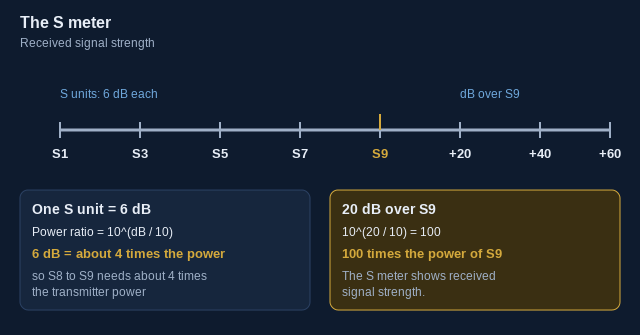
An S meter scale with 6 dB per S unit, 6 dB equal to about 4 times power, and 20 dB over S9 equal to 100 times power.
Describe this graphic in words

An S meter scale from S1 through S9 and then 20, 40 and 60 dB over S9. Each S unit is 6 dB. A panel says 6 dB is about 4 times the power, so going from S8 to S9 takes about 4 times the transmitter power. Another panel says 20 dB over S9 is 100 times the power of an S9 signal.

This is a teaching note. The S meter reads the level of the received signal at the receiver input, using the receiver's AGC voltage. It does not measure impedance, carrier suppression or transmitter power.

Why the other choices are wrong

  • A. Carrier suppression is measured with a spectrum analyzer.
  • B. Impedance is measured with an analyzer or bridge.
  • D. Transmitter power is measured with a wattmeter.

Rule text checked against the official source on November 17, 2026. This is a study aid; the linked rule is what governs.

G4D05

How does a signal that reads 20 dB over S9 compare to one that reads S9 on a receiver, assuming a properly calibrated S meter?

Show the answer and why

Answer D. It is 100 times more powerful

A signal 20 dB over S9 is 100 times more powerful than an S9 signal.

An S meter scale with 6 dB per S unit, 6 dB equal to about 4 times power, and 20 dB over S9 equal to 100 times power.
Describe this graphic in words

An S meter scale from S1 through S9 and then 20, 40 and 60 dB over S9. Each S unit is 6 dB. A panel says 6 dB is about 4 times the power, so going from S8 to S9 takes about 4 times the transmitter power. Another panel says 20 dB over S9 is 100 times the power of an S9 signal.

This is a teaching note. Decibels compare power: the ratio is 10 to the power of (dB / 10). For 20 dB that is 10^2 = 100.

Why the other choices are wrong

  • A. The signal is stronger, not weaker.
  • B. The signal is stronger, not weaker.
  • C. A 20 times ratio would be about 13 dB.

Rule text checked against the official source on November 17, 2026. This is a study aid; the linked rule is what governs.

G4D06

How much change in signal strength is typically represented by one S unit?

Show the answer and why

Answer A. 6 dB

One S unit typically represents a change of 6 dB.

An S meter scale with 6 dB per S unit, 6 dB equal to about 4 times power, and 20 dB over S9 equal to 100 times power.
Describe this graphic in words

An S meter scale from S1 through S9 and then 20, 40 and 60 dB over S9. Each S unit is 6 dB. A panel says 6 dB is about 4 times the power, so going from S8 to S9 takes about 4 times the transmitter power. Another panel says 20 dB over S9 is 100 times the power of an S9 signal.

This is a teaching note. On a calibrated S meter each S unit is 6 dB. From S9 upward the meter shows decibels over S9, such as S9 plus 20.

Why the other choices are wrong

  • B. 12 dB is two S units.
  • C. 15 dB is not a standard S unit step.
  • D. 18 dB is three S units.

Rule text checked against the official source on November 17, 2026. This is a study aid; the linked rule is what governs.

G4D07

How much must the power output of a transmitter be raised to change the S meter reading on a distant receiver from S8 to S9?

Show the answer and why

Answer C. Approximately 4 times

To go from S8 to S9 you need to raise the power by about 4 times.

An S meter scale with 6 dB per S unit, 6 dB equal to about 4 times power, and 20 dB over S9 equal to 100 times power.
Describe this graphic in words

An S meter scale from S1 through S9 and then 20, 40 and 60 dB over S9. Each S unit is 6 dB. A panel says 6 dB is about 4 times the power, so going from S8 to S9 takes about 4 times the transmitter power. Another panel says 20 dB over S9 is 100 times the power of an S9 signal.

This is a teaching note. One S unit is 6 dB. A change of 6 dB is a ratio of 10^(6/10), about 3.98, or about 4 times in power.

Worked example: raising a 25 W signal to 100 W gives 6 dB, one S unit.

Why the other choices are wrong

  • A. 1.5 times is about 1.8 dB.
  • B. 2 times is 3 dB, half an S unit.
  • D. 8 times is about 9 dB, 1.5 S units.

Rule text checked against the official source on November 17, 2026. This is a study aid; the linked rule is what governs.

G4D08

What frequency range is occupied by a 3 kHz LSB signal when the displayed carrier frequency is set to 7.178 MHz?

Show the answer and why

Answer C. 7.175 MHz to 7.178 MHz

With the carrier set to 7.178 MHz, a 3 kHz LSB signal occupies 7.175 to 7.178 MHz.

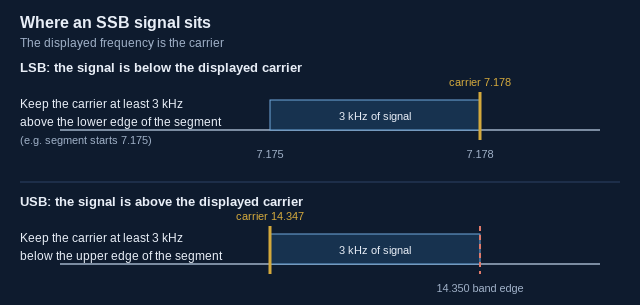
A 3 kHz LSB signal occupies the 3 kHz below the displayed carrier, and a 3 kHz USB signal occupies the 3 kHz above it; stay 3 kHz inside the band edge.
Describe this graphic in words

Two number lines. With the displayed carrier at 7.178 MHz, a 3 kHz lower sideband signal occupies 7.175 to 7.178 MHz, below the carrier, so the carrier must be at least 3 kHz above the lower edge of the segment. With the carrier at 14.347 MHz, a 3 kHz upper sideband signal occupies 14.347 to 14.350 MHz, above the carrier, so the carrier must be at least 3 kHz below the upper edge.

This is a teaching note. In lower sideband the transmitted energy is below the displayed carrier frequency. A signal 3 kHz wide therefore occupies the 3 kHz below it: 7.178 minus 0.003 is 7.175 MHz.

Why the other choices are wrong

  • A. This is the range above the carrier, which is where an upper sideband signal would be.
  • B. This is more than 3 kHz wide and above the carrier.
  • D. This is centered on the carrier, as for a double sideband signal.

Rule text checked against the official source on November 17, 2026. This is a study aid; the linked rule is what governs.

G4D09

What frequency range is occupied by a 3 kHz USB signal with the displayed carrier frequency set to 14.347 MHz?

Show the answer and why

Answer B. 14.347 MHz to 14.350 MHz

With the carrier set to 14.347 MHz, a 3 kHz USB signal occupies 14.347 to 14.350 MHz.

A 3 kHz LSB signal occupies the 3 kHz below the displayed carrier, and a 3 kHz USB signal occupies the 3 kHz above it; stay 3 kHz inside the band edge.
Describe this graphic in words

Two number lines. With the displayed carrier at 7.178 MHz, a 3 kHz lower sideband signal occupies 7.175 to 7.178 MHz, below the carrier, so the carrier must be at least 3 kHz above the lower edge of the segment. With the carrier at 14.347 MHz, a 3 kHz upper sideband signal occupies 14.347 to 14.350 MHz, above the carrier, so the carrier must be at least 3 kHz below the upper edge.

This is a teaching note. In upper sideband the energy is above the displayed carrier frequency. A signal 3 kHz wide occupies 14.347 plus 0.003, which is 14.350 MHz, right at the edge of the 20 m band.

Why the other choices are wrong

  • A. This is 300 kHz wide.
  • C. This is the range below the carrier, as for a lower sideband signal.
  • D. This is centered on the carrier, as for a double sideband signal.

Rule text checked against the official source on November 17, 2026. This is a study aid; the linked rule is what governs.

G4D10

How close to the lower edge of a band’s phone segment should your displayed carrier frequency be when using 3 kHz wide LSB?

Show the answer and why

Answer A. At least 3 kHz above the edge of the segment

With 3 kHz LSB, keep the displayed carrier at least 3 kHz above the lower edge of the phone segment.

A 3 kHz LSB signal occupies the 3 kHz below the displayed carrier, and a 3 kHz USB signal occupies the 3 kHz above it; stay 3 kHz inside the band edge.
Describe this graphic in words

Two number lines. With the displayed carrier at 7.178 MHz, a 3 kHz lower sideband signal occupies 7.175 to 7.178 MHz, below the carrier, so the carrier must be at least 3 kHz above the lower edge of the segment. With the carrier at 14.347 MHz, a 3 kHz upper sideband signal occupies 14.347 to 14.350 MHz, above the carrier, so the carrier must be at least 3 kHz below the upper edge.

This is a teaching note. The energy extends 3 kHz below the carrier in LSB. To keep all of it inside the segment, the carrier needs to be at least 3 kHz above the lower edge.

Why the other choices are wrong

  • B. Below the edge you would be out of the segment.
  • C. 1 kHz below the edge is outside the segment.
  • D. 1 kHz above leaves 2 kHz of the signal outside.

Rule text checked against the official source on November 17, 2026. This is a study aid; the linked rule is what governs.

G4D11

How close to the upper edge of a band’s phone segment should your displayed carrier frequency be when using 3 kHz wide USB?

Show the answer and why

Answer B. At least 3 kHz below the edge of the band

With 3 kHz USB, keep the displayed carrier at least 3 kHz below the upper edge of the phone segment.

A 3 kHz LSB signal occupies the 3 kHz below the displayed carrier, and a 3 kHz USB signal occupies the 3 kHz above it; stay 3 kHz inside the band edge.
Describe this graphic in words

Two number lines. With the displayed carrier at 7.178 MHz, a 3 kHz lower sideband signal occupies 7.175 to 7.178 MHz, below the carrier, so the carrier must be at least 3 kHz above the lower edge of the segment. With the carrier at 14.347 MHz, a 3 kHz upper sideband signal occupies 14.347 to 14.350 MHz, above the carrier, so the carrier must be at least 3 kHz below the upper edge.

This is a teaching note. The energy extends 3 kHz above the carrier in USB. To keep it all inside the segment, the carrier must be at least 3 kHz below the upper edge.

Why the other choices are wrong

  • A. Above the edge you would be out of the band.
  • C. 1 kHz above the edge is outside the segment.
  • D. 1 kHz below leaves 2 kHz of the signal outside.

Rule text checked against the official source on November 17, 2026. This is a study aid; the linked rule is what governs.