
ARSC Tech School

General G9C: Directional antennas

423 questions · pool July 1, 2023 to June 30, 2027 · the exam has 35 questions; 26 to pass

G9 · ANTENNAS AND FEED LINES

Directional antennas

11 questions in group G9C

One question from this group appears on each exam.

G9C01

Which of the following would increase the bandwidth of a Yagi antenna?

Show the answer and why

Answer A. Larger-diameter elements

Larger-diameter elements increase the bandwidth of a Yagi antenna.
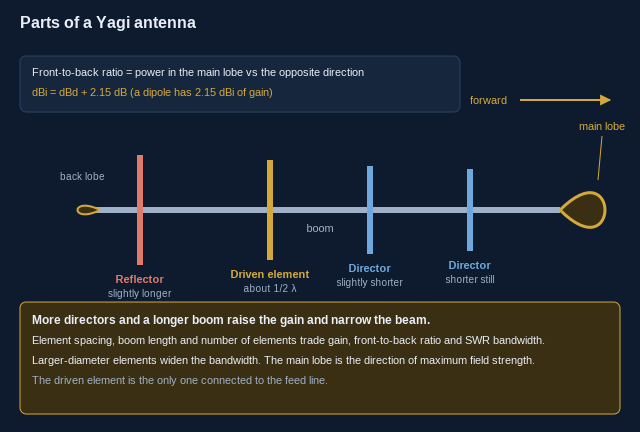
A three-or-four element Yagi with a longer reflector, a half-wave driven element and shorter directors, with the main lobe forward.
Describe this graphic in words

A Yagi on a boom. The reflector at the back is slightly longer than the driven element, the driven element is about half a wavelength, and the directors in front are progressively shorter. A large forward main lobe and a small back lobe are drawn. Notes explain front-to-back ratio, that dBi equals dBd plus 2.15, that more directors and a longer boom increase gain, that spacing, boom length and element count trade gain, front-to-back ratio and bandwidth, and that larger-diameter elements widen the bandwidth.

This is a teaching note. A thicker element has lower Q, so its impedance and pattern change less as the frequency changes. The antenna stays usable over a wider range of frequencies.

Why the other choices are wrong

  • B. Closer spacing generally makes the bandwidth narrower.
  • C. Loading coils in series with the elements reduce the bandwidth.
  • D. Tapered elements are used for strength and do not widen the bandwidth in this sense.

Rule text checked against the official source on November 17, 2026. This is a study aid; the linked rule is what governs.
G9C02

What is the approximate length of the driven element of a Yagi antenna?

Show the answer and why

Answer B. 1/2 wavelength

The driven element of a Yagi is approximately 1/2 wavelength long.

A three-or-four element Yagi with a longer reflector, a half-wave driven element and shorter directors, with the main lobe forward.
Describe this graphic in words

A Yagi on a boom. The reflector at the back is slightly longer than the driven element, the driven element is about half a wavelength, and the directors in front are progressively shorter. A large forward main lobe and a small back lobe are drawn. Notes explain front-to-back ratio, that dBi equals dBd plus 2.15, that more directors and a longer boom increase gain, that spacing, boom length and element count trade gain, front-to-back ratio and bandwidth, and that larger-diameter elements widen the bandwidth.

This is a teaching note. The driven element is a dipole, which is a half wavelength at the design frequency, a bit shorter in practice. The reflector and directors are parasitic elements near it.

Why the other choices are wrong

  • A. A quarter wavelength is the length of a monopole.
  • C. 3/4 wavelength is not the driven element length.
  • D. A full wavelength is not the driven element length.

Rule text checked against the official source on November 17, 2026. This is a study aid; the linked rule is what governs.

G9C03

How do the lengths of a three-element Yagi reflector and director compare to that of the driven element?

Show the answer and why

Answer A. The reflector is longer, and the director is shorter

In a three-element Yagi the reflector is longer and the director is shorter than the driven element.

A three-or-four element Yagi with a longer reflector, a half-wave driven element and shorter directors, with the main lobe forward.
Describe this graphic in words

A Yagi on a boom. The reflector at the back is slightly longer than the driven element, the driven element is about half a wavelength, and the directors in front are progressively shorter. A large forward main lobe and a small back lobe are drawn. Notes explain front-to-back ratio, that dBi equals dBd plus 2.15, that more directors and a longer boom increase gain, that spacing, boom length and element count trade gain, front-to-back ratio and bandwidth, and that larger-diameter elements widen the bandwidth.

This is a teaching note. The reflector is slightly longer than the driven element and the director is slightly shorter. That makes the currents in them have the phase that sends the signal toward the director side.

Why the other choices are wrong

  • B. It is the reverse: the reflector is longer.
  • C. The lengths are not all the same.
  • D. The relationship does not depend on frequency.

Rule text checked against the official source on November 17, 2026. This is a study aid; the linked rule is what governs.

G9C04

How does antenna gain in dBi compare to gain stated in dBd for the same antenna?

Show the answer and why

Answer B. Gain in dBi is 2.15 dB higher

Gain in dBi is 2.15 dB higher than gain in dBd for the same antenna.

A three-or-four element Yagi with a longer reflector, a half-wave driven element and shorter directors, with the main lobe forward.
Describe this graphic in words

A Yagi on a boom. The reflector at the back is slightly longer than the driven element, the driven element is about half a wavelength, and the directors in front are progressively shorter. A large forward main lobe and a small back lobe are drawn. Notes explain front-to-back ratio, that dBi equals dBd plus 2.15, that more directors and a longer boom increase gain, that spacing, boom length and element count trade gain, front-to-back ratio and bandwidth, and that larger-diameter elements widen the bandwidth.

This is a teaching note. dBi compares to an isotropic radiator, and dBd compares to a half-wave dipole. A dipole has 2.15 dB of gain over an isotropic radiator, so dBi = dBd + 2.15.

Worked example: a Yagi with 7 dBd has 9.15 dBi.

Why the other choices are wrong

  • A. dBi is higher, not lower, by 2.15 dB.
  • C. The difference is 2.15, not 1.25.
  • D. The difference is 2.15, not 1.25.

Rule text checked against the official source on November 17, 2026. This is a study aid; the linked rule is what governs.

G9C05

What is the primary effect of increasing boom length and adding directors to a Yagi antenna?

Show the answer and why

Answer A. Gain increases

Increasing boom length and adding directors to a Yagi increases its gain.

A three-or-four element Yagi with a longer reflector, a half-wave driven element and shorter directors, with the main lobe forward.
Describe this graphic in words

A Yagi on a boom. The reflector at the back is slightly longer than the driven element, the driven element is about half a wavelength, and the directors in front are progressively shorter. A large forward main lobe and a small back lobe are drawn. Notes explain front-to-back ratio, that dBi equals dBd plus 2.15, that more directors and a longer boom increase gain, that spacing, boom length and element count trade gain, front-to-back ratio and bandwidth, and that larger-diameter elements widen the bandwidth.

This is a teaching note. More directors focus the energy further, and a longer boom gives the room for them. The beamwidth narrows. The usable bandwidth tends to get smaller.

Why the other choices are wrong

  • B. Beamwidth decreases as gain increases.
  • C. The front-to-back ratio generally does not decrease.
  • D. The resonant frequency is set by element lengths, not boom length.

Rule text checked against the official source on November 17, 2026. This is a study aid; the linked rule is what governs.

G9C07

What does “front-to-back ratio” mean in reference to a Yagi antenna?

Show the answer and why

Answer C. The power radiated in the major lobe compared to that in the opposite direction

Front-to-back ratio is the power radiated in the major lobe compared to the power in the opposite direction.

A three-or-four element Yagi with a longer reflector, a half-wave driven element and shorter directors, with the main lobe forward.
Describe this graphic in words

A Yagi on a boom. The reflector at the back is slightly longer than the driven element, the driven element is about half a wavelength, and the directors in front are progressively shorter. A large forward main lobe and a small back lobe are drawn. Notes explain front-to-back ratio, that dBi equals dBd plus 2.15, that more directors and a longer boom increase gain, that spacing, boom length and element count trade gain, front-to-back ratio and bandwidth, and that larger-diameter elements widen the bandwidth.

This is a teaching note. It is a measure of how well the antenna rejects signals from behind. A high front-to-back ratio helps with interference from the rear.

Why the other choices are wrong

  • A. It is not a count of directors versus reflectors.
  • B. It is not about the position of the driven element.
  • D. The ratio of forward gain to a dipole is gain in dBd.

Rule text checked against the official source on November 17, 2026. This is a study aid; the linked rule is what governs.

G9C08

What is meant by the “main lobe” of a directive antenna?

Show the answer and why

Answer D. The direction of maximum radiated field strength from the antenna

The main lobe of a directive antenna is the direction of maximum radiated field strength.

A three-or-four element Yagi with a longer reflector, a half-wave driven element and shorter directors, with the main lobe forward.
Describe this graphic in words

A Yagi on a boom. The reflector at the back is slightly longer than the driven element, the driven element is about half a wavelength, and the directors in front are progressively shorter. A large forward main lobe and a small back lobe are drawn. Notes explain front-to-back ratio, that dBi equals dBd plus 2.15, that more directors and a longer boom increase gain, that spacing, boom length and element count trade gain, front-to-back ratio and bandwidth, and that larger-diameter elements widen the bandwidth.

This is a teaching note. A directive antenna has a pattern with several lobes. The main lobe is the biggest one, where the antenna sends the most.

Why the other choices are wrong

  • A. It is not about a vertical angle of radiation.
  • B. It is not the point of maximum current.
  • C. It is not the maximum voltage point on an element.

Rule text checked against the official source on November 17, 2026. This is a study aid; the linked rule is what governs.

G9C09

In free space, how does the gain of two three-element, horizontally polarized Yagi antennas spaced vertically 1/2 wavelength apart typically compare to the gain of a single three-element Yagi?

Show the answer and why

Answer B. Approximately 3 dB higher

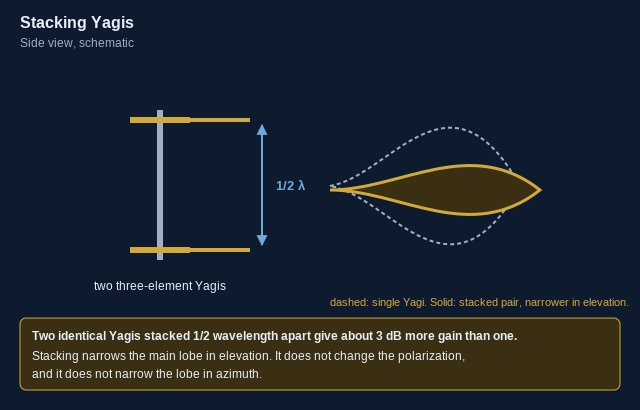
Two three-element Yagis stacked 1/2 wavelength apart have about 3 dB more gain than one.

Two Yagis stacked half a wavelength apart give about 3 dB more gain and a narrower main lobe in elevation.
Describe this graphic in words

Two three-element Yagis on one mast, spaced half a wavelength apart. Beside them, the side-view pattern of a single Yagi is drawn dashed, and the stacked pair has a flatter, narrower lobe in elevation. A note says two identical Yagis stacked half a wavelength apart give about 3 dB more gain, that stacking narrows the main lobe in elevation, and that it does not change polarization or narrow the lobe in azimuth.

This is a teaching note. Doubling the antenna area doubles the power in the beam, which is 3 dB. Stacking narrows the pattern in elevation.

Why the other choices are wrong

  • A. 1.5 dB is lower than the usual gain from stacking.
  • C. 6 dB is more than stacking two antennas typically gives.
  • D. 9 dB is much more than stacking two antennas gives.

Rule text checked against the official source on November 17, 2026. This is a study aid; the linked rule is what governs.

G9C10

Which of the following can be adjusted to optimize forward gain, front-to-back ratio, or SWR bandwidth of a Yagi antenna?

Show the answer and why

Answer D. All these choices are correct

Boom length, the number of elements and the element spacing can all be adjusted to optimize forward gain, front-to-back ratio or SWR bandwidth.

A three-or-four element Yagi with a longer reflector, a half-wave driven element and shorter directors, with the main lobe forward.
Describe this graphic in words

A Yagi on a boom. The reflector at the back is slightly longer than the driven element, the driven element is about half a wavelength, and the directors in front are progressively shorter. A large forward main lobe and a small back lobe are drawn. Notes explain front-to-back ratio, that dBi equals dBd plus 2.15, that more directors and a longer boom increase gain, that spacing, boom length and element count trade gain, front-to-back ratio and bandwidth, and that larger-diameter elements widen the bandwidth.

This is a teaching note. Yagi design is a compromise. Longer booms and more elements raise the gain. The spacing between elements sets the front-to-back ratio and the bandwidth.

Why the other choices are wrong

  • A. Boom length is one factor, but not the only one.
  • B. The number of elements is one factor, but not the only one.
  • C. The element spacing is one factor, but not the only one.

Rule text checked against the official source on November 17, 2026. This is a study aid; the linked rule is what governs.

G9C11

What is a beta or hairpin match?

Show the answer and why

Answer A. A shorted transmission line stub placed at the feed point of a Yagi antenna to provide impedance matching

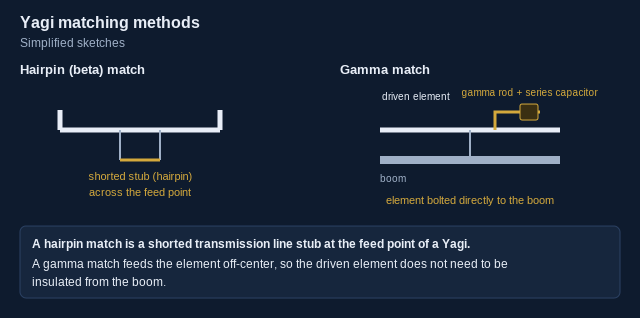
A beta or hairpin match is a shorted transmission line stub placed at the feed point of a Yagi to provide impedance matching.

A hairpin match is a shorted stub across the feed point; a gamma match uses a rod and series capacitor and lets the driven element be bolted to the boom.
Describe this graphic in words

Two sketches. Left, a hairpin or beta match: a shorted stub of wire across the feed point of the driven element. Right, a gamma match: a rod and series capacitor feed the driven element off-center, and the element is bolted directly to the boom. A note says the gamma match does not require the driven element to be insulated from the boom.

This is a teaching note. A driven element that is slightly short is capacitive at its feed point. A hairpin of wire across the feed point, a shorted stub, adds inductance that cancels it and steps up the impedance to match the line.

Why the other choices are wrong

  • B. A quarter wave of 75-ohm coax in series is a different matching method.
  • C. A series capacitor is not a hairpin match.
  • D. A section of 300-ohm twin-lead is not a hairpin match.

Rule text checked against the official source on November 17, 2026. This is a study aid; the linked rule is what governs.

G9C12

Which of the following is a characteristic of using a gamma match with a Yagi antenna?

Show the answer and why

Answer A. It does not require the driven element to be insulated from the boom

A gamma match does not require the driven element to be insulated from the boom.

A hairpin match is a shorted stub across the feed point; a gamma match uses a rod and series capacitor and lets the driven element be bolted to the boom.
Describe this graphic in words

Two sketches. Left, a hairpin or beta match: a shorted stub of wire across the feed point of the driven element. Right, a gamma match: a rod and series capacitor feed the driven element off-center, and the element is bolted directly to the boom. A note says the gamma match does not require the driven element to be insulated from the boom.

This is a teaching note. The gamma match feeds the element off-center through a rod and a series capacitor. Because the center of the dipole is at zero RF voltage, the element can be bolted directly to the boom.

Why the other choices are wrong

  • B. A gamma match does use a capacitor, and the rod acts as an inductor.
  • C. A gamma match is not especially useful for multiband antennas.
  • D. "All these choices" fails because B and C are wrong.

Rule text checked against the official source on November 17, 2026. This is a study aid; the linked rule is what governs.