
ARSC Tech School

General G7C: Transceiver design

423 questions · pool July 1, 2023 to June 30, 2027 · the exam has 35 questions; 26 to pass

G7 · PRACTICAL CIRCUITS

Transceiver design; filters; oscillators; digital signal processing (DSP)

14 questions in group G7C

One question from this group appears on each exam.

G7C01

What circuit is used to select one of the sidebands from a balanced modulator?

Show the answer and why

Answer B. Filter

A filter selects one of the sidebands from a balanced modulator.
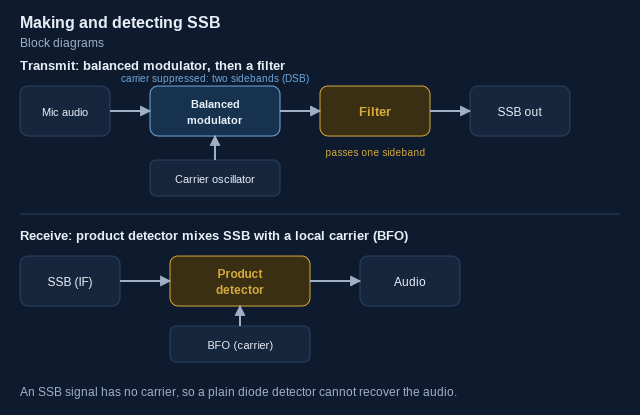
A balanced modulator makes double-sideband RF with no carrier, a filter selects one sideband, and a product detector with a local carrier recovers the audio from SSB.
Describe this graphic in words

Top: microphone audio and a carrier oscillator feed a balanced modulator, which produces double-sideband RF with the carrier suppressed. A filter then passes one sideband, giving SSB. Bottom: in a receiver the SSB signal and a locally generated carrier, the BFO, are mixed in a product detector, which recovers the audio. A note says an SSB signal has no carrier so a plain diode detector cannot recover the audio.

This is a teaching note. A balanced modulator suppresses the carrier and leaves two sidebands. To make single sideband, a sharp filter passes one of them and rejects the other.

Why the other choices are wrong

  • A. The carrier oscillator supplies the carrier. It does not select a sideband.
  • C. An IF amplifier amplifies. It does not select a sideband.
  • D. An RF amplifier amplifies. It does not select a sideband.

Rule text checked against the official source on November 17, 2026. This is a study aid; the linked rule is what governs.
G7C02

What output is produced by a balanced modulator?

Show the answer and why

Answer D. Double-sideband modulated RF

A balanced modulator produces double-sideband modulated RF.

A balanced modulator makes double-sideband RF with no carrier, a filter selects one sideband, and a product detector with a local carrier recovers the audio from SSB.
Describe this graphic in words

Top: microphone audio and a carrier oscillator feed a balanced modulator, which produces double-sideband RF with the carrier suppressed. A filter then passes one sideband, giving SSB. Bottom: in a receiver the SSB signal and a locally generated carrier, the BFO, are mixed in a product detector, which recovers the audio. A note says an SSB signal has no carrier so a plain diode detector cannot recover the audio.

This is a teaching note. It mixes the audio with the carrier and cancels the carrier, so the output is the two sidebands and no carrier. It does not give FM, and it does not extract audio.

Why the other choices are wrong

  • A. It does not produce frequency modulated RF.
  • B. It does not equalize audio response.
  • C. It does not extract audio. A detector does.

Rule text checked against the official source on November 17, 2026. This is a study aid; the linked rule is what governs.

G7C03

What is one reason to use an impedance matching transformer at a transmitter output?

Show the answer and why

Answer B. To present the desired impedance to the transmitter and feed line

An impedance matching transformer at a transmitter output presents the desired impedance to the transmitter and feed line.

This is a teaching note. A transmitter wants a particular load, usually 50 ohms. The transformer changes the impedance seen at one side into the impedance needed at the other, so the transmitter delivers its power and the line is properly matched.

Why the other choices are wrong

  • A. The purpose is not to minimize power output.
  • C. Reducing ripple is a power supply filter task.
  • D. It does not minimize radiation resistance.

Rule text checked against the official source on November 17, 2026. This is a study aid; the linked rule is what governs.

G7C04

How is a product detector used?

Show the answer and why

Answer D. Used in a single sideband receiver to extract the modulated signal

A product detector is used in a single sideband receiver to extract the modulated signal.

A balanced modulator makes double-sideband RF with no carrier, a filter selects one sideband, and a product detector with a local carrier recovers the audio from SSB.
Describe this graphic in words

Top: microphone audio and a carrier oscillator feed a balanced modulator, which produces double-sideband RF with the carrier suppressed. A filter then passes one sideband, giving SSB. Bottom: in a receiver the SSB signal and a locally generated carrier, the BFO, are mixed in a product detector, which recovers the audio. A note says an SSB signal has no carrier so a plain diode detector cannot recover the audio.

This is a teaching note. An SSB signal has no carrier. The product detector mixes it with a locally generated carrier (the BFO), and the output is the audio. A simple diode detector cannot do that.

Why the other choices are wrong

  • A. It does not detect spurious mixing products in test gear.
  • B. It does not multiply frequency.
  • C. It is not used in an FM receiver to filter sidebands.

Rule text checked against the official source on November 17, 2026. This is a study aid; the linked rule is what governs.

G7C05

Which of the following is characteristic of a direct digital synthesizer (DDS)?

Show the answer and why

Answer D. Variable output frequency with the stability of a crystal oscillator

A direct digital synthesizer gives a variable output frequency with the stability of a crystal oscillator.

This is a teaching note. A DDS builds a sine wave from numbers, using a clock that comes from a crystal. The output frequency can be changed in tiny steps, and it is as stable as the clock.

Why the other choices are wrong

  • A. A DDS has a wide tuning range, not a narrow one.
  • B. The output power of a DDS is low.
  • C. The output is a sampled sine wave that has spurs and must be filtered.

Rule text checked against the official source on November 17, 2026. This is a study aid; the linked rule is what governs.

G7C06

Which of the following is an advantage of a digital signal processing (DSP) filter compared to an analog filter?

Show the answer and why

Answer A. A wide range of filter bandwidths and shapes can be created

A DSP filter can be made in a wide range of bandwidths and shapes.

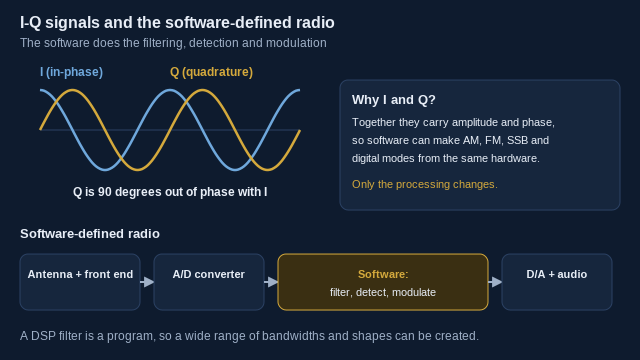
I and Q signals are 90 degrees apart; in a software-defined radio, filtering, detection and modulation are done by software after the A/D converter.
Describe this graphic in words

Top: two waves of the same frequency, the I signal and the Q signal, 90 degrees out of phase. Together they carry amplitude and phase, so software can create AM, FM, SSB and digital modes from the same hardware. Bottom: a software-defined radio chain from the antenna and front end, to an A/D converter, to software that filters, detects and modulates, to a D/A converter and audio. A DSP filter is a program, so a wide range of bandwidths and shapes can be created.

This is a teaching note. In DSP the filter is a program, so you can choose any bandwidth and shape by changing numbers. An analog filter has fixed components.

Why the other choices are wrong

  • B. A DSP filter does not necessarily need fewer components.
  • C. Reducing mixing products is not an advantage specific to DSP filters.
  • D. A DSP filter does not work better at VHF.

Rule text checked against the official source on November 17, 2026. This is a study aid; the linked rule is what governs.

G7C07

What term specifies a filter’s attenuation inside its passband?

Show the answer and why

Answer A. Insertion loss

Insertion loss specifies a filter's attenuation inside its passband.

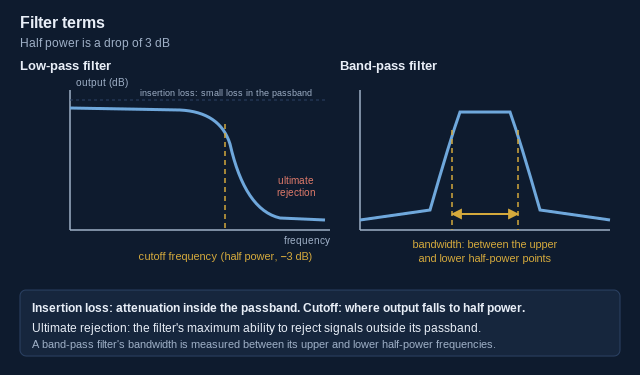
Response curves for a low-pass and a band-pass filter, labeled with insertion loss, the half-power cutoff, ultimate rejection and half-power bandwidth.
Describe this graphic in words

On the left, a low-pass filter response: a small insertion loss in the passband, the cutoff frequency where the output has fallen to half power, 3 dB down, and a floor of attenuation far from the passband called the ultimate rejection. On the right, a band-pass response with its bandwidth measured between the upper and lower half-power frequencies. A summary says insertion loss is attenuation inside the passband, cutoff is where output falls to half power, and ultimate rejection is the maximum ability to reject signals outside the passband.

This is a teaching note. A good filter passes the wanted signals with little loss, and the loss that remains inside the passband is called insertion loss. It is stated in decibels.

Why the other choices are wrong

  • B. Return loss describes how much power is reflected.
  • C. Q describes the sharpness of a resonant circuit.
  • D. Ultimate rejection describes the attenuation outside the passband.

Rule text checked against the official source on November 17, 2026. This is a study aid; the linked rule is what governs.

G7C08

Which parameter affects receiver sensitivity?

Show the answer and why

Answer D. All these choices are correct

Input amplifier gain, demodulator bandwidth and input amplifier noise figure all affect receiver sensitivity.

This is a teaching note. Sensitivity is the weakest signal the receiver can detect. A higher gain in the input stage helps. A low noise figure keeps the receiver's own noise down. A narrower bandwidth lets in less noise, so the detector bandwidth also matters.

Why the other choices are wrong

  • A. Gain affects sensitivity, but so do the others.
  • B. Bandwidth affects sensitivity, but so do the others.
  • C. Noise figure affects sensitivity, but so do the others.

Rule text checked against the official source on November 17, 2026. This is a study aid; the linked rule is what governs.

G7C09

What is the phase difference between the I and Q RF signals that software-defined radio (SDR) equipment uses for modulation and demodulation?

Show the answer and why

Answer B. 90 degrees

The I and Q signals in an SDR are 90 degrees apart in phase.

I and Q signals are 90 degrees apart; in a software-defined radio, filtering, detection and modulation are done by software after the A/D converter.
Describe this graphic in words

Top: two waves of the same frequency, the I signal and the Q signal, 90 degrees out of phase. Together they carry amplitude and phase, so software can create AM, FM, SSB and digital modes from the same hardware. Bottom: a software-defined radio chain from the antenna and front end, to an A/D converter, to software that filters, detects and modulates, to a D/A converter and audio. A DSP filter is a program, so a wide range of bandwidths and shapes can be created.

This is a teaching note. I stands for in-phase and Q for quadrature. They are two versions of the same frequency, 90 degrees apart, like a sine and a cosine. Together they carry both the amplitude and the phase of the signal.

Why the other choices are wrong

  • A. Zero phase difference would make them identical.
  • C. 180 degrees would make them opposites.
  • D. 45 degrees is not the I-Q relationship.

Rule text checked against the official source on November 17, 2026. This is a study aid; the linked rule is what governs.

G7C10

What is an advantage of using I-Q modulation with software-defined radios (SDRs)?

Show the answer and why

Answer B. All types of modulation can be created with appropriate processing

With I-Q modulation, all types of modulation can be created with appropriate processing.

I and Q signals are 90 degrees apart; in a software-defined radio, filtering, detection and modulation are done by software after the A/D converter.
Describe this graphic in words

Top: two waves of the same frequency, the I signal and the Q signal, 90 degrees out of phase. Together they carry amplitude and phase, so software can create AM, FM, SSB and digital modes from the same hardware. Bottom: a software-defined radio chain from the antenna and front end, to an A/D converter, to software that filters, detects and modulates, to a D/A converter and audio. A DSP filter is a program, so a wide range of bandwidths and shapes can be created.

This is a teaching note. Because I and Q give control of both amplitude and phase, software can make AM, FM, SSB, digital modes and others from the same hardware, only by changing the processing.

Why the other choices are wrong

  • A. I-Q does not remove the need for good analog-to-digital converters.
  • C. It does not by itself reduce the minimum detectable signal.
  • D. Digital to analog conversion is not automatic.

Rule text checked against the official source on November 17, 2026. This is a study aid; the linked rule is what governs.

G7C11

Which of these functions is performed by software in a software-defined radio (SDR)?

Show the answer and why

Answer D. All these choices are correct

Filtering, detection and modulation can all be performed by software in an SDR.

I and Q signals are 90 degrees apart; in a software-defined radio, filtering, detection and modulation are done by software after the A/D converter.
Describe this graphic in words

Top: two waves of the same frequency, the I signal and the Q signal, 90 degrees out of phase. Together they carry amplitude and phase, so software can create AM, FM, SSB and digital modes from the same hardware. Bottom: a software-defined radio chain from the antenna and front end, to an A/D converter, to software that filters, detects and modulates, to a D/A converter and audio. A DSP filter is a program, so a wide range of bandwidths and shapes can be created.

This is a teaching note. In a software-defined radio, the signal is digitized early, and the digital processor does the work that used to need dedicated circuits.

Why the other choices are wrong

  • A. Filtering is one function but not the only one.
  • B. Detection is one function but not the only one.
  • C. Modulation is one function but not the only one.

Rule text checked against the official source on November 17, 2026. This is a study aid; the linked rule is what governs.

G7C12

What is the frequency above which a low-pass filter’s output power is less than half the input power?

Show the answer and why

Answer C. Cutoff frequency

The cutoff frequency is where a low-pass filter's output power falls to half the input power.

Response curves for a low-pass and a band-pass filter, labeled with insertion loss, the half-power cutoff, ultimate rejection and half-power bandwidth.
Describe this graphic in words

On the left, a low-pass filter response: a small insertion loss in the passband, the cutoff frequency where the output has fallen to half power, 3 dB down, and a floor of attenuation far from the passband called the ultimate rejection. On the right, a band-pass response with its bandwidth measured between the upper and lower half-power frequencies. A summary says insertion loss is attenuation inside the passband, cutoff is where output falls to half power, and ultimate rejection is the maximum ability to reject signals outside the passband.

This is a teaching note. Half power is a drop of 3 dB. Below the cutoff frequency a low-pass filter passes signals. Above it, the output is less than half the input and falls off further.

Why the other choices are wrong

  • A. A notch frequency is where a notch filter rejects signals.
  • B. The neper is a unit of ratio, not a filter frequency.
  • D. Rolloff describes how fast attenuation rises above cutoff.

Rule text checked against the official source on November 17, 2026. This is a study aid; the linked rule is what governs.

G7C13

What term specifies a filter’s maximum ability to reject signals outside its passband?

Show the answer and why

Answer D. Ultimate rejection

Ultimate rejection is a filter's maximum ability to reject signals outside its passband.

Response curves for a low-pass and a band-pass filter, labeled with insertion loss, the half-power cutoff, ultimate rejection and half-power bandwidth.
Describe this graphic in words

On the left, a low-pass filter response: a small insertion loss in the passband, the cutoff frequency where the output has fallen to half power, 3 dB down, and a floor of attenuation far from the passband called the ultimate rejection. On the right, a band-pass response with its bandwidth measured between the upper and lower half-power frequencies. A summary says insertion loss is attenuation inside the passband, cutoff is where output falls to half power, and ultimate rejection is the maximum ability to reject signals outside the passband.

This is a teaching note. Far from the passband, a filter's attenuation levels off at a maximum value, called its ultimate rejection.

Why the other choices are wrong

  • A. Notch depth describes a notch filter.
  • B. Rolloff describes how fast attenuation increases.
  • C. Insertion loss is the loss inside the passband.

Rule text checked against the official source on November 17, 2026. This is a study aid; the linked rule is what governs.

G7C14

The bandwidth of a band-pass filter is measured between what two frequencies?

Show the answer and why

Answer A. Upper and lower half-power

The bandwidth of a band-pass filter is measured between the upper and lower half-power frequencies.

Response curves for a low-pass and a band-pass filter, labeled with insertion loss, the half-power cutoff, ultimate rejection and half-power bandwidth.
Describe this graphic in words

On the left, a low-pass filter response: a small insertion loss in the passband, the cutoff frequency where the output has fallen to half power, 3 dB down, and a floor of attenuation far from the passband called the ultimate rejection. On the right, a band-pass response with its bandwidth measured between the upper and lower half-power frequencies. A summary says insertion loss is attenuation inside the passband, cutoff is where output falls to half power, and ultimate rejection is the maximum ability to reject signals outside the passband.

This is a teaching note. These are the two frequencies where the output has dropped by 3 dB, which is half power. The difference between them is the bandwidth.

Why the other choices are wrong

  • B. Cutoff and rolloff are not the measuring points.
  • C. Pole and zero are mathematical terms.
  • D. Image and harmonic frequencies are not used to define bandwidth.

Rule text checked against the official source on November 17, 2026. This is a study aid; the linked rule is what governs.