
ARSC Tech School

General G9B: Basic dipole and monopole antennas

423 questions · pool July 1, 2023 to June 30, 2027 · the exam has 35 questions; 26 to pass

G9 · ANTENNAS AND FEED LINES

Basic dipole and monopole antennas

12 questions in group G9B

One question from this group appears on each exam.

G9B01

What is a characteristic of a random-wire HF antenna connected directly to the transmitter?

Show the answer and why

Answer B. Station equipment may carry significant RF current

A random-wire HF antenna connected directly to the transmitter can put significant RF current on station equipment.

This is a teaching note. A random wire has no counterpoise or ground system designed for it, so the return current for the antenna flows on the equipment, the shield of cables and the power wiring. That causes RF in the shack, shocks and interference.

Why the other choices are wrong

  • A. It does not have to be longer than a wavelength.
  • C. A random wire does not radiate only vertical polarization.
  • D. It is not more effective on lower bands than on higher bands.

Rule text checked against the official source on November 17, 2026. This is a study aid; the linked rule is what governs.
G9B02

Which of the following is a common way to adjust the feed point impedance of an elevated quarter-wave ground-plane vertical antenna to be approximately 50 ohms?

Show the answer and why

Answer B. Slope the radials downward

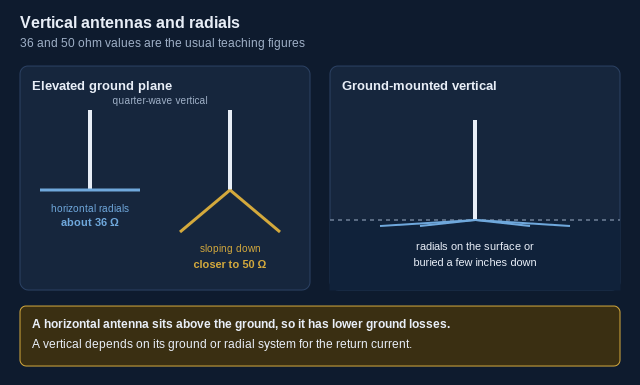
Sloping the radials downward raises the feed point impedance of an elevated quarter-wave ground-plane to about 50 ohms.

An elevated quarter-wave vertical with horizontal radials at about 36 ohms and sloping radials near 50 ohms, and a ground-mounted vertical with radials on or just under the surface.
Describe this graphic in words

Left: an elevated quarter-wave vertical with horizontal radials, which gives an impedance of about 36 ohms, and with radials sloping downward, which raises it toward 50 ohms. Right: a ground-mounted vertical with its radials laid on the surface or buried a few inches deep. A note says a horizontal antenna sits above the ground and has lower ground losses, while a vertical depends on its ground or radial system.

This is a teaching note. With horizontal radials a quarter-wave vertical has a feed point impedance of about 36 ohms. Bending the radials down toward the ground, a droop of about 45 degrees, raises it toward 50 ohms, which matches coax.

Why the other choices are wrong

  • A. Sloping the radials upward lowers the impedance.
  • C. Longer radials do not set the impedance.
  • D. Coiling the radials does not raise it to 50 ohms.

Rule text checked against the official source on November 17, 2026. This is a study aid; the linked rule is what governs.
G9B03

Which of the following best describes the radiation pattern of a quarter-wave ground-plane vertical antenna?

Show the answer and why

Answer D. Omnidirectional in azimuth

A quarter-wave ground-plane vertical is omnidirectional in azimuth.

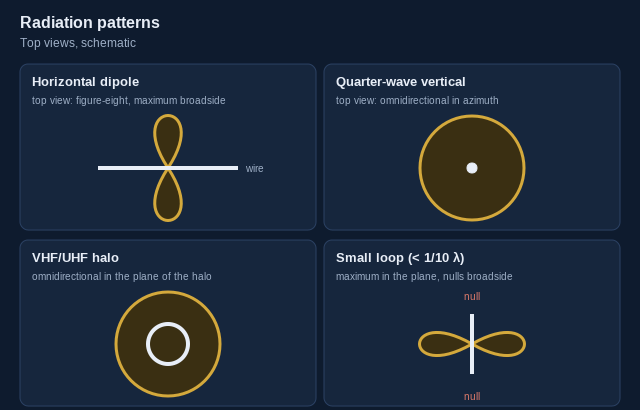
Radiation patterns: a dipole is a figure-eight at right angles to the wire, a quarter-wave vertical is omnidirectional in azimuth, a halo is omnidirectional in its plane, and a small loop has nulls broadside to the loop.
Describe this graphic in words

Four pattern sketches. A horizontal dipole seen from above has a figure-eight pattern with its maximum at right angles to the wire. A quarter-wave vertical seen from above has a circular, omnidirectional pattern in azimuth. A halo is omnidirectional in the plane of the halo. An electrically small loop has its maximum in the plane of the loop and deep nulls broadside to it.

This is a teaching note. Viewed from above, a vertical radiator sends the same signal in all compass directions. The pattern is not uniform in elevation, though, because the energy is concentrated at low angles.

Why the other choices are wrong

  • A. Bi-directional is the pattern of a horizontal dipole.
  • B. Isotropic means equal in all directions in space, which no real antenna does.
  • C. Hemispherical describes a different pattern.

Rule text checked against the official source on November 17, 2026. This is a study aid; the linked rule is what governs.
G9B04

What is the radiation pattern of a dipole antenna in free space in a plane containing the conductor?

Show the answer and why

Answer A. It is a figure-eight at right angles to the antenna

In a plane containing the conductor, a dipole's free-space pattern is a figure-eight at right angles to the antenna.

Radiation patterns: a dipole is a figure-eight at right angles to the wire, a quarter-wave vertical is omnidirectional in azimuth, a halo is omnidirectional in its plane, and a small loop has nulls broadside to the loop.
Describe this graphic in words

Four pattern sketches. A horizontal dipole seen from above has a figure-eight pattern with its maximum at right angles to the wire. A quarter-wave vertical seen from above has a circular, omnidirectional pattern in azimuth. A halo is omnidirectional in the plane of the halo. An electrically small loop has its maximum in the plane of the loop and deep nulls broadside to it.

This is a teaching note. A dipole radiates most strongly broadside, at right angles to the wire, and not at all off the ends. Drawn in the plane that contains the wire, that is a figure-eight with lobes on both sides and nulls off the ends.

Why the other choices are wrong

  • B. The nulls are off the ends, so the lobes are not off both ends.
  • C. A circle is the pattern in the plane perpendicular to the wire.
  • D. A dipole does not have a pair of lobes on one side and a single lobe on the other.

Rule text checked against the official source on November 17, 2026. This is a study aid; the linked rule is what governs.
G9B05

How does antenna height affect the azimuthal radiation pattern of a horizontal dipole HF antenna at elevation angles higher than about 45 degrees?

Show the answer and why

Answer C. If the antenna is less than 1/2 wavelength high, the azimuthal pattern is almost omnidirectional

If a horizontal dipole is less than 1/2 wavelength high, the azimuthal pattern at high elevation angles is almost omnidirectional.

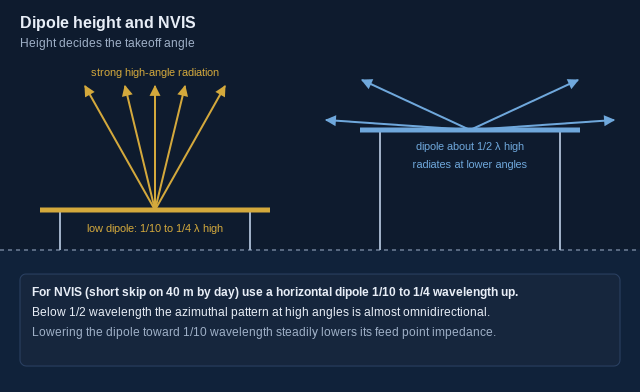
A low horizontal dipole radiates strongly at high angles for NVIS, while a dipole at half a wavelength radiates at lower angles.
Describe this graphic in words

Two dipoles above the ground. A low one, between 1/10 and 1/4 wavelength high, radiates strongly straight up, which suits near vertical incidence skywave communication. One about half a wavelength high radiates at lower angles. A note says below half a wavelength the azimuthal pattern at high angles is almost omnidirectional, and that lowering the dipole toward 1/10 wavelength steadily lowers its feed point impedance.

This is a teaching note. At high angles, a low dipole has little pattern in azimuth because the ground reflection dominates. That is why low dipoles work for short-skip communications. As the antenna is raised, the pattern gets more directional.

Why the other choices are wrong

  • A. A higher antenna has a more predictable pattern, not an unpredictable one.
  • B. Height does affect the pattern.
  • D. Radiation off the ends is not eliminated by a low height.

Rule text checked against the official source on November 17, 2026. This is a study aid; the linked rule is what governs.

G9B06

Where should the radial wires of a ground-mounted vertical antenna system be placed?

Show the answer and why

Answer C. On the surface or buried a few inches below the ground

The radial wires of a ground-mounted vertical are placed on the surface or buried a few inches below the ground.

An elevated quarter-wave vertical with horizontal radials at about 36 ohms and sloping radials near 50 ohms, and a ground-mounted vertical with radials on or just under the surface.
Describe this graphic in words

Left: an elevated quarter-wave vertical with horizontal radials, which gives an impedance of about 36 ohms, and with radials sloping downward, which raises it toward 50 ohms. Right: a ground-mounted vertical with its radials laid on the surface or buried a few inches deep. A note says a horizontal antenna sits above the ground and has lower ground losses, while a vertical depends on its ground or radial system.

This is a teaching note. The radials form the other half of the antenna and collect the return current in the ground near the base. Laying them on the ground or burying them a few inches deep keeps them out of the way and works well.

Why the other choices are wrong

  • A. Radials placed as high as possible would be an elevated ground plane, a different design.
  • B. Radials parallel to the element would not collect the ground return currents.
  • D. The radials are laid around the base, not at the center.

Rule text checked against the official source on November 17, 2026. This is a study aid; the linked rule is what governs.

G9B07

How does the feed point impedance of a horizontal 1/2 wave dipole antenna change as the antenna height is reduced to 1/10 wavelength above ground?

Show the answer and why

Answer B. It steadily decreases

The feed point impedance of a horizontal half-wave dipole steadily decreases as the antenna is lowered to 1/10 wavelength above ground.

A low horizontal dipole radiates strongly at high angles for NVIS, while a dipole at half a wavelength radiates at lower angles.
Describe this graphic in words

Two dipoles above the ground. A low one, between 1/10 and 1/4 wavelength high, radiates strongly straight up, which suits near vertical incidence skywave communication. One about half a wavelength high radiates at lower angles. A note says below half a wavelength the azimuthal pattern at high angles is almost omnidirectional, and that lowering the dipole toward 1/10 wavelength steadily lowers its feed point impedance.

This is a teaching note. A dipole in free space is about 73 ohms. Near the ground the reflection changes the impedance, and as the antenna gets very low it falls well below that.

Why the other choices are wrong

  • A. It does not increase as the antenna is lowered.
  • C. It does not peak at 1/8 wavelength.
  • D. The height above ground does change the impedance.

Rule text checked against the official source on November 17, 2026. This is a study aid; the linked rule is what governs.

G9B08

How does the feed point impedance of a 1/2 wave dipole change as the feed point is moved from the center toward the ends?

Show the answer and why

Answer A. It steadily increases

The feed point impedance of a half-wave dipole steadily increases as the feed point is moved from the center toward the ends.

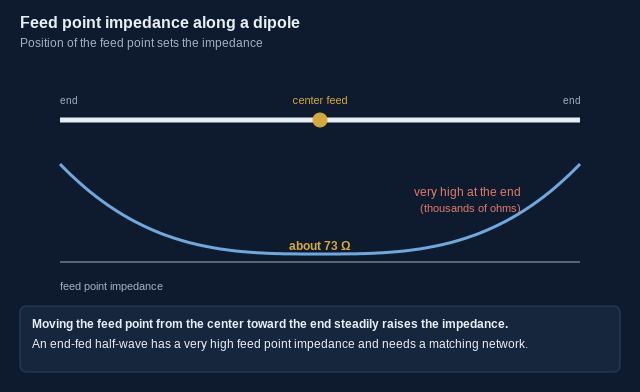
The feed point impedance of a half-wave dipole is about 73 ohms at the center and rises to a very high value at the ends.
Describe this graphic in words

A half-wave dipole with a curve beneath it showing the feed point impedance along its length. It is lowest, about 73 ohms, at the center and rises steadily toward the ends, where it is very high, thousands of ohms. So an end-fed half-wave antenna has a very high feed point impedance and needs a matching network.

This is a teaching note. The center is where the current is highest and the voltage is lowest, so the impedance is lowest there, about 73 ohms. Moving toward the ends, current drops and voltage rises, so impedance rises and becomes very high at the ends.

Why the other choices are wrong

  • B. It does not decrease toward the ends.
  • C. It does not peak 1/8 wavelength from the end.
  • D. The feed point location does affect the impedance.

Rule text checked against the official source on November 17, 2026. This is a study aid; the linked rule is what governs.

G9B09

Which of the following is an advantage of using a horizontally polarized as compared to a vertically polarized HF antenna?

Show the answer and why

Answer A. Lower ground losses

A horizontally polarized HF antenna has lower ground losses than a vertically polarized one.

An elevated quarter-wave vertical with horizontal radials at about 36 ohms and sloping radials near 50 ohms, and a ground-mounted vertical with radials on or just under the surface.
Describe this graphic in words

Left: an elevated quarter-wave vertical with horizontal radials, which gives an impedance of about 36 ohms, and with radials sloping downward, which raises it toward 50 ohms. Right: a ground-mounted vertical with its radials laid on the surface or buried a few inches deep. A note says a horizontal antenna sits above the ground and has lower ground losses, while a vertical depends on its ground or radial system.

This is a teaching note. A vertical antenna depends on the ground for its return current, so ground resistance wastes some power. A horizontal antenna sits above the ground and is much less affected.

Why the other choices are wrong

  • B. Feed point impedance is not lower for a horizontal antenna.
  • C. A horizontal dipole does not need radials at all, but "shorter radials" is not the advantage named.
  • D. Radiation resistance is not lower for a horizontal antenna.

Rule text checked against the official source on November 17, 2026. This is a study aid; the linked rule is what governs.

G9B10

What is the approximate length for a 1/2 wave dipole antenna cut for 14.250 MHz?

Show the answer and why

Answer D. 33 feet

A half-wave dipole for 14.250 MHz is about 33 feet long.

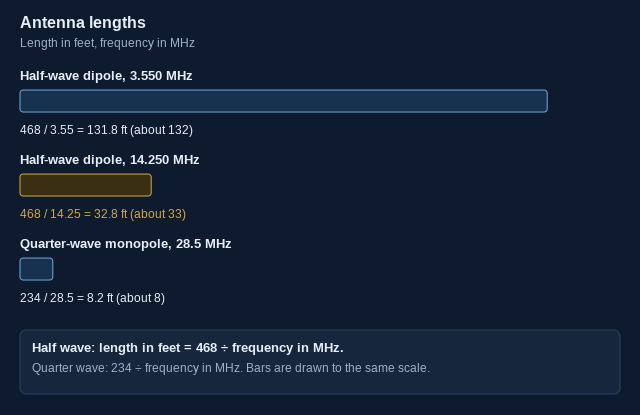
Antenna lengths from 468 over frequency for a half wave and 234 over frequency for a quarter wave: 132 feet at 3.550 MHz, 33 feet at 14.250 MHz and 8 feet at 28.5 MHz.
Describe this graphic in words

Three bars to the same scale. A half-wave dipole for 3.550 MHz is 468 divided by 3.55, about 132 feet. A half-wave dipole for 14.250 MHz is 468 divided by 14.25, about 33 feet. A quarter-wave monopole for 28.5 MHz is 234 divided by 28.5, about 8 feet. The rules of thumb are 468 over frequency for a half wave and 234 over frequency for a quarter wave.

This is a teaching note. The rule of thumb is length in feet = 468 / frequency in MHz. 468 / 14.25 = 32.8 feet.

Why the other choices are wrong

  • A. 8 feet is a quarter-wave length at about 29 MHz.
  • B. 16 feet is a quarter-wave length at about 14 MHz.
  • C. 24 feet is not the half-wave length for 14.25 MHz.

Rule text checked against the official source on November 17, 2026. This is a study aid; the linked rule is what governs.

G9B11

What is the approximate length for a 1/2 wave dipole antenna cut for 3.550 MHz?

Show the answer and why

Answer C. 132 feet

A half-wave dipole for 3.550 MHz is about 132 feet long.

Antenna lengths from 468 over frequency for a half wave and 234 over frequency for a quarter wave: 132 feet at 3.550 MHz, 33 feet at 14.250 MHz and 8 feet at 28.5 MHz.
Describe this graphic in words

Three bars to the same scale. A half-wave dipole for 3.550 MHz is 468 divided by 3.55, about 132 feet. A half-wave dipole for 14.250 MHz is 468 divided by 14.25, about 33 feet. A quarter-wave monopole for 28.5 MHz is 234 divided by 28.5, about 8 feet. The rules of thumb are 468 over frequency for a half wave and 234 over frequency for a quarter wave.

This is a teaching note. 468 / 3.55 = 131.8 feet.

Why the other choices are wrong

  • A. 42 feet is about the length for 11 MHz.
  • B. 84 feet is about the length for 5.5 MHz.
  • D. 263 feet is about the length for 1.8 MHz.

Rule text checked against the official source on November 17, 2026. This is a study aid; the linked rule is what governs.

G9B12

What is the approximate length for a 1/4 wave monopole antenna cut for 28.5 MHz?

Show the answer and why

Answer A. 8 feet

A quarter-wave monopole for 28.5 MHz is about 8 feet long.

Antenna lengths from 468 over frequency for a half wave and 234 over frequency for a quarter wave: 132 feet at 3.550 MHz, 33 feet at 14.250 MHz and 8 feet at 28.5 MHz.
Describe this graphic in words

Three bars to the same scale. A half-wave dipole for 3.550 MHz is 468 divided by 3.55, about 132 feet. A half-wave dipole for 14.250 MHz is 468 divided by 14.25, about 33 feet. A quarter-wave monopole for 28.5 MHz is 234 divided by 28.5, about 8 feet. The rules of thumb are 468 over frequency for a half wave and 234 over frequency for a quarter wave.

This is a teaching note. A quarter wave is 234 / frequency in MHz: 234 / 28.5 = 8.2 feet.

Why the other choices are wrong

  • B. 11 feet is a quarter wave on about 21 MHz.
  • C. 16 feet is a quarter wave on about 14.5 MHz.
  • D. 21 feet is a quarter wave on about 11 MHz.

Rule text checked against the official source on November 17, 2026. This is a study aid; the linked rule is what governs.