
ARSC Tech School

General G1B: Antenna structure limitations

423 questions · pool July 1, 2023 to June 30, 2027 · the exam has 35 questions; 26 to pass

G1 · COMMISSION’S RULES

Antenna structure limitations; good engineering and good amateur practice; beacon operation; prohibited transmissions; retransmitting radio signals

11 questions in group G1B

One question from this group appears on each exam.

G1B01FCC rule 97.15(a)

What is the maximum height above ground for an antenna structure not near a public use airport without requiring notification to the FAA and registration with the FCC?

Show the answer and why

Answer C. 200 feet

FCC rule 97.15(a)

An antenna structure must be 200 feet or less above ground, and not near a public use airport, to avoid FAA notification and FCC registration.

Section 97.15(a) says owners of certain antenna structures more than 60.96 meters (200 feet) above ground level at the site, or located near or at a public use airport, must notify the FAA and register with the FCC under Part 17.

So 200 feet is the height threshold, and the airport condition is a separate trigger that can apply at any height. The other choices, 50, 100 and 250 feet, are not thresholds in this rule.

Why the other choices are wrong

  • A. 50 feet is not a Part 97 threshold for FAA notification.
  • B. 100 feet is not the threshold; the rule says 200 feet.
  • D. 250 feet is above the threshold, so a structure that tall would already need notification.

References

Rule text checked against the official source on November 12, 2026. This is a study aid; the linked rule is what governs.
G1B02FCC rule 97.203(b)

With which of the following conditions must beacon stations comply?

Show the answer and why

Answer A. No more than one beacon station may transmit in the same band from the same station location

FCC rule 97.203(b)

A beacon must not transmit on more than one channel in the same band from the same station location at the same time.

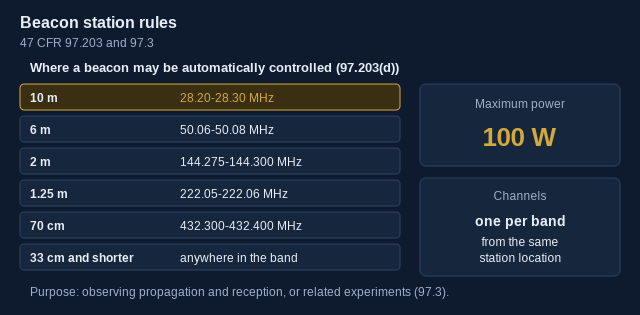
Summary of beacon rules: automatic control segments, with 28.20 to 28.30 MHz as the only HF one, a 100 watt power limit, and one channel per band per location.
Describe this graphic in words

A list of the segments where a beacon may be automatically controlled: 10 meters at 28.20 to 28.30 MHz, which is highlighted as the only HF segment, 6 meters at 50.06 to 50.08, 2 meters at 144.275 to 144.300, 1.25 meters at 222.05 to 222.06, 70 centimeters at 432.300 to 432.400, and anywhere in the 33 centimeter and shorter bands. Beside it are the maximum power, 100 watts, and the rule of one channel per band from the same station location. A beacon observes propagation and reception.

Section 97.203(b) says a beacon "must not concurrently transmit on more than 1 channel in the same amateur service frequency band, from the same station location." That is the only condition among the choices that appears in the rules.

There is no National Beacon Organization that coordinates frequencies, and Part 97 does not require a beacon's frequency to be posted online or in a periodical. Beacons are tied to specific segments instead, as in 97.203(d).

Why the other choices are wrong

  • B. Part 97 names no National Beacon Organization and requires no such coordination.
  • C. Part 97 has no requirement to post a beacon's frequency on the internet or in a periodical.
  • D. "All these choices are correct" fails because B and C are not in the rule.

References

Rule text checked against the official source on November 12, 2026. This is a study aid; the linked rule is what governs.

G1B03FCC rule 97.3(a)(9)

Which of the following is a purpose of a beacon station as identified in the FCC rules?

Show the answer and why

Answer A. Observation of propagation and reception

FCC rule 97.3(a)(9)

The FCC defines a beacon as a station transmitting for observing propagation and reception, or other related experimental activities.

Summary of beacon rules: automatic control segments, with 28.20 to 28.30 MHz as the only HF one, a 100 watt power limit, and one channel per band per location.
Describe this graphic in words

A list of the segments where a beacon may be automatically controlled: 10 meters at 28.20 to 28.30 MHz, which is highlighted as the only HF segment, 6 meters at 50.06 to 50.08, 2 meters at 144.275 to 144.300, 1.25 meters at 222.05 to 222.06, 70 centimeters at 432.300 to 432.400, and anywhere in the 33 centimeter and shorter bands. Beside it are the maximum power, 100 watts, and the rule of one channel per band from the same station location. A beacon observes propagation and reception.

Section 97.3(a)(9) defines a beacon as "an amateur station transmitting communications for the purposes of observation of propagation and reception or other related experimental activities." Operators listen for beacons to learn whether a band is open to a given region.

Beacons are not a way to identify repeaters, and bulletin transmissions are authorized separately in 97.111(b)(6). Neither is a purpose given in the beacon definition.

Why the other choices are wrong

  • B. Identifying repeaters is not part of the beacon definition. Repeaters identify themselves under the station identification rules.
  • C. Information bulletins are a separate kind of one-way transmission, not a beacon purpose.
  • D. "All these choices are correct" fails because B and C are not beacon purposes.

References

Rule text checked against the official source on November 12, 2026. This is a study aid; the linked rule is what governs.

G1B04FCC rule 97.113(c)

Which of the following transmissions is permitted for all amateur stations?

Show the answer and why

Answer C. Occasional retransmission of weather and propagation forecast information from US government stations

FCC rule 97.113(c)

Any amateur station may occasionally retransmit weather and propagation forecasts that come from US government stations.

Section 97.113(c) generally bars retransmitting programs or signals from any station that is not an amateur station. One exception is "propagation and weather forecast information intended for use by the general public and originated from United States Government stations," provided it is done only occasionally, as an incident of normal amateur communication, and not on a regular basis.

The other choices run into other rules: there is no exemption for unidentified tests (97.119 requires identification), automatic retransmission is limited to repeater, auxiliary and space stations (97.113(d)), and encoded messages are prohibited by 97.113(a)(4).

Why the other choices are wrong

  • A. No rule allows unidentified transmissions of under 10 seconds. Station identification is required by 97.119.
  • B. Automatic retransmission of other amateur signals is limited to auxiliary, repeater and space stations by 97.113(d), not to any station.
  • D. 97.113(a)(4) prohibits messages encoded to obscure their meaning. The criminal act language is a separate prohibition and does not make other encrypted messages legal.

References

Rule text checked against the official source on November 12, 2026. This is a study aid; the linked rule is what governs.

G1B05FCC rule 97.111((5)(b)

Which of the following one-way transmissions are permitted?

Show the answer and why

Answer B. Transmissions to assist with learning the International Morse code

FCC rule 97.111((5)(b)

One-way transmissions to help people learn or improve proficiency in the International Morse code are authorized.

Section 97.111(b) lists the one-way communications an amateur station may transmit in addition to those authorized elsewhere. Item (5) is "transmissions necessary to assisting persons learning, or improving proficiency in, the international Morse code." Code practice and code bulletins are examples.

Unidentified tests are not on the list, and regular equipment sales offers fall under the pecuniary interest limit in 97.113(a)(3)(ii), which only allows occasional notices of equipment for sale or trade.

Why the other choices are wrong

  • A. Brief test transmissions are allowed, but they must still be identified. There is no 10 second exemption.
  • C. 97.113(a)(3)(ii) allows notice of equipment for sale only when it is not conducted on a regular basis.
  • D. "All these choices are correct" fails because A and C are not permitted.

References

Rule text checked against the official source on November 12, 2026. This is a study aid; the linked rule is what governs.

G1B06FCC rule 97.15(b), PRB-1, 101 FCC 2d 952 (1985)

Under what conditions are state and local governments permitted to regulate amateur radio antenna structures?

Show the answer and why

Answer D. Amateur Service communications must be reasonably accommodated, and regulations must constitute the minimum practical to accommodate a legitimate purpose of the state or local entity

FCC rule 97.15(b), PRB-1, 101 FCC 2d 952 (1985)

State and local governments must reasonably accommodate amateur communications, and their regulation must be the minimum practicable.

Section 97.15(b) says state and local regulation of a station antenna structure "must not preclude amateur service communications. Rather, it must reasonably accommodate such communications and must constitute the minimum practicable regulation to accomplish the state or local authority's legitimate purpose." The rule points to the FCC's PRB-1 decision (101 FCC 2d 952, 1985).

That means local rules on height, setbacks and permits are allowed, but they cannot be so strict that they effectively ban an effective amateur station.

Why the other choices are wrong

  • A. The FCC does not preempt all local regulation. Reasonable, minimal regulation of antenna structures is allowed.
  • B. Local authorities cannot regulate "to any extent necessary". The regulation must be the minimum practicable, and amateur communications must be reasonably accommodated.
  • C. No such 50 foot and 1,000 foot visibility condition appears in the rule.

References

Rule text checked against the official source on November 12, 2026. This is a study aid; the linked rule is what governs.

G1B07FCC rule 97.113(a)(4)

What are the restrictions on the use of abbreviations or procedural signals in the amateur service?

Show the answer and why

Answer B. They may be used if they do not obscure the meaning of a message

FCC rule 97.113(a)(4)

Abbreviations and procedural signals may be used as long as they do not obscure the meaning of a message.

Part 97 prohibits messages "encoded for the purpose of obscuring their meaning" (97.113(a)(4)). Ordinary abbreviations, Q signals and procedural signals such as 73 or CQ are not a code in that sense, because the point of them is to make communication clearer and quicker, not to hide it.

So the working test is whether the abbreviation obscures the meaning. If it does, it can fall under the prohibition on obscured messages. Note that the eCFR text read for this entry does not contain a separate sentence about abbreviations, so the answer rests on this prohibition.

Why the other choices are wrong

  • A. Q signals are not the only abbreviations permitted. Part 97 contains no such limit.
  • C. Abbreviations are not banned. Only communication meant to obscure meaning is prohibited.
  • D. Part 97 contains no list of approved abbreviations, so use is not limited to a list.

References

Rule text checked against the official source on November 12, 2026. This is a study aid; the linked rule is what governs.

G1B08FCC rule 97.111(a)(1)

When is it permissible to communicate with amateur stations in countries outside the areas administered by the Federal Communications Commission?

Show the answer and why

Answer B. When the contact is with amateurs in any country except those whose administrations have notified the ITU that they object to such communications

FCC rule 97.111(a)(1)

You may talk with amateurs in any country except those whose governments have told the ITU they object to such communications.

Section 97.111(a)(1) authorizes transmissions needed to exchange messages with other amateur stations, "except those in any country whose administration has notified the ITU that it objects to such communications." The FCC publishes public notices of current arrangements for international communications.

No third-party agreement, United Nations membership or IARU membership is needed for ordinary amateur contacts. Third-party agreements matter only when passing messages on behalf of someone else, not for contacts between licensed amateurs.

Why the other choices are wrong

  • A. Third-party agreements apply to messages passed for a third party. They are not required for contacts between amateurs.
  • C. The rule does not tie permission to UN membership.
  • D. The rule does not tie permission to IARU membership.

References

Rule text checked against the official source on November 12, 2026. This is a study aid; the linked rule is what governs.

G1B09FCC rule 97.203(d)

On what HF frequencies are automatically controlled beacons permitted?

Show the answer and why

Answer D. 28.20 MHz to 28.30 MHz

FCC rule 97.203(d)

On HF, an automatically controlled beacon may operate only at 28.20 to 28.30 MHz.

Summary of beacon rules: automatic control segments, with 28.20 to 28.30 MHz as the only HF one, a 100 watt power limit, and one channel per band per location.
Describe this graphic in words

A list of the segments where a beacon may be automatically controlled: 10 meters at 28.20 to 28.30 MHz, which is highlighted as the only HF segment, 6 meters at 50.06 to 50.08, 2 meters at 144.275 to 144.300, 1.25 meters at 222.05 to 222.06, 70 centimeters at 432.300 to 432.400, and anywhere in the 33 centimeter and shorter bands. Beside it are the maximum power, 100 watts, and the rule of one channel per band from the same station location. A beacon observes propagation and reception.

Section 97.203(d) says a beacon may be automatically controlled while transmitting in the 28.20-28.30 MHz, 50.06-50.08 MHz, 144.275-144.300 MHz, 222.05-222.06 MHz or 432.300-432.400 MHz segments, or on the 33 cm and shorter wavelength bands. The only HF segment in that list is 28.20-28.30 MHz, on 10 meters.

This is why the 10 meter beacon sub-band is a good place to listen for propagation. Other HF frequencies are not available for automatic beacons, regardless of power or mode.

Why the other choices are wrong

  • A. Power does not make a frequency eligible. The rule limits automatic beacons to listed segments.
  • B. Morse code does not make a frequency eligible either. The rule is about segments, not emission type.
  • C. 21.08-21.09 MHz is on 15 meters and is not in the list of segments.

References

Rule text checked against the official source on November 12, 2026. This is a study aid; the linked rule is what governs.

G1B10FCC rule 97.203(c)

What is the power limit for beacon stations?

Show the answer and why

Answer C. 100 watts PEP output

FCC rule 97.203(c)

A beacon's transmitter power must not exceed 100 watts.

Summary of beacon rules: automatic control segments, with 28.20 to 28.30 MHz as the only HF one, a 100 watt power limit, and one channel per band per location.
Describe this graphic in words

A list of the segments where a beacon may be automatically controlled: 10 meters at 28.20 to 28.30 MHz, which is highlighted as the only HF segment, 6 meters at 50.06 to 50.08, 2 meters at 144.275 to 144.300, 1.25 meters at 222.05 to 222.06, 70 centimeters at 432.300 to 432.400, and anywhere in the 33 centimeter and shorter bands. Beside it are the maximum power, 100 watts, and the rule of one channel per band from the same station location. A beacon observes propagation and reception.

Section 97.203(c) says "the transmitter power of a beacon must not exceed 100 W." Beacons are meant to be heard at low power around the clock, so the limit is far below the legal limit for ordinary stations.

The rule says 100 W; the exam choices phrase it as PEP output. Do not confuse it with other limits you may have seen.

Why the other choices are wrong

  • A. 10 watts is lower than the limit. A beacon may use up to 100 watts.
  • B. 20 watts is lower than the limit. A beacon may use up to 100 watts.
  • D. 200 watts is above the 100 W limit.

References

Rule text checked against the official source on November 12, 2026. This is a study aid; the linked rule is what governs.

G1B11FCC rule 97.101(a)

Who or what determines “good engineering and good amateur practice,” as applied to the operation of an amateur station in all respects not covered by the Part 97 rules?

Show the answer and why

Answer A. The FCC

FCC rule 97.101(a)

The FCC is the authority that applies the standard of good engineering and good amateur practice.

Section 97.101(a) says that "in all respects not specifically covered by FCC Rules each amateur station must be operated in accordance with good engineering and good amateur practice." The rule is an FCC rule and the FCC enforces it, so the FCC decides in a given case whether practice met the standard.

Neither the control operator, the IEEE nor the ITU is the decider. A control operator is responsible for following the standard, but does not get to set it.

Why the other choices are wrong

  • B. The control operator must follow the standard but does not define it. The FCC decides.
  • C. The IEEE is a professional engineering society with no authority over amateur stations.
  • D. The ITU sets international rules, but the FCC applies Part 97 to US stations.

References

Rule text checked against the official source on November 12, 2026. This is a study aid; the linked rule is what governs.