
ARSC Tech School

General G7B: Digital circuits

423 questions · pool July 1, 2023 to June 30, 2027 · the exam has 35 questions; 26 to pass

G7 · PRACTICAL CIRCUITS

Digital circuits; amplifiers and oscillators

11 questions in group G7B

One question from this group appears on each exam.

G7B01

What is the purpose of neutralizing an amplifier?

Show the answer and why

Answer B. To eliminate self-oscillations

Neutralizing an amplifier eliminates self-oscillations.
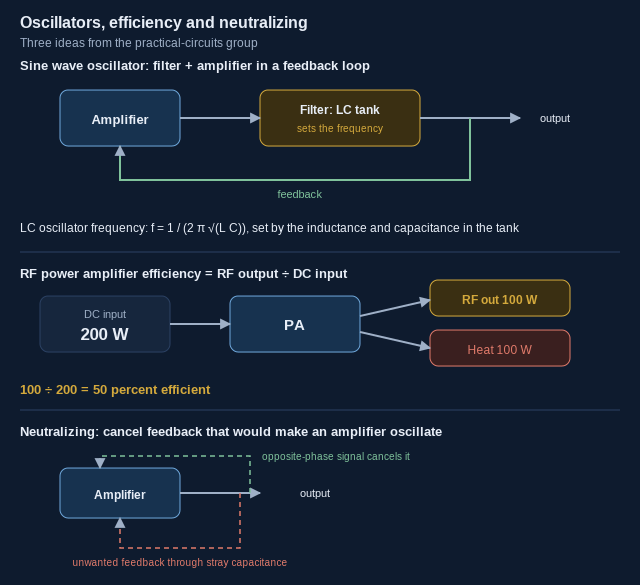
A feedback oscillator with an amplifier and an LC filter, the efficiency of a power amplifier as RF output over DC input, and neutralizing cancelling unwanted feedback.
Describe this graphic in words

Top: an amplifier and an LC tank filter in a feedback loop make a sine wave oscillator, and the frequency is set by the inductance and capacitance. Middle: a power amplifier takes 200 watts of DC and gives 100 watts of RF output and 100 watts of heat, so its efficiency, RF output divided by DC input, is 50 percent. Bottom: neutralizing feeds back a signal of opposite phase to cancel the unwanted feedback through stray capacitance that would otherwise make the amplifier oscillate.

This is a teaching note. An amplifier can feed some of its output back to the input through the capacitance between its output and input electrodes. If the feedback is in phase, the stage oscillates. Neutralizing feeds back a signal of the opposite phase through a small capacitor so that the two cancel.

Why the other choices are wrong

  • A. Neutralizing has nothing to do with modulation index.
  • C. It does not cut off the amplifier during standby.
  • D. Keeping a carrier on frequency is the job of an oscillator circuit.

Rule text checked against the official source on November 17, 2026. This is a study aid; the linked rule is what governs.
G7B02

Which of these classes of amplifiers has the highest efficiency?

Show the answer and why

Answer D. Class C

Class C amplifiers have the highest efficiency.

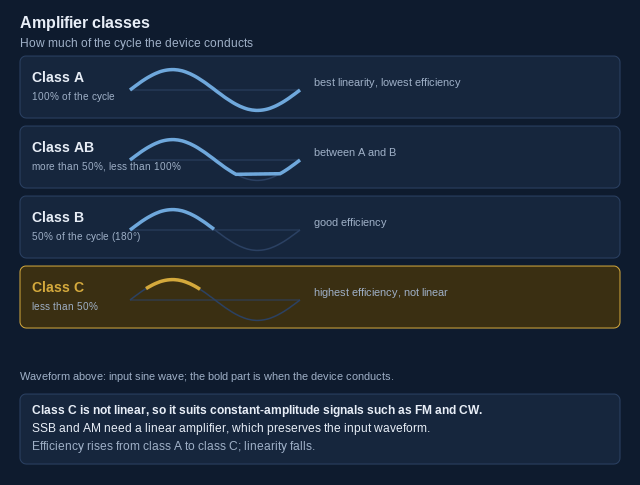
Amplifier classes A, AB, B and C drawn by how much of the input cycle the device conducts: 100 percent, more than half, half, and less than half.
Describe this graphic in words

Four rows, one per class, each with a sine wave and the part of the cycle where the device conducts drawn in bold. Class A conducts for the whole cycle and has the best linearity but the lowest efficiency. Class AB conducts for more than half but less than all. Class B conducts for half. Class C conducts for less than half, has the highest efficiency, and is not linear, so it suits FM and CW but not SSB or AM. Efficiency rises from A to C while linearity falls.

This is a teaching note. Class C conducts for less than half of the cycle, so there is little time when current flows with voltage across the device. Less power is wasted as heat. The cost is poor linearity.

In order of efficiency from lowest to highest: class A, class AB, class B, class C.

Why the other choices are wrong

  • A. Class A has the lowest efficiency but the best linearity.
  • B. Class B is more efficient than A but less than C.
  • C. Class AB is between class A and class B.

Rule text checked against the official source on November 17, 2026. This is a study aid; the linked rule is what governs.

G7B03

Which of the following describes the function of a two-input AND gate?

Show the answer and why

Answer B. Output is high only when both inputs are high

The output of a two-input AND gate is high only when both inputs are high.

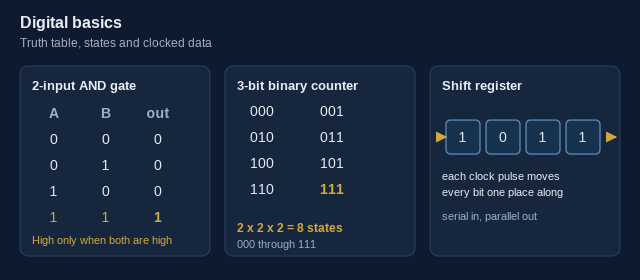
An AND gate truth table, the eight states of a 3-bit counter, and a shift register moving bits one place per clock pulse.
Describe this graphic in words

Three panels. A 2-input AND gate truth table where the output is high only when both inputs are high. A 3-bit binary counter listing its eight states from 000 to 111. A shift register of four cells where each clock pulse moves every bit one place along.

This is a teaching note. AND means all inputs must be true. If either input is low, the output is low. Truth table: 00 gives 0, 01 gives 0, 10 gives 0, 11 gives 1.

Why the other choices are wrong

  • A. This is the NAND function, not AND.
  • C. This is the NOR function, not AND.
  • D. This is also the NAND function, not AND.

Rule text checked against the official source on November 17, 2026. This is a study aid; the linked rule is what governs.

G7B04

In a Class A amplifier, what percentage of the time does the amplifying device conduct?

Show the answer and why

Answer A. 100%

In a Class A amplifier, the device conducts 100 percent of the time.

Amplifier classes A, AB, B and C drawn by how much of the input cycle the device conducts: 100 percent, more than half, half, and less than half.
Describe this graphic in words

Four rows, one per class, each with a sine wave and the part of the cycle where the device conducts drawn in bold. Class A conducts for the whole cycle and has the best linearity but the lowest efficiency. Class AB conducts for more than half but less than all. Class B conducts for half. Class C conducts for less than half, has the highest efficiency, and is not linear, so it suits FM and CW but not SSB or AM. Efficiency rises from A to C while linearity falls.

This is a teaching note. A Class A stage is biased so current flows through the whole input cycle. That makes it the most linear class, but it wastes the most power because it draws current even when there is no signal.

Why the other choices are wrong

  • B. More than 50 but less than 100 percent describes class AB.
  • C. 50 percent describes class B.
  • D. Less than 50 percent describes class C.

Rule text checked against the official source on November 17, 2026. This is a study aid; the linked rule is what governs.

G7B05

How many states does a 3-bit binary counter have?

Show the answer and why

Answer C. 8

A 3-bit binary counter has 8 states.

An AND gate truth table, the eight states of a 3-bit counter, and a shift register moving bits one place per clock pulse.
Describe this graphic in words

Three panels. A 2-input AND gate truth table where the output is high only when both inputs are high. A 3-bit binary counter listing its eight states from 000 to 111. A shift register of four cells where each clock pulse moves every bit one place along.

This is a teaching note. Each bit has two states, so three bits give 2 x 2 x 2 = 8 combinations, from 000 to 111.

Why the other choices are wrong

  • A. 3 is the number of bits, not of states.
  • B. 6 is not a power of 2.
  • D. 16 states would need 4 bits.

Rule text checked against the official source on November 17, 2026. This is a study aid; the linked rule is what governs.

G7B06

What is a shift register?

Show the answer and why

Answer A. A clocked array of circuits that passes data in steps along the array

A shift register is a clocked array of circuits that passes data in steps along the array.

An AND gate truth table, the eight states of a 3-bit counter, and a shift register moving bits one place per clock pulse.
Describe this graphic in words

Three panels. A 2-input AND gate truth table where the output is high only when both inputs are high. A 3-bit binary counter listing its eight states from 000 to 111. A shift register of four cells where each clock pulse moves every bit one place along.

This is a teaching note. It is a row of flip-flops. On each clock pulse, every bit moves one place. It is used to turn serial data into parallel data, and the reverse.

Why the other choices are wrong

  • B. An array of op amps for arithmetic is not a shift register.
  • C. A shift register is not a digital mixer.
  • D. A shift register is not an analog mixer.

Rule text checked against the official source on November 17, 2026. This is a study aid; the linked rule is what governs.

G7B07

Which of the following are basic components of a sine wave oscillator?

Show the answer and why

Answer D. A filter and an amplifier operating in a feedback loop

A sine wave oscillator has a filter and an amplifier in a feedback loop.

A feedback oscillator with an amplifier and an LC filter, the efficiency of a power amplifier as RF output over DC input, and neutralizing cancelling unwanted feedback.
Describe this graphic in words

Top: an amplifier and an LC tank filter in a feedback loop make a sine wave oscillator, and the frequency is set by the inductance and capacitance. Middle: a power amplifier takes 200 watts of DC and gives 100 watts of RF output and 100 watts of heat, so its efficiency, RF output divided by DC input, is 50 percent. Bottom: neutralizing feeds back a signal of opposite phase to cancel the unwanted feedback through stray capacitance that would otherwise make the amplifier oscillate.

This is a teaching note. The amplifier boosts the signal, and the filter, such as an LC tank or a crystal, passes only the wanted frequency. Part of the output is fed back to the input in phase. When the gain around the loop is just enough, it sustains a steady oscillation.

Why the other choices are wrong

  • A. An amplifier and a divider do not make a sine wave oscillator.
  • B. A multiplier and a mixer are used to change frequency, not to make oscillations.
  • C. A circulator in a feed-forward loop is not how an oscillator works.

Rule text checked against the official source on November 17, 2026. This is a study aid; the linked rule is what governs.

G7B08

How is the efficiency of an RF power amplifier determined?

Show the answer and why

Answer B. Divide the RF output power by the DC input power

Efficiency is the RF output power divided by the DC input power.

A feedback oscillator with an amplifier and an LC filter, the efficiency of a power amplifier as RF output over DC input, and neutralizing cancelling unwanted feedback.
Describe this graphic in words

Top: an amplifier and an LC tank filter in a feedback loop make a sine wave oscillator, and the frequency is set by the inductance and capacitance. Middle: a power amplifier takes 200 watts of DC and gives 100 watts of RF output and 100 watts of heat, so its efficiency, RF output divided by DC input, is 50 percent. Bottom: neutralizing feeds back a signal of opposite phase to cancel the unwanted feedback through stray capacitance that would otherwise make the amplifier oscillate.

This is a teaching note. Efficiency tells you how much of the power you pay for comes out as RF. The rest is heat.

Worked example: an amplifier with 100 W RF output from 200 W of DC input is 100 / 200 = 50 percent efficient and wastes 100 W as heat.

Why the other choices are wrong

  • A. Dividing the DC input by the DC output is not a measure of RF efficiency.
  • C. Multiplying by a reciprocal does not give efficiency.
  • D. Adding powers does not give efficiency.

Rule text checked against the official source on November 17, 2026. This is a study aid; the linked rule is what governs.

G7B09

What determines the frequency of an LC oscillator?

Show the answer and why

Answer C. The inductance and capacitance in the tank circuit

The inductance and capacitance in the tank circuit determine the frequency of an LC oscillator.

A feedback oscillator with an amplifier and an LC filter, the efficiency of a power amplifier as RF output over DC input, and neutralizing cancelling unwanted feedback.
Describe this graphic in words

Top: an amplifier and an LC tank filter in a feedback loop make a sine wave oscillator, and the frequency is set by the inductance and capacitance. Middle: a power amplifier takes 200 watts of DC and gives 100 watts of RF output and 100 watts of heat, so its efficiency, RF output divided by DC input, is 50 percent. Bottom: neutralizing feeds back a signal of opposite phase to cancel the unwanted feedback through stray capacitance that would otherwise make the amplifier oscillate.

This is a teaching note. The tank circuit resonates at f = 1 / (2 pi sqrt(L C)). Changing either the coil or the capacitor changes the frequency. Counters, dividers and lag circuits are not part of a simple LC oscillator.

Why the other choices are wrong

  • A. The number of counter stages does not set the frequency of an LC oscillator.
  • B. The number of divider stages does not set the frequency of an LC oscillator.
  • D. A time-delay lag circuit is a different type of oscillator.

Rule text checked against the official source on November 17, 2026. This is a study aid; the linked rule is what governs.

G7B10

Which of the following describes a linear amplifier?

Show the answer and why

Answer B. An amplifier in which the output preserves the input waveform

A linear amplifier is one in which the output preserves the input waveform.

Amplifier classes A, AB, B and C drawn by how much of the input cycle the device conducts: 100 percent, more than half, half, and less than half.
Describe this graphic in words

Four rows, one per class, each with a sine wave and the part of the cycle where the device conducts drawn in bold. Class A conducts for the whole cycle and has the best linearity but the lowest efficiency. Class AB conducts for more than half but less than all. Class B conducts for half. Class C conducts for less than half, has the highest efficiency, and is not linear, so it suits FM and CW but not SSB or AM. Efficiency rises from A to C while linearity falls.

This is a teaching note. In a linear amplifier, the output is a larger copy of the input, so modulation such as SSB is preserved. Not every amplifier used with a transceiver is linear, and a Class C amplifier is not.

Why the other choices are wrong

  • A. Not every amplifier used with a transceiver is linear.
  • C. Class C is efficient but not linear.
  • D. A frequency multiplier is a non-linear stage.

Rule text checked against the official source on November 17, 2026. This is a study aid; the linked rule is what governs.

G7B11

For which of the following modes is a Class C power stage appropriate for amplifying a modulated signal?

Show the answer and why

Answer B. FM

A Class C stage is appropriate for amplifying FM.

Amplifier classes A, AB, B and C drawn by how much of the input cycle the device conducts: 100 percent, more than half, half, and less than half.
Describe this graphic in words

Four rows, one per class, each with a sine wave and the part of the cycle where the device conducts drawn in bold. Class A conducts for the whole cycle and has the best linearity but the lowest efficiency. Class AB conducts for more than half but less than all. Class B conducts for half. Class C conducts for less than half, has the highest efficiency, and is not linear, so it suits FM and CW but not SSB or AM. Efficiency rises from A to C while linearity falls.

This is a teaching note. A Class C stage is non-linear, so it distorts the envelope of the signal. An FM signal carries its information in the frequency, and its amplitude is constant, so the distortion does not matter. SSB and AM carry information in the amplitude and need a linear amplifier.

Why the other choices are wrong

  • A. SSB needs a linear amplifier.
  • C. AM needs a linear amplifier.
  • D. "All these choices" fails because SSB and AM cannot use class C.

Rule text checked against the official source on November 17, 2026. This is a study aid; the linked rule is what governs.