
ARSC Tech School

General G0B: Station safety

423 questions · pool July 1, 2023 to June 30, 2027 · the exam has 35 questions; 26 to pass

G0 · ELECTRICAL AND RF SAFETY

Station safety: electrical shock, grounding, fusing, interlocks, and wiring; antenna and tower safety

13 questions in group G0B

One question from this group appears on each exam.

G0B01

Which wire or wires in a four-conductor 240 VAC circuit should be attached to fuses or circuit breakers?

Show the answer and why

Answer A. Only the hot wires

Only the hot wires get fuses or breakers. The neutral and ground wires are never fused.
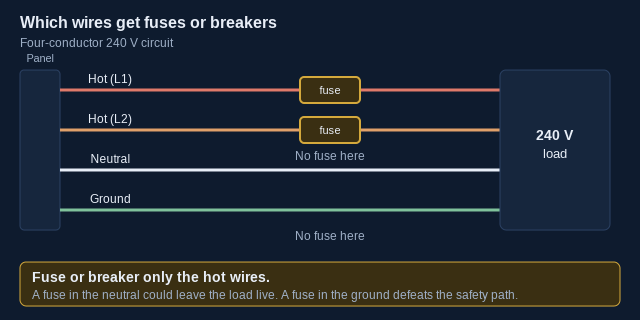
Four-conductor 240 volt circuit with fuses on the two hot wires only, none on the neutral or ground.
Describe this graphic in words

Four wires run from a panel to a 240 volt load: two hot wires, a neutral and a ground. Fuses or breakers sit on the two hot wires and are highlighted. The neutral and ground have no fuse. Only the hot wires should be fused.

This is a teaching note based on common wiring practice. A fuse or breaker opens the circuit to stop current. On a 240 V circuit with two hot wires, a neutral and a ground, protecting the hot wires removes the voltage from the load.

If a fuse were in the neutral and it blew, the neutral would be open while the hot wire was still energized, so a load could stay live relative to ground. The ground wire is a safety path, and a fuse in it would defeat its purpose of carrying fault current to trip the breaker.

Why the other choices are wrong

  • B. A fuse in the neutral could leave the equipment live with the neutral open.
  • C. The safety ground must stay continuous. A fuse in it could open and leave a fault with no path.
  • D. Fusing every wire would put protection in the neutral and ground, which is unsafe.

Rule text checked against the official source on November 13, 2026. This is a study aid; the linked rule is what governs.
G0B02

According to the National Electrical Code, what is the minimum wire size that may be used safely for wiring with a 20-ampere circuit breaker?

Show the answer and why

Answer C. AWG number 12

AWG 12 is the minimum wire size for a 20-ampere circuit breaker.

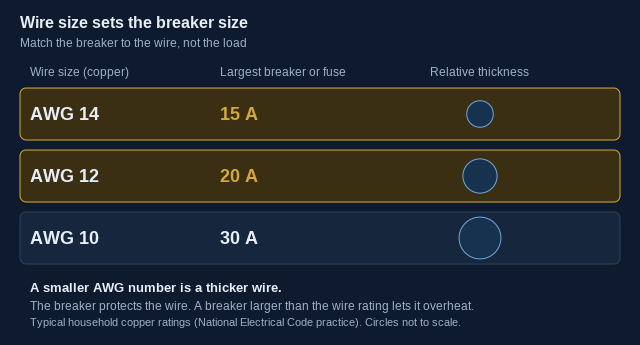
Table matching wire size to breaker size: AWG 14 with 15 amps, AWG 12 with 20 amps, AWG 10 with 30 amps.
Describe this graphic in words

Three rows. AWG 14 copper wire goes with a breaker or fuse of no more than 15 amps. AWG 12 goes with 20 amps. AWG 10 goes with 30 amps. Circles show that a smaller AWG number means a thicker wire. The first two rows are highlighted because they answer the two questions.

This is a teaching note based on the National Electrical Code's usual ratings for copper wire in household wiring: AWG 14 is protected at 15 A, AWG 12 at 20 A, and AWG 10 at 30 A. A smaller number is a thicker wire, so AWG 12 is thicker than AWG 14.

The breaker protects the wire, not the load. If the wire is too thin for the breaker, it can overheat and start a fire before the breaker trips.

Why the other choices are wrong

  • A. AWG 20 is a thin wire used for light signal work. It is far too small for 20 A.
  • B. AWG 16 is also too small for a 20 A breaker.
  • D. AWG 8 is larger than needed for 20 A. The question asks for the minimum size.

Rule text checked against the official source on November 13, 2026. This is a study aid; the linked rule is what governs.
G0B03

Which size of fuse or circuit breaker would be appropriate to use with a circuit that uses AWG number 14 wiring?

Show the answer and why

Answer D. 15 amperes

A 15-ampere fuse or breaker is appropriate for AWG 14 wiring.

Table matching wire size to breaker size: AWG 14 with 15 amps, AWG 12 with 20 amps, AWG 10 with 30 amps.
Describe this graphic in words

Three rows. AWG 14 copper wire goes with a breaker or fuse of no more than 15 amps. AWG 12 goes with 20 amps. AWG 10 goes with 30 amps. Circles show that a smaller AWG number means a thicker wire. The first two rows are highlighted because they answer the two questions.

This is a teaching note based on the National Electrical Code's usual ratings: AWG 14 copper is protected at no more than 15 A. The fuse or breaker must open before the wire carries more current than it can handle.

A 20 A, 25 A or 30 A breaker on AWG 14 would let the wire carry more current than it is rated for without tripping, which is how overloaded wiring overheats.

Why the other choices are wrong

  • A. 30 A is far above what AWG 14 wire can carry safely.
  • B. 25 A is above the wire's rating.
  • C. 20 A is above the wire's rating. AWG 12 is the size that goes with 20 A.

Rule text checked against the official source on November 13, 2026. This is a study aid; the linked rule is what governs.

G0B04

Where should the station’s lightning protection ground system be located?

Show the answer and why

Answer B. Outside the building

The lightning protection ground system should be outside the building.

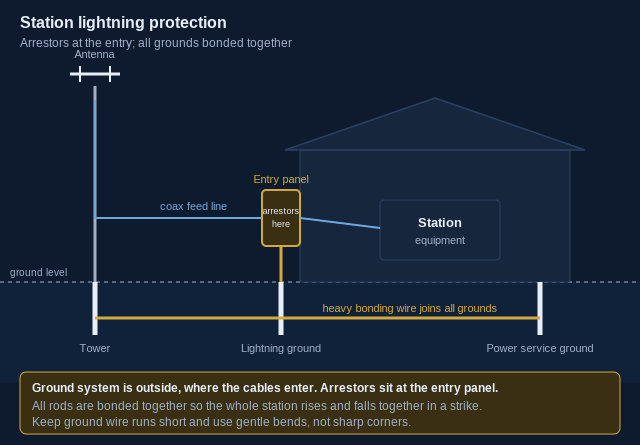
Station lightning protection: coax from the tower enters the house through an entry panel with arrestors, with ground rods outside bonded together with the tower and power grounds.
Describe this graphic in words

A tower and antenna at left, a house with station equipment at right. The coax feed line runs from the antenna to an entry panel on the outside wall where the lightning arrestors are located. Below ground, three ground rods, one at the tower, one at the entry panel and one at the power service, are joined by a heavy bonding wire. The ground system is outside the building and all grounds are bonded together.

This is a teaching note. Lightning current should be sent into the earth before it enters the house. The ground rods for the lightning system sit outside, close to where the feed lines and cables come in, and are bonded to the other grounds.

Putting it inside, next to the equipment, would bring the surge into the room. The location is chosen for the path of the current, not for convenience of the operator, and not because of the water pipe or the power pole.

Why the other choices are wrong

  • A. A ground system next to the equipment would bring the surge to the equipment instead of keeping it outside.
  • C. The nearest power pole is not where your lightning ground belongs. It is at your own entry point.
  • D. Running parallel to a water line is not a design goal.

Rule text checked against the official source on November 13, 2026. This is a study aid; the linked rule is what governs.

G0B05

Which of the following conditions will cause a ground fault circuit interrupter (GFCI) to disconnect AC power?

Show the answer and why

Answer B. Current flowing from one or more of the hot wires directly to ground

A GFCI disconnects power when current flows from a hot wire directly to ground.

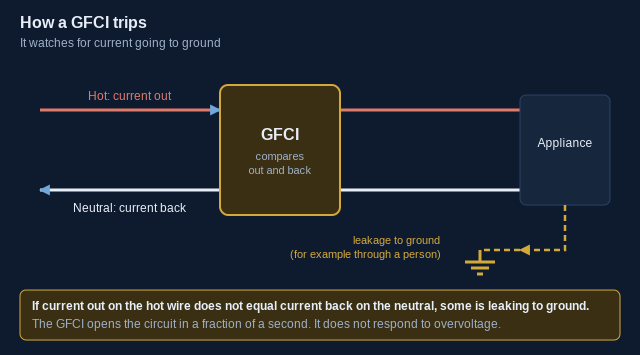
A GFCI compares current out on the hot wire with current back on the neutral and trips when some leaks to ground.
Describe this graphic in words

A GFCI sits between a source and an appliance. Current goes out on the hot wire and returns on the neutral. A dashed gold path shows leakage from the appliance to ground, for example through a person. When the current out and the current back differ because of leakage, the GFCI disconnects the power. It does not trip on overvoltage.

This is a teaching note. A GFCI compares the current going out on the hot wire with the current returning on the neutral. If some current leaks to ground, such as through a person, the two no longer match, and the GFCI opens in a fraction of a second.

Current going from hot to neutral is the normal load current, so that does not trip it, and a GFCI does not respond to overvoltage; that is a surge protector's job.

Why the other choices are wrong

  • A. Current from hot to neutral is normal load current. The GFCI looks for the imbalance caused by leakage to ground.
  • C. Overvoltage does not trip a GFCI.
  • D. "All these choices are correct" fails because A and C do not trip it.

Rule text checked against the official source on November 13, 2026. This is a study aid; the linked rule is what governs.

G0B06

Which of the following is covered by the National Electrical Code?

Show the answer and why

Answer C. Electrical safety of the station

The National Electrical Code covers the electrical safety of the station.

This is a teaching note. The National Electrical Code (NEC) is a set of rules for safe electrical installation, covering wiring, grounding, overcurrent protection and similar matters. It does not set bandwidth or modulation limits, which are in FCC Part 97, and it does not set RF exposure limits, which are in 47 CFR 1.1310.

Local building codes usually adopt the NEC, so it often applies to the wiring in a ham shack as well as to a house.

Why the other choices are wrong

  • A. Bandwidth limits are set by FCC rules, not the NEC.
  • B. Modulation limits are set by FCC rules, not the NEC.
  • D. RF exposure limits are set by the FCC in 47 CFR 1.1310.

Rule text checked against the official source on November 13, 2026. This is a study aid; the linked rule is what governs.

G0B07

Which of these choices should be observed when climbing a tower using a safety harness?

Show the answer and why

Answer B. Confirm that the harness is rated for the weight of the climber and that it is within its allowable service life

Confirm the harness is rated for the climber's weight and is still within its allowable service life.

OSHA's rules for personal fall protection systems in 29 CFR 1910.140 require components to be suited to the load and inspected before use, and to be taken out of service if defective. Manufacturers also give a service life, so a harness past its service life should not be used.

Holding the tower with one hand is not a rule, and heavy tools should not hang from the harness. Tools are better carried in a separate bag or raised on a line, because a heavy load on the harness changes how a fall behaves.

Why the other choices are wrong

  • A. Climbing practice is to stay attached by the fall protection and use both hands as needed, not to hold on with only one.
  • C. Fastening heavy tools to the harness adds load and risk. Tools should be secured separately or hoisted.
  • D. "All these choices are correct" fails because A and C are not good practice.

References

Rule text checked against the official source on November 13, 2026. This is a study aid; the linked rule is what governs.

G0B08

What should be done before climbing a tower that supports electrically powered devices?

Show the answer and why

Answer B. Make sure all circuits that supply power to the tower are locked out and tagged

Before climbing a tower with powered devices, make sure the circuits supplying them are locked out and tagged.

Lockout and tagout means isolating an energy source and attaching a lock and a tag so that no one can turn it on while you are working. OSHA's rule, 29 CFR 1910.147, describes the idea: a tagout device is a prominent warning that the energy isolating device and the equipment it controls may not be operated until the tag is removed.

That standard covers employers servicing machinery, but the practice applies to anyone working on a tower with a rotator, lights or a powered preamp. Notifying the power company or ungrounding the tower does not protect you from the equipment on the tower.

Why the other choices are wrong

  • A. The electric company does not control your tower circuits. You must isolate them yourself.
  • C. The tower should stay grounded. Removing the ground adds a shock and lightning hazard.
  • D. "All these choices are correct" fails because A and C are not appropriate.

References

Rule text checked against the official source on November 13, 2026. This is a study aid; the linked rule is what governs.

G0B09

Which of the following is true of an emergency generator installation?

Show the answer and why

Answer A. The generator should be operated in a well-ventilated area

An emergency generator should be operated in a well-ventilated area.

This is a teaching note. An engine generator makes carbon monoxide, a colorless, odorless gas that is deadly in an enclosed space. Run it outdoors, away from windows and doors, or in an area with plenty of fresh air.

Fuel should be stored away from the generator, because a spill on a hot engine can ignite. The generator frame should be grounded, not insulated from ground.

Why the other choices are wrong

  • B. A portable generator's frame is grounded as part of electrical safety. It is not insulated from ground.
  • C. Fuel stored near the generator is a fire hazard, especially when refueling a hot engine.
  • D. "All these choices are correct" fails because B and C are not good practice.

Rule text checked against the official source on November 13, 2026. This is a study aid; the linked rule is what governs.

G0B10

Which of the following is a danger from lead-tin solder?

Show the answer and why

Answer A. Lead can contaminate food if hands are not washed carefully after handling the solder

Lead from solder can contaminate food if you do not wash your hands after handling it.

Lead-tin solder contains lead, which is a toxic metal that can be swallowed from contaminated hands, food or drink. The lead exposure standard for workplaces, 29 CFR 1910.1025, is built around keeping lead out of the body, including by washing and by not eating where lead is used.

Solder does not disintegrate under high voltage, tin does not cold flow into short circuits, and RF does not turn lead into a gas. The hazard is ingesting lead dust or residue, plus fumes from the flux when heated, which you should ventilate.

Why the other choices are wrong

  • B. High voltage does not make solder disintegrate.
  • C. Tin does not cold flow into shorts in a circuit.
  • D. RF energy does not convert lead to a poisonous gas.

References

Rule text checked against the official source on November 13, 2026. This is a study aid; the linked rule is what governs.

G0B11

Which of the following is required for lightning protection ground rods?

Show the answer and why

Answer D. They must be bonded together with all other grounds

Lightning protection ground rods must be bonded together with all other grounds.

Station lightning protection: coax from the tower enters the house through an entry panel with arrestors, with ground rods outside bonded together with the tower and power grounds.
Describe this graphic in words

A tower and antenna at left, a house with station equipment at right. The coax feed line runs from the antenna to an entry panel on the outside wall where the lightning arrestors are located. Below ground, three ground rods, one at the tower, one at the entry panel and one at the power service, are joined by a heavy bonding wire. The ground system is outside the building and all grounds are bonded together.

This is a teaching note. If the lightning ground and the power or station grounds are separate, a strike can raise one of them to a very different voltage from the other, and the difference can arc through the equipment between them. Bonding them together keeps everything rising and falling together.

It does not mean connecting to water and gas lines, which can carry current into other parts of the building, and a lightning ground is not connected to ungrounded wiring. Bends in a ground wire should be gentle, not sharp, because lightning current does not follow sharp corners well.

Why the other choices are wrong

  • A. Bonding to gas lines is not the requirement, and it is a hazard.
  • B. Ground wires should have gentle bends. A sharp right angle is a poor path for the surge.
  • C. Connecting a lightning ground to ungrounded wiring would make that wiring live.

Rule text checked against the official source on November 13, 2026. This is a study aid; the linked rule is what governs.

G0B12

What is the purpose of a power supply interlock?

Show the answer and why

Answer C. To ensure that dangerous voltages are removed if the cabinet is opened

A power supply interlock ensures dangerous voltages are removed when the cabinet is opened.

An interlock is a switch on the cabinet that cuts power or discharges the supply when the cover is removed. Amplifier and power supply cabinets can have lethal voltages inside, so the interlock is a safeguard in case someone opens the case with the unit on.

It is not a thermal or overvoltage protection circuit, and it is not there for warranty purposes. Do not defeat an interlock, and still unplug the unit and discharge capacitors before working inside, as OSHA's electrical safety rules also teach.

Why the other choices are wrong

  • A. An interlock is a safety device, not a warranty seal.
  • B. Shutting down when hot is thermal protection, which is a different circuit.
  • D. Shutting off on too much voltage is overvoltage protection, a different circuit.

Rule text checked against the official source on November 13, 2026. This is a study aid; the linked rule is what governs.

G0B13

Where should lightning arrestors be located?

Show the answer and why

Answer A. Where the feed lines enter the building

Lightning arrestors should be located where the feed lines enter the building.

Station lightning protection: coax from the tower enters the house through an entry panel with arrestors, with ground rods outside bonded together with the tower and power grounds.
Describe this graphic in words

A tower and antenna at left, a house with station equipment at right. The coax feed line runs from the antenna to an entry panel on the outside wall where the lightning arrestors are located. Below ground, three ground rods, one at the tower, one at the entry panel and one at the power service, are joined by a heavy bonding wire. The ground system is outside the building and all grounds are bonded together.

This is a teaching note. An arrestor diverts surge current on a coax line to a ground. It is placed at the entry point and bonded to the entry panel and the outside ground system, so the surge is stopped before it travels into the house.

Putting it at the antenna, in series with the ground leads, or at a power pole does not do the job. The arrestor needs a short, direct path to the station's single point ground.

Why the other choices are wrong

  • B. An arrestor at the antenna end does not stop a surge from traveling along the line toward the building.
  • C. A ground lead is not a place for an arrestor. It would add impedance to the path you want low.
  • D. The closest power pole is unrelated to your feed line entry.

Rule text checked against the official source on November 13, 2026. This is a study aid; the linked rule is what governs.