Which mode is most commonly used for voice communications on frequencies of 14 MHz or higher?
Show the answer and why
Answer A. Upper sideband
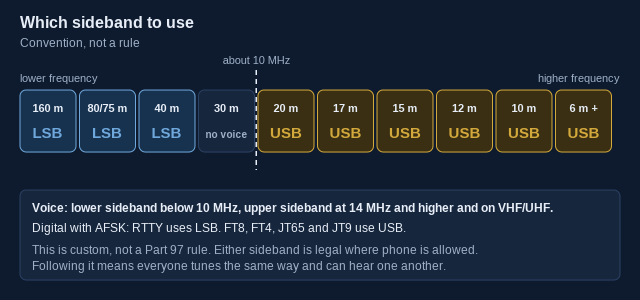
Upper sideband is the convention for voice on 14 MHz and above.
Describe this graphic in words
A row of band boxes in frequency order. 160, 80/75 and 40 meters are marked lower sideband. 30 meters is marked no voice. 20, 17, 15, 12 and 10 meters and 6 meters and up are marked upper sideband. A dashed line at about 10 MHz separates the two. Below, a note says digital RTTY with AFSK uses LSB while FT8, FT4, JT65 and JT9 use USB, and that this is custom, not a Part 97 rule.
This is a teaching note. Amateurs use lower sideband below 10 MHz and upper sideband at 14 MHz and higher. It is a custom, not a rule, so that everyone tunes the same way and can hear one another.
Worked example: a station on 14.250 MHz USB transmits audio from 14.250 to about 14.2528 MHz, just above the displayed carrier frequency.
Why the other choices are wrong
- B. Lower sideband is the custom on 160, 75 and 40 m, not at 14 MHz and up.
- C. "Suppressed sideband" is not a mode. In SSB the carrier and one sideband are suppressed.
- D. Double sideband is a different mode and is not the usual voice choice at HF.
Rule text checked against the official source on November 13, 2026. This is a study aid; the linked rule is what governs.