
ARSC Tech School

General G3B: Maximum Usable Frequency

423 questions · pool July 1, 2023 to June 30, 2027 · the exam has 35 questions; 26 to pass

G3 · RADIO WAVE PROPAGATION

Maximum Usable Frequency; Lowest Usable Frequency; short path and long path propagation; determining propagation conditions; ionospheric refraction

12 questions in group G3B

One question from this group appears on each exam.

G3B01

What is a characteristic of skywave signals arriving at your location by both short-path and long-path propagation?

Show the answer and why

Answer D. A slightly delayed echo might be heard

When a signal arrives by both short path and long path, you may hear a slightly delayed echo.

This is a teaching note. The two paths have different lengths, so the same signal arrives at slightly different times. The delay sounds like an echo. In the worst cases the two signals add or cancel as they interfere, causing fading.

Why the other choices are wrong

  • A. A fading period of about 10 seconds is not characteristic of this effect.
  • B. The signal does not become 3 dB stronger from this effect.
  • C. Cancellation can occur, but the typical characteristic is an echo.

Rule text checked against the official source on November 13, 2026. This is a study aid; the linked rule is what governs.
G3B02

What factors affect the MUF?

Show the answer and why

Answer D. All these choices are correct

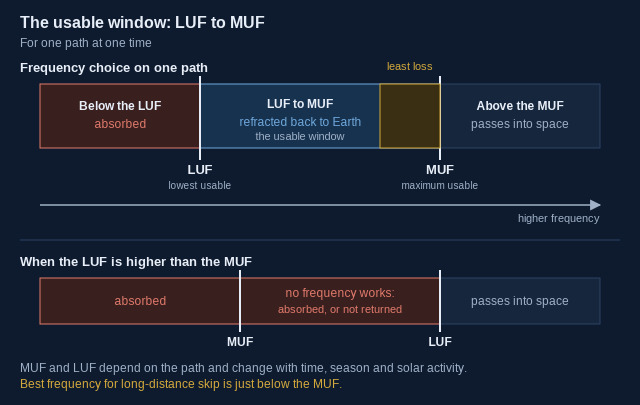
All of these factors affect the maximum usable frequency (MUF): path distance and location, time of day and season, and solar radiation and ionospheric disturbances.

Frequencies below the LUF are absorbed, between the LUF and MUF they are refracted back to Earth, and above the MUF they pass into space; if the LUF is above the MUF no skywave frequency works.
Describe this graphic in words

A frequency axis with three zones. Below the lowest usable frequency, or LUF, signals are absorbed. Between the LUF and the maximum usable frequency, or MUF, signals are refracted back to Earth, which is the usable window. Frequencies just below the MUF have the least loss and are highlighted. Above the MUF signals pass into space. A second axis shows the LUF above the MUF, leaving no frequency that works by skywave on that path. Both depend on the path and change with time, season and solar activity.

This is a teaching note. The MUF is the highest frequency that the ionosphere will bend back to a given location. It changes with the path, with the day-night cycle and the seasons, and with solar activity and disturbances.

Why the other choices are wrong

  • A. Path and location affect it, but so do the other factors.
  • B. Time and season affect it, but so do the other factors.
  • C. Solar radiation affects it, but so do the other factors.

Rule text checked against the official source on November 13, 2026. This is a study aid; the linked rule is what governs.

G3B03

Which frequency will have the least attenuation for long-distance skip propagation?

Show the answer and why

Answer A. Just below the MUF

Frequencies just below the MUF have the least attenuation for long-distance skip.

Frequencies below the LUF are absorbed, between the LUF and MUF they are refracted back to Earth, and above the MUF they pass into space; if the LUF is above the MUF no skywave frequency works.
Describe this graphic in words

A frequency axis with three zones. Below the lowest usable frequency, or LUF, signals are absorbed. Between the LUF and the maximum usable frequency, or MUF, signals are refracted back to Earth, which is the usable window. Frequencies just below the MUF have the least loss and are highlighted. Above the MUF signals pass into space. A second axis shows the LUF above the MUF, leaving no frequency that works by skywave on that path. Both depend on the path and change with time, season and solar activity.

This is a teaching note. Absorption by the lower ionosphere falls as frequency goes up. The highest frequency that is still refracted back is just below the MUF, so it has the lowest loss. Above the MUF the signal passes through and is lost to space.

Why the other choices are wrong

  • B. Just above the LUF the signal is close to the limit of absorption and has the most loss.
  • C. The critical frequency is a vertical-incidence limit, not the best choice for long skip.
  • D. Just above the critical frequency is not the best for long-distance paths.

Rule text checked against the official source on November 13, 2026. This is a study aid; the linked rule is what governs.

G3B04

Which of the following is a way to determine current propagation on a desired band from your station?

Show the answer and why

Answer A. Use a network of automated receiving stations on the internet to see where your transmissions are being received

A network of automated receiving stations on the internet shows where your transmissions are being received.

This is a teaching note. Systems such as automated receiver networks decode signals from many stations and report who heard whom. Sending your signal and looking at the map shows current propagation from your station. The A-index describes the geomagnetic field and does not tell you where your signal goes, and "sending dots" to hear echoes is not a method.

Why the other choices are wrong

  • B. The A-index describes geomagnetic disturbance but not where a particular signal is heard.
  • C. Echoes of dots are not a propagation test.
  • D. "All these choices" fails because B and C are not effective.

Rule text checked against the official source on November 13, 2026. This is a study aid; the linked rule is what governs.

G3B05

How does the ionosphere affect radio waves with frequencies below the MUF and above the LUF?

Show the answer and why

Answer A. They are refracted back to Earth

Frequencies below the MUF and above the LUF are refracted back to Earth.

Frequencies below the LUF are absorbed, between the LUF and MUF they are refracted back to Earth, and above the MUF they pass into space; if the LUF is above the MUF no skywave frequency works.
Describe this graphic in words

A frequency axis with three zones. Below the lowest usable frequency, or LUF, signals are absorbed. Between the LUF and the maximum usable frequency, or MUF, signals are refracted back to Earth, which is the usable window. Frequencies just below the MUF have the least loss and are highlighted. Above the MUF signals pass into space. A second axis shows the LUF above the MUF, leaving no frequency that works by skywave on that path. Both depend on the path and change with time, season and solar activity.

This is a teaching note. The usable window for a path lies between the LUF and the MUF. Above the MUF the signal passes through the ionosphere. Below the LUF it is absorbed. In between, the ionosphere bends it back to Earth.

Why the other choices are wrong

  • B. Waves above the MUF pass through.
  • C. The ionosphere does not amplify radio waves.
  • D. Waves are not trapped to circle the Earth under these conditions.

Rule text checked against the official source on November 13, 2026. This is a study aid; the linked rule is what governs.

G3B06

What usually happens to radio waves with frequencies below the LUF?

Show the answer and why

Answer C. They are attenuated before reaching the destination

Frequencies below the LUF are usually absorbed before reaching the destination.

Frequencies below the LUF are absorbed, between the LUF and MUF they are refracted back to Earth, and above the MUF they pass into space; if the LUF is above the MUF no skywave frequency works.
Describe this graphic in words

A frequency axis with three zones. Below the lowest usable frequency, or LUF, signals are absorbed. Between the LUF and the maximum usable frequency, or MUF, signals are refracted back to Earth, which is the usable window. Frequencies just below the MUF have the least loss and are highlighted. Above the MUF signals pass into space. A second axis shows the LUF above the MUF, leaving no frequency that works by skywave on that path. Both depend on the path and change with time, season and solar activity.

This is a teaching note. The lowest usable frequency is where absorption by the D region becomes too great to leave a usable signal. Below it, the signal is attenuated before reaching the destination.

Why the other choices are wrong

  • A. Refraction back to Earth happens between the LUF and MUF.
  • B. Passing through the ionosphere happens above the MUF.
  • D. Signals are not trapped to circle Earth below the LUF.

Rule text checked against the official source on November 13, 2026. This is a study aid; the linked rule is what governs.

G3B07

What does LUF stand for?

Show the answer and why

Answer A. The Lowest Usable Frequency for communications between two specific points

LUF stands for the Lowest Usable Frequency for communications between two specific points.

Frequencies below the LUF are absorbed, between the LUF and MUF they are refracted back to Earth, and above the MUF they pass into space; if the LUF is above the MUF no skywave frequency works.
Describe this graphic in words

A frequency axis with three zones. Below the lowest usable frequency, or LUF, signals are absorbed. Between the LUF and the maximum usable frequency, or MUF, signals are refracted back to Earth, which is the usable window. Frequencies just below the MUF have the least loss and are highlighted. Above the MUF signals pass into space. A second axis shows the LUF above the MUF, leaving no frequency that works by skywave on that path. Both depend on the path and change with time, season and solar activity.

This is a teaching note. The LUF depends on the path, so there is no single LUF for a band or a day. It is the lowest frequency at which a signal over a given path is strong enough to be useful.

Why the other choices are wrong

  • B. The LUF is not defined as for communications outside a 100 mile radius.
  • C. It is not defined over a 24 hour period.
  • D. It is not defined over the past 60 minutes.

Rule text checked against the official source on November 13, 2026. This is a study aid; the linked rule is what governs.

G3B08

What does MUF stand for?

Show the answer and why

Answer B. The Maximum Usable Frequency for communications between two points

MUF stands for the Maximum Usable Frequency for communications between two points.

Frequencies below the LUF are absorbed, between the LUF and MUF they are refracted back to Earth, and above the MUF they pass into space; if the LUF is above the MUF no skywave frequency works.
Describe this graphic in words

A frequency axis with three zones. Below the lowest usable frequency, or LUF, signals are absorbed. Between the LUF and the maximum usable frequency, or MUF, signals are refracted back to Earth, which is the usable window. Frequencies just below the MUF have the least loss and are highlighted. Above the MUF signals pass into space. A second axis shows the LUF above the MUF, leaving no frequency that works by skywave on that path. Both depend on the path and change with time, season and solar activity.

This is a teaching note. The MUF is the highest frequency that will be refracted back to Earth over a given path under the current conditions. It is not a minimum, and it is for a particular pair of points, not a 24 hour figure.

Why the other choices are wrong

  • A. The M stands for maximum, not minimum.
  • C. It is not a minimum value over 24 hours.
  • D. It is for a particular path at a particular time, not a 24 hour maximum.

Rule text checked against the official source on November 13, 2026. This is a study aid; the linked rule is what governs.

G3B09

What is the approximate maximum distance along the Earth’s surface normally covered in one hop using the F2 region?

Show the answer and why

Answer C. 2,500 miles

A single F2 hop covers up to about 2,500 miles.

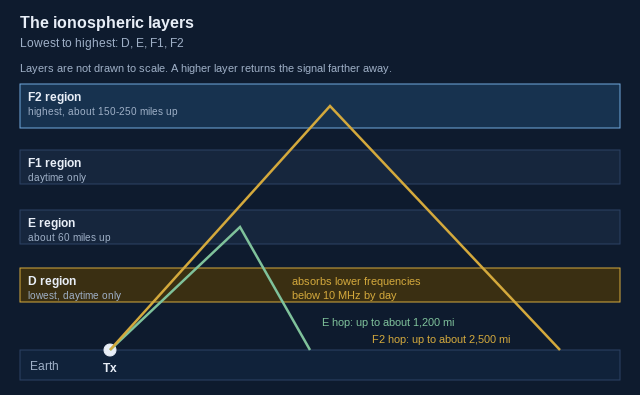
Cross-section of the ionosphere: D region lowest, then E, F1 and F2; one E hop reaches about 1,200 miles and one F2 hop about 2,500 miles.
Describe this graphic in words

Horizontal bands from the ground upward: the D region, lowest and present in daytime only, highlighted because it absorbs signals below 10 MHz by day; the E region at about 60 miles; the F1 region, daytime only; and the F2 region, the highest at about 150 to 250 miles. A path from a transmitter through the E region lands about 1,200 miles away. A path through the F2 region lands about 2,500 miles away. A higher layer returns the signal farther from the transmitter. Layers are not to scale.

This is a teaching note. The F2 region is the highest layer, at roughly 150 to 250 miles up. A signal leaving at a very low angle can reach about 2,500 miles along the surface before it returns. Longer distances need multiple hops.

Why the other choices are wrong

  • A. 180 miles is much shorter than an F2 hop.
  • B. 1,200 miles is the approximate maximum for an E region hop.
  • D. 12,000 miles is more than half way around the Earth, which takes several hops.

Rule text checked against the official source on November 13, 2026. This is a study aid; the linked rule is what governs.

G3B10

What is the approximate maximum distance along the Earth’s surface normally covered in one hop using the E region?

Show the answer and why

Answer B. 1,200 miles

A single E region hop covers up to about 1,200 miles.

Cross-section of the ionosphere: D region lowest, then E, F1 and F2; one E hop reaches about 1,200 miles and one F2 hop about 2,500 miles.
Describe this graphic in words

Horizontal bands from the ground upward: the D region, lowest and present in daytime only, highlighted because it absorbs signals below 10 MHz by day; the E region at about 60 miles; the F1 region, daytime only; and the F2 region, the highest at about 150 to 250 miles. A path from a transmitter through the E region lands about 1,200 miles away. A path through the F2 region lands about 2,500 miles away. A higher layer returns the signal farther from the transmitter. Layers are not to scale.

This is a teaching note. The E region is lower, at about 60 miles up, so a signal returned from it reaches a shorter distance than one from the F2 region. About 1,200 miles is the approximate limit.

Why the other choices are wrong

  • A. 180 miles is much shorter than an E hop.
  • C. 2,500 miles is the F2 distance.
  • D. 12,000 miles would take many hops.

Rule text checked against the official source on November 13, 2026. This is a study aid; the linked rule is what governs.

G3B11

What happens to HF propagation when the LUF exceeds the MUF?

Show the answer and why

Answer A. Propagation via ordinary skywave communications is not possible over that path

When the LUF exceeds the MUF, ordinary skywave communication over the path is not possible.

Frequencies below the LUF are absorbed, between the LUF and MUF they are refracted back to Earth, and above the MUF they pass into space; if the LUF is above the MUF no skywave frequency works.
Describe this graphic in words

A frequency axis with three zones. Below the lowest usable frequency, or LUF, signals are absorbed. Between the LUF and the maximum usable frequency, or MUF, signals are refracted back to Earth, which is the usable window. Frequencies just below the MUF have the least loss and are highlighted. Above the MUF signals pass into space. A second axis shows the LUF above the MUF, leaving no frequency that works by skywave on that path. Both depend on the path and change with time, season and solar activity.

This is a teaching note. The usable range is between the LUF and the MUF. If the LUF is higher than the MUF, there is no frequency that is both strong enough and refracted back, so the band is closed on that path.

Why the other choices are wrong

  • B. Communications are not enhanced when the window closes.
  • C. Double-hop propagation does not become more common.
  • D. Propagation on all frequencies is not enhanced.

Rule text checked against the official source on November 13, 2026. This is a study aid; the linked rule is what governs.

G3B12

Which of the following is typical of the lower HF frequencies during the summer?

Show the answer and why

Answer D. High levels of atmospheric noise or static

High levels of atmospheric noise or static are typical of the lower HF frequencies during the summer.

This is a teaching note. Thunderstorms are more frequent in summer, and their lightning produces static that travels well on the lower HF bands. That noise often limits what you can hear on 160, 80 and 40 meters in summer.

Why the other choices are wrong

  • A. Propagation is not poor at any time of day. Nighttime conditions are fine.
  • B. Worldwide propagation in daylight on lower HF is not typical, because the D region absorbs them.
  • C. Photon absorption does not cause distortion in this way.

Rule text checked against the official source on November 13, 2026. This is a study aid; the linked rule is what governs.