
ARSC Tech School

General G0A: RF safety principles, rules, and guidelines

423 questions · pool July 1, 2023 to June 30, 2027 · the exam has 35 questions; 26 to pass

G0 · ELECTRICAL AND RF SAFETY

RF safety principles, rules, and guidelines; routine station evaluation

12 questions in group G0A

One question from this group appears on each exam.

G0A01

What is one way that RF energy can affect human body tissue?

Show the answer and why

Answer A. It heats body tissue

RF energy at amateur frequencies can heat body tissue.

The body absorbs some of the RF energy that reaches it, and the absorbed energy becomes heat. The FCC's exposure limits in 47 CFR 1.1310 are set to prevent harmful heating, which is why they are stated as specific absorption rate (SAR) and as power density.

Radio waves at amateur frequencies are non-ionizing, so they do not cause radiation poisoning, and they do not change blood counts or cool tissue. A related effect is that tissue with poor blood flow, such as the lens of the eye, cools less well and is more sensitive to heating.

Why the other choices are wrong

  • B. Radiation poisoning comes from ionizing radiation. RF at amateur frequencies is non-ionizing.
  • C. RF exposure at permitted levels does not lower the blood count.
  • D. The effect of absorbed RF is heating, not cooling.

References

Rule text checked against the official source on November 12, 2026. This is a study aid; the linked rule is what governs.
G0A02

Which of the following is used to determine RF exposure from a transmitted signal?

Show the answer and why

Answer D. All these choices are correct

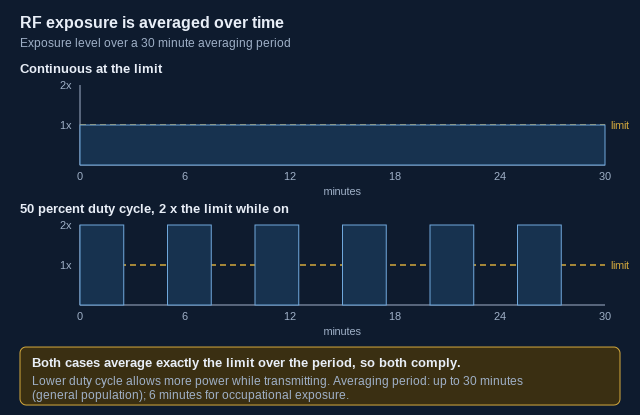
Exposure depends on the signal's duty cycle, its frequency, and its power density, so all of them are used.

Two charts of RF exposure over 30 minutes. A continuous signal at the limit and a signal at twice the limit that is on half the time both average to the limit.
Describe this graphic in words

The top chart shows a steady signal at the exposure limit for 30 minutes. The bottom chart shows six pulses at twice the limit, each on for 2.5 minutes and off for 2.5 minutes, a 50 percent duty cycle. The average of both over the period equals the limit, so both comply. A lower duty cycle permits a higher level while transmitting. The averaging period is up to 30 minutes for the general population and 6 minutes for occupational exposure.

The limits in 47 CFR 1.1310 are different at different frequencies, they are expressed as power density, and they are averaged over time, so the duty cycle of the signal changes the average a person receives. To judge a signal you need all three.

Worked example: if the limit at your frequency is 0.2 mW/cm2 and your transmitter is keyed 50 percent of the time, the average exposure is half of the power density measured while transmitting.

Why the other choices are wrong

  • A. Duty cycle is used, but so are frequency and power density.
  • B. Frequency is used, but so are duty cycle and power density.
  • C. Power density is used, but so are duty cycle and frequency.

References

Rule text checked against the official source on November 12, 2026. This is a study aid; the linked rule is what governs.

G0A03FCC rule 97.13(c)(1)

How can you determine that your station complies with FCC RF exposure regulations?

Show the answer and why

Answer D. All these choices are correct

FCC rule 97.13(c)(1)

You may show compliance by calculation using OET Bulletin 65, by computer modeling, or by measurement with calibrated equipment.

Section 97.13(c)(1) requires the licensee to ensure compliance with the RF exposure rules and says appropriate methods and guidance for amateur stations are in OET Bulletin 65, Supplement B. That bulletin describes calculation, and the rules also accept technically supported computer modeling and measurement.

For many stations a simple calculation is enough, but a very close or high power antenna may call for modeling or a calibrated field measurement.

Why the other choices are wrong

  • A. A calculation based on OET Bulletin 65 is allowed, but so are the other methods.
  • B. Computer modeling is allowed, but so are the other methods.
  • C. Measurement with calibrated equipment is allowed, but so are the other methods.

References

Rule text checked against the official source on November 12, 2026. This is a study aid; the linked rule is what governs.

G0A04

What does “time averaging” mean when evaluating RF radiation exposure?

Show the answer and why

Answer D. The total RF exposure averaged over a certain period

Time averaging means the total RF exposure averaged over a certain period.

Two charts of RF exposure over 30 minutes. A continuous signal at the limit and a signal at twice the limit that is on half the time both average to the limit.
Describe this graphic in words

The top chart shows a steady signal at the exposure limit for 30 minutes. The bottom chart shows six pulses at twice the limit, each on for 2.5 minutes and off for 2.5 minutes, a 50 percent duty cycle. The average of both over the period equals the limit, so both comply. A lower duty cycle permits a higher level while transmitting. The averaging period is up to 30 minutes for the general population and 6 minutes for occupational exposure.

The exposure limits are averages over a period of time. A level above the limit is acceptable for a short time as long as the average over the full averaging period stays within the limit. Section 1.1307 describes the averaging period for a fixed RF source as not more than 30 minutes, and 1.1310 uses 6 minutes for occupational exposure and 30 minutes for the general population.

Worked example: for a 30 minute period, 15 minutes of exposure at twice the limit followed by 15 minutes at zero averages exactly to the limit.

Why the other choices are wrong

  • A. It is not an average of transmitter power over 24 hours. The period is at most 30 minutes.
  • B. It is not the time for effects to appear. It is an averaging period for exposure.
  • C. It is not the total time of the exposure. It is the exposure averaged over a period.

References

Rule text checked against the official source on November 12, 2026. This is a study aid; the linked rule is what governs.

G0A05FCC rule 97.13(c)(2), 1.1307(b)

What must you do if an evaluation of your station shows that the RF energy radiated by your station exceeds permissible limits for possible human absorption?

Show the answer and why

Answer A. Take action to prevent human exposure to the excessive RF fields

FCC rule 97.13(c)(2), 1.1307(b)

If your station exceeds the limits, you must take action to prevent human exposure to the excessive fields.

Section 97.13(c)(2) says that if a routine evaluation indicates the RF fields could exceed the limits in accessible areas, the licensee "must take action to prevent human exposure to such RF electromagnetic fields." Typical actions are lowering power, moving or raising the antenna, restricting access, or limiting operating time.

There is no Environmental Impact Statement form for this, and there is no neighbor permission process that lets you operate above the limits.

Why the other choices are wrong

  • B. No "EIS-97" filing exists. The required action is to prevent the exposure.
  • C. Neighbors cannot give permission to exceed the limits for the general population.
  • D. "All these choices are correct" fails because B and C are not required or allowed.

References

Rule text checked against the official source on November 12, 2026. This is a study aid; the linked rule is what governs.

G0A06FCC rule 97.13(c)(2), 1.1307(1)(b)(3)(i)

What must you do if your station fails to meet the FCC RF exposure exemption criteria?

Show the answer and why

Answer A. Perform an RF exposure evaluation in accordance with FCC OET Bulletin 65

FCC rule 97.13(c)(2), 1.1307(1)(b)(3)(i)

If your station does not meet the exemption criteria, you must perform an RF exposure evaluation, following OET Bulletin 65.

Section 1.1307(b)(3) lists the conditions under which a source is exempt from the routine evaluation. A source that does not qualify must, under 1.1307(b)(1), have an evaluation showing compliance with the limits in 1.1310. Section 97.13(c) points amateurs to OET Bulletin 65, Supplement B for how to do it.

The exemption is only from the obligation to evaluate. It is not an exemption from the exposure limits themselves.

Why the other choices are wrong

  • B. You do not need permission from the FCC to transmit. You need to show compliance.
  • C. The World Meteorological Organization has no role in RF exposure evaluation.
  • D. No FCC-approved band-pass filter is needed. A filter does not change exposure.

References

Rule text checked against the official source on November 12, 2026. This is a study aid; the linked rule is what governs.

G0A07

What is the effect of modulation duty cycle on RF exposure?

Show the answer and why

Answer A. A lower duty cycle permits greater power levels to be transmitted

A lower duty cycle permits greater power to be transmitted, because the average exposure is lower.

Two charts of RF exposure over 30 minutes. A continuous signal at the limit and a signal at twice the limit that is on half the time both average to the limit.
Describe this graphic in words

The top chart shows a steady signal at the exposure limit for 30 minutes. The bottom chart shows six pulses at twice the limit, each on for 2.5 minutes and off for 2.5 minutes, a 50 percent duty cycle. The average of both over the period equals the limit, so both comply. A lower duty cycle permits a higher level while transmitting. The averaging period is up to 30 minutes for the general population and 6 minutes for occupational exposure.

Exposure limits apply to the time-averaged exposure. A transmitter that is on only part of the time delivers less average power than one on continuously, so the power while on can be higher for the same average.

Worked example: SSB voice on average keys the output well below its peak, and a mode that transmits 50 percent of the time can run at twice the power for the same average exposure. No duty cycle makes a station exempt from the limits; it only changes the average.

Why the other choices are wrong

  • B. A higher duty cycle raises the average, so it permits less power, not more.
  • C. Low duty cycle does not exempt a station from the evaluation requirements.
  • D. High duty cycle does not exempt a station. It makes compliance harder.

References

Rule text checked against the official source on November 12, 2026. This is a study aid; the linked rule is what governs.

G0A08FCC rule 97.13(c)(2)

Which of the following steps must an amateur operator take to ensure compliance with RF safety regulations?

Show the answer and why

Answer C. Perform a routine RF exposure evaluation and prevent access to any identified high exposure areas

FCC rule 97.13(c)(2)

You must perform a routine RF exposure evaluation and prevent access to any areas identified as having high exposure.

Section 97.13(c) requires the licensee to ensure compliance with the RF exposure rules and, if the evaluation shows the limits could be exceeded in accessible areas, to take action to prevent exposure. That is an evaluation, then mitigation if needed.

Posting a copy of the rule and notifying neighbors are not required by Part 97.

Why the other choices are wrong

  • A. Part 97 does not require a copy of 97.13 to be posted in the station.
  • B. No rule requires notifying neighbors within 100 feet.
  • D. "All these choices are correct" fails because A and B are not required.

References

Rule text checked against the official source on November 12, 2026. This is a study aid; the linked rule is what governs.

G0A09

What type of instrument can be used to accurately measure an RF field strength?

Show the answer and why

Answer B. A calibrated field strength meter with a calibrated antenna

A calibrated field strength meter with a calibrated antenna can accurately measure an RF field.

This is a teaching note. To measure a field you need an instrument whose response is known across the frequency range of interest, together with a probe or antenna of known characteristics. A calibrated field strength meter with a calibrated antenna is that combination.

A receiver with noise reduction, an SWR meter and an oscilloscope all show other things, such as received signal level, reflected power or waveform, and none of them is calibrated to give field strength.

Why the other choices are wrong

  • A. A receiver with DSP noise reduction is not calibrated for field strength, and noise reduction changes what you see.
  • C. An SWR meter measures impedance mismatch on a feed line, not field strength.
  • D. An oscilloscope with a marker generator shows waveforms and timing, not RF field strength.

Rule text checked against the official source on November 12, 2026. This is a study aid; the linked rule is what governs.

G0A10

What should be done if evaluation shows that a neighbor might experience more than the allowable limit of RF exposure from the main lobe of a directional antenna?

Show the answer and why

Answer C. Take precautions to ensure that the antenna cannot be pointed in their direction when they are present

Take precautions to ensure the antenna cannot be pointed toward the neighbor when they are present.

Section 97.13(c)(2) requires action to prevent exposure above the limits. For a directional antenna the main lobe carries the most energy, so the practical fix is to control where it points: limit the rotation, or do not transmit when it is aimed at the neighbor's occupied area.

Changing polarization or choosing a higher front-to-back ratio does not reduce what the main lobe delivers, and a higher gain antenna would increase it.

Why the other choices are wrong

  • A. A higher gain antenna concentrates more power in the main lobe, which makes exposure worse.
  • B. A better front-to-back ratio reduces the rear lobe. The exposure here is from the main lobe.
  • D. "All these choices are correct" fails because A and B do not solve the problem.

References

Rule text checked against the official source on November 12, 2026. This is a study aid; the linked rule is what governs.

G0A11

What precaution should be taken if you install an indoor transmitting antenna?

Show the answer and why

Answer C. Make sure that MPE limits are not exceeded in occupied areas

With an indoor antenna, make sure the maximum permissible exposure (MPE) limits are not exceeded in occupied areas.

An indoor antenna puts the radiating element close to people, so the distance in the exposure calculation is small and the field can be strong. The same 97.13(c) duty applies: evaluate, and prevent exposure above the limits in places people can be.

Moving the antenna nearer the operating position makes things worse, not better, and neither wall placement nor shielding is a substitute for checking the exposure in the occupied rooms.

Why the other choices are wrong

  • A. Placing the antenna close to the operating position puts the operator closer to the radiating element, which raises exposure.
  • B. Where the antenna sits on a wall is not the point. The exposure in occupied areas is.
  • D. Shielding an antenna would defeat its radiation. The check is on the field in occupied areas.

References

Rule text checked against the official source on November 12, 2026. This is a study aid; the linked rule is what governs.

G0A12FCC rule 1.1307(1)(b)(3)(i)(A)

What stations are subject to the FCC rules on RF exposure?

Show the answer and why

Answer D. All stations with a time-averaged transmission of more than one milliwatt

FCC rule 1.1307(1)(b)(3)(i)(A)

A station is subject to the rules if its time-averaged transmitter power is more than one milliwatt.

Section 1.1307(b)(3)(i)(A) exempts a single RF source from the routine evaluation if its available maximum time-averaged power is no more than 1 mW. Above that, a source can be exempt only under the other tests (the thresholds in (B) and (C)), or it must be evaluated.

So amateur stations are not exempt as a class, and the rules are not limited to commercial stations, high antennas or 500 watt stations. Note that even an exempt source must still comply with the limits in 1.1310.

Why the other choices are wrong

  • A. Amateur stations are not exempt as a class.
  • B. Antenna height above ground is not the criterion.
  • C. There is no 500 watt PEP cutoff in the rule.

References

Rule text checked against the official source on November 12, 2026. This is a study aid; the linked rule is what governs.