
What happens when inductive and capacitive reactance are equal in a series LC circuit?
Show the answer and why
Answer C. Resonance causes impedance to be very low
In a series LC circuit at resonance, the impedance is very low.
Describe this graphic in words
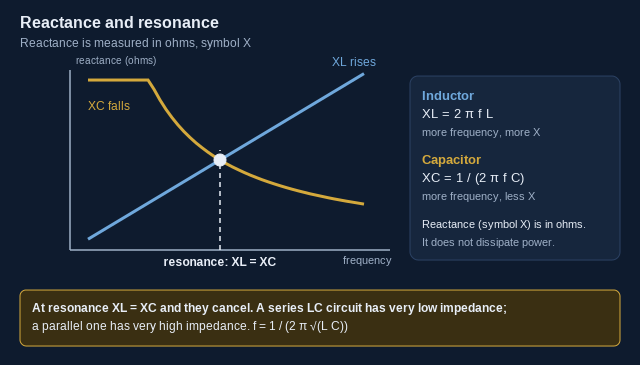
A graph of reactance in ohms against frequency. The inductive reactance, XL, is a rising line. The capacitive reactance, XC, is a falling curve. The two cross at the resonant frequency, where XL equals XC and they cancel. Side formulas give XL as 2 pi f L and XC as 1 over 2 pi f C. A note says a series LC circuit has very low impedance at resonance and a parallel one very high.
This is a teaching note. At resonance the inductive reactance and the capacitive reactance are equal. They act in opposite senses, so they cancel, and only the small resistance of the circuit is left. The current is then at its maximum.
A parallel LC circuit is the opposite: its impedance is very high at resonance.
Why the other choices are wrong
- A. Very high impedance at resonance is the behavior of a parallel LC circuit, not a series one.
- B. Impedance is not a geometric mean of inductance and capacitance.
- D. Impedance is not an arithmetic mean of inductance and capacitance.
Rule text checked against the official source on November 17, 2026. This is a study aid; the linked rule is what governs.