
ARSC Tech School

General G6B: Analog and digital integrated circuits (ICs)

423 questions · pool July 1, 2023 to June 30, 2027 · the exam has 35 questions; 26 to pass

G6 · CIRCUIT COMPONENTS

Analog and digital integrated circuits (ICs); microwave ICs (MMICs); display devices; RF connectors; ferrite cores

11 questions in group G6B

One question from this group appears on each exam.

G6B01

What determines the performance of a ferrite core at different frequencies?

Show the answer and why

Answer C. The composition, or “mix,” of materials used

The composition, or mix, of the ferrite material determines how a core performs at different frequencies.
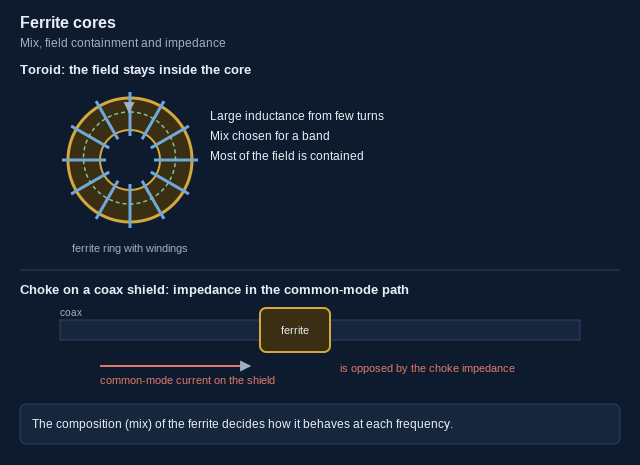
A ferrite toroid keeps its magnetic field inside the core, and a ferrite choke on a coax shield adds impedance to common-mode current.
Describe this graphic in words

Top: a ferrite ring with windings; the toroid gives a large inductance from few turns, the mix can be chosen for a band, and most of the magnetic field is contained in the core. Bottom: a ferrite choke on a coax cable adds impedance in the path of the common-mode current on the shield. The composition, or mix, of the ferrite decides how it behaves at each frequency.

This is a teaching note. Ferrite cores are made with different mixes of materials. One mix works well at HF and another at VHF. The shape and size of the core are secondary. The same bead can be good as a choke on one band and poor on another.

Why the other choices are wrong

  • A. Conductivity is not what sets the frequency performance.
  • B. Thickness is not what sets the frequency performance.
  • D. The diameter ratio affects inductance but not the frequency response of the material.

Rule text checked against the official source on November 17, 2026. This is a study aid; the linked rule is what governs.
G6B02

What is meant by the term MMIC?

Show the answer and why

Answer B. Monolithic Microwave Integrated Circuit

MMIC stands for Monolithic Microwave Integrated Circuit.

This is a teaching note. An MMIC is a small amplifier or other circuit built on a single piece of semiconductor, designed for microwave frequencies. Many hobby preamps and drivers use them.

Why the other choices are wrong

  • A. "Multi-Mode Integrated Circuit" is not the meaning.
  • C. "Metal Monolayer Integrated Circuit" is not the meaning.
  • D. "Mode Modulated Integrated Circuit" is not the meaning.

Rule text checked against the official source on November 17, 2026. This is a study aid; the linked rule is what governs.

G6B03

Which of the following is an advantage of CMOS integrated circuits compared to TTL integrated circuits?

Show the answer and why

Answer A. Low power consumption

CMOS integrated circuits have low power consumption compared to TTL.

This is a teaching note. A CMOS gate uses very little current when it is not switching, so it is the common choice for battery equipment. TTL draws a steady current in both states.

Why the other choices are wrong

  • B. CMOS logic is not noted for high power handling.
  • C. CMOS logic is not a better RF amplifier.
  • D. Neither logic family is a power supply regulator.

Rule text checked against the official source on November 17, 2026. This is a study aid; the linked rule is what governs.

G6B04

What is a typical upper frequency limit for low SWR operation of 50-ohm BNC connectors?

Show the answer and why

Answer C. 4 GHz

A typical upper frequency limit for low SWR on 50-ohm BNC connectors is 4 GHz.

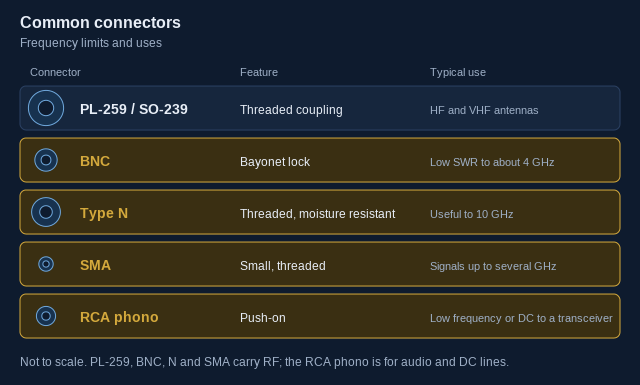
Table of connectors: PL-259 for HF and VHF, BNC to about 4 GHz, type N moisture resistant to 10 GHz, SMA small threaded for several GHz, and RCA phono for low frequency or DC.
Describe this graphic in words

Five rows. PL-259 and SO-239 have a threaded coupling and are used on HF and VHF antennas. BNC has a bayonet lock and gives low SWR to about 4 GHz. Type N is threaded and moisture resistant, useful to 10 GHz. SMA is small and threaded and handles signals up to several GHz. The RCA phono is a push-on connector for low frequency or DC connections to a transceiver.

This is a teaching note. BNC connectors are used on test equipment and radios. Their bayonet lock and design keep the impedance steady to about 4 GHz. Above that the SWR rises.

Why the other choices are wrong

  • A. 50 MHz is far below the limit.
  • B. 500 MHz is below the limit.
  • D. 40 GHz is far above the limit for a BNC connector.

Rule text checked against the official source on November 17, 2026. This is a study aid; the linked rule is what governs.

G6B05

What is an advantage of using a ferrite core toroidal inductor?

Show the answer and why

Answer D. All these choices are correct

A ferrite core toroidal inductor can give large inductance, can be optimized for a range of frequencies, and contains most of its field.

A ferrite toroid keeps its magnetic field inside the core, and a ferrite choke on a coax shield adds impedance to common-mode current.
Describe this graphic in words

Top: a ferrite ring with windings; the toroid gives a large inductance from few turns, the mix can be chosen for a band, and most of the magnetic field is contained in the core. Bottom: a ferrite choke on a coax cable adds impedance in the path of the common-mode current on the shield. The composition, or mix, of the ferrite decides how it behaves at each frequency.

This is a teaching note. The ferrite increases the permeability, so fewer turns give a lot of inductance. Different mixes suit different bands. The ring shape keeps most of the magnetic field inside the core, so it couples little to nearby parts.

Why the other choices are wrong

  • A. This is an advantage, but not the only one.
  • B. This is an advantage, but not the only one.
  • C. This is an advantage, but not the only one.

Rule text checked against the official source on November 17, 2026. This is a study aid; the linked rule is what governs.

G6B06

What kind of device is an integrated circuit operational amplifier?

Show the answer and why

Answer D. Analog

An integrated circuit operational amplifier is an analog device.

This is a teaching note. An op amp amplifies continuously varying voltages. It is used in filters, audio amplifiers and similar circuits. It is not a logic or programmable device, and it is not an MMIC.

Why the other choices are wrong

  • A. Digital devices work with two-state signals.
  • B. An MMIC is a microwave device.
  • C. Programmable logic is digital.

Rule text checked against the official source on November 17, 2026. This is a study aid; the linked rule is what governs.

G6B07

Which of the following describes a type N connector?

Show the answer and why

Answer A. A moisture-resistant RF connector useful to 10 GHz

A type N connector is a moisture-resistant RF connector useful to 10 GHz.

Table of connectors: PL-259 for HF and VHF, BNC to about 4 GHz, type N moisture resistant to 10 GHz, SMA small threaded for several GHz, and RCA phono for low frequency or DC.
Describe this graphic in words

Five rows. PL-259 and SO-239 have a threaded coupling and are used on HF and VHF antennas. BNC has a bayonet lock and gives low SWR to about 4 GHz. Type N is threaded and moisture resistant, useful to 10 GHz. SMA is small and threaded and handles signals up to several GHz. The RCA phono is a push-on connector for low frequency or DC connections to a transceiver.

This is a teaching note. The N connector is a threaded, weather-sealed connector. It is used on VHF, UHF and microwave antennas and equipment. It performs well to about 10 GHz and above.

Why the other choices are wrong

  • B. A small bayonet connector is a BNC.
  • C. N is not described as a low noise figure VHF connector.
  • D. It is not a nickel-plated PL-259, which is a different connector.

Rule text checked against the official source on November 17, 2026. This is a study aid; the linked rule is what governs.

G6B08

How is an LED biased when emitting light?

Show the answer and why

Answer D. Forward biased

An LED emits light when it is forward biased.

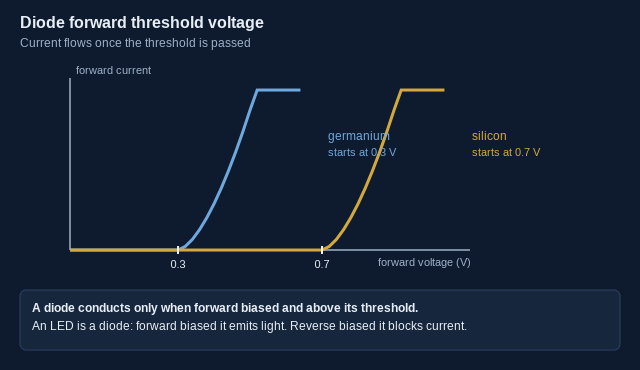
Diode forward current curves: germanium starts conducting at about 0.3 volts and silicon at about 0.7 volts.
Describe this graphic in words

A graph of forward current against forward voltage. The germanium diode curve turns upward at about 0.3 volts. The silicon diode curve turns upward at about 0.7 volts. A note says a diode conducts only when forward biased above its threshold, and that an LED is a diode that emits light when forward biased.

This is a teaching note. An LED is a diode. When forward voltage is applied, current flows and the junction emits light. Reverse bias blocks the current, and there is no light.

Why the other choices are wrong

  • A. A tunnel effect region is how a tunnel diode works.
  • B. A Zener voltage is the reverse breakdown voltage used for regulation.
  • C. Reverse bias does not produce light.

Rule text checked against the official source on November 17, 2026. This is a study aid; the linked rule is what governs.

G6B10

How does a ferrite bead or core reduce common-mode RF current on the shield of a coaxial cable?

Show the answer and why

Answer A. By creating an impedance in the current’s path

A ferrite bead or core reduces common-mode RF current by creating an impedance in the current's path.

A ferrite toroid keeps its magnetic field inside the core, and a ferrite choke on a coax shield adds impedance to common-mode current.
Describe this graphic in words

Top: a ferrite ring with windings; the toroid gives a large inductance from few turns, the mix can be chosen for a band, and most of the magnetic field is contained in the core. Bottom: a ferrite choke on a coax cable adds impedance in the path of the common-mode current on the shield. The composition, or mix, of the ferrite decides how it behaves at each frequency.

This is a teaching note. The ferrite adds impedance in the path of current that flows on the outside of the coax shield, which is the common-mode current. The current is reduced and its energy dissipated as heat. The wanted signal inside the coax is not affected.

Why the other choices are wrong

  • B. It does not convert common-mode current to differential mode.
  • C. It does not make an out-of-phase current to cancel.
  • D. Ferrites do not expel magnetic fields. They concentrate them.

Rule text checked against the official source on November 17, 2026. This is a study aid; the linked rule is what governs.

G6B11

What is an SMA connector?

Show the answer and why

Answer B. A small threaded connector suitable for signals up to several GHz

An SMA connector is a small threaded connector for signals up to several GHz.

Table of connectors: PL-259 for HF and VHF, BNC to about 4 GHz, type N moisture resistant to 10 GHz, SMA small threaded for several GHz, and RCA phono for low frequency or DC.
Describe this graphic in words

Five rows. PL-259 and SO-239 have a threaded coupling and are used on HF and VHF antennas. BNC has a bayonet lock and gives low SWR to about 4 GHz. Type N is threaded and moisture resistant, useful to 10 GHz. SMA is small and threaded and handles signals up to several GHz. The RCA phono is a push-on connector for low frequency or DC connections to a transceiver.

This is a teaching note. SMA connectors are common on handheld radios, test gear and microwave equipment. They have a threaded coupling, and a small size. They are used up to many GHz depending on the cable and construction.

Why the other choices are wrong

  • A. It is not a type-S to type-M adaptor.
  • C. SMA does not stand for serial multiple access.
  • D. It is not a push-on connector for high voltage.

Rule text checked against the official source on November 17, 2026. This is a study aid; the linked rule is what governs.

G6B12

Which of these connector types is commonly used for low frequency or dc signal connections to a transceiver?

Show the answer and why

Answer C. RCA Phono

The RCA phono connector is commonly used for low frequency or dc connections to a transceiver.

Table of connectors: PL-259 for HF and VHF, BNC to about 4 GHz, type N moisture resistant to 10 GHz, SMA small threaded for several GHz, and RCA phono for low frequency or DC.
Describe this graphic in words

Five rows. PL-259 and SO-239 have a threaded coupling and are used on HF and VHF antennas. BNC has a bayonet lock and gives low SWR to about 4 GHz. Type N is threaded and moisture resistant, useful to 10 GHz. SMA is small and threaded and handles signals up to several GHz. The RCA phono is a push-on connector for low frequency or DC connections to a transceiver.

This is a teaching note. RCA plugs are used for audio, keying, ALC and other low frequency or DC lines on the back of a transceiver. The PL-259 and the N and BNC types carry RF.

Why the other choices are wrong

  • A. The PL-259 is an RF connector used for HF and VHF antennas.
  • B. The BNC is an RF connector.
  • D. The type N is an RF connector.

Rule text checked against the official source on November 17, 2026. This is a study aid; the linked rule is what governs.