
ARSC Tech School

General G4C: Interference to consumer electronics

423 questions · pool July 1, 2023 to June 30, 2027 · the exam has 35 questions; 26 to pass

G4 · AMATEUR RADIO PRACTICES

Interference to consumer electronics; grounding and bonding

12 questions in group G4C

One question from this group appears on each exam.

G4C01

Which of the following might be useful in reducing RF interference to audio frequency circuits?

Show the answer and why

Answer B. Bypass capacitor

A bypass capacitor helps reduce RF interference to audio circuits.

This is a teaching note. A capacitor offers a very low impedance to RF and a high impedance to audio. Connected from the audio line to ground, it shunts RF to ground and lets the audio pass.

Why the other choices are wrong

  • A. A series inductor would block RF, but "bypass inductor" is not the standard fix.
  • C. A forward-biased diode would conduct and distort audio.
  • D. A reverse-biased diode would not shunt RF.

Rule text checked against the official source on November 17, 2026. This is a study aid; the linked rule is what governs.
G4C02

Which of the following could be a cause of interference covering a wide range of frequencies?

Show the answer and why

Answer C. Arcing at a poor electrical connection

Arcing at a poor electrical connection can cause interference over a wide range of frequencies.

This is a teaching note. A spark is a very short pulse, and a very short pulse contains energy at all frequencies. A loose or corroded connection that arcs makes broadband noise that can be heard far from its source.

Why the other choices are wrong

  • A. Missing balun or isolator produces common-mode current, not wide-range noise.
  • B. This is not a real cause.
  • D. Using a balun to feed an unbalanced antenna does not produce wide-range noise.

Rule text checked against the official source on November 17, 2026. This is a study aid; the linked rule is what governs.
G4C03

What sound is heard from an audio device experiencing RF interference from a single sideband phone transmitter?

Show the answer and why

Answer C. Distorted speech

SSB interference to an audio device sounds like distorted speech.

This is a teaching note. The audio device rectifies RF and demodulates it, but an SSB signal has no carrier, so the speech comes out garbled and hard to understand. An AM signal, which has a carrier, can come through clearly.

Why the other choices are wrong

  • A. A steady hum is not typical of SSB.
  • B. On-and-off humming is typical of CW.
  • D. Without a carrier, the speech is not clearly audible.

Rule text checked against the official source on November 17, 2026. This is a study aid; the linked rule is what governs.

G4C04

What sound is heard from an audio device experiencing RF interference from a CW transmitter?

Show the answer and why

Answer A. On-and-off humming or clicking

CW interference to an audio device sounds like on-and-off humming or clicking.

This is a teaching note. A CW transmitter turns RF on and off with the key. The audio device rectifies the RF, so it hears a thump or click each time the key goes down and up.

Why the other choices are wrong

  • B. A pure tone is not what the key makes in an audio device.
  • C. A chirpy signal is a transmitter fault, not interference to an audio device.
  • D. Severely distorted audio is more typical of SSB.

Rule text checked against the official source on November 17, 2026. This is a study aid; the linked rule is what governs.

G4C05

What is a possible cause of high voltages that produce RF burns?

Show the answer and why

Answer D. The ground wire has high impedance on that frequency

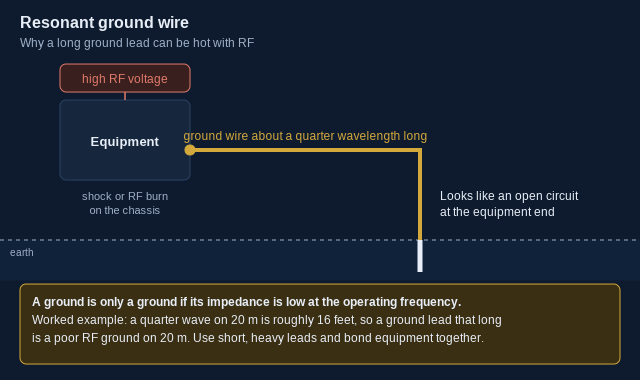
A ground wire that has high impedance at that frequency can have high voltages that cause RF burns.

A ground wire about a quarter wavelength long looks like an open circuit at the equipment end, producing high RF voltage on the chassis.
Describe this graphic in words

Equipment connected by a long ground wire to a ground rod. The wire is about a quarter wavelength, so at the equipment end it looks like an open circuit and high RF voltage appears there, causing shock or RF burn hazards. A note says a ground is only a ground if its impedance is low at the operating frequency, and that a quarter wave on 20 meters is about 16 feet.

This is a teaching note. An RF ground is only a ground if its impedance is low at the operating frequency. A wire that is about a quarter wavelength long looks like a very high impedance at the end that connects to the equipment, so high RF voltage appears on it, and on the chassis. Touching it can cause an RF burn.

Worked example: a quarter wave on 20 m is roughly 16 feet. A ground lead of about that length would be a poor RF ground on 20 m.

Why the other choices are wrong

  • A. Flat braid usually has a lower impedance than round wire.
  • B. Insulated wire is not the cause.
  • C. A ground rod does not become resonant in this way.

Rule text checked against the official source on November 17, 2026. This is a study aid; the linked rule is what governs.

G4C06

What is a possible effect of a resonant ground connection?

Show the answer and why

Answer C. High RF voltages on the enclosures of station equipment

A resonant ground connection can put high RF voltages on the enclosures of station equipment.

A ground wire about a quarter wavelength long looks like an open circuit at the equipment end, producing high RF voltage on the chassis.
Describe this graphic in words

Equipment connected by a long ground wire to a ground rod. The wire is about a quarter wavelength, so at the equipment end it looks like an open circuit and high RF voltage appears there, causing shock or RF burn hazards. A note says a ground is only a ground if its impedance is low at the operating frequency, and that a quarter wave on 20 meters is about 16 feet.

This is a teaching note. A quarter-wavelength ground lead acts like an open circuit at the equipment end. RF voltage builds up there instead of being shunted to ground, so the chassis or cabinet can be hot with RF.

Why the other choices are wrong

  • A. Overheating of ground straps is not the usual effect.
  • B. Corrosion is a chemical effect, not due to resonance.
  • D. A ground loop is a different problem.

Rule text checked against the official source on November 17, 2026. This is a study aid; the linked rule is what governs.

G4C07

Why should soldered joints not be used in lightning protection ground connections?

Show the answer and why

Answer A. A soldered joint will likely be destroyed by the heat of a lightning strike

A soldered joint will likely be destroyed by the heat of a lightning strike.

This is a teaching note. Lightning drives a very large current through the connection. Solder melts at a low temperature, so a soldered joint can open at the moment it is needed. Lightning grounds use clamps, bolts, or welded joints that can survive the heat.

Why the other choices are wrong

  • B. Flux does not stop a soldered joint from conducting.
  • C. The dielectric constant of solder is not a factor.
  • D. "All these choices" fails because B and C are not the reason.

Rule text checked against the official source on November 17, 2026. This is a study aid; the linked rule is what governs.

G4C08

Which of the following would reduce RF interference caused by common-mode current on an audio cable?

Show the answer and why

Answer A. Place a ferrite choke on the cable

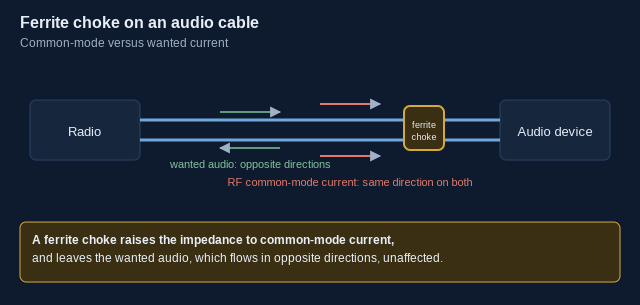
A ferrite choke on the cable can reduce common-mode RF interference on an audio cable.

A ferrite choke on an audio cable blocks common-mode RF current but passes the wanted audio.
Describe this graphic in words

A radio connected to an audio device by a two-conductor cable. The wanted audio flows in opposite directions on the two conductors and passes. RF common-mode current flows in the same direction on both and is blocked by a ferrite choke placed on the cable.

This is a teaching note. Common-mode current flows in the same direction on all the conductors of a cable. A ferrite core raises the impedance to that current while leaving the wanted signal, which flows in opposite directions on the conductors, unaffected.

Why the other choices are wrong

  • B. Shorting the center conductor to the shield would short the audio signal.
  • C. Grounding the center conductor would short the audio signal.
  • D. An extra jacket does not change the electrical path.

Rule text checked against the official source on November 17, 2026. This is a study aid; the linked rule is what governs.

G4C09

How can the effects of ground loops be minimized?

Show the answer and why

Answer D. Bond equipment enclosures together

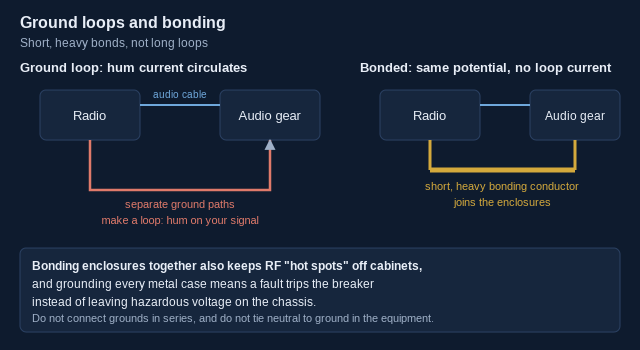
Bonding equipment enclosures together helps minimize ground loops.

Left: separate ground paths form a loop that causes hum. Right: bonding the equipment enclosures together keeps them at the same potential.
Describe this graphic in words

On the left, a radio and audio gear are connected by an audio cable and have separate ground paths forming a loop with a red current, which produces hum on your transmitted signal. On the right, the same equipment has a short heavy bonding conductor joining the enclosures, so they are at the same potential and no loop current flows. A note says bonding also prevents RF hot spots, and that grounding every metal case means a fault trips the breaker instead of leaving a hazardous voltage on the chassis.

This is a teaching note. A ground loop is a loop of conductor between pieces of equipment, with a current driven around it by a difference in potential. Bonding the enclosures together with short, heavy conductors holds them at the same potential, so no current is driven between them.

Why the other choices are wrong

  • A. Connecting grounds in series creates a long path with high impedance.
  • B. Connecting the AC neutral to the ground wire is unsafe and creates loops.
  • C. Lock and star washers help make good contact, so avoiding them does not help.

Rule text checked against the official source on November 17, 2026. This is a study aid; the linked rule is what governs.

G4C10

What could be a symptom caused by a ground loop in your station’s audio connections?

Show the answer and why

Answer A. You receive reports of “hum” on your station’s transmitted signal

A ground loop can cause hum on your transmitted signal.

Left: separate ground paths form a loop that causes hum. Right: bonding the equipment enclosures together keeps them at the same potential.
Describe this graphic in words

On the left, a radio and audio gear are connected by an audio cable and have separate ground paths forming a loop with a red current, which produces hum on your transmitted signal. On the right, the same equipment has a short heavy bonding conductor joining the enclosures, so they are at the same potential and no loop current flows. A note says bonding also prevents RF hot spots, and that grounding every metal case means a fault trips the breaker instead of leaving a hazardous voltage on the chassis.

This is a teaching note. Current in a ground loop adds a 60 Hz or 120 Hz voltage to the audio, which is heard as hum on your signal. Bonding and a single point for audio grounds cure it.

Why the other choices are wrong

  • B. A high SWR is an antenna or feed line problem.
  • C. Excess current is not caused by a ground loop.
  • D. Harmonic interference comes from the transmitter, not from a ground loop.

Rule text checked against the official source on November 17, 2026. This is a study aid; the linked rule is what governs.

G4C11

What technique helps to minimize RF “hot spots” in an amateur station?

Show the answer and why

Answer C. Bonding all equipment enclosures together

Bonding all the equipment enclosures together helps minimize RF hot spots.

Left: separate ground paths form a loop that causes hum. Right: bonding the equipment enclosures together keeps them at the same potential.
Describe this graphic in words

On the left, a radio and audio gear are connected by an audio cable and have separate ground paths forming a loop with a red current, which produces hum on your transmitted signal. On the right, the same equipment has a short heavy bonding conductor joining the enclosures, so they are at the same potential and no loop current flows. A note says bonding also prevents RF hot spots, and that grounding every metal case means a fault trips the breaker instead of leaving a hazardous voltage on the chassis.

This is a teaching note. Hot spots are places where RF voltage builds up on cabinets. If the enclosures are bonded together, they are at the same RF potential, and no voltage appears between them or on the case.

Why the other choices are wrong

  • A. A metal enclosure alone does not stop hot spots.
  • B. Surge suppressors protect against surges, not RF.
  • D. Low-pass filters reduce harmonics, not hot spots.

Rule text checked against the official source on November 17, 2026. This is a study aid; the linked rule is what governs.

G4C12

Why must all metal enclosures of station equipment be grounded?

Show the answer and why

Answer D. It ensures that hazardous voltages cannot appear on the chassis

All metal enclosures must be grounded so hazardous voltages cannot appear on the chassis.

Left: separate ground paths form a loop that causes hum. Right: bonding the equipment enclosures together keeps them at the same potential.
Describe this graphic in words

On the left, a radio and audio gear are connected by an audio cable and have separate ground paths forming a loop with a red current, which produces hum on your transmitted signal. On the right, the same equipment has a short heavy bonding conductor joining the enclosures, so they are at the same potential and no loop current flows. A note says bonding also prevents RF hot spots, and that grounding every metal case means a fault trips the breaker instead of leaving a hazardous voltage on the chassis.

This is a teaching note. If a hot wire touches the chassis inside the equipment, a grounded case carries the fault current, so the fuse or breaker opens. An ungrounded case would stay live and could shock whoever touched it.

Why the other choices are wrong

  • A. The purpose is not to prevent a blown fuse. A blown fuse is the desired result of a fault.
  • B. Grounding does not prevent signal overload.
  • C. Grounding the case does not ground the neutral.

Rule text checked against the official source on November 17, 2026. This is a study aid; the linked rule is what governs.