
ARSC Tech School

General G3A: Sunspots and solar radiation

423 questions · pool July 1, 2023 to June 30, 2027 · the exam has 35 questions; 26 to pass

G3 · RADIO WAVE PROPAGATION

Sunspots and solar radiation; geomagnetic field and stability indices

14 questions in group G3A

One question from this group appears on each exam.

G3A01

How does a higher sunspot number affect HF propagation?

Show the answer and why

Answer A. Higher sunspot numbers generally indicate a greater probability of good propagation at higher frequencies

Higher sunspot numbers generally mean a greater chance of good propagation at higher frequencies.
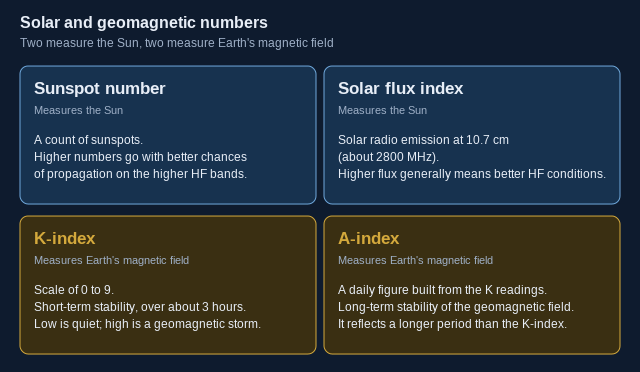
Four cards: sunspot number and solar flux measure the Sun; K-index and A-index measure the stability of Earth's magnetic field.
Describe this graphic in words

Four panels. The sunspot number is a count of sunspots, and higher numbers mean better chances of propagation on the higher bands. The solar flux index is the solar radio emission at 10.7 centimeters, about 2800 MHz. The K-index, on a scale of 0 to 9, measures the short-term stability of Earth's geomagnetic field. The A-index is a daily figure that measures the longer-term stability of Earth's geomagnetic field.

This is a teaching note. More sunspots go with more ultraviolet and X-ray output from the Sun. That ionizes the upper atmosphere more strongly, so the ionosphere can bend higher frequencies back to Earth. Near the peak of the solar cycle, 15, 12 and 10 meters open to long distances more often.

A sunspot number of zero does not shut off radio. Lower bands still work, and the number says nothing about sporadic E.

Why the other choices are wrong

  • B. Sporadic E does not follow low sunspot numbers in that way.
  • C. Even with a zero sunspot number the lower HF bands still support propagation.
  • D. A sunspot number of zero does not by itself describe undisturbed conditions.

Rule text checked against the official source on November 13, 2026. This is a study aid; the linked rule is what governs.
G3A02

What effect does a sudden ionospheric disturbance have on the daytime ionospheric propagation?

Show the answer and why

Answer B. It disrupts signals on lower frequencies more than those on higher frequencies

A sudden ionospheric disturbance disrupts signals on lower frequencies more than on higher ones.

This is a teaching note. A solar flare sends a burst of X-rays that suddenly increases ionization in the D region on the sunlit side of the Earth. The D region absorbs lower frequencies the most, so signals on the lower HF bands fade or disappear, sometimes for minutes to hours. Higher frequencies are absorbed less and may be less affected.

Why the other choices are wrong

  • A. The disturbance does not improve propagation on any HF band.
  • C. Satellite paths above the D region are affected less than HF paths through it.
  • D. The sunlit side is the side affected. The night side is not.

Rule text checked against the official source on November 13, 2026. This is a study aid; the linked rule is what governs.

G3A03

Approximately how long does it take the increased ultraviolet and X-ray radiation from a solar flare to affect radio propagation on Earth?

Show the answer and why

Answer C. 8 minutes

The increased ultraviolet and X-ray radiation from a solar flare reaches Earth in about 8 minutes.

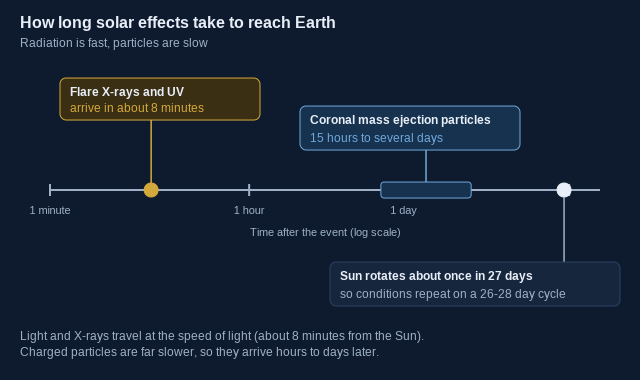
Log timeline: flare radiation arrives in about 8 minutes, coronal mass ejection particles in 15 hours to several days, and the Sun rotates about every 27 days.
Describe this graphic in words

A log-scale time axis from one minute to one month. A gold marker at about 8 minutes shows when flare X-rays and ultraviolet arrive. A blue bar from 15 hours to several days shows the arrival of coronal mass ejection particles. A marker at 27 days shows the rotation period of the Sun, which makes conditions repeat on a 26 to 28 day cycle.

This is a teaching note. Light and X-rays travel at the speed of light. The Sun is about 93 million miles away, and light covers that in about 8.3 minutes, so the effect on the ionosphere begins about 8 minutes after the flare.

Particles from the Sun are much slower. They take hours or days, as in the coronal mass ejection question.

Why the other choices are wrong

  • A. 28 days is about one rotation of the Sun, not the travel time of radiation.
  • B. 1 to 2 hours is too slow for light-speed radiation.
  • D. 20 to 40 hours is closer to the time for charged particles.

Rule text checked against the official source on November 13, 2026. This is a study aid; the linked rule is what governs.

G3A04

Which of the following are the least reliable bands for long-distance communications during periods of low solar activity?

Show the answer and why

Answer D. 15 meters, 12 meters, and 10 meters

The higher bands, 15, 12 and 10 meters, are the least reliable for long distance during low solar activity.

This is a teaching note. At low solar activity the ionosphere is weakly ionized, so higher frequencies pass through it instead of bending back. The highest HF bands may be closed for days, while the lower bands, such as 80 and 40 meters, work best then.

Why the other choices are wrong

  • A. 80 and 160 meters are good at low solar activity, mainly at night.
  • B. 60 and 40 meters work well at night in low solar activity.
  • C. 30 and 20 meters are usable at low activity, though less than at the peak.

Rule text checked against the official source on November 13, 2026. This is a study aid; the linked rule is what governs.

G3A05

What is the solar flux index?

Show the answer and why

Answer D. A measure of solar radiation with a wavelength of 10.7 centimeters

The solar flux index is a measure of solar radiation at a wavelength of 10.7 centimeters.

Four cards: sunspot number and solar flux measure the Sun; K-index and A-index measure the stability of Earth's magnetic field.
Describe this graphic in words

Four panels. The sunspot number is a count of sunspots, and higher numbers mean better chances of propagation on the higher bands. The solar flux index is the solar radio emission at 10.7 centimeters, about 2800 MHz. The K-index, on a scale of 0 to 9, measures the short-term stability of Earth's geomagnetic field. The A-index is a daily figure that measures the longer-term stability of Earth's geomagnetic field.

This is a teaching note. The solar flux index is the strength of the Sun's radio emission at 2800 MHz, which is a wavelength of 10.7 cm. It is measured daily and follows the ionization of the upper atmosphere. Higher flux generally means better HF conditions at the higher bands.

Why the other choices are wrong

  • A. The highest useful frequency is the MUF, not the flux index.
  • B. A sunspot count is the sunspot number, a different measure.
  • C. The flux index is not another name for the sunspot number, though the two usually rise and fall together.

Rule text checked against the official source on November 13, 2026. This is a study aid; the linked rule is what governs.

G3A06

What is a geomagnetic storm?

Show the answer and why

Answer D. A temporary disturbance in Earth’s geomagnetic field

A geomagnetic storm is a temporary disturbance in Earth's geomagnetic field.

This is a teaching note. Charged particles from the Sun, often from a coronal mass ejection or a coronal hole, strike Earth's magnetic field and disturb it. The disturbance lasts hours to days and can disrupt HF propagation, especially near the poles.

Why the other choices are wrong

  • A. A drop in the flux index is not a geomagnetic storm.
  • B. A thunderstorm is a weather event.
  • C. "Ripples in the geomagnetic force" is not a defined term.

Rule text checked against the official source on November 13, 2026. This is a study aid; the linked rule is what governs.

G3A07

At what point in the solar cycle does the 20-meter band usually support worldwide propagation during daylight hours?

Show the answer and why

Answer D. At any point

The 20 meter band can usually support worldwide propagation during the day at any point in the solar cycle.

This is a teaching note. 20 meters sits in a range that the daytime ionosphere supports even when solar activity is low. It is the most reliable DX band overall, and at the minimum of the cycle it is often the best band that is open. At the maximum it stays open later into the evening.

Why the other choices are wrong

  • A. The summer solstice is not the factor.
  • B. The band does not need the maximum to open.
  • C. The band does not work only at the minimum.

Rule text checked against the official source on November 13, 2026. This is a study aid; the linked rule is what governs.

G3A08

How can a geomagnetic storm affect HF propagation?

Show the answer and why

Answer D. Degrade high-latitude HF propagation

A geomagnetic storm can degrade high-latitude HF propagation.

This is a teaching note. Disturbances in the geomagnetic field act most strongly near the poles. Paths that cross the polar regions suffer absorption and fading, sometimes losing the band altogether. Ground wave is not affected because it does not use the ionosphere.

Why the other choices are wrong

  • A. The effect at high latitudes is worse, not better.
  • B. Ground wave does not depend on the ionosphere.
  • C. Ground wave is not improved by a geomagnetic storm.

Rule text checked against the official source on November 13, 2026. This is a study aid; the linked rule is what governs.

G3A09

How can high geomagnetic activity benefit radio communications?

Show the answer and why

Answer A. Creates auroras that can reflect VHF signals

High geomagnetic activity can create auroras that reflect VHF signals.

This is a teaching note. Auroras form when charged particles excite the upper atmosphere near the poles. The ionized curtains reflect VHF signals, so stations at high and mid latitudes can make contacts by aiming toward the aurora. The signals sound raspy because of the motion of the reflecting region.

Why the other choices are wrong

  • B. Signals passing through the polar regions are generally weakened during high activity.
  • C. High activity does not improve long path propagation.
  • D. It does not reduce long delayed echoes.

Rule text checked against the official source on November 13, 2026. This is a study aid; the linked rule is what governs.

G3A10

What causes HF propagation conditions to vary periodically in a 26- to 28-day cycle?

Show the answer and why

Answer C. Rotation of the Sun’s surface layers around its axis

The 26 to 28 day cycle comes from the rotation of the Sun's surface layers around its axis.

Log timeline: flare radiation arrives in about 8 minutes, coronal mass ejection particles in 15 hours to several days, and the Sun rotates about every 27 days.
Describe this graphic in words

A log-scale time axis from one minute to one month. A gold marker at about 8 minutes shows when flare X-rays and ultraviolet arrive. A blue bar from 15 hours to several days shows the arrival of coronal mass ejection particles. A marker at 27 days shows the rotation period of the Sun, which makes conditions repeat on a 26 to 28 day cycle.

This is a teaching note. The Sun rotates about once every 27 days as seen from Earth. A sunspot group or coronal hole that affects propagation faces Earth once per rotation, so conditions can repeat about every 27 days.

Why the other choices are wrong

  • A. Upper atmosphere oscillations do not follow this cycle.
  • B. Earth's radiation belts do not cause this cycle.
  • D. The Moon's orbit takes about 27.3 days, but it does not control the Sun's ionizing output.

Rule text checked against the official source on November 13, 2026. This is a study aid; the linked rule is what governs.

G3A11

How long does it take a coronal mass ejection to affect radio propagation on Earth?

Show the answer and why

Answer D. 15 hours to several days

A coronal mass ejection takes about 15 hours to several days to affect propagation.

Log timeline: flare radiation arrives in about 8 minutes, coronal mass ejection particles in 15 hours to several days, and the Sun rotates about every 27 days.
Describe this graphic in words

A log-scale time axis from one minute to one month. A gold marker at about 8 minutes shows when flare X-rays and ultraviolet arrive. A blue bar from 15 hours to several days shows the arrival of coronal mass ejection particles. A marker at 27 days shows the rotation period of the Sun, which makes conditions repeat on a 26 to 28 day cycle.

This is a teaching note. A coronal mass ejection is a cloud of charged particles thrown out by the Sun. It travels far more slowly than light, so it arrives at Earth hours to days later. Radiation from a flare arrives in minutes, but the cloud takes longer.

Why the other choices are wrong

  • A. 28 days is the solar rotation period.
  • B. 14 days is far longer than the usual travel time.
  • C. 4 to 8 minutes is about the light travel time, not the speed of a particle cloud.

Rule text checked against the official source on November 13, 2026. This is a study aid; the linked rule is what governs.

G3A12

What does the K-index measure?

Show the answer and why

Answer B. The short-term stability of Earth’s geomagnetic field

The K-index measures the short-term stability of Earth's geomagnetic field.

Four cards: sunspot number and solar flux measure the Sun; K-index and A-index measure the stability of Earth's magnetic field.
Describe this graphic in words

Four panels. The sunspot number is a count of sunspots, and higher numbers mean better chances of propagation on the higher bands. The solar flux index is the solar radio emission at 10.7 centimeters, about 2800 MHz. The K-index, on a scale of 0 to 9, measures the short-term stability of Earth's geomagnetic field. The A-index is a daily figure that measures the longer-term stability of Earth's geomagnetic field.

This is a teaching note. The K-index is a number from 0 to 9 that describes disturbance of the geomagnetic field over a short period, typically three hours. A low K means quiet conditions and a high K means a storm.

Why the other choices are wrong

  • A. It does not measure the position of sunspots.
  • C. It measures Earth's field, not the Sun's.
  • D. The solar flux is a different measure.

Rule text checked against the official source on November 13, 2026. This is a study aid; the linked rule is what governs.

G3A13

What does the A-index measure?

Show the answer and why

Answer C. The long-term stability of Earth’s geomagnetic field

The A-index measures the long-term stability of Earth's geomagnetic field.

Four cards: sunspot number and solar flux measure the Sun; K-index and A-index measure the stability of Earth's magnetic field.
Describe this graphic in words

Four panels. The sunspot number is a count of sunspots, and higher numbers mean better chances of propagation on the higher bands. The solar flux index is the solar radio emission at 10.7 centimeters, about 2800 MHz. The K-index, on a scale of 0 to 9, measures the short-term stability of Earth's geomagnetic field. The A-index is a daily figure that measures the longer-term stability of Earth's geomagnetic field.

This is a teaching note. The A-index is a daily figure derived from the K readings. It describes the overall level of geomagnetic activity for a day, so it reflects a longer period than the K-index.

Why the other choices are wrong

  • A. It does not measure sunspot positions.
  • B. It does not measure polarization of the Sun's electric field.
  • D. The solar flux is a different measure.

Rule text checked against the official source on November 13, 2026. This is a study aid; the linked rule is what governs.

G3A14

How is long distance radio communication usually affected by the charged particles that reach Earth from solar coronal holes?

Show the answer and why

Answer B. HF communication is disturbed

Charged particles from coronal holes usually disturb HF communication.

This is a teaching note. A coronal hole is a region where the Sun's magnetic field opens, letting a fast stream of particles flow out. When it reaches Earth, it can cause geomagnetic disturbances, which degrade HF propagation, especially on high-latitude paths.

Why the other choices are wrong

  • A. The effect is generally a degradation, not an improvement.
  • C. VHF/UHF ducting is a weather effect in the lower atmosphere, not helped by these particles.
  • D. VHF and UHF ducting is not affected in this way.

Rule text checked against the official source on November 13, 2026. This is a study aid; the linked rule is what governs.