
ARSC Tech School

General G3C: Ionospheric regions

423 questions · pool July 1, 2023 to June 30, 2027 · the exam has 35 questions; 26 to pass

G3 · RADIO WAVE PROPAGATION

Ionospheric regions; critical angle and frequency; HF scatter; near vertical incidence skywave (NVIS)

11 questions in group G3C

One question from this group appears on each exam.

G3C01

Which ionospheric region is closest to the surface of Earth?

Show the answer and why

Answer A. The D region

The D region is the ionospheric region closest to the surface of Earth.
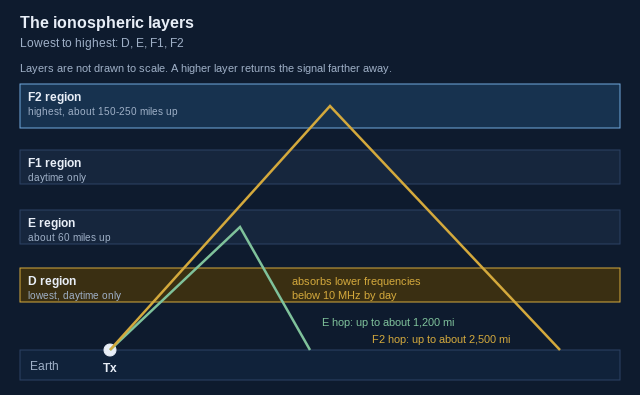
Cross-section of the ionosphere: D region lowest, then E, F1 and F2; one E hop reaches about 1,200 miles and one F2 hop about 2,500 miles.
Describe this graphic in words

Horizontal bands from the ground upward: the D region, lowest and present in daytime only, highlighted because it absorbs signals below 10 MHz by day; the E region at about 60 miles; the F1 region, daytime only; and the F2 region, the highest at about 150 to 250 miles. A path from a transmitter through the E region lands about 1,200 miles away. A path through the F2 region lands about 2,500 miles away. A higher layer returns the signal farther from the transmitter. Layers are not to scale.

This is a teaching note. The ionospheric layers from lowest to highest are D, E, F1 and F2. The D region sits at about 30 to 60 miles. It exists only during the day, and it absorbs lower frequency signals.

Why the other choices are wrong

  • B. The E region is above the D region.
  • C. The F1 region is above the E region.
  • D. The F2 region is the highest.

Rule text checked against the official source on November 13, 2026. This is a study aid; the linked rule is what governs.
G3C02

What is meant by the term “critical frequency” at a given incidence angle?

Show the answer and why

Answer A. The highest frequency which is refracted back to Earth

The critical frequency is the highest frequency that is refracted back to Earth at a given incidence angle.

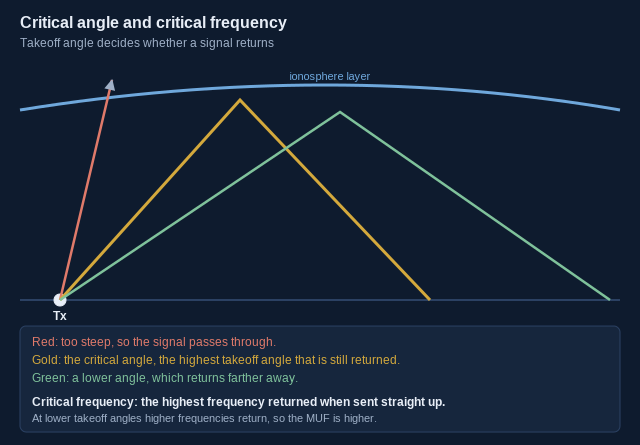
Three rays from a transmitter toward the ionosphere: one too steep that passes through, one at the critical angle that returns, and a lower one that returns farther away.
Describe this graphic in words

A transmitter sends three rays toward an ionospheric layer. A red ray that is too steep passes through the layer. A gold ray at the critical angle, the highest takeoff angle that still returns, bends back to Earth. A green ray at a lower angle returns farther away. A note defines the critical frequency as the highest frequency returned when sent straight up, and says that at lower takeoff angles higher frequencies return.

This is a teaching note. A signal sent straight up will return only if its frequency is below the critical frequency of the layer. Above that frequency it passes through. At lower angles of incidence a layer can return higher frequencies, which is why the MUF is higher than the critical frequency.

Why the other choices are wrong

  • B. The lowest frequency that returns is not the critical frequency.
  • C. The critical frequency has nothing to do with a signal-to-noise ratio of unity.
  • D. It has nothing to do with a 6 dB signal-to-noise ratio.

Rule text checked against the official source on November 13, 2026. This is a study aid; the linked rule is what governs.
G3C03

Why is skip propagation via the F2 region longer than that via the other ionospheric regions?

Show the answer and why

Answer C. Because it is the highest

Skip via the F2 region is longer because that region is the highest.

Cross-section of the ionosphere: D region lowest, then E, F1 and F2; one E hop reaches about 1,200 miles and one F2 hop about 2,500 miles.
Describe this graphic in words

Horizontal bands from the ground upward: the D region, lowest and present in daytime only, highlighted because it absorbs signals below 10 MHz by day; the E region at about 60 miles; the F1 region, daytime only; and the F2 region, the highest at about 150 to 250 miles. A path from a transmitter through the E region lands about 1,200 miles away. A path through the F2 region lands about 2,500 miles away. A higher layer returns the signal farther from the transmitter. Layers are not to scale.

This is a teaching note. The higher the layer, the farther from the transmitter the signal comes down. F2 is the highest layer, at roughly 150 to 250 miles, so one hop covers the longest distance.

Why the other choices are wrong

  • A. Density does not set the hop length. Height does.
  • B. The Doppler effect does not determine the hop length.
  • D. Temperature inversions are a lower atmosphere effect.

Rule text checked against the official source on November 13, 2026. This is a study aid; the linked rule is what governs.

G3C04

What does the term “critical angle” mean, as applied to radio wave propagation?

Show the answer and why

Answer D. The highest takeoff angle that will return a radio wave to Earth under specific ionospheric conditions

The critical angle is the highest takeoff angle that will return a radio wave to Earth under specific ionospheric conditions.

Three rays from a transmitter toward the ionosphere: one too steep that passes through, one at the critical angle that returns, and a lower one that returns farther away.
Describe this graphic in words

A transmitter sends three rays toward an ionospheric layer. A red ray that is too steep passes through the layer. A gold ray at the critical angle, the highest takeoff angle that still returns, bends back to Earth. A green ray at a lower angle returns farther away. A note defines the critical frequency as the highest frequency returned when sent straight up, and says that at lower takeoff angles higher frequencies return.

This is a teaching note. A wave leaving the antenna at too steep an angle goes through the layer. Below the critical angle it is bent back. The critical angle is the highest takeoff angle that is still returned.

Why the other choices are wrong

  • A. It is not a long path azimuth.
  • B. It is not a short path azimuth.
  • C. The lowest angle is not the limit. The highest angle is.

Rule text checked against the official source on November 13, 2026. This is a study aid; the linked rule is what governs.

G3C05

Why is long-distance communication on the 40-, 60-, 80-, and 160-meter bands more difficult during the day?

Show the answer and why

Answer C. The D region absorbs signals at these frequencies during daylight hours

On 40, 60, 80 and 160 meters, long-distance communication is harder in the day because the D region absorbs signals at these frequencies.

Cross-section of the ionosphere: D region lowest, then E, F1 and F2; one E hop reaches about 1,200 miles and one F2 hop about 2,500 miles.
Describe this graphic in words

Horizontal bands from the ground upward: the D region, lowest and present in daytime only, highlighted because it absorbs signals below 10 MHz by day; the E region at about 60 miles; the F1 region, daytime only; and the F2 region, the highest at about 150 to 250 miles. A path from a transmitter through the E region lands about 1,200 miles away. A path through the F2 region lands about 2,500 miles away. A higher layer returns the signal farther from the transmitter. Layers are not to scale.

This is a teaching note. The D region forms when the Sun is up. It absorbs lower frequencies, so by day the signals from these bands never reach the F region. After sunset the D region fades, and these bands open for long-distance work.

Why the other choices are wrong

  • A. The F region refracts these signals. It does not absorb them.
  • B. The F region is not the unstable one.
  • D. The E region is not what blocks these bands during the day.

Rule text checked against the official source on November 13, 2026. This is a study aid; the linked rule is what governs.

G3C06

What is a characteristic of HF scatter?

Show the answer and why

Answer B. Signals have a fluttering sound

HF scatter signals have a fluttering sound.

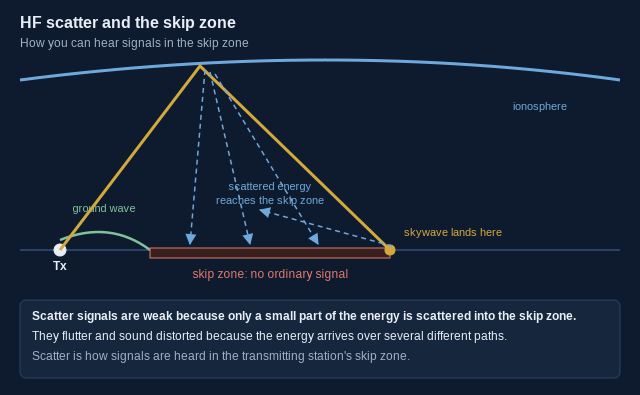
Ground wave covers a short distance, a skip zone follows where nothing arrives, the skywave lands beyond it, and weak scattered energy reaches into the skip zone by several paths.
Describe this graphic in words

A transmitter at left. A ground wave covers a short distance. A red strip marks the skip zone where ordinary signals do not arrive. The gold skywave path goes up to the ionosphere and lands beyond the skip zone. Dashed blue arrows show energy scattered from the ionosphere and from the landing area back into the skip zone over several different paths. Because only a small part of the energy is scattered there, the signals are weak, and because the paths differ they flutter and sound distorted.

This is a teaching note. Scattered energy arrives from many paths with slightly different delays, so the signal flutters and is distorted.

Why the other choices are wrong

  • A. Intelligibility of scatter signals is poor.
  • C. Scatter signals are weak and flutter. They do not swing widely and suddenly.
  • D. Scatter propagation can occur at any time.

Rule text checked against the official source on November 13, 2026. This is a study aid; the linked rule is what governs.

G3C07

What makes HF scatter signals often sound distorted?

Show the answer and why

Answer D. Energy is scattered into the skip zone through several different paths

HF scatter signals often sound distorted because energy is scattered into the skip zone through several different paths.

Ground wave covers a short distance, a skip zone follows where nothing arrives, the skywave lands beyond it, and weak scattered energy reaches into the skip zone by several paths.
Describe this graphic in words

A transmitter at left. A ground wave covers a short distance. A red strip marks the skip zone where ordinary signals do not arrive. The gold skywave path goes up to the ionosphere and lands beyond the skip zone. Dashed blue arrows show energy scattered from the ionosphere and from the landing area back into the skip zone over several different paths. Because only a small part of the energy is scattered there, the signals are weak, and because the paths differ they flutter and sound distorted.

This is a teaching note. Each path has a different length, so the parts of the signal arrive at different times and combine unevenly, which distorts the audio.

Why the other choices are wrong

  • A. Instability of a region is not the main cause.
  • B. Ground waves do not absorb scatter signals.
  • C. The E region being absent is not the cause.

Rule text checked against the official source on November 13, 2026. This is a study aid; the linked rule is what governs.

G3C08

Why are HF scatter signals in the skip zone usually weak?

Show the answer and why

Answer A. Only a small part of the signal energy is scattered into the skip zone

HF scatter signals in the skip zone are usually weak because only a small part of the signal energy is scattered into the skip zone.

Ground wave covers a short distance, a skip zone follows where nothing arrives, the skywave lands beyond it, and weak scattered energy reaches into the skip zone by several paths.
Describe this graphic in words

A transmitter at left. A ground wave covers a short distance. A red strip marks the skip zone where ordinary signals do not arrive. The gold skywave path goes up to the ionosphere and lands beyond the skip zone. Dashed blue arrows show energy scattered from the ionosphere and from the landing area back into the skip zone over several different paths. Because only a small part of the energy is scattered there, the signals are weak, and because the paths differ they flutter and sound distorted.

This is a teaching note. Most of the energy goes on past the skip zone. Only a tiny fraction is scattered back, so the signals are weak.

Why the other choices are wrong

  • B. The magnetosphere is not the scattering source in this case.
  • C. Scatter is not propagated by ground wave.
  • D. Scatter is not caused by F region ducts.

Rule text checked against the official source on November 13, 2026. This is a study aid; the linked rule is what governs.

G3C09

What type of propagation allows signals to be heard in the transmitting station’s skip zone?

Show the answer and why

Answer B. Scatter

Scatter propagation allows signals to be heard in the transmitting station's skip zone.

Ground wave covers a short distance, a skip zone follows where nothing arrives, the skywave lands beyond it, and weak scattered energy reaches into the skip zone by several paths.
Describe this graphic in words

A transmitter at left. A ground wave covers a short distance. A red strip marks the skip zone where ordinary signals do not arrive. The gold skywave path goes up to the ionosphere and lands beyond the skip zone. Dashed blue arrows show energy scattered from the ionosphere and from the landing area back into the skip zone over several different paths. Because only a small part of the energy is scattered there, the signals are weak, and because the paths differ they flutter and sound distorted.

This is a teaching note. The skip zone is the area too far for ground wave and too near for the sky wave to land. Scattered energy, though weak, lands there.

Why the other choices are wrong

  • A. Faraday rotation is a change in polarization.
  • C. Chordal hop travels beyond the skip zone.
  • D. Short-path is a route direction and does not fill the skip zone.

Rule text checked against the official source on November 13, 2026. This is a study aid; the linked rule is what governs.

G3C10

What is near vertical incidence skywave (NVIS) propagation?

Show the answer and why

Answer B. Short distance MF or HF propagation at high elevation angles

NVIS is short distance MF or HF propagation at high elevation angles.

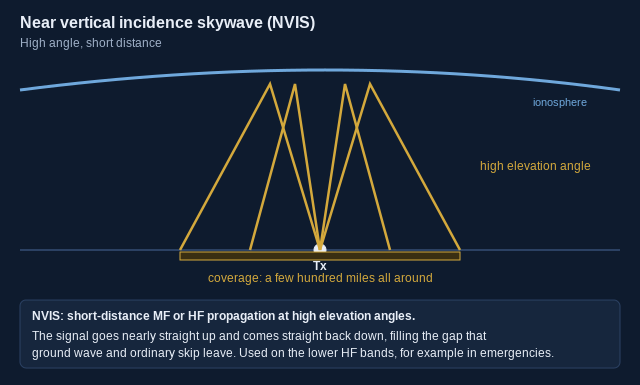
Near vertical incidence skywave: signals go almost straight up and return nearby, covering a few hundred miles around the transmitter.
Describe this graphic in words

A transmitter sends four steep rays almost straight up to the ionosphere. They bend back and land in a ring close to the transmitter, covering a few hundred miles around it. The note says NVIS is short-distance MF or HF propagation at high elevation angles that fills the gap left by ground wave and ordinary skip, used on the lower HF bands.

This is a teaching note. Near vertical incidence skywave sends the signal nearly straight up so that it comes down within a few hundred miles. It is used on the lower HF bands to fill the gap that ground wave and normal skip leave, for example in emergency communications.

Why the other choices are wrong

  • A. NVIS uses frequencies below the critical frequency, not near the MUF.
  • C. It is not a long path effect.
  • D. It is not double hop near the LUF.

Rule text checked against the official source on November 13, 2026. This is a study aid; the linked rule is what governs.

G3C11

Which ionospheric region is the most absorbent of signals below 10 MHz during daylight hours?

Show the answer and why

Answer D. The D region

The D region is the most absorbent of signals below 10 MHz during daylight hours.

Cross-section of the ionosphere: D region lowest, then E, F1 and F2; one E hop reaches about 1,200 miles and one F2 hop about 2,500 miles.
Describe this graphic in words

Horizontal bands from the ground upward: the D region, lowest and present in daytime only, highlighted because it absorbs signals below 10 MHz by day; the E region at about 60 miles; the F1 region, daytime only; and the F2 region, the highest at about 150 to 250 miles. A path from a transmitter through the E region lands about 1,200 miles away. A path through the F2 region lands about 2,500 miles away. A higher layer returns the signal farther from the transmitter. Layers are not to scale.

This is a teaching note. The D region is the lowest layer. It is present only during the day, and the signals below 10 MHz that pass through it lose most of their energy there.

Why the other choices are wrong

  • A. The F2 region refracts these signals.
  • B. The F1 region does not absorb as much.
  • C. The E region absorbs less than the D region.

Rule text checked against the official source on November 13, 2026. This is a study aid; the linked rule is what governs.