
ARSC Tech School

Amateur Extra E9H: Receiving antennas

599 questions · pool July 1, 2024 to June 30, 2028 · the exam has 50 questions; 37 to pass

E9 · ANTENNAS AND TRANSMISSION LINES

Receiving antennas: radio direction finding (RDF) techniques; Beverage antennas; single- and multiple-turn loops

11 questions in group E9H

One question from this group appears on each exam.

E9H01

When constructing a Beverage antenna, which of the following factors should be included in the design to achieve good performance at the desired frequency?

Show the answer and why

Answer D. It should be at least one wavelength long

A Beverage antenna should be at least one wavelength long to give good performance.
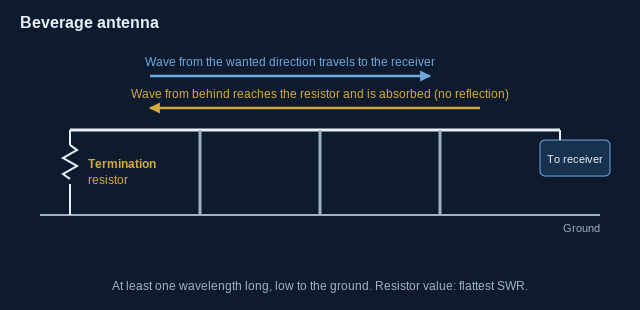
A Beverage antenna: a long low wire with a termination resistor to ground at the far end and the receiver at the other end.
Describe this graphic in words

A long horizontal wire is held on short posts just above the ground. The end toward the wanted signal has a termination resistor to ground, and the other end goes to the receiver. A wave from the wanted direction travels to the receiver. A wave from behind runs into the resistor and is absorbed. The wire should be at least one wavelength long.

This is a teaching note. A Beverage is a long, low, terminated wire that picks up a traveling wave. It needs to be at least about one wavelength long (and ideally several) to get useful directivity and gain. A short one has a broad pattern and little gain.

It is mounted close to the ground, not a wavelength above it, and it is a straight wire, not a loop.

Why the other choices are wrong

  • A. A quarter-wave Beverage would barely have any directivity.
  • B. Beverages are mounted low, a few meters above the ground.
  • C. It is a single straight wire, not a four-sided loop.

Rule text checked against the official source on November 17, 2026. This is a study aid; the linked rule is what governs.
E9H02

Which is generally true for 160- and 80-meter receiving antennas?

Show the answer and why

Answer A. Atmospheric noise is so high that directivity is much more important than losses

On 160 and 80 meters, atmospheric noise is so high that directivity matters much more than losses.

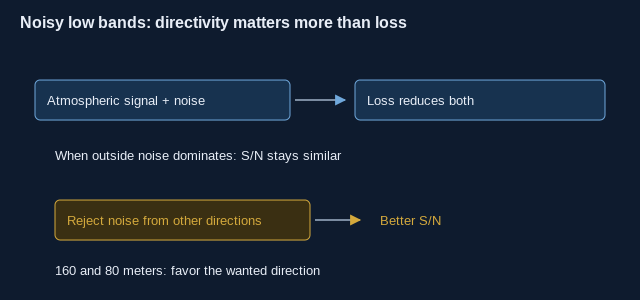
Noisy low bands: directivity matters more than loss.
Describe this graphic in words

One path shows antenna loss reducing both wanted signal and atmospheric noise. When that external noise dominates receiver noise, directivity improves reception by rejecting noise from other directions, which is why lossy receive antennas can be useful on 160 and 80 meters.

This is a teaching note. At these frequencies the noise from lightning and the atmosphere is stronger than the receiver's own noise, so the signal to noise ratio is set by the noise from outside. An inefficient antenna reduces the signal and the noise by the same amount, so the ratio does not change. Directivity, in contrast, rejects noise from other directions and improves it.

That is why small, lossy receive antennas such as a Beverage work well, even though they are very inefficient.

Why the other choices are wrong

  • B. Receive antennas do not need to be a half wavelength up. Beverages are low.
  • C. Low-loss coax is not essential when the noise floor is set by the atmosphere.
  • D. Only the first statement is correct.

Rule text checked against the official source on November 17, 2026. This is a study aid; the linked rule is what governs.
E9H03

What is receiving directivity factor (RDF)?

Show the answer and why

Answer D. Peak antenna gain compared to average gain over the hemisphere around and above the antenna

RDF is the peak antenna gain compared to the average gain over the hemisphere around and above the antenna.

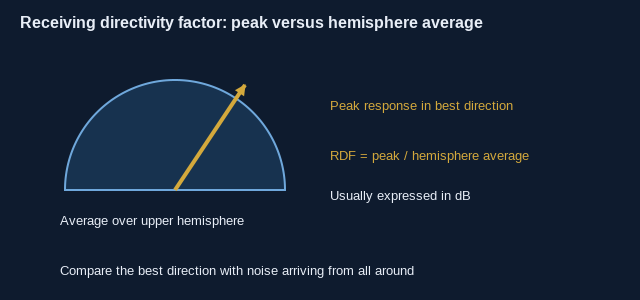
Receiving directivity factor: peak versus hemisphere average.
Describe this graphic in words

A semicircle represents directions in the upper hemisphere and a gold arrow marks the best response. RDF compares peak gain with average gain over that hemisphere, usually expressed in decibels.

This is a teaching note. Receiving directivity factor measures how well an antenna favors one direction over the noise coming from all around, which is what matters for receiving on noisy bands. It is the ratio of the response in the best direction to the average over the whole upper hemisphere, usually in dB.

It is neither a front-to-back ratio nor a gain against an isotropic or dipole reference.

Why the other choices are wrong

  • A. That is the front-to-back ratio.
  • B. That describes directivity relative to isotropic, not RDF.
  • C. RDF is not referenced to a dipole.

Rule text checked against the official source on November 17, 2026. This is a study aid; the linked rule is what governs.
E9H04

What is the purpose of placing an electrostatic shield around a small-loop direction-finding antenna?

Show the answer and why

Answer B. It eliminates unbalanced capacitive coupling to the antenna’s surroundings, improving the depth of its nulls

An electrostatic shield removes unbalanced capacitive coupling to the surroundings, which improves the depth of the nulls.

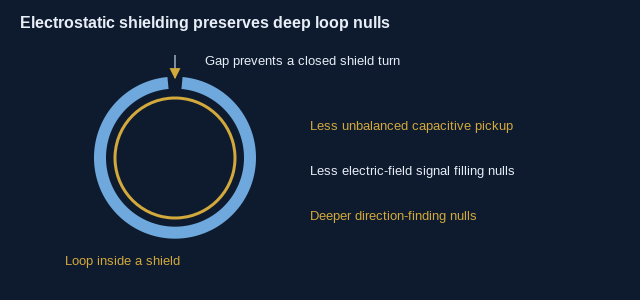
Electrostatic shielding preserves deep loop nulls.
Describe this graphic in words

A loop is surrounded by an electrostatic shield with a gap at its top. The gap prevents the shield from becoming a closed conducting turn. Reducing unbalanced capacitive pickup prevents unwanted electric-field response from filling the loop nulls.

This is a teaching note. A loop is meant to respond to the magnetic field only. Without a shield, it also picks up the electric field through its capacitance to nearby objects, and that signal fills in the nulls. A shield with a small gap, which prevents a closed loop for current, keeps the loop balanced and the nulls deep.

It does not add capacitive loading, handle out-of-band signals, or improve the match.

Why the other choices are wrong

  • A. Adding capacitive loading is not the purpose, and it would not widen the bandwidth.
  • C. Tracking errors from strong signals are not corrected by the shield.
  • D. Signal strength is not increased by the shield.

Rule text checked against the official source on November 17, 2026. This is a study aid; the linked rule is what governs.
E9H05

What challenge is presented by a small wire-loop antenna for direction finding?

Show the answer and why

Answer A. It has a bidirectional null pattern

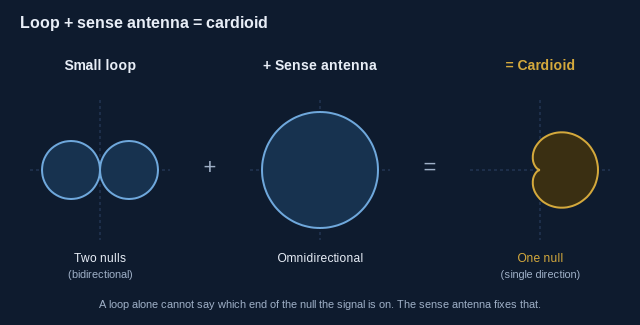
A small loop has a bidirectional null pattern, so you cannot tell which end of the null the signal comes from.

A figure-eight loop pattern plus an omnidirectional sense pattern gives a cardioid with a single null.
Describe this graphic in words

Three polar patterns are shown left to right. A small loop has a figure-eight pattern with two nulls. A sense antenna is omnidirectional, a circle. Combining them gives a heart-shaped cardioid with only one null, which is useful for direction finding.

This is a teaching note. The loop has two deep nulls 180 degrees apart. If you turn the loop to the null you know the line of the signal, but not which of the two directions it is in. A sense antenna or a second bearing from another place resolves that.

The null is well defined, and a loop works on HF as well as VHF.

Why the other choices are wrong

  • B. A small loop has a very sharp null.
  • C. It works on lower bands too.
  • D. Only the first statement is true.

Rule text checked against the official source on November 17, 2026. This is a study aid; the linked rule is what governs.

E9H06

What indicates the correct value of terminating resistance for a Beverage antenna?

Show the answer and why

Answer D. Minimum variation in SWR over the desired frequency range

The correct terminating resistance is the one giving the minimum variation in SWR over the desired frequency range.

A Beverage antenna: a long low wire with a termination resistor to ground at the far end and the receiver at the other end.
Describe this graphic in words

A long horizontal wire is held on short posts just above the ground. The end toward the wanted signal has a termination resistor to ground, and the other end goes to the receiver. A wave from the wanted direction travels to the receiver. A wave from behind runs into the resistor and is absorbed. The wire should be at least one wavelength long.

This is a teaching note. When the resistor equals the wire's characteristic impedance, the wave is absorbed and there are no reflections, so the SWR stays flat as the frequency changes. If the resistor is wrong, reflections create standing waves, and the SWR will vary a lot. So the best value is found by adjusting for the flattest SWR.

The DC resistance and current of the resistor are not good indicators.

Why the other choices are wrong

  • A. DC feed point resistance does not show the proper termination.
  • B. You want the front-to-back ratio to be at its maximum, not a minimum, so this describes the wrong target.
  • C. DC current in the resistor is not relevant to the proper value.

Rule text checked against the official source on November 17, 2026. This is a study aid; the linked rule is what governs.

E9H07

What is the function of a Beverage antenna’s termination resistor?

Show the answer and why

Answer B. Absorb signals from the reverse direction

The termination resistor absorbs signals from the reverse direction.

A Beverage antenna: a long low wire with a termination resistor to ground at the far end and the receiver at the other end.
Describe this graphic in words

A long horizontal wire is held on short posts just above the ground. The end toward the wanted signal has a termination resistor to ground, and the other end goes to the receiver. A wave from the wanted direction travels to the receiver. A wave from behind runs into the resistor and is absorbed. The wire should be at least one wavelength long.

This is a teaching note. A Beverage receives a wave traveling along the wire toward the feed end. A wave coming from behind travels to the far end, and the resistor absorbs it instead of reflecting it. That is what gives the antenna its one-way pattern, with good rejection of signals from behind.

It does not increase the front-to-side ratio, reduce SWR bandwidth, or suppress harmonics.

Why the other choices are wrong

  • A. The effect is on the front-to-back, not front-to-side.
  • C. It does not decrease the bandwidth. A matched termination keeps the SWR flat.
  • D. Harmonics are not controlled by the resistor.

Rule text checked against the official source on November 17, 2026. This is a study aid; the linked rule is what governs.

E9H08

What is the function of a sense antenna?

Show the answer and why

Answer A. It modifies the pattern of a DF antenna to provide a null in only one direction

A sense antenna modifies a direction-finding antenna's pattern to give a null in only one direction.

A figure-eight loop pattern plus an omnidirectional sense pattern gives a cardioid with a single null.
Describe this graphic in words

Three polar patterns are shown left to right. A small loop has a figure-eight pattern with two nulls. A sense antenna is omnidirectional, a circle. Combining them gives a heart-shaped cardioid with only one null, which is useful for direction finding.

This is a teaching note. A loop alone has two nulls, 180 degrees apart. The signal from a small omnidirectional sense antenna is combined with the loop in the right phase. The sum is a cardioid with one null, so the direction is unambiguous.

It does not add sensitivity, change vertical angles, or provide diversity.

Why the other choices are wrong

  • B. The sense antenna is not for sensitivity.
  • C. It does not allow reception at different vertical angles.
  • D. It does not cancel multipath.

Rule text checked against the official source on November 17, 2026. This is a study aid; the linked rule is what governs.

E9H09

What type of radiation pattern is created by a single-turn, terminated loop such as a pennant antenna?

Show the answer and why

Answer A. Cardioid

A single-turn terminated loop such as a pennant has a cardioid pattern.

A figure-eight loop pattern plus an omnidirectional sense pattern gives a cardioid with a single null.
Describe this graphic in words

Three polar patterns are shown left to right. A small loop has a figure-eight pattern with two nulls. A sense antenna is omnidirectional, a circle. Combining them gives a heart-shaped cardioid with only one null, which is useful for direction finding.

This is a teaching note. A terminated loop has a resistor at one corner, which absorbs the wave arriving from one side and prevents it from adding. The pattern is then one-sided, with a broad lobe in one direction and a null in the other, which is a cardioid. A pennant is a triangle version of this idea, used for receiving on the low bands.

It is neither bidirectional nor omnidirectional.

Why the other choices are wrong

  • B. An unterminated loop would be bidirectional.
  • C. A terminated loop is not omnidirectional.
  • D. A hyperbolic pattern is not a pattern type for this antenna.

Rule text checked against the official source on November 17, 2026. This is a study aid; the linked rule is what governs.

E9H10

How can the output voltage of a multiple-turn receiving loop antenna be increased?

Show the answer and why

Answer C. By increasing the number of turns and/or the area enclosed by the loop

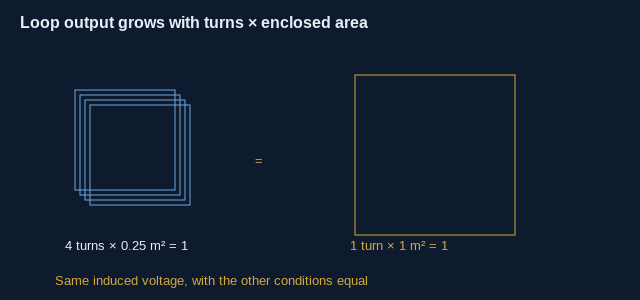
The output of a multiple-turn loop goes up with the number of turns and the area enclosed.

Loop output grows with turns × enclosed area.
Describe this graphic in words

Four turns each enclosing 0.25 square meters are compared with one turn enclosing one square meter. Both have the same turns-times-area product and therefore the same induced voltage under equal field, frequency and orientation conditions; shapes are schematic.

This is a teaching note. The voltage induced in a loop is proportional to the number of turns times the area. Doubling either doubles the voltage, other things being equal. For example, a 4-turn loop of 0.25 square meters gives the same output as a 1-turn loop of 1 square meter.

Reducing the permeability of a shield or using a high impedance wire does not do that.

Why the other choices are wrong

  • A. Reducing shield permeability does not increase the voltage.
  • B. High impedance wire does not raise the output.
  • D. Only the number of turns and area are correct.

Rule text checked against the official source on November 17, 2026. This is a study aid; the linked rule is what governs.

E9H11

What feature of a cardioid pattern antenna makes it useful for direction-finding antennas?

Show the answer and why

Answer B. A single null

A cardioid pattern has a single null, which makes it useful for direction finding.

A figure-eight loop pattern plus an omnidirectional sense pattern gives a cardioid with a single null.
Describe this graphic in words

Three polar patterns are shown left to right. A small loop has a figure-eight pattern with two nulls. A sense antenna is omnidirectional, a circle. Combining them gives a heart-shaped cardioid with only one null, which is useful for direction finding.

This is a teaching note. A single null points away from the signal source, so a bearing can be found and there is no front/back ambiguity. A bidirectional pattern has two nulls and cannot tell which of the two directions is the right one.

The cardioid is a broad pattern with a deep null on one side, not a sharp peak.

Why the other choices are wrong

  • A. A cardioid has a broad peak, not a sharp one.
  • C. Broadband response is not a feature of its shape.
  • D. The radiation angle is not the useful feature.

Rule text checked against the official source on November 17, 2026. This is a study aid; the linked rule is what governs.