What is Quadrature Amplitude Modulation or QAM?
Show the answer and why
Answer B. Transmission of data by modulating the amplitude of two carriers of the same frequency but 90 degrees out of phase
QAM sends data by modulating the amplitude of two carriers of the same frequency that are 90 degrees out of phase.
Describe this graphic in words
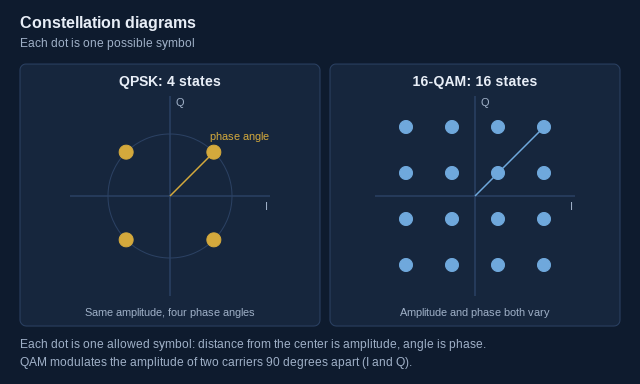
Two constellation diagrams on I and Q axes. The QPSK diagram has four gold dots at equal distance from the center, at 45, 135, 225 and 315 degrees, so only phase differs. The 16-QAM diagram has sixteen blue dots in a 4 by 4 grid, so both amplitude and phase vary. Each dot is one allowed symbol.
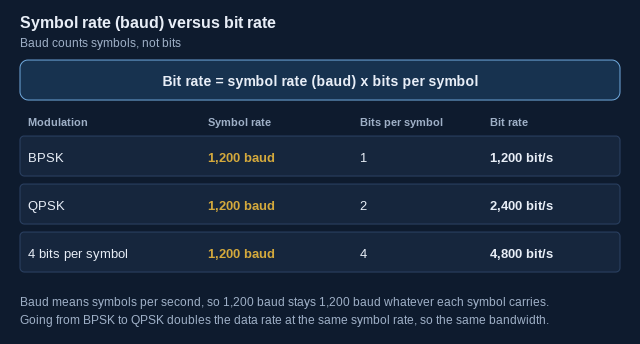
This is a teaching note. The two carriers, called I (in phase) and Q (quadrature), can each be set to several amplitudes. The combinations form a grid of possible symbols, and each symbol carries several bits. 16-QAM, for instance, has 4 levels on each carrier, giving 16 symbols and 4 bits per symbol.
It is a way to move more data in the same bandwidth.
Why the other choices are wrong
- A. QAM is not a data compression method.
- C. QAM is not a way of generating SSB.
- D. QAM is digital and is not a TV video compression technique.
Rule text checked against the official source on November 17, 2026. This is a study aid; the linked rule is what governs.