
ARSC Tech School

Amateur Extra E1B: Station restrictions and special operations

599 questions · pool July 1, 2024 to June 30, 2028 · the exam has 50 questions; 37 to pass

E1 · COMMISSION RULES

Station restrictions and special operations: restrictions on station location; general operating restrictions; spurious emissions; antenna structure restrictions; RACES operations

11 questions in group E1B

One question from this group appears on each exam.

E1B01FCC rule 97.3

Which of the following constitutes a spurious emission?

Show the answer and why

Answer D. An emission outside the signal’s necessary bandwidth that can be reduced or eliminated without affecting the information transmitted

FCC rule 97.3

A spurious emission is one outside the necessary bandwidth whose level can be reduced without affecting the information sent.
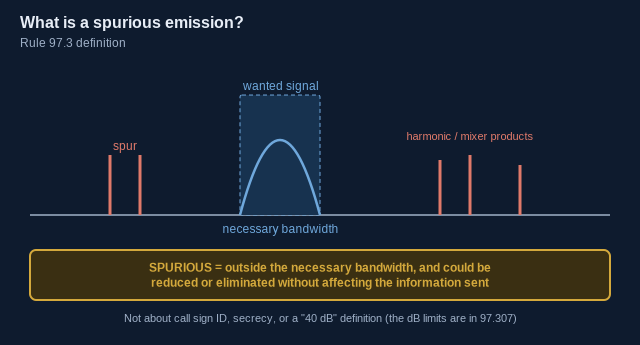
A spectrum plot with a wanted signal and red spikes outside the necessary bandwidth labeled spurious.
Describe this graphic in words

A frequency axis with the wanted signal in blue inside a dashed box marked necessary bandwidth. Red spikes to the left and right, outside that box, are the spurious emissions such as harmonics and mixer products. A gold banner states the definition: outside the necessary bandwidth and reducible without affecting the information sent.

The FCC definition in 97.3 is: "an emission, or frequencies outside the necessary bandwidth of a transmission, the level of which may be reduced without affecting the information being transmitted." Harmonics and mixer products are typical examples.

The definition does not mention identification, secrecy or a 40 dB figure. The dB limits (such as 43 dB below the fundamental under 30 MHz) are standards in 97.307, not part of the definition.

Why the other choices are wrong

  • A. A missing call sign is an identification violation, not a spurious emission.
  • B. Transmitting to avoid detection describes an intentionally concealed signal, not spurs.
  • C. The definition does not depend on causing interference or on a 40 dB level; the dB limits are in 97.307.

References

Rule text checked against the official source on November 17, 2026. This is a study aid; the linked rule is what governs.
E1B02FCC rule 97.307(f)(2)

Which of the following is an acceptable bandwidth for digital voice or slow-scan TV transmissions made on the HF amateur bands?

Show the answer and why

Answer A. 3 kHz

FCC rule 97.307(f)(2)

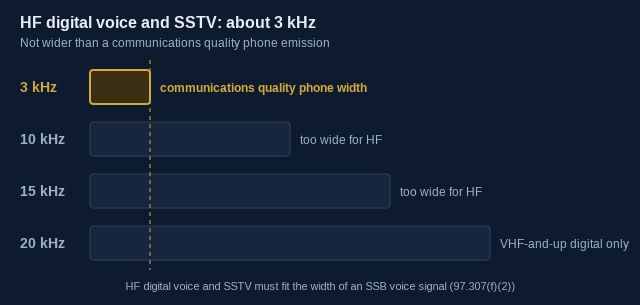
Digital voice and SSTV on HF are limited to the bandwidth of a communications quality phone signal, about 3 kHz.

Four bars comparing 3, 10, 15 and 20 kHz, with the 3 kHz bar highlighted as the acceptable HF width.
Describe this graphic in words

Horizontal bars proportional to 3, 10, 15 and 20 kHz. The 3 kHz bar is gold and labeled as the width of a communications quality phone signal. The wider bars are dimmed with notes that they are too wide for HF.

Rule 97.307(f)(2) says no non-phone emission may exceed the bandwidth of a communications quality phone emission of the same modulation type. SSTV and digital voice on HF therefore fit in roughly the width of an SSB voice signal, which is typically about 3 kHz.

The 10, 15 and 20 kHz choices are too wide for the HF phone and image segments. Wider emissions such as 20 kHz are authorized only on VHF and above for some digital codes.

Why the other choices are wrong

  • B. 10 kHz is far wider than a communications quality phone signal.
  • C. 15 kHz is far wider than a communications quality phone signal.
  • D. 20 kHz is allowed only for certain unspecified digital codes at 6 meters and above, not on HF.

References

Rule text checked against the official source on November 17, 2026. This is a study aid; the linked rule is what governs.
E1B03FCC rule 97.13

Within what distance must an amateur station protect an FCC monitoring facility from harmful interference?

Show the answer and why

Answer A. 1 mile

FCC rule 97.13

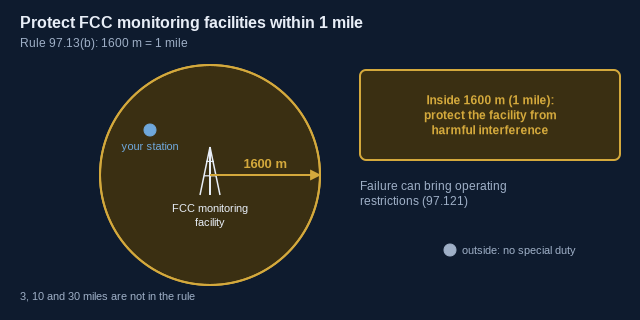
A station within 1600 meters, about 1 mile, of an FCC monitoring facility must protect it from harmful interference.

A circle of 1600 meters, about 1 mile, around an FCC monitoring facility.
Describe this graphic in words

A gold circle with a tower at the center labeled FCC monitoring facility, with a radius arrow marked 1600 meters. A station inside the circle must protect the facility from harmful interference. A station outside has no such special duty.

Rule 97.13(b) says a station within 1600 m (1 mile) of an FCC monitoring facility must protect that facility from harmful interference. Failing to do so can lead to operating restrictions under 97.121.

The coordinates of these facilities are listed in 47 CFR 0.121(c).

Why the other choices are wrong

  • B. 3 miles is not the distance in the rule.
  • C. 10 miles is not the distance in the rule.
  • D. 30 miles is not the distance in the rule.

References

Rule text checked against the official source on November 17, 2026. This is a study aid; the linked rule is what governs.
E1B04FCC rule 97.303(b)

What must the control operator of a repeater operating in the 70-centimeter band do if a radiolocation system experiences interference from that repeater?

Show the answer and why

Answer C. Cease operation or make changes to the repeater that mitigate the interference

FCC rule 97.303(b)

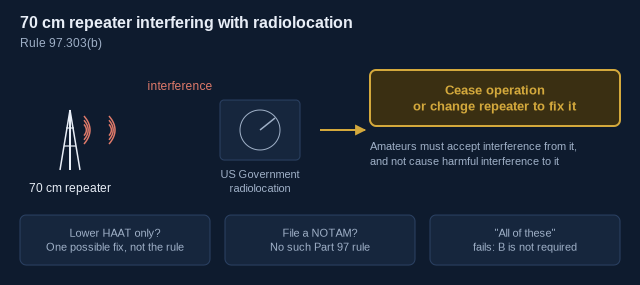
The repeater control operator must stop operating or change the repeater so it no longer interferes with the radiolocation system.

A 70 cm repeater interfering with a radiolocation system, with the required fix highlighted.
Describe this graphic in words

A repeater tower sends red interference waves toward a government radiolocation installation. A gold arrow leads to the required action: cease operation or change the repeater to mitigate the interference. Three dimmed boxes explain the wrong choices: lowering HAAT is only one possible fix, no NOTAM filing is required, and all of these therefore fails.

On 70 cm, amateur stations must not cause harmful interference to, and must accept interference from, US Government radiolocation stations (97.303(b)). If your repeater is causing that interference, the only way to comply is to stop it, by ceasing operation or by changing the repeater (power, antenna pattern, frequency, filtering) so the interference goes away.

Lowering the antenna may be one fix, but the rule does not require that specific step, and Part 97 does not spell out which steps to take. Part 97 contains no NOTAM filing requirement, so that choice and "all of these" are not supported.

Why the other choices are wrong

  • A. Reducing HAAT might help, but it is one possible mitigation, not the stated requirement.
  • B. No rule requires filing a NOTAM with an ERP and grid locator.
  • D. Since choice B is not a requirement, "all of these" fails.

References

Rule text checked against the official source on November 17, 2026. This is a study aid; the linked rule is what governs.
E1B05FCC rule 97.3

What is the National Radio Quiet Zone?

Show the answer and why

Answer C. An area surrounding the National Radio Astronomy Observatory

FCC rule 97.3

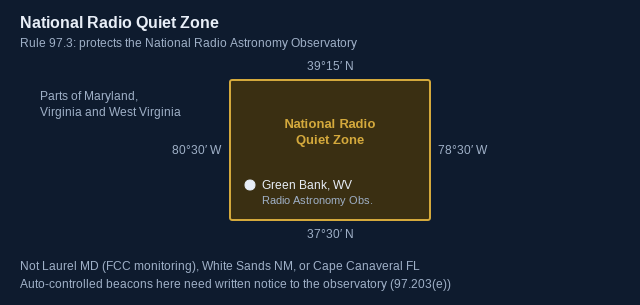
The National Radio Quiet Zone is the area around the National Radio Astronomy Observatory in West Virginia.

A rectangle labeled with its latitude and longitude edges marking the National Radio Quiet Zone around Green Bank, West Virginia.
Describe this graphic in words

A gold rectangle bounded by 39 degrees 15 minutes north, 37 degrees 30 minutes south, 78 degrees 30 minutes west on the east side and 80 degrees 30 minutes west on the west side. A dot inside marks the National Radio Astronomy Observatory at Green Bank, West Virginia. Text notes that the zone is in parts of Maryland, Virginia and West Virginia.

The FCC defines the zone in 97.3 as the area in Maryland, Virginia and West Virginia bounded by 39 degrees 15 minutes N on the north, 78 degrees 30 minutes W on the east, 37 degrees 30 minutes N on the south and 80 degrees 30 minutes W on the west. It protects the radio telescopes at Green Bank, West Virginia.

Rule 97.203(e) requires an automatically controlled beacon in this zone to give written notice to the observatory first.

Why the other choices are wrong

  • A. The FCC monitoring facilities are a different matter; 97.13(b) protects them by a separate 1 mile rule, and Part 97 does not define the Radio Quiet Zone around any of them.
  • B. White Sands has its own 33 cm power limit in 97.313(g), but that is not the Radio Quiet Zone.
  • D. Cape Canaveral has no such zone defined in Part 97.

References

Rule text checked against the official source on November 17, 2026. This is a study aid; the linked rule is what governs.
E1B06FCC rule 97.15

Which of the following additional rules apply if you are erecting an amateur station antenna structure at a site at or near a public use airport?

Show the answer and why

Answer A. You may have to notify the Federal Aviation Administration and register it with the FCC as required by Part 17 of the FCC rules

FCC rule 97.15

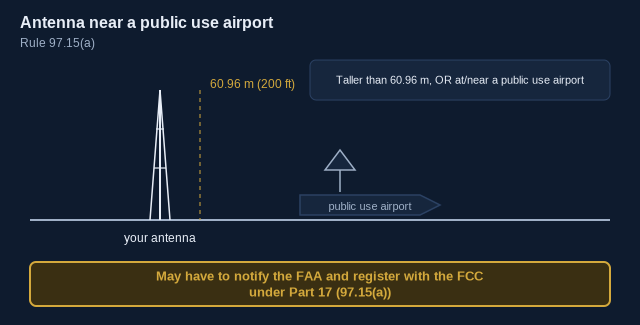
A tower near a public use airport may require notifying the FAA and registering with the FCC under Part 17.

A tower and a public use airport, with a note that FAA notification and FCC registration under Part 17 may be needed.
Describe this graphic in words

An antenna tower on a ground line with a dashed height line at 60.96 meters, or 200 feet, and a small airport nearby. A gold banner says you may have to notify the FAA and register the structure with the FCC under Part 17.

Rule 97.15(a) says owners of certain antenna structures, those over 60.96 meters (200 feet) above ground, or those at or near a public use airport, must notify the FAA and register with the FCC as required by Part 17. "May have to" is the right level of caution because it depends on height and location.

The other choices add steps that are not in this rule.

Why the other choices are wrong

  • B. The rule does not specify entering metric heights and DMS coordinates on an FAA website; it points to Part 17.
  • C. No Environmental Impact Statement filing with the EPA is required by this rule.
  • D. The rule names no FAA Part 119 construction permit from an airport zoning authority.

References

Rule text checked against the official source on November 17, 2026. This is a study aid; the linked rule is what governs.
E1B07FCC rule 97.15

To what type of regulations does PRB-1 apply?

Show the answer and why

Answer C. State and local zoning

FCC rule 97.15

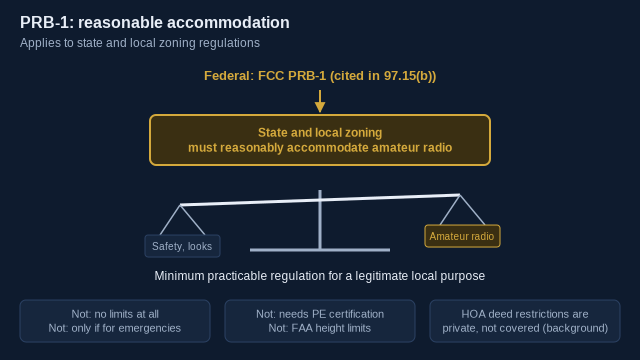
PRB-1 applies to state and local zoning regulations of amateur antennas.

PRB-1 applies to state and local zoning, which must reasonably accommodate amateur radio, shown as a balance.
Describe this graphic in words

A gold banner places PRB-1 above state and local zoning, which must reasonably accommodate amateur radio. A balance shows local safety and aesthetics weighed against amateur radio, with a note on minimum practicable regulation. Dimmed boxes list things PRB-1 does not mean: no limits at all, emergency-only, engineer certification, FAA limits, and private homeowner association restrictions.

PRB-1 is the FCC ruling cited in 97.15(b). It says state and local regulation of antenna structures must reasonably accommodate amateur communications and be the minimum practicable regulation for the authority's legitimate purpose.

It covers state and local government rules such as zoning ordinances. Private deed restrictions and homeowners association covenants are not government regulation, and PRB-1 is generally understood not to override them; that point is background knowledge, not something Part 97 states, so check current FCC guidance and your own covenants. FAA height limits and vehicle laws are outside PRB-1 as well.

Why the other choices are wrong

  • A. PRB-1 addresses state and local government regulation. Private HOA covenants are generally treated as a separate matter (general background, not stated in Part 97).
  • B. FAA height limits are federal and come through Part 17, not PRB-1.
  • D. Use of wireless devices in vehicles has nothing to do with PRB-1.

References

Rule text checked against the official source on November 17, 2026. This is a study aid; the linked rule is what governs.
E1B08FCC rule 97.121

What limitations may the FCC place on an amateur station if its signal causes interference to domestic broadcast reception, assuming that the receivers involved are of good engineering design?

Show the answer and why

Answer D. The amateur station must avoid transmitting during certain hours on frequencies that cause the interference

FCC rule 97.121

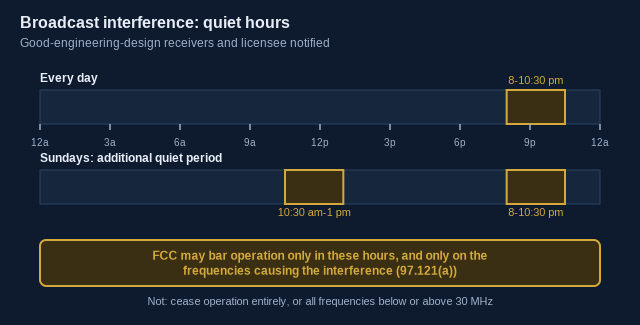
The FCC may order the station off the air only during certain hours on the interfering frequencies.

Two 24-hour timelines showing the quiet hours the FCC may impose: 8 to 10:30 pm daily and 10:30 am to 1 pm on Sundays.
Describe this graphic in words

Two day timelines. On every day the gold block is 8 p.m. to 10:30 p.m. On Sundays an additional gold block covers 10:30 a.m. to 1 p.m. A banner says the station may be barred from operating only during these hours and only on the interfering frequencies.

Rule 97.121(a) covers general interference to domestic broadcast reception when the receivers are of good engineering design and the licensee is told. The station must not operate from 8 p.m. to 10:30 p.m. local time, and on Sundays also from 10:30 a.m. to 1 p.m., on the frequencies that cause the interference.

It is a time-of-day restriction on those frequencies, not a total shutdown or a ban on a whole range of bands.

Why the other choices are wrong

  • A. The rule restricts hours; it does not require the station to cease operation entirely.
  • B. No rule bans everything below 30 MHz.
  • C. No rule bans everything above 30 MHz.

References

Rule text checked against the official source on November 17, 2026. This is a study aid; the linked rule is what governs.

E1B09FCC rule 97.407

Which amateur stations may be operated under RACES rules?

Show the answer and why

Answer C. Any FCC-licensed amateur station certified by the responsible civil defense organization for the area served

FCC rule 97.407

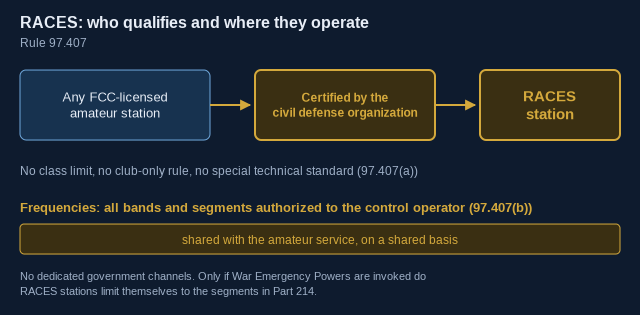
Any FCC-licensed amateur station certified by the responsible civil defense organization may operate under RACES rules.

Any FCC-licensed amateur station certified by civil defense becomes a RACES station, using any frequencies the control operator is authorized.
Describe this graphic in words

A flow from any FCC-licensed amateur station, through certification by the civil defense organization, to a RACES station. Below, a gold bar says RACES may use all bands and segments authorized to the control operator on a shared basis with the amateur service. A note says special segments apply only if War Emergency Powers are invoked.

Rule 97.407(a) says no station may transmit in RACES unless it is an FCC-licensed primary, club, or military recreation station and is certified by a civil defense organization as registered with that organization. The control operator must hold an FCC amateur license and be certified as enrolled.

There is no license class restriction and no special technical standard beyond normal Part 97.

Why the other choices are wrong

  • A. RACES is not limited to club stations or Extra class operators.
  • B. The rule does not exclude Technician licensees.
  • D. No special RACES-only technical standard is in the rule; certification by civil defense is what is required.

References

Rule text checked against the official source on November 17, 2026. This is a study aid; the linked rule is what governs.

E1B10FCC rule 97.407

What frequencies are authorized to an amateur station operating under RACES rules?

Show the answer and why

Answer A. All amateur service frequencies authorized to the control operator

FCC rule 97.407

A RACES station may use all amateur service frequencies authorized to the control operator.

Any FCC-licensed amateur station certified by civil defense becomes a RACES station, using any frequencies the control operator is authorized.
Describe this graphic in words

A flow from any FCC-licensed amateur station, through certification by the civil defense organization, to a RACES station. Below, a gold bar says RACES may use all bands and segments authorized to the control operator on a shared basis with the amateur service. A note says special segments apply only if War Emergency Powers are invoked.

Rule 97.407(b) says the bands, segments and emissions authorized to the control operator are available for RACES communications on a shared basis with the amateur service. Only if the President's War Emergency Powers are invoked are RACES stations limited to the segments listed in Part 214.

RACES stations do not get dedicated government channels or a special set of amateur segments.

Why the other choices are wrong

  • B. The special segments apply only when the War Emergency Powers are invoked.
  • C. RACES does not get local government channels.
  • D. Only choice A is correct, so "all of these" fails.

References

Rule text checked against the official source on November 17, 2026. This is a study aid; the linked rule is what governs.

E1B11FCC rule 97.15

What does PRB-1 require of state and local regulations affecting amateur radio antenna size and structures?

Show the answer and why

Answer B. Reasonable accommodations of amateur radio must be made

FCC rule 97.15

PRB-1 requires state and local rules to make reasonable accommodation of amateur radio.

PRB-1 applies to state and local zoning, which must reasonably accommodate amateur radio, shown as a balance.
Describe this graphic in words

A gold banner places PRB-1 above state and local zoning, which must reasonably accommodate amateur radio. A balance shows local safety and aesthetics weighed against amateur radio, with a note on minimum practicable regulation. Dimmed boxes list things PRB-1 does not mean: no limits at all, emergency-only, engineer certification, FAA limits, and private homeowner association restrictions.

Rule 97.15(b) puts it this way: state and local regulation "must reasonably accommodate such communications and must constitute the minimum practicable regulation to accomplish the state or local authority's legitimate purpose." Localities may still regulate, for example for safety or aesthetics, but they cannot be so strict that they prevent amateur communications.

PRB-1 does not give an unlimited right to any size or place, it does not depend on emergency use, and it does not require an engineer's certification. The standard is about reasonable accommodation, so a locality can still impose sensible limits.

Why the other choices are wrong

  • A. PRB-1 does not forbid all limits on size or placement; reasonable regulation is allowed.
  • C. Reasonable accommodation does not depend on demonstrating emergency communications use.
  • D. No PE certification is required by the rule.

References

Rule text checked against the official source on November 17, 2026. This is a study aid; the linked rule is what governs.