
ARSC Tech School

Amateur Extra E7F: Software defined radio fundamentals

599 questions · pool July 1, 2024 to June 30, 2028 · the exam has 50 questions; 37 to pass

E7 · PRACTICAL CIRCUITS

Software defined radio fundamentals: digital signal processing (DSP) filtering, modulation, and demodulation; analog-digital conversion; digital filters

14 questions in group E7F

One question from this group appears on each exam.

E7F01

What is meant by “direct sampling” in software defined radios?

Show the answer and why

Answer C. Incoming RF is digitized by an analog-to-digital converter without being mixed with a local oscillator signal

Direct sampling digitizes the incoming RF with an analog-to-digital converter without mixing it with a local oscillator.
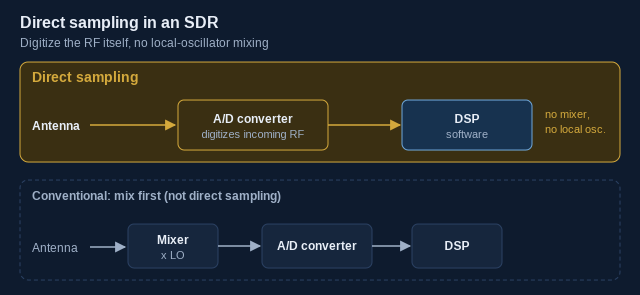
Direct sampling digitizes incoming RF with an A/D converter without mixing it with a local oscillator.
Describe this graphic in words

A gold row shows antenna, then an analog-to-digital converter that digitizes the RF directly, then DSP software, with no mixer or local oscillator. A dimmed row below shows the conventional receiver that mixes with a local oscillator before the converter.

This is a teaching note. The ADC samples the antenna signal (after filtering) directly, and the digital processing does all tuning and demodulation in software.

It is not about compiling code or about how I and Q are made.

Why the other choices are wrong

  • A. That describes compiling code.
  • B. Direct sampling is not defined by a lack of RF amplification.
  • D. A switching mixer is a different architecture.

Rule text checked against the official source on November 17, 2026. This is a study aid; the linked rule is what governs.
E7F02

What kind of digital signal processing audio filter is used to remove unwanted noise from a received SSB signal?

Show the answer and why

Answer A. An adaptive filter

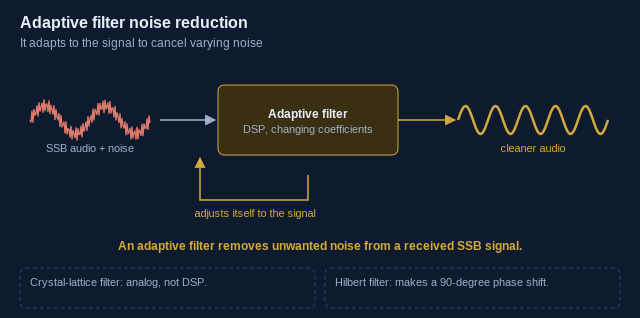
An adaptive filter removes unwanted noise from a received SSB signal.

An adaptive DSP filter adjusts itself to remove noise from received SSB audio.
Describe this graphic in words

A noisy red audio waveform enters a gold box labeled adaptive filter, which has an arrow looping back to show it adjusts its coefficients. A clean gold sine wave leaves it. Dimmed notes say crystal-lattice filters are analog and Hilbert filters shift phase by 90 degrees.

This is a teaching note. It adjusts its coefficients to the signal so it can cancel noise or interference that varies.

Crystal-lattice filters are analog, and a Hilbert transform makes a 90-degree phase shift.

Why the other choices are wrong

  • B. A crystal-lattice filter is analog.
  • C. A Hilbert filter makes phase shifts.
  • D. A phase-inverting filter is not a DSP noise reducer.

Rule text checked against the official source on November 17, 2026. This is a study aid; the linked rule is what governs.
E7F03

What type of digital signal processing filter is used to generate an SSB signal?

Show the answer and why

Answer C. A Hilbert-transform filter

A Hilbert-transform filter is used to generate an SSB signal in DSP.

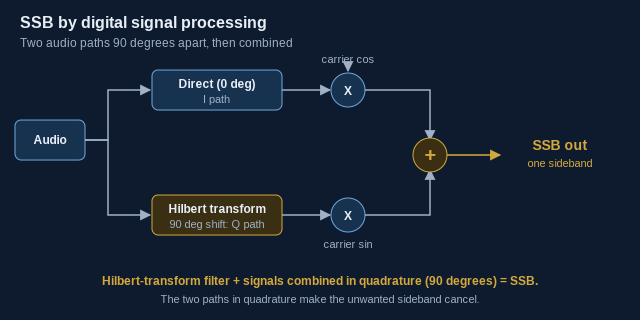
DSP makes SSB with a Hilbert-transform filter and by combining two paths in quadrature phase.
Describe this graphic in words

Audio splits into two paths. The top path goes straight to a multiplier with the carrier cosine. The bottom path passes through a gold Hilbert transform filter that shifts it 90 degrees and then a multiplier with the carrier sine. The two outputs are added to give one sideband, the SSB output.

This is a teaching note. It shifts the phase of all frequencies by 90 degrees, creating the quadrature signal needed to cancel one sideband.

Notch, adaptive and elliptical filters do other jobs.

Why the other choices are wrong

  • A. An adaptive filter reduces noise.
  • B. A notch removes a single tone.
  • D. An elliptical filter is a response type for sharp cutoff, not an SSB generator.

Rule text checked against the official source on November 17, 2026. This is a study aid; the linked rule is what governs.
E7F04

Which method generates an SSB signal using digital signal processing?

Show the answer and why

Answer D. Signals are combined in quadrature phase relationship

DSP generates SSB by combining signals in a quadrature phase relationship.

DSP makes SSB with a Hilbert-transform filter and by combining two paths in quadrature phase.
Describe this graphic in words

Audio splits into two paths. The top path goes straight to a multiplier with the carrier cosine. The bottom path passes through a gold Hilbert transform filter that shifts it 90 degrees and then a multiplier with the carrier sine. The two outputs are added to give one sideband, the SSB output.

This is a teaching note. I and Q signals are 90 degrees apart. Adding or subtracting them cancels one sideband and leaves the other.

This is the phasing method done digitally. For example, with a 1 kHz tone on a 14.200 MHz carrier, one sign of the sum gives only 14.201 MHz (upper sideband) and the opposite sign gives only 14.199 MHz (lower sideband).

Why the other choices are wrong

  • A. This is not how the quadrature method works.
  • B. A synthesizer does not remove sidebands.
  • C. Emulating crystals is a filter method.

Rule text checked against the official source on November 17, 2026. This is a study aid; the linked rule is what governs.
E7F05

How frequently must an analog signal be sampled to be accurately reproduced?

Show the answer and why

Answer B. At least twice the rate of the highest frequency component of the signal

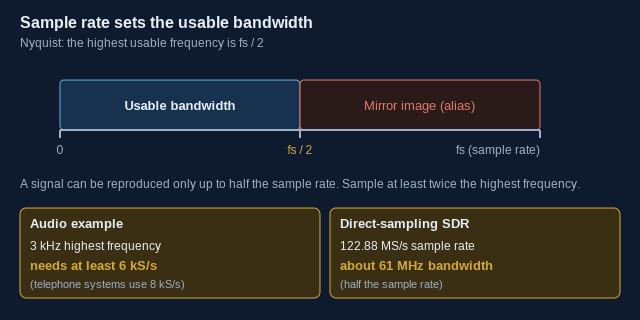
A signal must be sampled at least twice the rate of its highest frequency component.

Frequency axis showing usable bandwidth up to half the sample rate, with two examples.
Describe this graphic in words

A frequency axis from zero to the sample rate is split at half the sample rate. The lower half is the usable bandwidth and the upper half is a mirror image where aliases appear. Two examples follow: a 3 kilohertz audio signal needs at least 6 kilosamples per second, and a direct-sampling SDR at 122.88 megasamples per second has about 61 megahertz of bandwidth.

This is a teaching note. That is the Nyquist rate. For a 3 kHz audio signal you need at least 6 kS/s; telephone systems use 8 kS/s.

Slower than that causes aliasing.

Why the other choices are wrong

  • A. Half the rate would lose information.
  • C. The same rate is too slow.
  • D. Four times would work but is more than required.

Rule text checked against the official source on November 17, 2026. This is a study aid; the linked rule is what governs.
E7F06

What is the minimum number of bits required to sample a signal with a range of 1 volt at a resolution of 1 millivolt?

Show the answer and why

Answer D. 10 bits

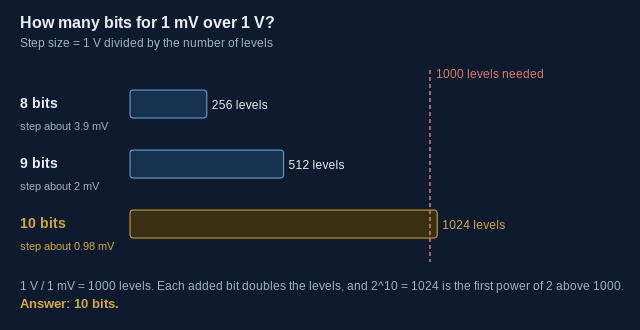
Ten bits are needed: 1 V / 1 mV = 1000 levels, and 2^10 = 1024 is the smallest power of 2 that covers that.

Bars comparing 8, 9 and 10 bit converters against the 1000 levels needed for 1 mV over 1 V.
Describe this graphic in words

Three horizontal bars show the number of levels for 8, 9 and 10 bit converters: 256, 512 and 1024. A dashed line marks the 1000 levels needed to resolve 1 millivolt over a 1 volt range. Only the 10 bit bar, highlighted, passes the line, with steps of about 0.98 millivolt.

This is a teaching note. Each bit doubles the number of steps. 2^8 = 256 and 2^9 = 512 are not enough, but 2^10 = 1024 is.

As a check, a 9-bit converter has 512 steps over 1 V, so each step is about 2 mV, too coarse for 1 mV resolution. A 10-bit converter has steps of about 0.98 mV.

Why the other choices are wrong

  • A. 4 bits gives only 16 levels.
  • B. 6 bits gives only 64 levels.
  • C. 8 bits gives only 256 levels.

Rule text checked against the official source on November 17, 2026. This is a study aid; the linked rule is what governs.
E7F07

What function is performed by a Fast Fourier Transform?

Show the answer and why

Answer C. Converting signals from the time domain to the frequency domain

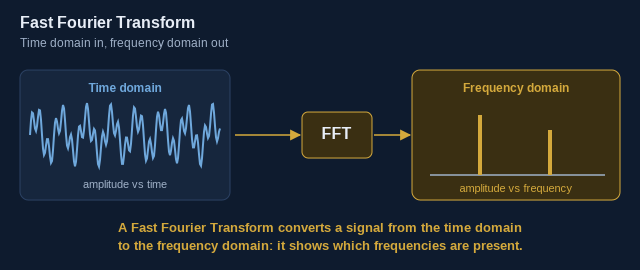
An FFT converts signals from the time domain to the frequency domain.

An FFT converts a time-domain signal into a frequency-domain spectrum.
Describe this graphic in words

A blue two-tone waveform labeled time domain passes through a gold FFT box and becomes a gold spectrum with two spikes labeled frequency domain. A caption says an FFT shows which frequencies are present.

This is a teaching note. It breaks a sampled waveform into its component frequencies, like a spectrum display or waterfall.

ADC and DAC convert between analog and digital.

Why the other choices are wrong

  • A. That is an A/D converter.
  • B. That is a D/A converter.
  • D. That is the inverse FFT.

Rule text checked against the official source on November 17, 2026. This is a study aid; the linked rule is what governs.
E7F08

What is the function of decimation?

Show the answer and why

Answer B. Reducing the effective sample rate by removing samples

Decimation reduces the effective sample rate by removing samples.

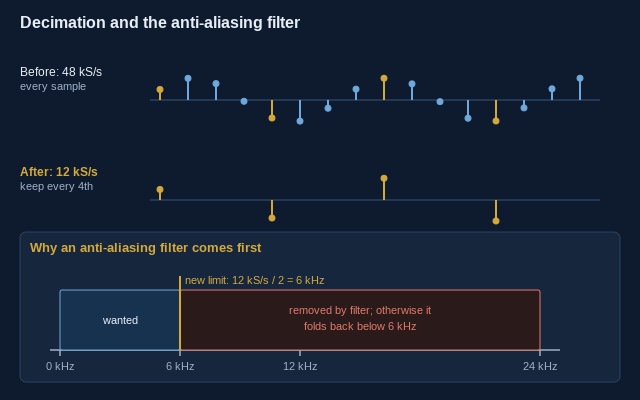
Decimation keeps every fourth sample, and a filter removes content above the new limit first.
Describe this graphic in words

Two rows of samples show a 48 kilosample per second stream and the same stream after decimating by 4, keeping every fourth sample for 12 kilosamples per second. A frequency strip below shows that after decimation only 6 kilohertz is usable, so everything above that must be removed by the anti-aliasing filter first or it would fold back into the wanted band.

This is a teaching note. Keeping every Nth sample lowers the rate by N, which saves processing power once the bandwidth has been narrowed. For example, decimating a 48 kS/s stream by 4 leaves 12 kS/s, which is enough for a 6 kHz-wide signal.

It is unrelated to BCD or digit trimming.

Why the other choices are wrong

  • A. BCD is a number format.
  • C. It does not attenuate.
  • D. It does not trim digits.

Rule text checked against the official source on November 17, 2026. This is a study aid; the linked rule is what governs.

E7F09

Why is an anti-aliasing filter required in a decimator?

Show the answer and why

Answer A. It removes high-frequency signal components that would otherwise be reproduced as lower frequency components

An anti-aliasing filter removes high-frequency components that would otherwise appear as lower-frequency ones.

Decimation keeps every fourth sample, and a filter removes content above the new limit first.
Describe this graphic in words

Two rows of samples show a 48 kilosample per second stream and the same stream after decimating by 4, keeping every fourth sample for 12 kilosamples per second. A frequency strip below shows that after decimation only 6 kilohertz is usable, so everything above that must be removed by the anti-aliasing filter first or it would fold back into the wanted band.

This is a teaching note. After decimation the sample rate is lower, so any energy above half the new rate would fold back into the passband. The filter removes it first.

It does not peak the response or notch the sampling frequency.

Why the other choices are wrong

  • B. It does not peak the response.
  • C. It removes high, not low, frequencies.
  • D. It is not a notch at the sampling frequency.

Rule text checked against the official source on November 17, 2026. This is a study aid; the linked rule is what governs.

E7F10

What aspect of receiver analog-to-digital conversion determines the maximum receive bandwidth of a direct-sampling software defined radio (SDR)?

Show the answer and why

Answer A. Sample rate

The sample rate determines the maximum receive bandwidth of a direct-sampling SDR.

Frequency axis showing usable bandwidth up to half the sample rate, with two examples.
Describe this graphic in words

A frequency axis from zero to the sample rate is split at half the sample rate. The lower half is the usable bandwidth and the upper half is a mirror image where aliases appear. Two examples follow: a 3 kilohertz audio signal needs at least 6 kilosamples per second, and a direct-sampling SDR at 122.88 megasamples per second has about 61 megahertz of bandwidth.

This is a teaching note. By the Nyquist theorem the usable bandwidth is up to half the sample rate. Sampling at 122.88 MS/s gives about 61 MHz.

Bits affect dynamic range.

Why the other choices are wrong

  • B. Sample width affects dynamic range.
  • C. Non-linearity affects distortion.
  • D. Non-linearity affects distortion.

Rule text checked against the official source on November 17, 2026. This is a study aid; the linked rule is what governs.

E7F11

What sets the minimum detectable signal level for a direct-sampling software defined receiver in the absence of atmospheric or thermal noise?

Show the answer and why

Answer B. Reference voltage level and sample width in bits

Reference voltage level and sample width in bits set the minimum detectable signal level.

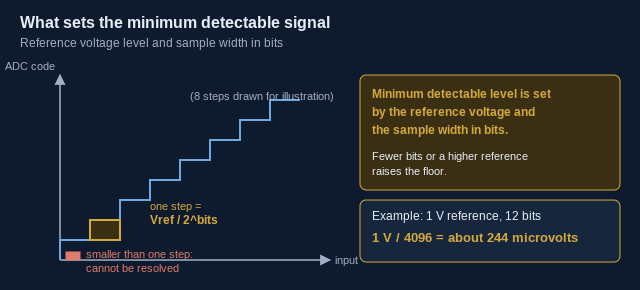
The ADC reference voltage and sample width in bits set the smallest detectable step.
Describe this graphic in words

A staircase converter response with one step highlighted in gold, labeled the reference voltage divided by two to the power of the bits. A signal smaller than one step cannot be resolved. A gold example box shows 1 volt over 4096 for a 12-bit converter, about 244 microvolts.

This is a teaching note. The smallest step is the reference voltage divided by 2^bits. A signal smaller than one step cannot be resolved. Fewer bits or a higher reference raises the floor. For example, a 1 V reference with a 12-bit converter has steps of 1 V / 4096, about 244 microvolts.

Phase noise and jitter matter but do not set the quantization floor.

Why the other choices are wrong

  • A. Phase noise limits dynamic range, not the floor.
  • C. Transfer rate has nothing to do with it.
  • D. These are error sources.

Rule text checked against the official source on November 17, 2026. This is a study aid; the linked rule is what governs.

E7F12

Which of the following is generally true of Finite Impulse Response (FIR) filters?

Show the answer and why

Answer A. FIR filters can delay all frequency components of the signal by the same amount

FIR filters can delay all frequency components by the same amount (linear phase).

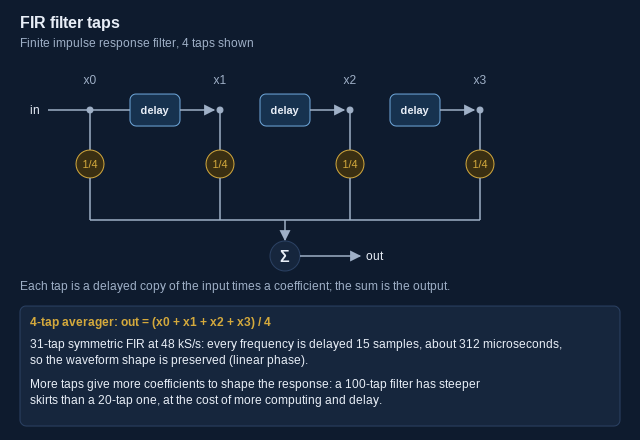
A four-tap FIR filter built from delays, coefficients and a summer.
Describe this graphic in words

A tapped delay line takes the input through three delay blocks. The input and each delayed output are tapped as x0 to x3, each multiplied by a coefficient of one quarter and added in a summer to give the output, which is a 4-tap averager. Notes below explain that 31 symmetric taps at 48 kilosamples per second delay all frequencies by about 312 microseconds, and that more taps make a sharper response.

This is a teaching note. With symmetric coefficients, an FIR has constant group delay, so a signal is not distorted in shape.

For example, a 31-tap symmetric FIR running at 48 kS/s delays every frequency by 15 samples, about 312 microseconds, so the waveform shape is preserved. They are not easier for sharp roll-off, because that takes many taps.

Why the other choices are wrong

  • B. Sharp roll-off takes many taps.
  • C. FIRs do not respond faster.
  • D. Only one of them is true.

Rule text checked against the official source on November 17, 2026. This is a study aid; the linked rule is what governs.

E7F13

What is the function of taps in a digital signal processing filter?

Show the answer and why

Answer D. Provide incremental signal delays for filter algorithms

Taps provide incremental signal delays for filter algorithms.

A four-tap FIR filter built from delays, coefficients and a summer.
Describe this graphic in words

A tapped delay line takes the input through three delay blocks. The input and each delayed output are tapped as x0 to x3, each multiplied by a coefficient of one quarter and added in a summer to give the output, which is a 4-tap averager. Notes below explain that 31 symmetric taps at 48 kilosamples per second delay all frequencies by about 312 microseconds, and that more taps make a sharper response.

This is a teaching note. Each tap is a delayed copy of the input multiplied by a coefficient, and the sum of those products forms the output. For example, a 4-tap averaging filter outputs (x0 + x1 + x2 + x3) / 4, where x1 to x3 are the previous three samples.

They are not debugging access.

Why the other choices are wrong

  • A. Not about pressure.
  • B. Not for debugging.
  • C. Not related to baseband generation.

Rule text checked against the official source on November 17, 2026. This is a study aid; the linked rule is what governs.

E7F14

Which of the following would allow a digital signal processing filter to create a sharper filter response?

Show the answer and why

Answer B. More taps

More taps allow a sharper filter response.

A four-tap FIR filter built from delays, coefficients and a summer.
Describe this graphic in words

A tapped delay line takes the input through three delay blocks. The input and each delayed output are tapped as x0 to x3, each multiplied by a coefficient of one quarter and added in a summer to give the output, which is a 4-tap averager. Notes below explain that 31 symmetric taps at 48 kilosamples per second delay all frequencies by about 312 microseconds, and that more taps make a sharper response.

This is a teaching note. More taps mean more coefficients to shape the response, so steeper skirts. A 100-tap filter is sharper than a 20-tap one, at the cost of more computing and delay.

Data rate, Q and precision do not do it.

Why the other choices are wrong

  • A. Data rate does not change sharpness.
  • C. Lower Q is the opposite.
  • D. Precision reduces rounding errors only.

Rule text checked against the official source on November 17, 2026. This is a study aid; the linked rule is what governs.