
ARSC Tech School

Amateur Extra E3A: Electromagnetic Waves and Specialized Propagation

599 questions · pool July 1, 2024 to June 30, 2028 · the exam has 50 questions; 37 to pass

E3 · RADIO WAVE PROPAGATION

Electromagnetic Waves and Specialized Propagation: Earth-Moon-Earth (EME) communications; meteor scatter; microwave tropospheric and scatter propagation; auroral propagation; daily variation of ionospheric propagation; circular polarization

14 questions in group E3A

One question from this group appears on each exam.

E3A01

What is the approximate maximum separation measured along the surface of the Earth between two stations communicating by EME?

Show the answer and why

Answer D. 12,000 miles, if the moon is “visible” by both stations

Two EME stations can be as far apart as about 12,000 miles, as long as the Moon is above the horizon for both of them.
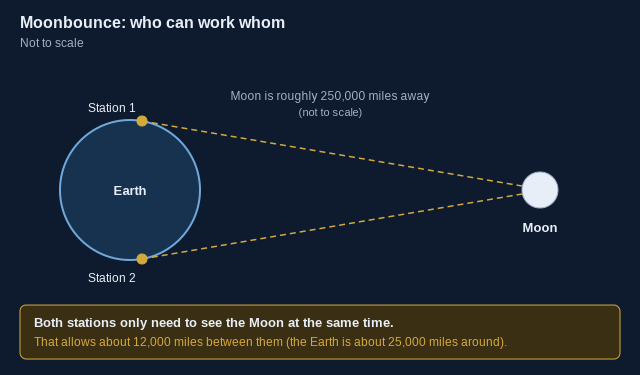
Two stations on opposite edges of the Earth both see the Moon, so they can be about 12,000 miles apart.
Describe this graphic in words

The Earth is drawn at left and the Moon at right, not to scale. Two stations sit near opposite edges of the Earth facing the Moon, and a dashed gold line runs from each to the Moon. A note says the only requirement is that both see the Moon at the same time, which allows about 12,000 miles between them.

This is a teaching note. Moonbounce only needs both stations to see the Moon at the same time. The Moon is roughly a quarter of a million miles away, so a station can see it from nearly half of the Earth's surface. The farthest pair of stations that can both see it are nearly opposite sides of the planet, which is on the order of 12,000 miles apart (the Earth is about 25,000 miles around).

Perigee and apogee change how strong the echo is, but they do not change who can see the Moon.

Why the other choices are wrong

  • A. Perigee makes the path shorter and the echo stronger, but it does not limit the surface distance to 2,000 miles.
  • B. Apogee weakens the echo, but the surface separation is still set by who can see the Moon, not by 2,000 miles.
  • C. Nothing about perigee caps the distance at 5,000 miles. Any two stations that both see the Moon can work each other.

Rule text checked against the official source on November 17, 2026. This is a study aid; the linked rule is what governs.
E3A02

What characterizes libration fading of an EME signal?

Show the answer and why

Answer B. A fluttery, irregular fading

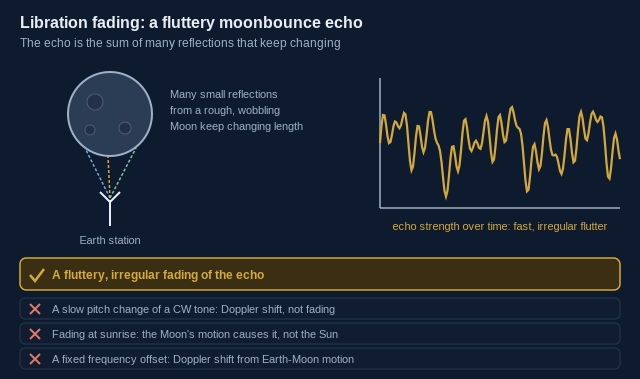
Libration fading is a fluttery, irregular fading of the moonbounce echo.

Many changing reflection paths from the rough librating Moon produce a fluttery, irregular fading echo.
Describe this graphic in words

On the left, several path lines from an Earth station reach different spots on a rough Moon, each with a slightly different and changing length. On the right, a graph of echo strength over time shows a rapid, irregular, fluttery fade from the pieces adding and canceling.

This is a teaching note. The Moon wobbles slightly as it orbits, and its surface is rough. The echo is really the sum of many small reflections from different spots, and as the Moon librates those paths keep changing length, so the pieces add and cancel at random. You hear that as a rapid, fluttery, irregular fade.

The same motion also spreads the echo slightly in frequency, but that is Doppler spread, not the fading itself.

Why the other choices are wrong

  • A. A slow change in the pitch of a CW tone is a Doppler shift effect, not fading.
  • C. Sunrise has nothing to do with libration. The Moon's motion causes it.
  • D. A fixed frequency offset of the echo is Doppler shift from the relative motion of Earth and Moon, not fading.

Rule text checked against the official source on November 17, 2026. This is a study aid; the linked rule is what governs.
E3A03

When scheduling EME contacts, which of these conditions will generally result in the least path loss?

Show the answer and why

Answer A. When the Moon is at perigee

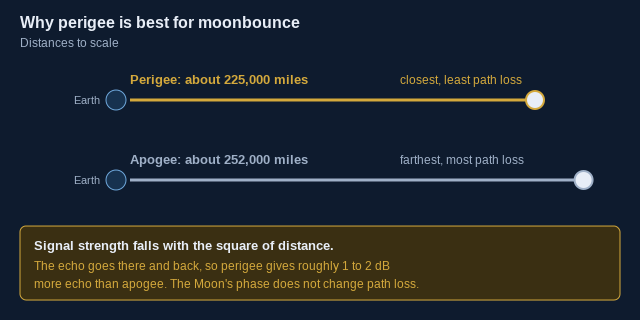
Path loss to the Moon is least when the Moon is at perigee, its closest point to Earth.

The Moon is about 225,000 miles from Earth at perigee and about 252,000 miles at apogee, so path loss is least at perigee.
Describe this graphic in words

Two horizontal bars run from the Earth to the Moon. The shorter gold bar is perigee, about 225,000 miles, with the least path loss. The longer bar is apogee, about 252,000 miles. A note says the round trip gives roughly 1 to 2 dB more echo at perigee and that the Moon's phase does not matter.

This is a teaching note. Signal strength falls with the square of distance, so getting closer pays off. The Moon is about 225,000 miles away at perigee and about 252,000 miles at apogee. An EME echo travels there and back, so the difference in the round trip adds up to a gain of roughly 1 to 2 dB in echo strength at perigee. That small amount matters a lot with weak signals.

The Moon's phase has no effect on path loss, and the MUF is an HF ionosphere idea that does not matter for signals that pass through the ionosphere to space.

Why the other choices are wrong

  • B. Moon phase changes how it is lit, not how far away it is, so it does not change path loss.
  • C. Apogee is the farthest point, so the path loss is greatest, not least.
  • D. MUF concerns bouncing signals off the ionosphere. EME signals go straight through it to the Moon.

Rule text checked against the official source on November 17, 2026. This is a study aid; the linked rule is what governs.
E3A04

In what direction does an electromagnetic wave travel?

Show the answer and why

Answer D. It travels at a right angle to the electric and magnetic fields

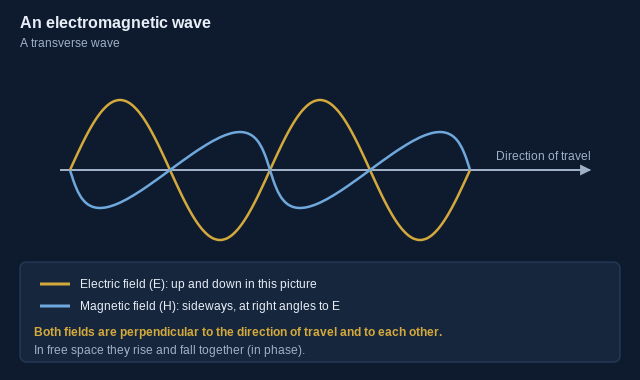
An electromagnetic wave travels at a right angle to both its electric and magnetic fields.

The electric and magnetic fields of a wave are at right angles to each other and to the direction of travel.
Describe this graphic in words

A horizontal arrow shows the direction of travel. A gold wave swings up and down for the electric field, and a blue wave swings sideways, drawn on a slant, for the magnetic field. A key states that the two fields are perpendicular to each other and to the direction of travel, and that they rise and fall together in free space.

This is a teaching note. The electric field and the magnetic field in a wave are perpendicular to each other, and the wave moves in the direction that is perpendicular to both. If the E field points up and the H field points sideways, the wave travels straight out ahead of them. This is why it is called a transverse wave.

The direction of travel does not depend on the phase of either field.

Why the other choices are wrong

  • A. Direction of travel is fixed by the geometry of the fields, not by the magnetic field's phase angle.
  • B. The wave does not travel along the fields. It moves at right angles to them.
  • C. Direction of travel is fixed by the geometry of the fields, not by the electric field's phase angle.

Rule text checked against the official source on November 17, 2026. This is a study aid; the linked rule is what governs.
E3A05

How are the component fields of an electromagnetic wave oriented?

Show the answer and why

Answer C. They are at right angles

The electric and magnetic fields of an electromagnetic wave are oriented at right angles to each other.

The electric and magnetic fields of a wave are at right angles to each other and to the direction of travel.
Describe this graphic in words

A horizontal arrow shows the direction of travel. A gold wave swings up and down for the electric field, and a blue wave swings sideways, drawn on a slant, for the magnetic field. A key states that the two fields are perpendicular to each other and to the direction of travel, and that they rise and fall together in free space.

This is a teaching note. In a plane wave the E field and the H field are perpendicular to each other in space, and both are perpendicular to the direction of travel. In free space they also rise and fall together, which is to say they are in phase.

The question is about orientation in space, so the "90 degrees" in the last choice would be a statement about timing, which is not correct for a wave in free space.

Why the other choices are wrong

  • A. Parallel fields would not form a transverse wave. The fields are perpendicular.
  • B. Tangential describes a line touching a curve and is not how the wave fields are related.
  • D. In free space the two fields are in phase, not 90 degrees out of phase. The right angle is in space, not in time.

Rule text checked against the official source on November 17, 2026. This is a study aid; the linked rule is what governs.
E3A06

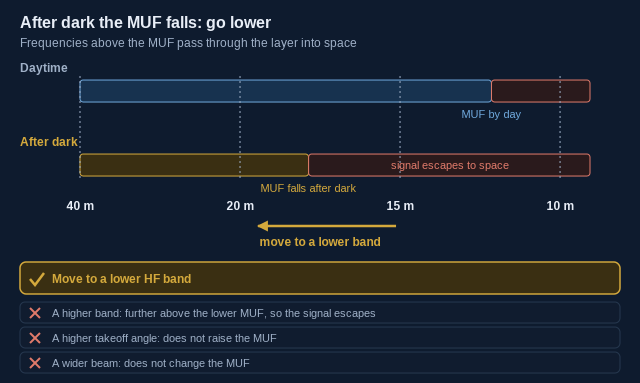
What should be done to continue a long-distance contact when the MUF for that path decreases due to darkness?

Show the answer and why

Answer B. Switch to a lower frequency HF band

When the MUF drops after dark, move to a lower HF band.

A frequency axis showing the MUF falling after dark so 15 meters escapes to space and a lower band is needed.
Describe this graphic in words

Two bars run across a frequency axis marked 40, 20, 15 and 10 meters. The daytime bar is usable up to a high MUF. After dark the MUF falls to between 20 and 15 meters, so 15 meters lies in the red region where signals pass through into space. A gold arrow points to the lower 20 and 40 meter bands.

This is a teaching note. The MUF is the highest frequency the ionosphere can bend back to Earth over a given path. At night the F layer is no longer being ionized by the Sun, so the MUF falls. If you stay on a frequency above the new MUF, the signal passes through the layer and into space.

So if 15 meters stops working after sunset, 20 or 40 meters is a better bet. Going higher makes things worse, and changing your takeoff angle or beam width does not raise the MUF.

Why the other choices are wrong

  • A. A higher band is further above the lower MUF, so the signal would escape into space.
  • C. A higher takeoff angle does not raise the MUF for a given path. It changes where the signal lands.
  • D. Beam width is about how the antenna spreads power sideways. It does not change the MUF.

Rule text checked against the official source on November 17, 2026. This is a study aid; the linked rule is what governs.
E3A07

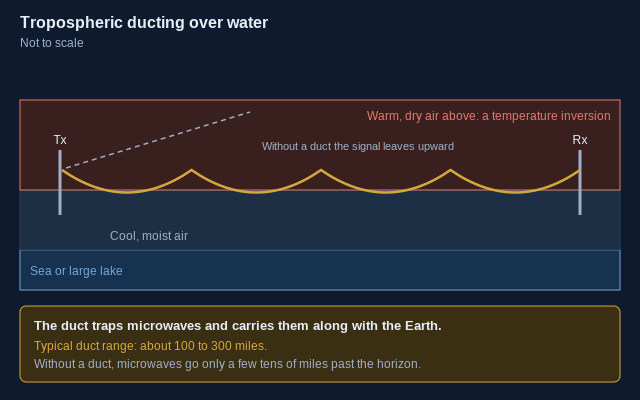
Atmospheric ducts capable of propagating microwave signals often form over what geographic feature?

Show the answer and why

Answer C. Large bodies of water

Microwave ducts often form over large bodies of water.

A layer of warm dry air over cool moist air above the sea traps microwave signals in a duct for about 100 to 300 miles.
Describe this graphic in words

Three layers are stacked over the sea: cool moist air, with a layer of warm dry air above it forming a temperature inversion. A gold path bounces along near the boundary of the layers from a transmitter at left to a receiver at right. A grey dashed line shows a signal without a duct leaving upward. A note says typical duct range is about 100 to 300 miles, against a few tens of miles past the horizon without one.

This is a teaching note. A tropospheric duct forms when a layer of warm, dry air sits over cooler, moist air, which is called a temperature inversion. Over the ocean or a large lake the air near the surface is cooled and moistened by the water, and warm dry air often lies above it. That makes ideal conditions for a stable duct, such as the well-known path from California to Hawaii.

Mountains tend to break up the smooth layers, and clouds are not the cause.

Why the other choices are wrong

  • A. Mountains disturb layers of air and block the path, so they are not where ducts typically form.
  • B. Clouds are a result of the weather, not the layered inversion that makes a duct.
  • D. Nimbus clouds mean rain and mixing of the air, which works against a stable duct.

Rule text checked against the official source on November 17, 2026. This is a study aid; the linked rule is what governs.
E3A08

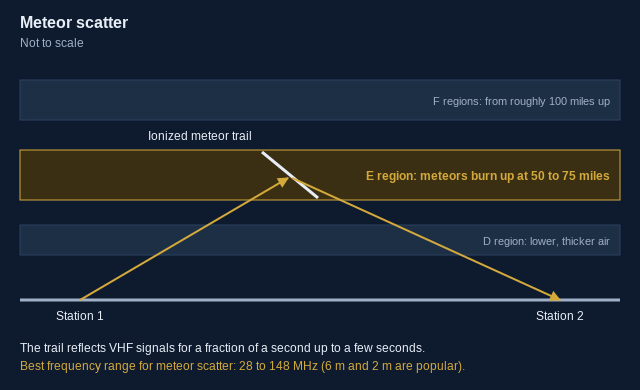
When a meteor strikes the Earth’s atmosphere, a linear ionized region is formed at what region of the ionosphere?

Show the answer and why

Answer A. The E region

A meteor leaves its ionized trail in the E region.

A meteor trail in the E region reflects a VHF signal between two stations.
Describe this graphic in words

Layers of the ionosphere are stacked over two stations on the ground: the D region lowest, the E region in gold at 50 to 75 miles, and the F regions from about 100 miles. A short ionized meteor trail sits inside the E region, and a gold path goes from the first station up to the trail and down to the second. Notes say the trail reflects VHF for a fraction of a second to a few seconds and that 28 to 148 MHz is the best range.

This is a teaching note. Meteors burn up at roughly 50 to 75 miles up, which is the height of the E region of the ionosphere. The trail of ionized gas they leave is long and thin, and it can reflect VHF signals for a fraction of a second up to a few seconds.

The F regions are higher, from roughly 100 miles up, and the D region is lower, where the air is thicker.

Why the other choices are wrong

  • B. The F1 region is far higher than where meteors burn up.
  • C. The F2 region is far higher than where meteors burn up.
  • D. The D region is lower and the air is too dense there for most meteors to leave a lasting trail.

Rule text checked against the official source on November 17, 2026. This is a study aid; the linked rule is what governs.
E3A09

Which of the following frequency ranges is most suited for meteor-scatter communications?

Show the answer and why

Answer C. 28 MHz - 148 MHz

Meteor-scatter work is best at 28 to 148 MHz.

A meteor trail in the E region reflects a VHF signal between two stations.
Describe this graphic in words

Layers of the ionosphere are stacked over two stations on the ground: the D region lowest, the E region in gold at 50 to 75 miles, and the F regions from about 100 miles. A short ionized meteor trail sits inside the E region, and a gold path goes from the first station up to the trail and down to the second. Notes say the trail reflects VHF for a fraction of a second to a few seconds and that 28 to 148 MHz is the best range.

This is a teaching note. A meteor trail is short-lived and weakly ionized. Below about 28 MHz the ordinary ionosphere is the main path, and the trail adds little. From 28 MHz up through the 2 meter band the trail reflects well enough, for long enough, to pass data, and 6 meters and 2 meters are the popular meteor-scatter bands.

The echo gets weaker and briefer as frequency rises, so at 220 MHz and above it is much harder to use.

Why the other choices are wrong

  • A. At 1.8 MHz the signal depends on the ordinary ionosphere, and the D layer absorbs it in the daytime, so meteor trails are not the useful path.
  • B. At 10 to 14 MHz the ionosphere does the job, and meteor trails add little.
  • D. At 220 to 450 MHz the reflections are too weak and brief to be of much use.

Rule text checked against the official source on November 17, 2026. This is a study aid; the linked rule is what governs.
E3A10

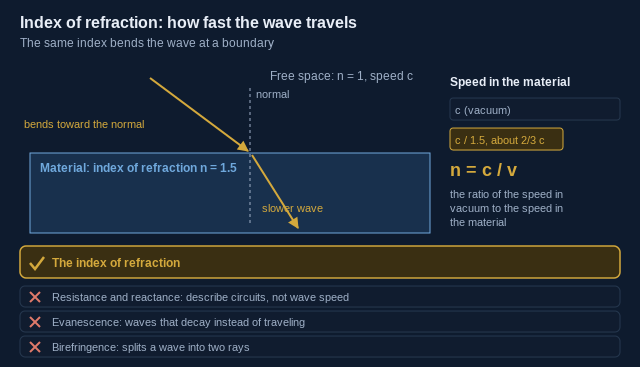
What determines the speed of electromagnetic waves through a medium?

Show the answer and why

Answer D. The index of refraction

The index of refraction determines how fast a wave travels through a medium.

A ray bending at the boundary of a material with index 1.5 where the wave travels at about two thirds of free-space speed.
Describe this graphic in words

A ray from free space strikes a boundary and bends toward the normal inside a material with index of refraction 1.5. Bars compare the speed c in vacuum with about two thirds of c in the material. The index is the ratio of vacuum speed to the speed in the material.

This is a teaching note. The index of refraction is the ratio of the speed of light in a vacuum to the speed of the wave in the material. If a material has an index of 1.5, waves travel at 1/1.5, or about two thirds of the speed in free space. The same index is what bends a wave when it enters at an angle, which is the idea behind refraction in the ionosphere and in the troposphere.

Resistance and reactance describe circuits, and evanescence and birefringence are different effects.

Why the other choices are wrong

  • A. Resistance and reactance describe how a circuit opposes current. They do not set wave speed in a medium.
  • B. Evanescence refers to waves that decay quickly instead of traveling, so it does not set the speed.
  • C. Birefringence is when a material splits a wave into two rays, and it does not set the speed.

Rule text checked against the official source on November 17, 2026. This is a study aid; the linked rule is what governs.

E3A11

What is a typical range for tropospheric duct propagation of microwave signals?

Show the answer and why

Answer B. 100 miles to 300 miles

Tropospheric ducting of microwaves typically spans about 100 to 300 miles.

A layer of warm dry air over cool moist air above the sea traps microwave signals in a duct for about 100 to 300 miles.
Describe this graphic in words

Three layers are stacked over the sea: cool moist air, with a layer of warm dry air above it forming a temperature inversion. A gold path bounces along near the boundary of the layers from a transmitter at left to a receiver at right. A grey dashed line shows a signal without a duct leaving upward. A note says typical duct range is about 100 to 300 miles, against a few tens of miles past the horizon without one.

This is a teaching note. A duct acts like a leaky pipe that keeps signals curving along with the Earth instead of going out into space. In normal conditions microwaves go only a bit past the horizon, which is a few tens of miles. With a good duct they can go a few hundred miles. This is a typical figure, not a firm limit: exceptional ducts have reached much farther, as on the long over-water paths.

Ten to 50 miles is about what you get without a duct, and 1,200 miles or more is far beyond what a normal duct delivers.

Why the other choices are wrong

  • A. Ten to 50 miles is closer to ordinary line-of-sight range than a duct.
  • C. 1,200 miles is much beyond a typical duct. Only extreme events approach it.
  • D. 2,500 miles is far beyond a typical duct.

Rule text checked against the official source on November 17, 2026. This is a study aid; the linked rule is what governs.

E3A12

What is most likely to result in auroral propagation?

Show the answer and why

Answer C. Severe geomagnetic storms

Severe geomagnetic storms are the most likely cause of auroral propagation.

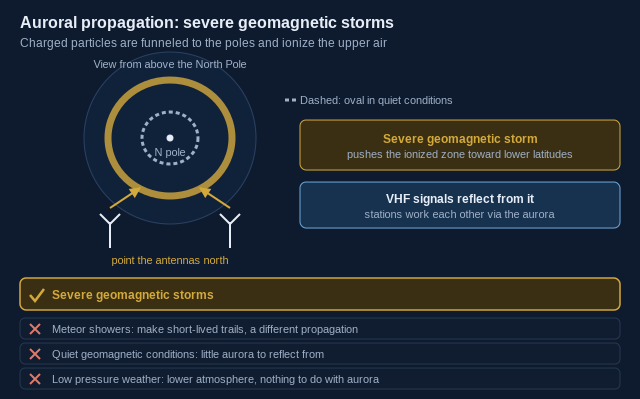
The auroral oval pushed toward lower latitudes during a geomagnetic storm, with two stations pointing north at it.
Describe this graphic in words

A polar view shows a small dashed ring for the quiet auroral zone and a large gold ring for the zone expanded by a severe geomagnetic storm. Two stations to the south aim their antennas north at it, and VHF signals reflect from the ionized region.

This is a teaching note. The aurora happens when charged particles from the Sun are funneled by the Earth's magnetic field into the polar regions, where they ionize the upper air. Strong disturbances of the field, which are geomagnetic storms, push that ionized zone to lower latitudes. VHF signals can then be reflected from it, so stations can work each other by pointing their antennas north.

Quiet conditions give no aurora, meteor showers cause meteor scatter instead, and weather systems do not make the aurora.

Why the other choices are wrong

  • A. Meteor showers make short-lived reflecting trails, which is a different kind of propagation.
  • B. Quiet geomagnetic conditions mean there is little aurora to reflect from.
  • D. Low-pressure weather happens in the lower atmosphere and has nothing to do with the aurora.

Rule text checked against the official source on November 17, 2026. This is a study aid; the linked rule is what governs.

E3A13

Which of these emission modes is best for auroral propagation?

Show the answer and why

Answer A. CW

CW is the best mode for auroral propagation.

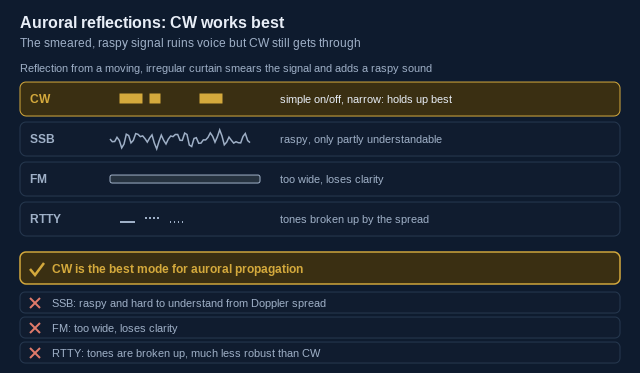
Four modes compared for auroral propagation, with CW highlighted as holding up best.
Describe this graphic in words

Four rows list modes with a small waveform icon each. CW, in gold, is a simple narrow on and off signal that holds up best. SSB becomes raspy and only partly understandable, FM is too wide and loses clarity, and RTTY tones are broken up by the spread.

This is a teaching note. Signals reflected from an aurora are scattered by a moving, irregular curtain of ionization. That smears the signal and adds a rough, raspy sound, so voice modes become hard to understand. Because CW is a simple on and off signal with a narrow bandwidth, it holds up best in this kind of garble.

SSB is partly understandable, FM is too wide to work well, and RTTY suffers from the smearing.

Why the other choices are wrong

  • B. SSB voice becomes raspy and hard to understand from the Doppler spread of the aurora.
  • C. FM is too wide and loses its clarity in the smeared signal.
  • D. RTTY tones are broken up by the spread, so it is much less robust than CW.

Rule text checked against the official source on November 17, 2026. This is a study aid; the linked rule is what governs.

E3A14

What are circularly polarized electromagnetic waves?

Show the answer and why

Answer B. Waves with rotating electric and magnetic fields

A circularly polarized wave has electric and magnetic fields that rotate.

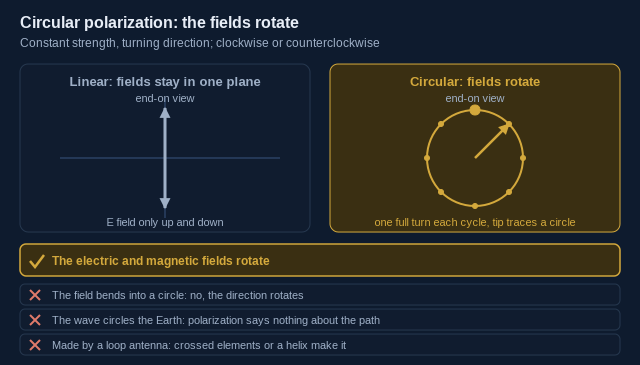
An end-on view showing a linear field staying in one line while a circular field tip traces a circle.
Describe this graphic in words

Looking along the direction of travel, the left panel shows a linear wave whose electric field only swings up and down in one line. The right panel shows a circularly polarized wave where the field strength stays constant while its direction rotates, the tip tracing a circle once each cycle.

This is a teaching note. In linear polarization the fields stay in one plane. In circular polarization the fields keep a constant strength while their direction turns around the direction of travel, making one full rotation each cycle. Seen from the front, the tip of the E field traces a circle, and it can turn clockwise or counterclockwise.

The wave itself is not a bent field, it does not circle the Earth, and a loop antenna does not necessarily make it.

Why the other choices are wrong

  • A. The field does not bend into a circle. Its direction rotates around the travel path.
  • C. Circular polarization says nothing about a path around the Earth.
  • D. A loop antenna is not required and normally makes linear polarization. Circular polarization is made by crossed elements or a helix.

Rule text checked against the official source on November 17, 2026. This is a study aid; the linked rule is what governs.