
ARSC Tech School

Amateur Extra E7E: Modulation and demodulation

599 questions · pool July 1, 2024 to June 30, 2028 · the exam has 50 questions; 37 to pass

E7 · PRACTICAL CIRCUITS

Modulation and demodulation: reactance, phase, and balanced modulators; detectors; mixers

11 questions in group E7E

One question from this group appears on each exam.

E7E01

Which of the following can be used to generate FM phone signals?

Show the answer and why

Answer B. Reactance modulation of a local oscillator

Reactance modulation of a local oscillator can generate FM.
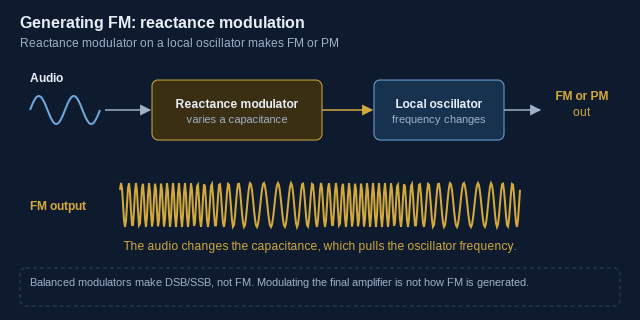
Audio drives a reactance modulator that varies a capacitance, pulling an oscillator to make FM or PM.
Describe this graphic in words

A block chain: audio waveform into a gold reactance modulator that varies a capacitance, then into a local oscillator, then out as FM or PM. A gold waveform below shows the output frequency speeding up and slowing down. A dimmed note says balanced modulators make DSB or SSB, not FM.

This is a teaching note. A reactance modulator changes the effective capacitance or inductance of the oscillator tuning circuit in step with the audio, so the oscillator frequency swings. That is frequency modulation. For example, a 3 kHz audio tone can swing a 10 MHz oscillator by a few kHz either side of center, and that swing is the frequency deviation.

Balanced modulators produce suppressed-carrier double sideband. The final amplifier does not set the frequency, so modulating its reactance would not produce clean FM.

Why the other choices are wrong

  • A. A balanced modulator cancels the carrier and makes DSB, not FM.
  • C. The oscillator is what sets the frequency; the final amplifier only amplifies it.
  • D. Balanced modulation of an oscillator still gives suppressed-carrier DSB, not a swinging frequency.

Rule text checked against the official source on November 17, 2026. This is a study aid; the linked rule is what governs.
E7E02

What is the function of a reactance modulator?

Show the answer and why

Answer D. Produce PM or FM signals by varying a capacitance

A reactance modulator produces PM or FM signals by varying a capacitance.

Audio drives a reactance modulator that varies a capacitance, pulling an oscillator to make FM or PM.
Describe this graphic in words

A block chain: audio waveform into a gold reactance modulator that varies a capacitance, then into a local oscillator, then out as FM or PM. A gold waveform below shows the output frequency speeding up and slowing down. A dimmed note says balanced modulators make DSB or SSB, not FM.

This is a teaching note. It uses a transistor or varactor that acts as a variable reactance across the oscillator tank. The audio changes that reactance, which shifts the oscillator frequency.

It works on reactance, not resistance, and it creates angle modulation rather than AM.

Why the other choices are wrong

  • A. It varies reactance, not resistance.
  • B. It does not make AM.
  • C. Varying resistance would not produce FM.

Rule text checked against the official source on November 17, 2026. This is a study aid; the linked rule is what governs.
E7E03

What is a frequency discriminator?

Show the answer and why

Answer D. A circuit for detecting FM signals

A frequency discriminator is a circuit for detecting FM signals.

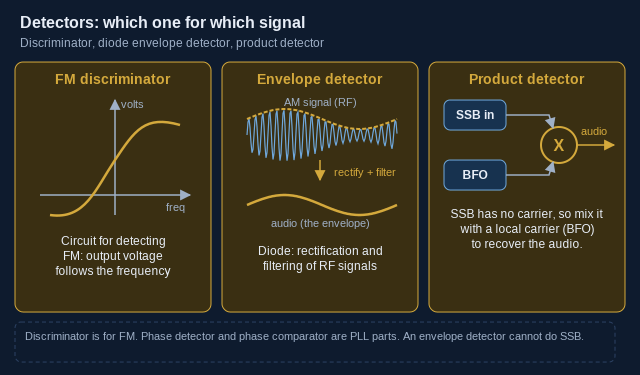
Three detectors: FM discriminator, diode envelope detector and SSB product detector.
Describe this graphic in words

Three gold panels. The first shows an S-shaped discriminator curve of output voltage against frequency for detecting FM. The second shows an AM signal whose envelope is recovered by rectifying and filtering. The third shows SSB mixed with a locally generated carrier, the BFO, to give audio. A dimmed note lists wrong choices.

This is a teaching note. It converts frequency deviations of the incoming signal into a voltage that follows the original audio.

Generators, adjacent-channel filters and band switching are different circuits.

Why the other choices are wrong

  • A. An FM generator is a modulator.
  • B. Filtering close signals is a selectivity function.
  • C. Band switching is unrelated.

Rule text checked against the official source on November 17, 2026. This is a study aid; the linked rule is what governs.
E7E04

What is one way to produce a single-sideband phone signal?

Show the answer and why

Answer A. Use a balanced modulator followed by a filter

One way to make SSB is a balanced modulator followed by a filter.

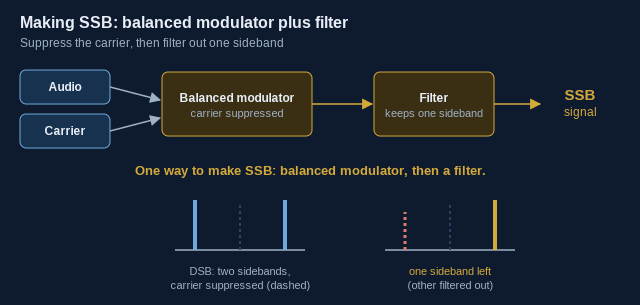
A balanced modulator makes a double-sideband signal and a filter keeps one sideband to make SSB.
Describe this graphic in words

A chain of blocks: audio and carrier feed a balanced modulator that suppresses the carrier, followed by a filter, then the SSB signal. Spectrum sketches below show two sidebands with the carrier missing after the modulator and only one sideband, in gold, after the filter.

This is a teaching note. The balanced modulator cancels the carrier and leaves two sidebands. A sharp filter then removes the unwanted one, leaving single sideband.

A product detector is a receiver circuit.

Why the other choices are wrong

  • B. Reactance modulators make FM or PM.
  • C. A loop modulator is not an SSB method.
  • D. A product detector demodulates.

Rule text checked against the official source on November 17, 2026. This is a study aid; the linked rule is what governs.
E7E05

What is added to an FM speech channel to boost the higher audio frequencies?

Show the answer and why

Answer D. A pre-emphasis network

A pre-emphasis network boosts the higher audio frequencies in an FM transmitter.

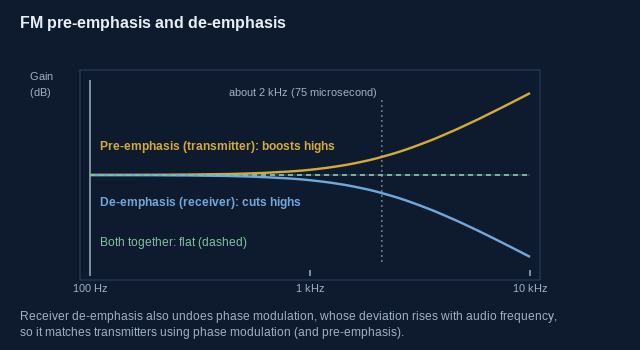
Pre-emphasis rises above about 2 kHz, de-emphasis falls by the same amount, and together they are flat.
Describe this graphic in words

A graph of gain against audio frequency on a log scale. The pre-emphasis curve in the transmitter is flat at low frequencies and rises above about 2 kilohertz, based on a 75 microsecond time constant. The de-emphasis curve in the receiver is its mirror image, falling at high frequencies. A dashed flat line shows the two together restore the original audio balance.

This is a teaching note. Noise in FM is worse at higher audio frequencies, so the transmitter boosts them before modulation. The receiver then uses the opposite de-emphasis to restore the original balance, which also cuts noise. Broadcast FM, for instance, uses a 75 microsecond time constant, which starts boosting the audio above roughly 2 kHz.

De-emphasis is in the receiver and does the opposite.

Why the other choices are wrong

  • A. De-emphasis cuts the high frequencies in the receiver.
  • B. Harmonic enhancer is not a standard FM block.
  • C. Heterodyne enhancer is not a standard FM block.

Rule text checked against the official source on November 17, 2026. This is a study aid; the linked rule is what governs.
E7E06

Why is de-emphasis used in FM communications receivers?

Show the answer and why

Answer A. For compatibility with transmitters using phase modulation

De-emphasis is used for compatibility with transmitters that use phase modulation (and pre-emphasis).

Pre-emphasis rises above about 2 kHz, de-emphasis falls by the same amount, and together they are flat.
Describe this graphic in words

A graph of gain against audio frequency on a log scale. The pre-emphasis curve in the transmitter is flat at low frequencies and rises above about 2 kilohertz, based on a 75 microsecond time constant. The de-emphasis curve in the receiver is its mirror image, falling at high frequencies. A dashed flat line shows the two together restore the original audio balance.

This is a teaching note. The key says "for compatibility with transmitters using phase modulation". Phase modulation naturally gives a deviation that rises with audio frequency, which is the same as FM with pre-emphasis. A receiver with de-emphasis restores flat audio from both.

De-emphasis also reduces high-frequency hiss, but the pool's keyed reason is compatibility with phase-modulated transmitters.

Why the other choices are wrong

  • B. De-emphasis cuts high-frequency hiss, but impulse noise is wideband and is handled by blankers and limiters. The keyed reason is compatibility.
  • C. It is not about efficiency.
  • D. It does not remove distortion products.

Rule text checked against the official source on November 17, 2026. This is a study aid; the linked rule is what governs.

E7E07

What is meant by the term “baseband” in radio communications?

Show the answer and why

Answer B. The frequency range occupied by a message signal prior to modulation

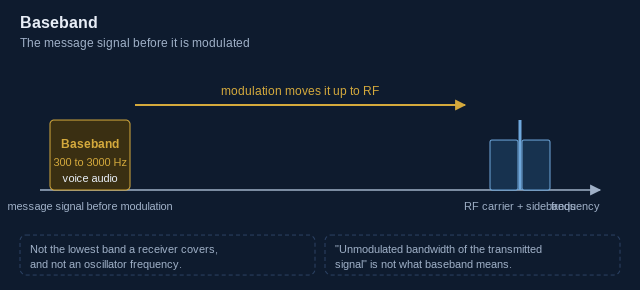
Baseband is the frequency range occupied by a message signal prior to modulation.

Baseband is the frequency range of the message signal before modulation.
Describe this graphic in words

A frequency axis with a gold block at the low end labeled baseband, 300 to 3000 hertz voice audio. A gold arrow labeled modulation moves it up to a blue RF carrier with sidebands at the high end. Dimmed notes list wrong meanings.

This is a teaching note. For voice, baseband is roughly 300 to 3000 Hz audio. Modulation moves it to the RF frequency.

It is not the lowest band a receiver covers or the oscillator frequency.

Why the other choices are wrong

  • A. It is not the lowest band covered.
  • C. Unmodulated is not what baseband means here.
  • D. That is a multiplier chain description.

Rule text checked against the official source on November 17, 2026. This is a study aid; the linked rule is what governs.

E7E08

What are the principal frequencies that appear at the output of a mixer?

Show the answer and why

Answer C. The two input frequencies along with their sum and difference frequencies

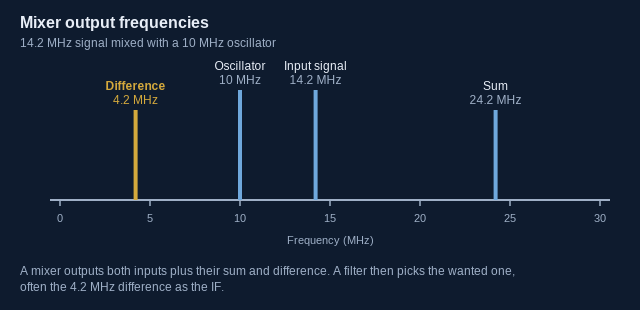
A mixer outputs the two input frequencies along with their sum and difference frequencies.

Spectrum of a mixer output with a 14.2 MHz input and 10 MHz oscillator.
Describe this graphic in words

A frequency axis from 0 to 30 megahertz shows four vertical lines at the mixer output. They sit at 4.2 megahertz (the difference, highlighted), 10 megahertz (the oscillator), 14.2 megahertz (the input signal) and 24.2 megahertz (the sum). A filter picks the wanted one, often the 4.2 megahertz difference.

This is a teaching note. Mix 14.2 MHz with a 10 MHz oscillator and you get 14.2, 10, 24.2 (sum) and 4.2 (difference) MHz. A filter then picks the one wanted, often 4.2 MHz as the IF.

The other choices are not mixer outputs.

Why the other choices are wrong

  • A. Doubling is a multiplier.
  • B. A square root product is not a mixer output.
  • D. These ratios are not mixer products.

Rule text checked against the official source on November 17, 2026. This is a study aid; the linked rule is what governs.

E7E09

What occurs when the input signal levels to a mixer are too high?

Show the answer and why

Answer A. Spurious mixer products are generated

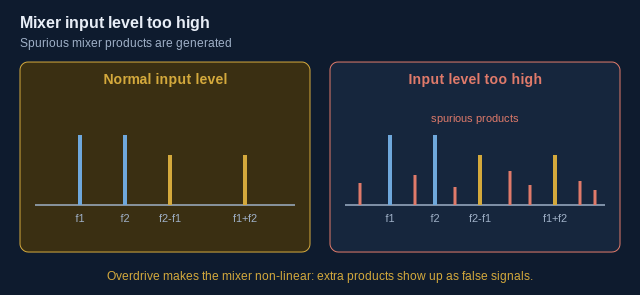
Too high an input level to a mixer causes spurious mixer products.

Too high an input level to a mixer creates spurious mixer products.
Describe this graphic in words

Two spectrum panels. The normal panel shows only the two input frequencies and their sum and difference. The overdriven panel adds many short red lines, the spurious mixer products. A gold caption says overdrive makes the mixer non-linear.

This is a teaching note. Overdrive pushes the mixer into non-linear operation, which makes extra intermodulation products that show up as false signals.

Blanking and AGC are different effects.

Why the other choices are wrong

  • B. Blanking is a noise-blanker term.
  • C. Limiting is not the main result.
  • D. AGC is not the issue.

Rule text checked against the official source on November 17, 2026. This is a study aid; the linked rule is what governs.

E7E10

How does a diode envelope detector function?

Show the answer and why

Answer A. By rectification and filtering of RF signals

A diode envelope detector works by rectification and filtering of RF signals.

Three detectors: FM discriminator, diode envelope detector and SSB product detector.
Describe this graphic in words

Three gold panels. The first shows an S-shaped discriminator curve of output voltage against frequency for detecting FM. The second shows an AM signal whose envelope is recovered by rectifying and filtering. The third shows SSB mixed with a locally generated carrier, the BFO, to give audio. A dimmed note lists wrong choices.

This is a teaching note. The diode passes one half of the AM waveform, and a capacitor smooths it to the audio envelope.

It does not use Zener breakdown, noise mixing or reactance.

Why the other choices are wrong

  • B. Zener breakdown is not used.
  • C. It does not mix with noise.
  • D. It does not sense reactance changes.

Rule text checked against the official source on November 17, 2026. This is a study aid; the linked rule is what governs.

E7E11

Which type of detector is used for demodulating SSB signals?

Show the answer and why

Answer C. Product detector

A product detector demodulates SSB signals.

Three detectors: FM discriminator, diode envelope detector and SSB product detector.
Describe this graphic in words

Three gold panels. The first shows an S-shaped discriminator curve of output voltage against frequency for detecting FM. The second shows an AM signal whose envelope is recovered by rectifying and filtering. The third shows SSB mixed with a locally generated carrier, the BFO, to give audio. A dimmed note lists wrong choices.

This is a teaching note. It mixes the SSB signal with a locally generated carrier (the BFO), recovering the audio. An envelope detector cannot work because SSB has no carrier.

Discriminators and phase comparators are FM or PLL parts.

Why the other choices are wrong

  • A. A discriminator is used for FM.
  • B. A phase detector is used in PLLs.
  • D. A phase comparator is used in PLLs.

Rule text checked against the official source on November 17, 2026. This is a study aid; the linked rule is what governs.