What is the modulation index of an FM signal?
Show the answer and why
Answer A. The ratio of frequency deviation to modulating signal frequency
Modulation index in FM is the frequency deviation divided by the modulating frequency.
Describe this graphic in words
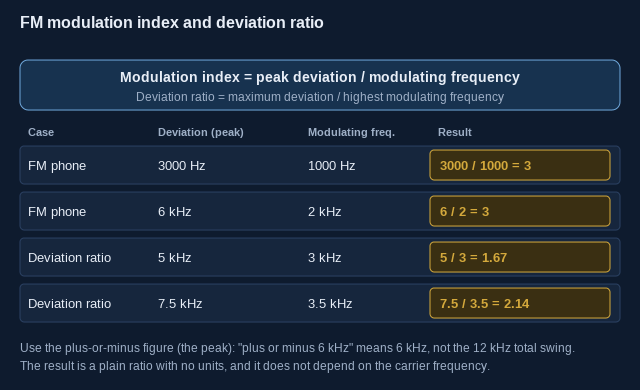
A formula box states that modulation index equals peak deviation divided by modulating frequency, and deviation ratio is the same arithmetic using the maximum deviation and the highest modulating frequency. Below, a table works four cases: 3000 Hz over 1000 Hz gives 3, 6 kHz over 2 kHz gives 3, 5 kHz over 3 kHz gives 1.67, and 7.5 kHz over 3.5 kHz gives 2.14. The results are in gold.
This is a teaching note. The index tells how far the carrier swings compared with how fast it is being modulated: index = deviation / modulating frequency. Example: 5 kHz of deviation with a 1 kHz tone gives an index of 5.
The other choices are not the definition; bandwidth is not part of the ratio.
Why the other choices are wrong
- B. Amplitude divided by deviation is not the definition.
- C. Bandwidth is not in the definition of the index.
- D. Bandwidth over modulating frequency is not the index either.
Rule text checked against the official source on November 17, 2026. This is a study aid; the linked rule is what governs.