
ARSC Tech School

Amateur Extra E4E: Noise and interference

599 questions · pool July 1, 2024 to June 30, 2028 · the exam has 50 questions; 37 to pass

E4 · AMATEUR PRACTICES

Noise and interference: external RF interference; electrical and computer noise; line noise; DSP filtering and noise reduction; common-mode current; surge protectors; single point ground panel

14 questions in group E4E

One question from this group appears on each exam.

E4E01

What problem can occur when using an automatic notch filter (ANF) to remove interfering carriers while receiving CW signals?

Show the answer and why

Answer A. Removal of the CW signal as well as the interfering carrier

An automatic notch filter can remove the CW signal along with the interfering carrier.
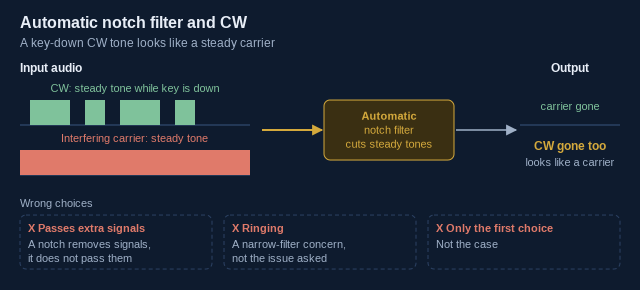
An automatic notch filter treats a steady CW tone like an interfering carrier and removes both.
Describe this graphic in words

A keyed green CW tone and a red steady carrier go into a gold automatic notch filter. Because the CW tone is steady while the key is down, the filter removes it along with the carrier, leaving a flat output. Three dimmed boxes reject the other choices.

This is a teaching note. An automatic notch filter looks for a steady tone and cuts it out. A CW signal is a steady tone while the key is down, so the filter may treat it as an interfering carrier and notch it as well.

The other choices are not the problem associated with the filter.

Why the other choices are wrong

  • B. The notch removes signals, and does not pass them to overwhelm the desired one.
  • C. Ringing is a concern with narrow filters, but it is not the issue asked about here.
  • D. Only the first choice is correct.

Rule text checked against the official source on November 17, 2026. This is a study aid; the linked rule is what governs.
E4E02

Which of the following types of noise can often be reduced by a digital noise reduction?

Show the answer and why

Answer D. All these choices are correct

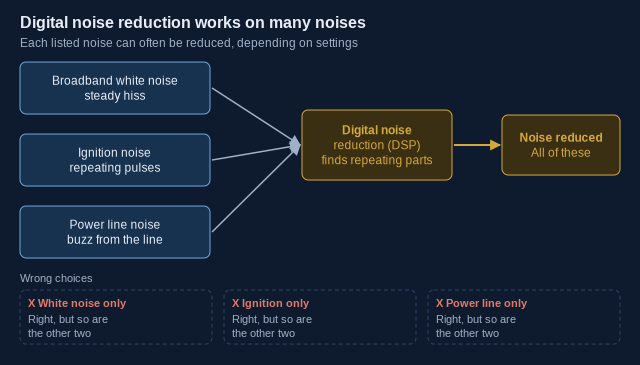
Digital noise reduction can often reduce broadband white noise, ignition noise and power line noise.

Digital noise reduction can often reduce white noise, ignition noise and power line noise.
Describe this graphic in words

Three blue boxes name broadband white noise, ignition noise and power line noise. All three feed a gold DSP digital noise reduction box, which outputs reduced noise labeled all of these. Three dimmed boxes note each single choice is true but incomplete.

This is a teaching note. DSP noise reduction works by finding the repetitive or predictable parts of a signal and subtracting out the random parts. It can help with several kinds of noise, depending on the settings and how the noise behaves.

Since each of the listed noises can often be reduced, "all of these" is correct.

Why the other choices are wrong

  • A. This noise can be reduced, but so can the others.
  • B. This noise can be reduced, but so can the others.
  • C. This noise can be reduced, but so can the others.

Rule text checked against the official source on November 17, 2026. This is a study aid; the linked rule is what governs.
E4E03

Which of the following types of noise are removed by a noise blanker?

Show the answer and why

Answer B. Impulse noise

A noise blanker removes impulse noise.

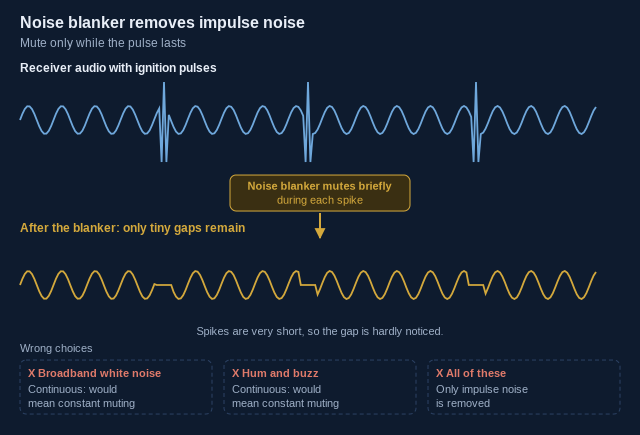
A noise blanker mutes the receiver for the instant of each short impulse, which removes impulse noise.
Describe this graphic in words

A blue audio trace has three tall spikes of ignition noise. A gold noise blanker mutes the receiver during each spike, giving a second gold trace with only tiny gaps where the spikes were. Three dimmed boxes explain that continuous noises like white noise, hum and buzz cannot be blanked this way.

This is a teaching note. Impulse noise, such as ignition pulses, is made of very short high-level spikes. A noise blanker senses a spike and briefly mutes the receiver for its duration. Because the pulse is so short, the gap is hardly noticed.

It cannot remove continuous noise like white noise, or hum and buzz, because the receiver would have to be muted all the time.

Why the other choices are wrong

  • A. Broadband white noise is continuous, so blanking does not suit it.
  • C. Hum and buzz are continuous, so blanking does not suit them.
  • D. Only impulse noise is removed.

Rule text checked against the official source on November 17, 2026. This is a study aid; the linked rule is what governs.
E4E04

How can conducted noise from an automobile battery charging system be suppressed?

Show the answer and why

Answer D. By installing ferrite chokes on the charging system leads

Ferrite chokes on the charging system leads suppress conducted noise from the alternator.

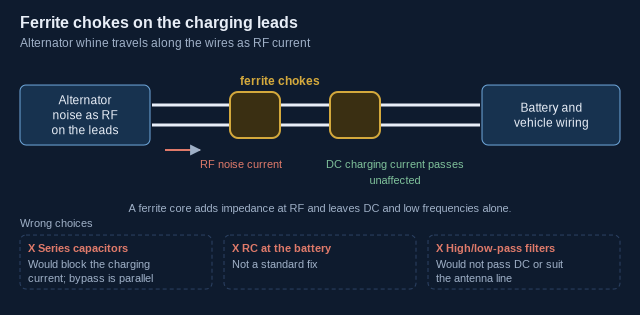
Ferrite chokes slipped over the alternator charging leads block RF noise while DC current still passes.
Describe this graphic in words

Two leads run from an alternator to the battery and vehicle wiring, with two gold ferrite chokes around them. RF noise current is blocked by the ferrites while DC charging current passes unaffected. Three dimmed boxes reject series capacitors, an RC network and high or low-pass filters.

This is a teaching note. Noise from an alternator travels along its wires as RF current. A ferrite core slipped over the leads adds impedance at RF while leaving DC and low-frequency current unaffected.

Putting capacitors in series would block the power current, which defeats the purpose, and the other suggestions do not match how the noise travels.

Why the other choices are wrong

  • A. Series capacitors would block the charging current. Bypass capacitors go in parallel.
  • B. A resistor and capacitor at the battery is not a standard fix for alternator noise.
  • C. High-pass and low-pass filters like these would not pass the DC power or suit the antenna line.

Rule text checked against the official source on November 17, 2026. This is a study aid; the linked rule is what governs.
E4E05

What is used to suppress radio frequency interference from a line-driven AC motor?

Show the answer and why

Answer B. A brute-force AC-line filter in series with the motor’s power leads

A brute-force AC-line filter in series with the motor power leads suppresses RFI from a line-driven AC motor.

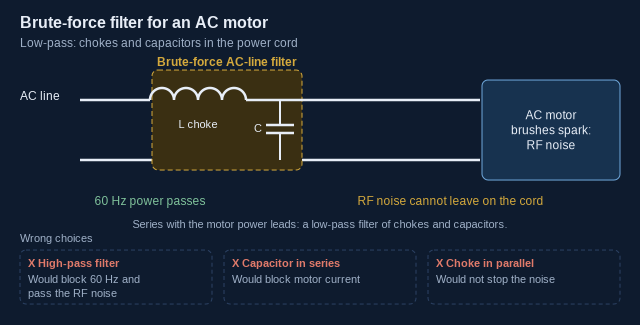
A brute-force low-pass AC-line filter in series with the motor power leads blocks motor RF noise while passing 60 Hz.
Describe this graphic in words

A schematic shows the AC line passing through a gold dashed filter made of a series choke and a shunt capacitor before the AC motor. 60 Hz power passes while RF noise from the motor brushes is stopped. Three dimmed boxes reject a high-pass filter, a series capacitor and a parallel choke.

This is a teaching note. A brute-force filter is a low-pass filter made of chokes and capacitors, put in the power cord. It lets 60 Hz through while blocking the RF noise made by the motor brushes or sparking from the cord.

A high-pass filter would pass the RF and block the power, so it would be wrong.

Why the other choices are wrong

  • A. A high-pass filter would block the 60 Hz power and pass the RF noise.
  • C. A capacitor in series with the field winding would block the motor current.
  • D. A choke in parallel with the winding would not stop the noise from leaving on the power line.

Rule text checked against the official source on November 17, 2026. This is a study aid; the linked rule is what governs.
E4E06

What type of electrical interference can be caused by computer network equipment?

Show the answer and why

Answer C. The appearance of unstable modulated or unmodulated signals at specific frequencies

Computer network equipment can produce unstable modulated or unmodulated signals at specific frequencies.

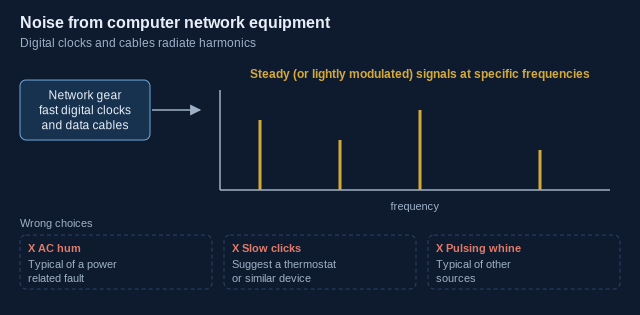
Network equipment radiates harmonics of its digital clocks as unstable modulated or unmodulated signals at specific frequencies.
Describe this graphic in words

A network gear box feeds a spectrum of a few steady gold carriers at specific frequencies. Three dimmed boxes note that hum, slow clicks and a pulsing whine point to other sources.

This is a teaching note. Network gear uses fast digital clocks and data signals, and its cables can radiate harmonics of those. In a receiver these appear as steady or lightly modulated signals at fixed frequencies, not a hum or a click.

A hum, a slow click or a pulsing whine are typical of other sources such as power supplies or motors.

Why the other choices are wrong

  • A. AC hum is more typical of a power related fault.
  • B. Slow clicks suggest a thermostat or similar device.
  • D. A pulsing whine is typical of other sources, not network gear.

Rule text checked against the official source on November 17, 2026. This is a study aid; the linked rule is what governs.
E4E07

Which of the following can cause shielded cables to radiate or receive interference?

Show the answer and why

Answer B. Common-mode currents on the shield and conductors

Common-mode currents on the shield and conductors can make shielded cables radiate or receive interference.

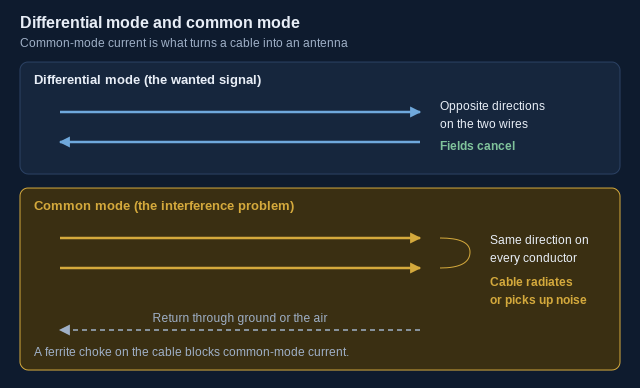
Differential-mode current flows in opposite directions on two wires; common-mode current flows the same way on all of them and makes the cable radiate.
Describe this graphic in words

Two panels. In the first, arrows on two wires point in opposite directions, which is differential mode, the wanted signal, and the fields cancel. In the gold panel, arrows on both wires point the same way, which is common mode, with the current returning through ground or the air by a dashed path; this makes the cable radiate or pick up noise. A ferrite choke blocks common-mode current.

This is a teaching note. A shield works best when the signal currents stay inside it and its fields cancel. When a current flows in the same direction on both the shield and the conductors, the cable acts as an antenna and radiates or picks up noise.

Low inductance ground connections and braided shielding are actually good practice.

Why the other choices are wrong

  • A. Low inductance grounds help the shield do its job.
  • C. Braid is a normal and good shielding material.
  • D. Differential-mode current is the intended signal flow. It is common-mode current that makes a shield radiate or pick up noise, and a common ground point is normally good practice.

Rule text checked against the official source on November 17, 2026. This is a study aid; the linked rule is what governs.
E4E08

What current flows equally on all conductors of an unshielded multiconductor cable?

Show the answer and why

Answer B. Common-mode current

Common-mode current flows equally on all conductors of an unshielded multiconductor cable.

Differential-mode current flows in opposite directions on two wires; common-mode current flows the same way on all of them and makes the cable radiate.
Describe this graphic in words

Two panels. In the first, arrows on two wires point in opposite directions, which is differential mode, the wanted signal, and the fields cancel. In the gold panel, arrows on both wires point the same way, which is common mode, with the current returning through ground or the air by a dashed path; this makes the cable radiate or pick up noise. A ferrite choke blocks common-mode current.

This is a teaching note. In common-mode flow, the current goes the same direction on every conductor and returns by some other path, such as the ground or the air. Differential-mode current flows in opposite directions on a pair of wires, so its fields cancel.

Common-mode current is the kind that makes cables radiate and that ferrite chokes are used to stop.

Why the other choices are wrong

  • A. Differential-mode current flows in opposite directions on the conductors.
  • C. The question is about the type of current, and not reactive current only.
  • D. Magnetic coupling is one cause, but it does not define the current as flowing equally.

Rule text checked against the official source on November 17, 2026. This is a study aid; the linked rule is what governs.
E4E09

What undesirable effect can occur when using a noise blanker?

Show the answer and why

Answer C. Strong signals may be distorted and appear to cause spurious emissions

A noise blanker can distort strong signals and make them appear to cause spurious emissions.

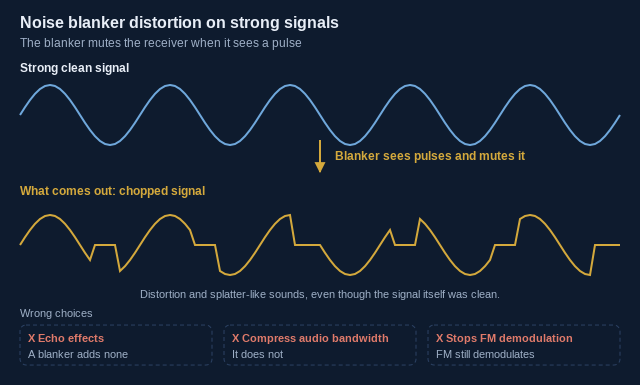
A noise blanker can chop a strong signal and make it distort, appearing to cause spurious emissions.
Describe this graphic in words

A clean strong blue sine wave goes into a noise blanker that mistakes it for pulses. The gold output shows the wave chopped by regular gaps, which causes distortion and splatter-like sounds. Three dimmed boxes reject echo, audio compression and stopping FM demodulation.

This is a teaching note. A blanker mutes the receiver when it sees a pulse. A strong signal can look like a pulse to the blanker, so it gets chopped, and that produces distortion and splatter-like sounds, even though the signal itself is clean.

It does not add echo, compress audio bandwidth or stop FM demodulation.

Why the other choices are wrong

  • A. A blanker does not produce echo effects.
  • B. It does not compress audio bandwidth.
  • D. FM can still be demodulated.

Rule text checked against the official source on November 17, 2026. This is a study aid; the linked rule is what governs.
E4E10

Which of the following can create intermittent loud roaring or buzzing AC line interference?

Show the answer and why

Answer D. All these choices are correct

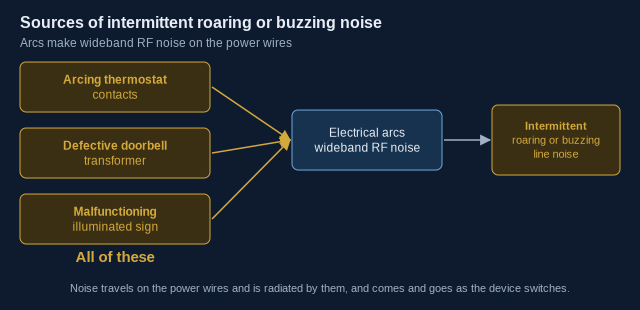
Arcing thermostat contacts, a defective doorbell transformer and a malfunctioning illuminated sign can all cause intermittent roaring or buzzing line noise.

Arcing thermostat contacts, a defective doorbell transformer and a faulty illuminated sign can all cause intermittent roaring or buzzing line noise.
Describe this graphic in words

Three gold boxes list the arcing thermostat contacts, defective doorbell transformer and malfunctioning illuminated sign. All lead to electrical arcs producing wideband RF noise, heard as intermittent roaring or buzzing. The label all of these marks the keyed answer.

This is a teaching note. These devices create electrical arcs, and arcs produce wideband RF noise that travels along the power wires and is radiated by them. It sounds like a loud, rough buzz or roar, and it comes and goes as the device switches.

Since all three can do it, "all of these" is correct.

Why the other choices are wrong

  • A. This is a cause, but so are the other two.
  • B. This is a cause, but so are the other two.
  • C. This is a cause, but so are the other two.

Rule text checked against the official source on November 17, 2026. This is a study aid; the linked rule is what governs.
E4E11

What could be the cause of local AM broadcast band signals combining to generate spurious signals on the MF or HF bands?

Show the answer and why

Answer B. Nearby corroded metal connections are mixing and reradiating the broadcast signals

Corroded metal connections nearby can mix and reradiate local AM broadcast signals.

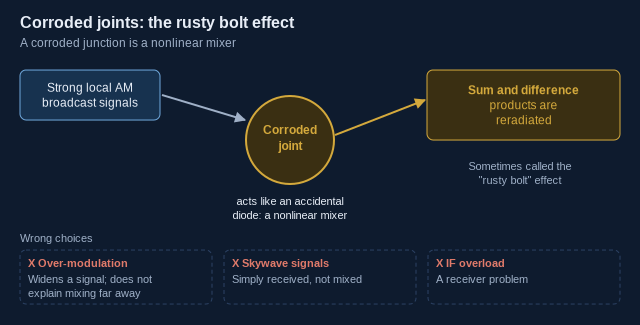
Corroded metal joints act as nonlinear mixers for strong AM broadcast signals and reradiate the mixing products.
Describe this graphic in words

Strong local AM broadcast signals reach a gold corroded joint that acts like an accidental diode. The nonlinear joint mixes the signals and reradiates sum and difference products. Three dimmed boxes reject over-modulation, skywave and IF overload.

This is a teaching note. Rusty or corroded joints form accidental diode junctions. When strong broadcast signals reach them, the junction acts as a nonlinear mixer, and creates the sum and difference products which get reradiated. This is sometimes called the rusty bolt effect.

Over-modulation at the station would not create signals on other bands, and skywave signals do not mix like this.

Why the other choices are wrong

  • A. Over-modulation would widen the signal but does not explain mixing products far from the station.
  • C. Skywave signals are simply received, not combined into spurs.
  • D. IF overload is a receiver problem and would not be caused by nearby corroded metal.

Rule text checked against the official source on November 17, 2026. This is a study aid; the linked rule is what governs.
E4E12

What causes interference received as a series of carriers at regular intervals across a wide frequency range?

Show the answer and why

Answer A. Switch-mode power supplies

Switch-mode power supplies can cause a series of carriers at regular intervals across a wide frequency range.

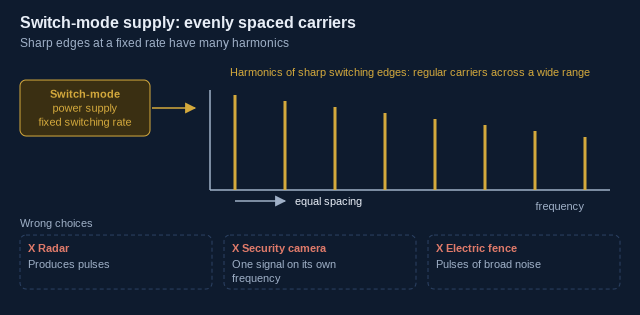
A switch-mode power supply makes a series of carriers at regular intervals across a wide frequency range.
Describe this graphic in words

A gold switch-mode supply box leads to a spectrum of evenly spaced carriers that gradually shrink with frequency. Three dimmed boxes note that radar produces pulses, a security camera a single frequency, and an electric fence broad noise pulses.

This is a teaching note. A switching supply runs at a fixed frequency, often tens or hundreds of kilohertz, with sharp edges. Those edges have many harmonics, which appear as evenly spaced carriers across the band.

Radar produces pulses, and electric fences produce clicks at intervals. Security cameras produce a signal on a single frequency.

Why the other choices are wrong

  • B. Radar produces pulses, not evenly spaced carriers.
  • C. A security camera transmitter makes a signal on its own frequency.
  • D. An electric fence makes pulses of broad noise, not regular carriers.

Rule text checked against the official source on November 17, 2026. This is a study aid; the linked rule is what governs.

E4E13

Where should a station AC surge protector be installed?

Show the answer and why

Answer C. On the single point ground panel

The station AC surge protector is installed on the single point ground panel.

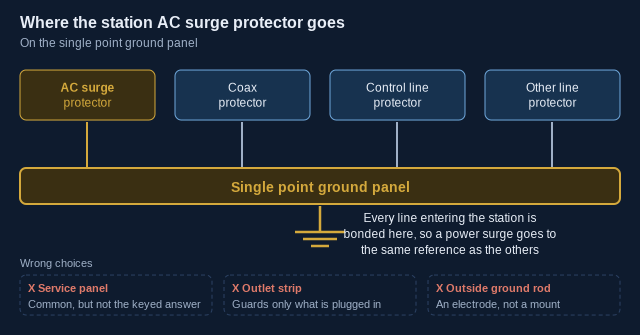
The station AC surge protector is installed on the single point ground panel along with the other line protectors.
Describe this graphic in words

Four protector boxes sit above a gold single point ground panel which connects to a ground symbol. The AC surge protector in gold is mounted on that panel with the coax, control and other line protectors in blue. Three dimmed boxes reject the service panel, an outlet strip and an outside ground rod.

This is a teaching note. The single point ground panel is where every line entering the station, including the AC power protector, is bonded to one common ground point. Mounting the AC surge protector there means a surge on the power line is shunted to the same reference as the coax and control line protectors, so no large voltage difference appears between them.

This key is the pool's answer. A protector at the service panel or an outlet is also commonly used, but the pool picks the single point ground panel.

Why the other choices are wrong

  • A. A service panel protector is common practice, but it is not the keyed answer, which is the single point ground panel.
  • B. An outlet protector only guards what is plugged into it and is not tied to the station single point ground.
  • D. A ground rod outside is a ground electrode, not a place to mount an AC surge protector.

Rule text checked against the official source on November 17, 2026. This is a study aid; the linked rule is what governs.

E4E14

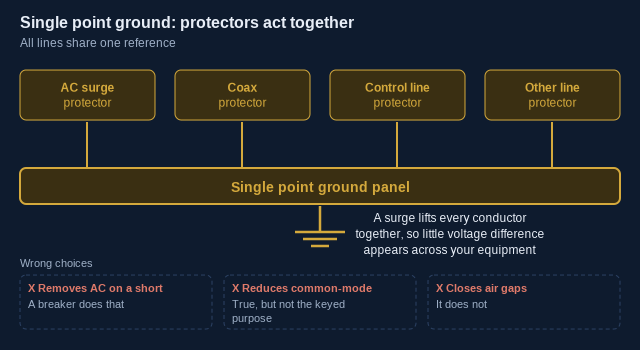
What is the purpose of a single point ground panel?

Show the answer and why

Answer D. Ensure all lightning protectors activate at the same time

A single point ground panel ensures all lightning protectors activate at the same time.

All protectors bond to one single point ground panel so they share a reference and act together during a surge.
Describe this graphic in words

Four gold protector boxes connect to one gold single point ground panel and then to ground. Text explains that a surge lifts all conductors together so little voltage difference appears across the equipment. Three dimmed boxes reject removing AC power, a common-mode reduction answer that is not keyed, and closing air gaps.

This is a teaching note. In a single point ground, every cable entry and protector is bonded to the same panel, so when a surge hits, the protectors share the same ground reference and clamp together, and all the conductors rise in voltage together. With little voltage difference between them, little current flows through your equipment.

The panel does not remove AC power or eliminate air gaps.

Why the other choices are wrong

  • A. Removing AC power on a short is the job of a breaker.
  • B. Common-mode transients are reduced by the bonding, but this is not the keyed purpose.
  • C. It does not close air gaps between circuits.

Rule text checked against the official source on November 17, 2026. This is a study aid; the linked rule is what governs.