
ARSC Tech School

Amateur Extra E3B: Transequatorial propagation

599 questions · pool July 1, 2024 to June 30, 2028 · the exam has 50 questions; 37 to pass

E3 · RADIO WAVE PROPAGATION

Transequatorial propagation; long-path propagation; ordinary and extraordinary waves; chordal hop; sporadic-E mechanisms; ground-wave propagation

13 questions in group E3B

One question from this group appears on each exam.

E3B01

Where is transequatorial propagation (TEP) most likely to occur?

Show the answer and why

Answer A. Between points separated by 2,000 miles to 3,000 miles over a path perpendicular to the geomagnetic equator

TEP is most likely between points about 2,000 to 3,000 miles apart on a path perpendicular to the geomagnetic equator.
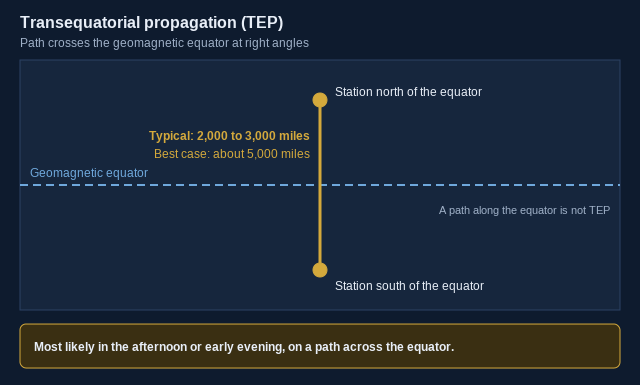
Transequatorial propagation runs north-south across the geomagnetic equator, typically 2,000 to 3,000 miles and up to about 5,000 miles.
Describe this graphic in words

A map-like panel has a dashed blue line for the geomagnetic equator. Two stations sit one north and one south of it, joined by a gold north-south path that crosses the equator at a right angle. Labels give the typical range of 2,000 to 3,000 miles and a best case of about 5,000 miles. A note says it is most likely in the afternoon or early evening.

This is a teaching note. Transequatorial propagation links stations roughly equal distances north and south of the geomagnetic equator, with the path running across it. Ionization near the equator forms clouds and bubbles that let VHF signals travel much farther than normal. Typical contacts span about 2,000 to 3,000 miles.

The path must cross the equator and not run along it.

Why the other choices are wrong

  • B. A path along the equator does not take advantage of the equatorial structure. TEP crosses it.
  • C. Antipodal paths run to the opposite side of the Earth, which is far longer than a TEP path and is not what defines TEP.
  • D. The terminator crossing the equator does not define TEP. Though TEP does tend to occur in the afternoon and evening, it depends on the geomagnetic equator.

Rule text checked against the official source on November 17, 2026. This is a study aid; the linked rule is what governs.
E3B02

What is the approximate maximum range for signals using transequatorial propagation?

Show the answer and why

Answer C. 5,000 miles

The maximum range for TEP is about 5,000 miles.

Transequatorial propagation runs north-south across the geomagnetic equator, typically 2,000 to 3,000 miles and up to about 5,000 miles.
Describe this graphic in words

A map-like panel has a dashed blue line for the geomagnetic equator. Two stations sit one north and one south of it, joined by a gold north-south path that crosses the equator at a right angle. Labels give the typical range of 2,000 to 3,000 miles and a best case of about 5,000 miles. A note says it is most likely in the afternoon or early evening.

This is a teaching note. TEP paths of roughly 2,000 to 3,000 miles are common, and the best conditions stretch out to about 5,000 miles. Contacts much beyond that are rare.

This is a typical figure from operating experience, not a hard rule.

Why the other choices are wrong

  • A. 1,000 miles is shorter than a normal TEP path.
  • B. 2,500 miles is a typical path length, but not the maximum.
  • D. 7,500 miles is longer than TEP normally reaches.

Rule text checked against the official source on November 17, 2026. This is a study aid; the linked rule is what governs.
E3B03

At what time of day is transequatorial propagation most likely to occur?

Show the answer and why

Answer C. Afternoon or early evening

TEP is most likely in the afternoon or early evening.

Transequatorial propagation runs north-south across the geomagnetic equator, typically 2,000 to 3,000 miles and up to about 5,000 miles.
Describe this graphic in words

A map-like panel has a dashed blue line for the geomagnetic equator. Two stations sit one north and one south of it, joined by a gold north-south path that crosses the equator at a right angle. Labels give the typical range of 2,000 to 3,000 miles and a best case of about 5,000 miles. A note says it is most likely in the afternoon or early evening.

This is a teaching note. The equatorial ionosphere is heated and ionized by the Sun during the day. In the afternoon and early evening the ionization near the geomagnetic equator forms the irregular structures that let VHF signals cross it. The effect usually fades by late evening.

It is not a morning or a noon effect, and it is mostly gone by late at night.

Why the other choices are wrong

  • A. Morning is before the equatorial ionization has built up.
  • B. Noon is too early. The effect builds into the afternoon.
  • D. Late at night the conditions that support TEP have faded.

Rule text checked against the official source on November 17, 2026. This is a study aid; the linked rule is what governs.
E3B04

What are “extraordinary” and “ordinary” waves?

Show the answer and why

Answer B. Independently propagating, elliptically polarized waves created in the ionosphere

Ordinary and extraordinary waves are independently propagating, elliptically polarized waves created in the ionosphere.

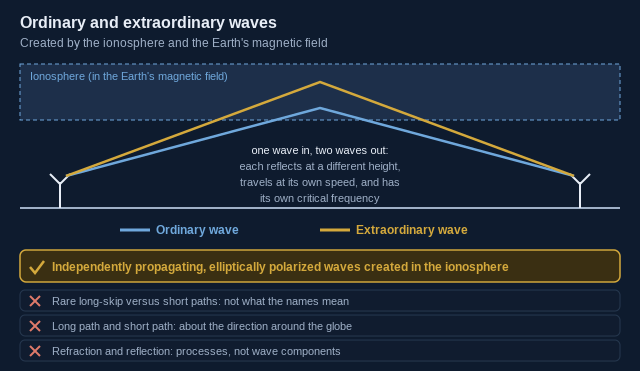
One radio wave splitting in the ionosphere into an ordinary and an extraordinary wave that reflect at different heights.
Describe this graphic in words

A wave from a station on the left enters the ionosphere and splits into an ordinary wave in blue and an extraordinary wave in gold. Each is elliptically polarized, travels at its own speed and reflects at a different height with its own critical frequency.

This is a teaching note. The Earth's magnetic field makes the ionosphere split a radio wave into two components that move separately. These are called the ordinary wave and the extraordinary wave. They are elliptically polarized, they travel at different speeds, and they can reflect at different heights, so each has its own critical frequency.

The names do not refer to long-skip, to path direction, or to the type of bending.

Why the other choices are wrong

  • A. The names do not mean rare long-skip versus short paths. They describe polarization components.
  • C. Long path and short path are about the direction around the globe, not the two components.
  • D. Refraction and reflection are processes, not these two wave components.

Rule text checked against the official source on November 17, 2026. This is a study aid; the linked rule is what governs.
E3B05

Which of the following paths is most likely to support long-distance propagation on 160 meters?

Show the answer and why

Answer D. A path entirely in darkness

A path entirely in darkness is most likely to support long-distance 160 meter propagation.

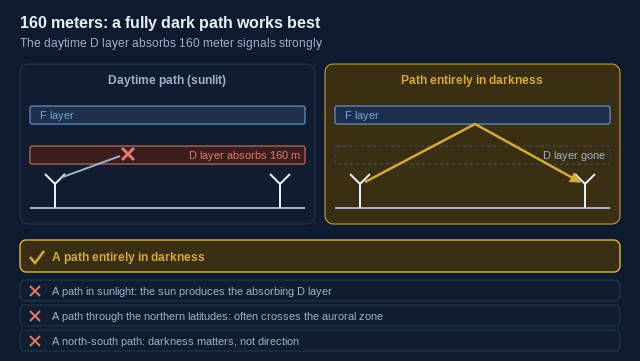
A sunlit path where the D layer absorbs 160 meter signals compared with a dark path where they reach the F layer and return.
Describe this graphic in words

The left panel shows a daytime path where a ray hits the D layer and is absorbed. The right panel, in gold, shows a path entirely in darkness: the D layer is gone, so the ray reaches the F layer and returns to the ground with much less loss.

This is a teaching note. In daytime the D layer absorbs 160 meter signals very strongly. At night the D layer fades away, so the signals can reach the F layer and return with much less loss. A path where both ends and everything between are dark is therefore the best choice for long distance work.

Sunlit paths are heavily absorbed, and polar paths are bad because of auroral effects. Direction by itself does not matter.

Why the other choices are wrong

  • A. Sunlight produces the D layer that absorbs 160 meter signals.
  • B. High latitude paths often cross the auroral zone, which is generally poor for this band.
  • C. North-south direction is not the key factor. Darkness is.

Rule text checked against the official source on November 17, 2026. This is a study aid; the linked rule is what governs.
E3B06

On which of the following amateur bands is long-path propagation most frequent?

Show the answer and why

Answer B. 40 meters and 20 meters

Long-path propagation is most frequent on 40 and 20 meters.

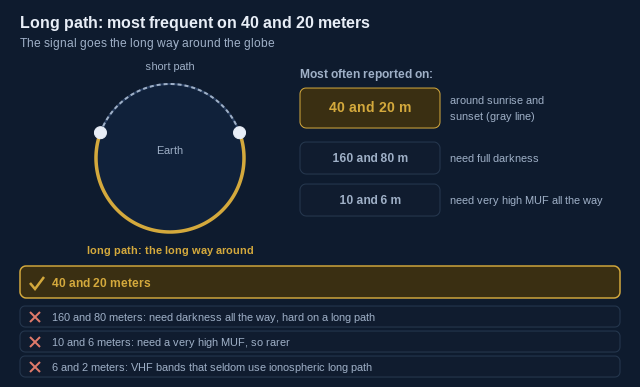
A globe with a short path and a long path between two stations, with 40 and 20 meters highlighted as the usual long-path bands.
Describe this graphic in words

A globe shows two stations joined by a short path as a dashed line and by the long path, the gold line the other way around. Beside it, 40 and 20 meters are highlighted as the bands where long path is most often reported, usually near sunrise and sunset. 160 and 80 meters need full darkness and 10 and 6 meters need a very high MUF along the whole path.

This is a teaching note. Long path means the signal goes the long way around the globe instead of the short way. It is most often reported on 20 meters and 40 meters, usually around sunrise and sunset when the path follows the gray line.

This is a matter of operating experience. 160 and 80 meters need full darkness, and 10 and 6 meters need a very high MUF along the whole long path, which is seldom available.

Why the other choices are wrong

  • A. 160 and 80 meters need darkness all the way, which is harder to get along a long path.
  • C. 10 and 6 meters need a very high MUF, so long path openings there are much rarer.
  • D. 6 and 2 meters are VHF bands that seldom use ionospheric long-path propagation.

Rule text checked against the official source on November 17, 2026. This is a study aid; the linked rule is what governs.
E3B07

What effect does lowering a signal’s transmitted elevation angle have on ionospheric HF skip propagation?

Show the answer and why

Answer C. The distance covered by each hop increases

Lowering the transmitted elevation angle increases the distance covered by each hop.

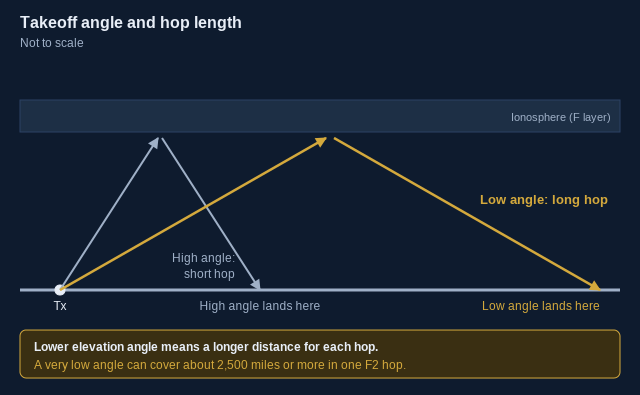
A low takeoff angle makes a long hop and a high takeoff angle makes a short hop.
Describe this graphic in words

A transmitter on the ground sends two rays up to the ionosphere. A steep grey ray returns to the ground a short distance away. A shallow gold ray returns much farther away. A note says that lowering the elevation angle increases the distance covered by each hop, up to about 2,500 miles or more for a single F2 hop.

This is a teaching note. A signal sent at a low angle strikes the ionosphere at a shallow angle, a long way from the transmitter, and returns far away. A signal sent at a high angle comes down closer in. With a typical F2 layer a single hop at a very low angle can cover about 2,500 miles or more.

The layer itself, and therefore the critical frequency, does not change with the angle you use. The MUF for a path actually rises as the angle gets lower.

Why the other choices are wrong

  • A. Faraday rotation depends on the magnetic field and the path through the ionosphere, not on the takeoff angle in this way.
  • B. The MUF goes up, not down, at lower angles because the signal meets the layer more obliquely.
  • D. The critical frequency is a property of the layer and does not depend on your elevation angle.

Rule text checked against the official source on November 17, 2026. This is a study aid; the linked rule is what governs.
E3B08

How does the maximum range of ground-wave propagation change when the signal frequency is increased?

Show the answer and why

Answer C. It decreases

Ground-wave range decreases as the frequency increases.

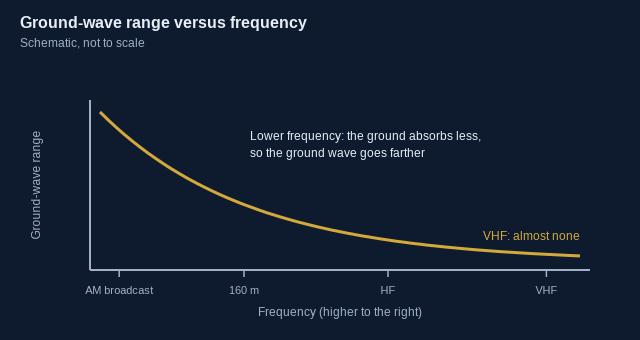
Ground-wave range falls steadily as frequency rises.
Describe this graphic in words

A graph with frequency along the bottom, rising to the right, and ground-wave range up the side. A gold curve starts high at AM broadcast and 160 meters and drops steadily through HF to almost nothing at VHF. It is a schematic: the ground absorbs more signal as frequency goes up.

This is a teaching note. Ground waves follow the curve of the Earth, and the ground absorbs more of the signal as the frequency goes up. So the lower the frequency, the farther the ground wave travels. This is why AM broadcast and 160 meter signals get a useful ground wave and VHF signals do not.

Nothing peaks near 8 MHz, and the range does not stay the same.

Why the other choices are wrong

  • A. The ground absorbs more at higher frequencies, so the range does change.
  • B. Range gets shorter with higher frequency, not longer.
  • D. There is no special peak near 8 MHz. The range falls steadily as the frequency goes up.

Rule text checked against the official source on November 17, 2026. This is a study aid; the linked rule is what governs.
E3B09

At what time of year is sporadic-E propagation most likely to occur?

Show the answer and why

Answer A. Around the solstices, especially the summer solstice

Sporadic-E is most likely around the solstices, especially the summer solstice.

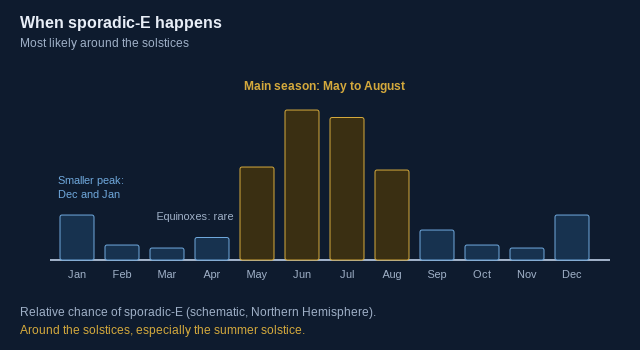
Sporadic-E peaks in May to August, with a smaller peak in December and January.
Describe this graphic in words

A bar chart of the twelve months showing relative chance of sporadic-E, drawn as a schematic for the Northern Hemisphere. The gold bars for May through August are tallest, peaking around the summer solstice in June. A smaller peak shows in December and January, and the months near the equinoxes are low.

This is a teaching note. Sporadic-E clouds are most common in the early summer months, with a smaller peak in midwinter. For the Northern Hemisphere the main season runs from about May to August, and the weaker season is around December and January. The cause is not fully settled, but wind shear moving metal ions into thin dense layers is the usual explanation.

It is much less common near the equinoxes.

Why the other choices are wrong

  • B. The winter peak is real but smaller than the summer one.
  • C. The equinoxes are the quiet times for sporadic-E, not the busy ones.
  • D. The equinoxes are the quiet times for sporadic-E, not the busy ones.

Rule text checked against the official source on November 17, 2026. This is a study aid; the linked rule is what governs.

E3B10

What is the effect of chordal-hop propagation?

Show the answer and why

Answer A. The signal experiences less loss compared to multi-hop propagation, which uses Earth as a reflector

Chordal-hop propagation means less loss than multi-hop propagation that uses Earth as a reflector.

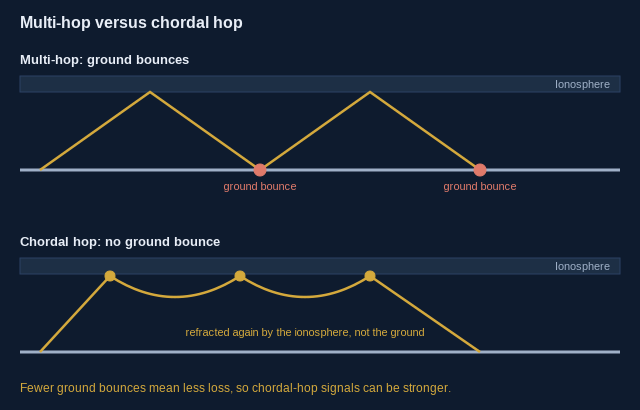
Multi-hop signals bounce off the ground between hops; a chordal-hop signal is refracted again by the ionosphere with no ground bounce.
Describe this graphic in words

Two panels. The top panel shows a gold path zigzagging between the ionosphere and the ground, with red marks at each ground bounce. The bottom panel shows a gold path that goes up to the ionosphere and then dips and returns to the ionosphere again and again without touching the ground. A note says fewer ground bounces mean less loss.

This is a teaching note. In chordal hop a signal is refracted by the ionosphere, travels along a path inside it, and is refracted again without ever returning to the ground. Every ground bounce loses some signal, so skipping the ground cuts those losses. It can give stronger signals over very long paths.

It does not lower the MUF, does not reduce atmospheric noise in itself, and the waves do not travel faster.

Why the other choices are wrong

  • B. Nothing makes the MUF much lower. Chordal hop meets the layer at a shallow angle, which tends to allow higher frequencies, not lower.
  • C. Atmospheric noise is not changed by this way of traveling.
  • D. Radio waves travel at the same speed whichever path they follow.

Rule text checked against the official source on November 17, 2026. This is a study aid; the linked rule is what governs.

E3B11

At what time of day is sporadic-E propagation most likely to occur?

Show the answer and why

Answer D. Between sunrise and sunset

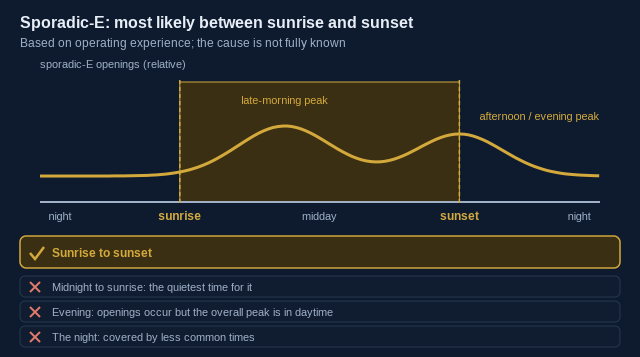
Sporadic-E is most likely between sunrise and sunset.

A day-long activity curve for sporadic-E with peaks in late morning and late afternoon between sunrise and sunset.
Describe this graphic in words

A 24-hour axis marks sunrise and sunset, with the daylight span shaded gold. The curve of sporadic-E activity is low at night and rises to a peak in late morning and a second peak in the late afternoon or early evening. Openings do happen after dark, but less often.

This is a teaching note. Sporadic-E openings happen most often during the daytime, with a peak in late morning and another one in the late afternoon or early evening. They do happen after dark but less often. This is based on operating experience, since the cause is not fully known.

The pool key is the daytime window, so the choices that include the night or run through midnight are not the keyed answer.

Why the other choices are wrong

  • A. Midnight to sunrise is the quietest time for it.
  • B. Evening openings occur but the overall peak is in the daytime.
  • C. This covers the night, when it is less common.

Rule text checked against the official source on November 17, 2026. This is a study aid; the linked rule is what governs.

E3B12

What is chordal-hop propagation?

Show the answer and why

Answer B. Successive ionospheric refractions without an intermediate reflection from the ground

Chordal hop is successive ionospheric refractions without an intermediate reflection from the ground.

Multi-hop signals bounce off the ground between hops; a chordal-hop signal is refracted again by the ionosphere with no ground bounce.
Describe this graphic in words

Two panels. The top panel shows a gold path zigzagging between the ionosphere and the ground, with red marks at each ground bounce. The bottom panel shows a gold path that goes up to the ionosphere and then dips and returns to the ionosphere again and again without touching the ground. A note says fewer ground bounces mean less loss.

This is a teaching note. In ordinary multi-hop propagation the signal goes up, comes down to the ground, reflects up again, and so on. In chordal hop the signal arrives at the ionosphere, bends, and meets the layer a second time before it ever comes down. It follows a chord through the ionosphere instead of making ground bounces.

Fewer ground bounces mean fewer losses.

Why the other choices are wrong

  • A. Going off the great circle bearing is called off-path or side-scatter propagation.
  • C. Crossing the geomagnetic equator is TEP.
  • D. Signals coming back toward the transmitter describe backscatter or echoes.

Rule text checked against the official source on November 17, 2026. This is a study aid; the linked rule is what governs.

E3B13

What type of polarization is supported by ground-wave propagation?

Show the answer and why

Answer A. Vertical

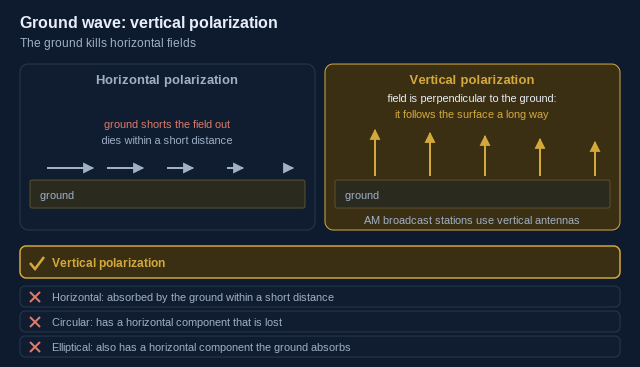
Ground-wave propagation supports vertical polarization.

A horizontal electric field dying out near the ground compared with a vertical field that persists along the surface.
Describe this graphic in words

In the left panel, horizontal electric field arrows lie parallel to the ground and shrink quickly because the ground short-circuits them. In the right panel, vertical arrows stand perpendicular to the ground and stay strong along the surface, which is why ground-wave signals and AM broadcast antennas are vertical.

This is a teaching note. A horizontally polarized wave has its electric field parallel to the ground, and the ground short-circuits it, so it dies out within a short distance. A vertically polarized wave has its field perpendicular to the ground and can follow the surface for a long way. That is why AM broadcast stations use vertical antennas.

Circular and elliptical polarization include a horizontal part that is lost the same way.

Why the other choices are wrong

  • B. The ground quickly absorbs horizontal polarization, so it does not work for ground waves.
  • C. Circular polarization has a horizontal component that is lost to the ground.
  • D. Elliptical polarization also has a horizontal component that the ground absorbs.

Rule text checked against the official source on November 17, 2026. This is a study aid; the linked rule is what governs.