In digital television, what does a coding rate of 3/4 mean?
Show the answer and why
Answer A. 25% of the data sent is forward error correction data
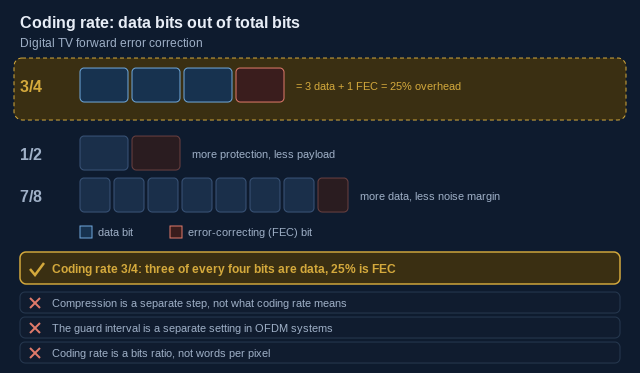
A coding rate of 3/4 means three of every four bits are data, so 25% is forward error correction.
Describe this graphic in words
The 3/4 row, highlighted in gold, has four boxes with three data bits and one error-correcting bit, so 25 percent is overhead. A 1/2 row has equal data and error correction, and a 7/8 row has seven data boxes and one error correction box.
This is a teaching note. In digital TV the coding rate is the fraction of transmitted bits that carry real information. At 3/4, out of every 4 bits sent, 3 are payload and 1 is error-correcting overhead, which is 25%.
A lower rate such as 1/2 gives more protection but less payload. A higher rate such as 7/8 carries more data but tolerates less noise.
Why the other choices are wrong
- B. Compression is a separate step and is not what coding rate means.
- C. The guard interval is a separate setting in OFDM systems.
- D. Coding rate is about the ratio of data to total bits, not how many words per pixel.
Rule text checked against the official source on November 17, 2026. This is a study aid; the linked rule is what governs.