What is the maximum bandwidth for a data emission on 60 meters?
Show the answer and why
Answer D. 2.8 kHz
FCC rule 97.303
Data on 60 meters may not occupy more than 2.8 kHz.
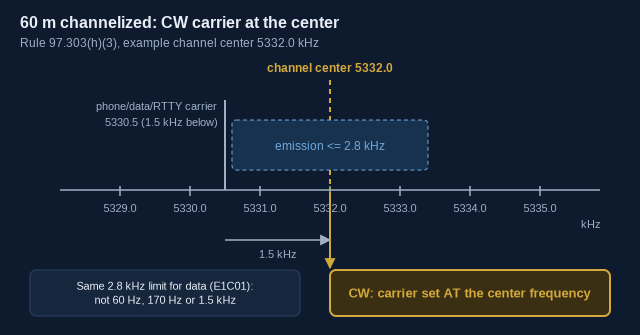
Describe this graphic in words
A frequency axis around the 5332.0 kHz channel center. Phone, data and RTTY carriers sit 1.5 kHz below center at 5330.5. A gold arrow shows that for CW the carrier is set exactly at the channel center. A dashed box centered on the channel shows the 2.8 kHz maximum emission bandwidth that applies to all emissions on 60 meters.
The 60-meter rules say emissions must not exceed a bandwidth of 2.8 kilohertz. This applies to phone, data, RTTY and the other allowed emissions on the channels, and the same 2.8 kHz figure appears in both 97.303(h)(3) and 97.307(f)(14).
The 60 Hz, 170 Hz and 1.5 kHz choices are narrower than the maximum, so they would be legal signals, but they are not the limit. (1.5 kHz is also the carrier offset below channel center, which is a different thing.)
Why the other choices are wrong
- A. A 60 Hz signal is legal but is not the maximum.
- B. A 170 Hz signal (a common RTTY shift) is legal but is not the maximum.
- C. 1.5 kHz is the carrier offset below center for phone and data, not the bandwidth limit.
References
- FCC rule47 CFR § 97.303, Frequency sharing requirements — Paragraph (h)(3) says emissions on 60 m must not occupy more than 2.8 kHz.
- FCC rule47 CFR § 97.307, Emission standards — Paragraph (f)(14) sets the 2.8 kHz bandwidth limit on 60 m.
Rule text checked against the official source on November 17, 2026. This is a study aid; the linked rule is what governs.