
ARSC Tech School

Amateur Extra E7C: Filters and matching networks

599 questions · pool July 1, 2024 to June 30, 2028 · the exam has 50 questions; 37 to pass

E7 · PRACTICAL CIRCUITS

Filters and matching networks: types of networks; types of filters; filter applications; filter characteristics; impedance matching

11 questions in group E7C

One question from this group appears on each exam.

E7C01

How are the capacitors and inductors of a low-pass filter Pi-network arranged between the network’s input and output?

Show the answer and why

Answer D. A capacitor is connected between the input and ground, another capacitor is connected between the output and ground, and an inductor is connected between the input and output

A low-pass Pi network has a capacitor from the input to ground, another from the output to ground, and an inductor in series between input and output.
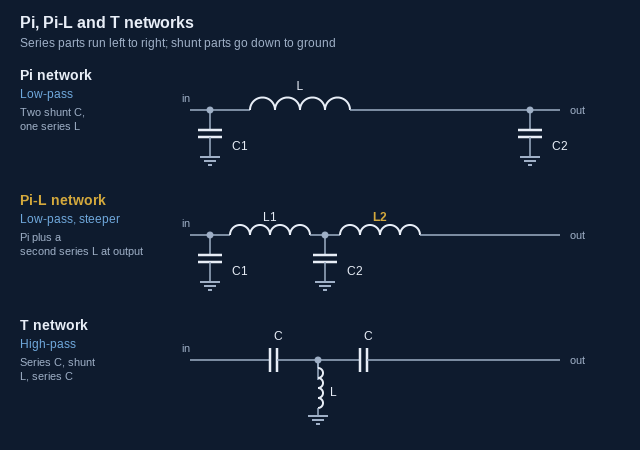
Schematics of a low-pass Pi network, a Pi-L network and a high-pass T network.
Describe this graphic in words

Three schematics are stacked. The Pi network has a series inductor between input and output with a shunt capacitor to ground at each end, making a low-pass filter. The Pi-L network is the same with an extra series inductor after the output capacitor, which improves harmonic suppression. The T network has series capacitors with a shunt inductor to ground between them, making a high-pass filter.

This is a teaching note. Picture the Greek letter pi: a bar across the top and two legs down to ground. The top bar is the series inductor, which resists high frequencies. The two legs are shunt capacitors, which shunt high frequencies to ground.

Together they pass low frequencies and block high ones.

Why the other choices are wrong

  • A. Two series inductors with a shunt capacitor is a T network.
  • B. Two series capacitors with a shunt inductor is a high-pass T network.
  • C. Shunt inductors with a series capacitor is a high-pass Pi network.

Rule text checked against the official source on November 17, 2026. This is a study aid; the linked rule is what governs.
E7C02

What is the frequency response of a T-network with series capacitors and a shunt inductor?

Show the answer and why

Answer B. High-pass

A T network with series capacitors and a shunt inductor is a high-pass filter.

Schematics of a low-pass Pi network, a Pi-L network and a high-pass T network.
Describe this graphic in words

Three schematics are stacked. The Pi network has a series inductor between input and output with a shunt capacitor to ground at each end, making a low-pass filter. The Pi-L network is the same with an extra series inductor after the output capacitor, which improves harmonic suppression. The T network has series capacitors with a shunt inductor to ground between them, making a high-pass filter.

This is a teaching note. The series capacitors pass high frequencies easily and block low ones, and the shunt inductor shorts low frequencies to ground. Both effects remove low frequencies.

Swap the parts (series inductors, shunt capacitor) and you get the low-pass version.

Why the other choices are wrong

  • A. Low-pass needs series inductors and shunt capacitors.
  • C. A band-pass needs resonant circuits.
  • D. A notch needs a resonant trap.

Rule text checked against the official source on November 17, 2026. This is a study aid; the linked rule is what governs.
E7C03

What is the purpose of adding an inductor to a Pi-network to create a Pi-L-network?

Show the answer and why

Answer A. Greater harmonic suppression

The extra inductor in a Pi-L network gives greater harmonic suppression.

Schematics of a low-pass Pi network, a Pi-L network and a high-pass T network.
Describe this graphic in words

Three schematics are stacked. The Pi network has a series inductor between input and output with a shunt capacitor to ground at each end, making a low-pass filter. The Pi-L network is the same with an extra series inductor after the output capacitor, which improves harmonic suppression. The T network has series capacitors with a shunt inductor to ground between them, making a high-pass filter.

This is a teaching note. A Pi-L is a Pi network with an extra series inductor at the output, which makes the filter act like a higher-order low-pass filter. That attenuates harmonics more steeply than a plain Pi.

It is common in tube amplifiers where a strong harmonic rejection is important.

Why the other choices are wrong

  • B. Efficiency is not the reason for adding it.
  • C. It adds a part rather than eliminating one.
  • D. The transformation range is not the main benefit.

Rule text checked against the official source on November 17, 2026. This is a study aid; the linked rule is what governs.

E7C04

How does an impedance-matching circuit transform a complex impedance to a resistive impedance?

Show the answer and why

Answer C. It cancels the reactive part of the impedance and changes the resistive part to the desired value

A matching network cancels the reactive part of the impedance and changes the resistive part to the value wanted.

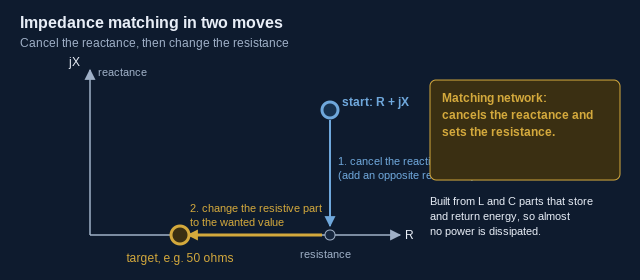
A matching network first cancels the reactance, then changes the resistance to the wanted value.
Describe this graphic in words

A graph with resistance across and reactance up. A blue point at R plus jX moves straight down to the resistance axis, which cancels the reactance. A gold arrow then slides left along the axis to the target resistance, for example 50 ohms.

This is a teaching note. A complex impedance has resistance plus reactance. An L, Pi or T network adds an opposite reactance to cancel the unwanted reactance, then transforms the leftover resistance to the target value, such as 50 ohms.

This is done with reactive parts that store and return energy, so very little is dissipated.

Why the other choices are wrong

  • A. Passive matching networks do not introduce negative resistance.
  • B. Transconductance is a property of active devices, not matching networks.
  • D. Reactive currents are not dissipated; matching does not rely on lossy resistors.

Rule text checked against the official source on November 17, 2026. This is a study aid; the linked rule is what governs.

E7C05

Which filter type has ripple in the passband and a sharp cutoff?

Show the answer and why

Answer D. A Chebyshev filter

A Chebyshev filter has ripple in the passband and a sharp cutoff.

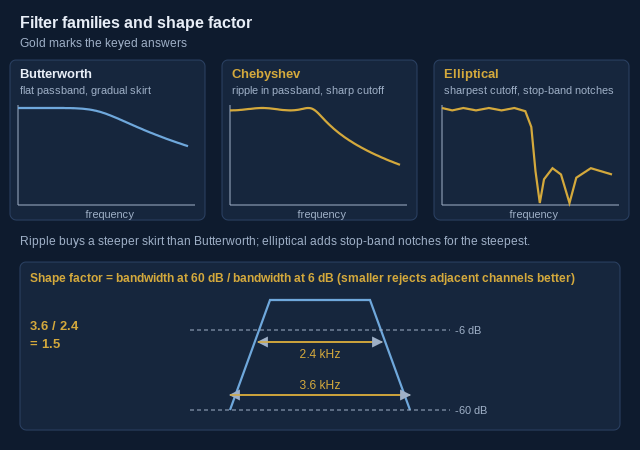
Response curves of Butterworth, Chebyshev and elliptical filters, and a shape factor example.
Describe this graphic in words

Three small graphs of attenuation against frequency compare filter families. The Butterworth curve is flat in the passband with a gradual skirt. The Chebyshev curve has ripple in the passband and a sharper cutoff. The elliptical curve has the sharpest cutoff with notches in the stop band. Below, a filter 2.4 kHz wide at 6 dB and 3.6 kHz wide at 60 dB has a shape factor of 1.5.

This is a teaching note. Chebyshev designs trade a controlled amount of passband ripple for a steeper roll-off than a Butterworth of the same order.

A Butterworth is maximally flat in the passband. "Active LC" and "passive op-amp" are not filter response families.

Why the other choices are wrong

  • A. A Butterworth has a flat passband and a gentler cutoff.
  • B. Active LC is not a response type.
  • C. Passive op-amp is not a response type either.

Rule text checked against the official source on November 17, 2026. This is a study aid; the linked rule is what governs.

E7C06

What are the characteristics of an elliptical filter?

Show the answer and why

Answer C. Extremely sharp cutoff with one or more notches in the stop band

An elliptical filter has an extremely sharp cutoff with one or more notches in the stop band.

Response curves of Butterworth, Chebyshev and elliptical filters, and a shape factor example.
Describe this graphic in words

Three small graphs of attenuation against frequency compare filter families. The Butterworth curve is flat in the passband with a gradual skirt. The Chebyshev curve has ripple in the passband and a sharper cutoff. The elliptical curve has the sharpest cutoff with notches in the stop band. Below, a filter 2.4 kHz wide at 6 dB and 3.6 kHz wide at 60 dB has a shape factor of 1.5.

This is a teaching note. An elliptic (Cauer) filter allows ripple in both passband and stop band and uses stop-band zeros, which show up as notches. That gives the steepest cutoff for a given order.

A filter with gradually rounded corners is a Bessel or Butterworth type.

Why the other choices are wrong

  • A. Gradual rolloff with minimal ripple describes a different type.
  • B. A flat passband with rounded corners is a Butterworth.
  • D. Gradual roll-off with heavy stop-band ripple is not what an elliptical filter does.

Rule text checked against the official source on November 17, 2026. This is a study aid; the linked rule is what governs.

E7C07

Which describes a Pi-L network?

Show the answer and why

Answer B. A Pi-network with an additional output series inductor

A Pi-L network is a Pi network with an additional series inductor at the output.

Schematics of a low-pass Pi network, a Pi-L network and a high-pass T network.
Describe this graphic in words

Three schematics are stacked. The Pi network has a series inductor between input and output with a shunt capacitor to ground at each end, making a low-pass filter. The Pi-L network is the same with an extra series inductor after the output capacitor, which improves harmonic suppression. The T network has series capacitors with a shunt inductor to ground between them, making a high-pass filter.

This is a teaching note. The Pi has two shunt capacitors and a series inductor. Adding another series inductor after the output capacitor makes it a Pi-L, which gives better harmonic suppression.

It has more than three parts, and it does connect to ground through its capacitors.

Why the other choices are wrong

  • A. The "L" is not a phase inverter load.
  • C. It has more than three parts.
  • D. The shunt capacitors connect to ground.

Rule text checked against the official source on November 17, 2026. This is a study aid; the linked rule is what governs.

E7C08

Which of the following is most frequently used as a band-pass or notch filter in VHF and UHF transceivers?

Show the answer and why

Answer B. A helical filter

Helical filters are the common band-pass or notch filter in VHF and UHF transceivers.

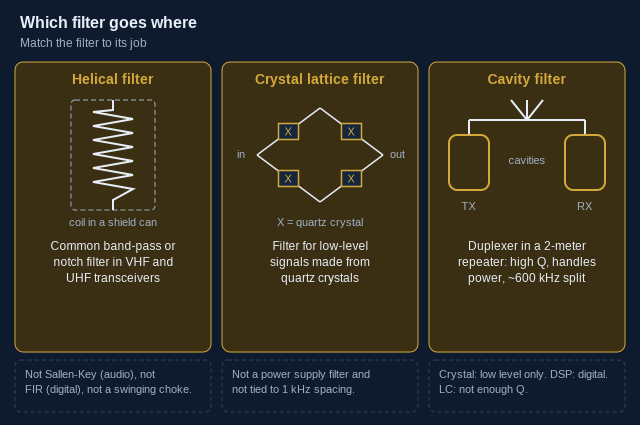
Three filter types: helical for VHF/UHF transceivers, crystal lattice for low-level signals, cavity for a 2-meter duplexer.
Describe this graphic in words

Three gold panels side by side. The first shows a coil inside a dashed shield can for the helical filter used in VHF and UHF transceivers. The second shows four crystals in a lattice bridge for low-level signals. The third shows a duplexer with two tall cavities for a 2-meter repeater. Dimmed notes below give the wrong choices.

This is a teaching note. A helical resonator is a coil inside a shield can, which makes a compact, high-Q tuned circuit at VHF and UHF. Several in a row give good selectivity.

Sallen-Key and FIR designs are audio and digital approaches, and a swinging choke is a power supply part.

Why the other choices are wrong

  • A. A Sallen-Key is an op-amp filter used at audio frequencies.
  • C. A swinging choke is a power supply filter inductor.
  • D. An FIR filter is a digital signal processing filter.

Rule text checked against the official source on November 17, 2026. This is a study aid; the linked rule is what governs.

E7C09

What is a crystal lattice filter?

Show the answer and why

Answer D. A filter for low-level signals made using quartz crystals

A crystal lattice filter is a filter for low-level signals made using quartz crystals.

Three filter types: helical for VHF/UHF transceivers, crystal lattice for low-level signals, cavity for a 2-meter duplexer.
Describe this graphic in words

Three gold panels side by side. The first shows a coil inside a dashed shield can for the helical filter used in VHF and UHF transceivers. The second shows four crystals in a lattice bridge for low-level signals. The third shows a duplexer with two tall cavities for a 2-meter repeater. Dimmed notes below give the wrong choices.

This is a teaching note. Crystals are connected in a lattice (bridge) arrangement, usually two pairs at slightly offset frequencies, to make a narrow band-pass filter with very steep skirts. They are common in receiver IF stages for selecting an SSB or CW signal.

It is for signal levels, not power supplies, and it is not tied to audio at 1 kHz intervals.

Why the other choices are wrong

  • A. It is not a power supply filter.
  • B. It is not an audio filter with crystals at 1 kHz intervals.
  • C. It is a lattice of connections, not lattice-shaped crystals.

Rule text checked against the official source on November 17, 2026. This is a study aid; the linked rule is what governs.

E7C10

Which of the following filters is used in a 2-meter band repeater duplexer?

Show the answer and why

Answer B. A cavity filter

A cavity filter is used in a 2-meter repeater duplexer.

Three filter types: helical for VHF/UHF transceivers, crystal lattice for low-level signals, cavity for a 2-meter duplexer.
Describe this graphic in words

Three gold panels side by side. The first shows a coil inside a dashed shield can for the helical filter used in VHF and UHF transceivers. The second shows four crystals in a lattice bridge for low-level signals. The third shows a duplexer with two tall cavities for a 2-meter repeater. Dimmed notes below give the wrong choices.

This is a teaching note. A duplexer lets one antenna serve both the transmitter and receiver, with only 600 kHz between them on a typical 2-meter repeater. That needs very sharp, high-Q filtering that can also handle high power. Tuned cavities provide both.

Crystal filters are for low-level IFs, DSP filters work on digitized signals, and ordinary LC filters do not have enough Q or power handling.

Why the other choices are wrong

  • A. Crystal filters are low-level and do not handle transmitter power.
  • C. A DSP filter works on digital samples, not on RF at repeater power.
  • D. An LC filter cannot give the needed Q.

Rule text checked against the official source on November 17, 2026. This is a study aid; the linked rule is what governs.

E7C11

Which of the following measures a filter’s ability to reject signals in adjacent channels?

Show the answer and why

Answer C. Shape factor

Shape factor measures how well a filter rejects adjacent-channel signals.

Response curves of Butterworth, Chebyshev and elliptical filters, and a shape factor example.
Describe this graphic in words

Three small graphs of attenuation against frequency compare filter families. The Butterworth curve is flat in the passband with a gradual skirt. The Chebyshev curve has ripple in the passband and a sharper cutoff. The elliptical curve has the sharpest cutoff with notches in the stop band. Below, a filter 2.4 kHz wide at 6 dB and 3.6 kHz wide at 60 dB has a shape factor of 1.5.

This is a teaching note. Shape factor is the ratio of the bandwidth at a deep attenuation (such as 60 dB) to the bandwidth at 6 dB. A smaller ratio means steeper skirts, so signals just outside the passband are rejected better.

For example, a filter 2.4 kHz wide at 6 dB and 3.6 kHz at 60 dB has a shape factor of 1.5.

Why the other choices are wrong

  • A. Ripple describes passband flatness.
  • B. Phase response is about timing across frequency.
  • D. Noise factor is a measure of added noise.

Rule text checked against the official source on November 17, 2026. This is a study aid; the linked rule is what governs.