Which of the following types of modulation is used for data emissions below 30 MHz?
Show the answer and why
Answer B. FSK
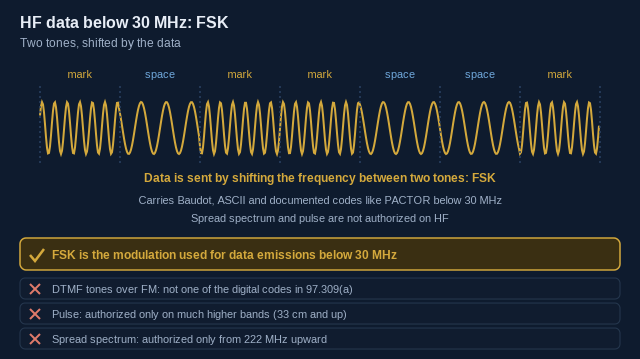
FSK is the modulation used for data emissions below 30 MHz.
Describe this graphic in words
A gold waveform switches between a higher frequency and a lower frequency in step with the bits, labeled mark and space. This is frequency shift keying, the usual modulation for RTTY and data emissions below 30 MHz.
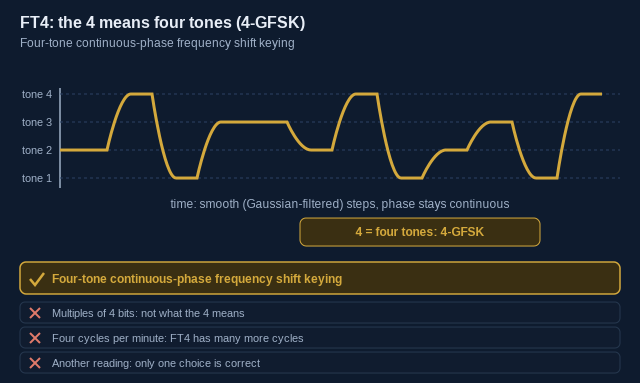
Below 30 MHz the data emissions in the HF bands are RTTY and data, and the usual modulation for them is frequency-shift keying (FSK). Section 97.307(f)(3) says only a RTTY or data emission using a code listed in 97.309(a) may be sent there, with an authorized bandwidth of 2.8 kHz. (The 500 Hz occupied-bandwidth condition in the 97.3(c)(2) definition applies only to certain emission types such as A1C, F1C, F2C, J2C and J3C below 30 MHz, so it is not a general limit on HF data.)
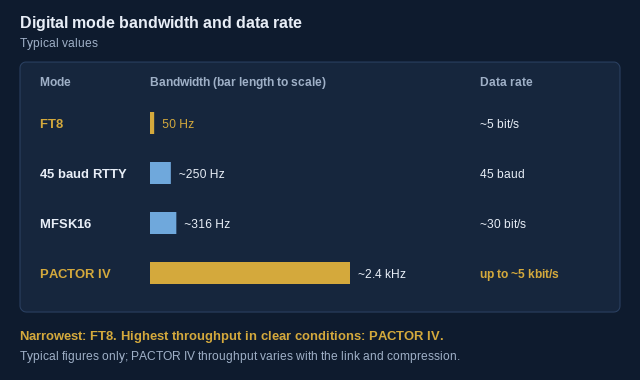
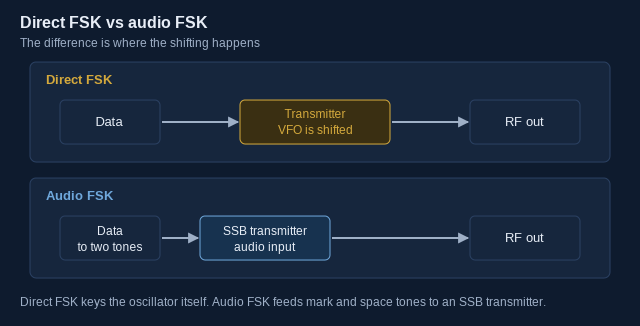
Treat the keyed answer as the common practice: FSK carries Baudot, ASCII and documented codes like PACTOR on HF. Spread spectrum and pulse are not authorized on HF at all, and a DTMF-modulated FM signal is not one of the specified digital codes.
Why the other choices are wrong
- A. DTMF tones over FM are not one of the digital codes listed in 97.309(a), so this is not an HF data emission.
- C. Pulse emissions are authorized only on much higher bands (33 cm and up), not below 30 MHz.
- D. Spread spectrum is authorized only from 222 MHz upward, not on HF.
References
- FCC rule47 CFR § 97.3, Definitions — Paragraph (c)(2) defines data emissions; the 500 Hz occupied-bandwidth condition below 30 MHz applies only to A1C, F1C, F2C, J2C and J3C.
- FCC rule47 CFR § 97.305, Authorized emission types — The table lists RTTY and data on the HF bands; SS appears only from 222 MHz up and pulse only from the 33 cm band up.
- FCC rule47 CFR § 97.307, Emission standards — Paragraph (f)(3) allows only RTTY or data using a code listed in 97.309(a) and sets a 2.8 kHz authorized bandwidth.
Rule text checked against the official source on November 17, 2026. This is a study aid; the linked rule is what governs.