
ARSC Tech School

Amateur Extra E8D: Keying defects and overmodulation of digital signals

599 questions · pool July 1, 2024 to June 30, 2028 · the exam has 50 questions; 37 to pass

E8 · SIGNALS AND EMISSIONS

Keying defects and overmodulation of digital signals; digital codes; spread spectrum

11 questions in group E8D

One question from this group appears on each exam.

E8D01

Why are received spread spectrum signals resistant to interference?

Show the answer and why

Answer A. Signals not using the spread spectrum algorithm are suppressed in the receiver

Spread spectrum receivers suppress signals that do not use the same spreading code.
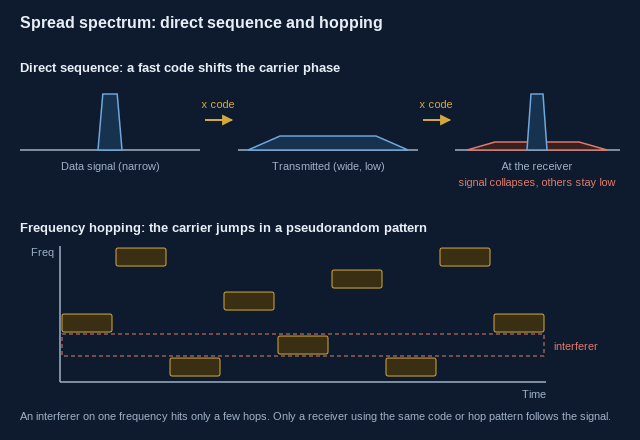
Direct sequence spreads a narrow signal into a wide low one and despreads it; frequency hopping jumps between frequencies over time.
Describe this graphic in words

The top panel shows direct sequence spread spectrum in three spectra: a narrow tall data signal, a wide low transmitted signal after multiplying by a fast code, and at the receiver the wanted signal collapsed to narrow and tall while interference stays spread and low. The bottom panel is a time and frequency grid in which a gold block jumps to a new frequency in each time step. A red dashed row marks an interferer on one frequency that hits only one hop.

This is a teaching note. The receiver correlates the incoming signal with its own copy of the spreading code. The wanted signal is collapsed back to a narrow bandwidth, while signals without the matching code stay spread out and appear as low-level noise.

High power, built-in error correction and asking the transmitter to change frequency are not how this works.

Why the other choices are wrong

  • B. Spread spectrum does not rely on high power.
  • C. Error correction is not the source of the resistance.
  • D. The receiver does not signal the transmitter to change frequency.

Rule text checked against the official source on November 17, 2026. This is a study aid; the linked rule is what governs.
E8D02

What spread spectrum communications technique uses a high-speed binary bit stream to shift the phase of an RF carrier?

Show the answer and why

Answer B. Direct sequence

Direct sequence uses a high-speed bit stream to shift the phase of the carrier.

Direct sequence spreads a narrow signal into a wide low one and despreads it; frequency hopping jumps between frequencies over time.
Describe this graphic in words

The top panel shows direct sequence spread spectrum in three spectra: a narrow tall data signal, a wide low transmitted signal after multiplying by a fast code, and at the receiver the wanted signal collapsed to narrow and tall while interference stays spread and low. The bottom panel is a time and frequency grid in which a gold block jumps to a new frequency in each time step. A red dashed row marks an interferer on one frequency that hits only one hop.

This is a teaching note. A fast pseudorandom code (chips) phase-shifts the carrier, which spreads the energy over a wide bandwidth. Only a receiver using the same code can recover the data.

Frequency hopping spreads by changing frequency, not phase.

Why the other choices are wrong

  • A. Frequency hopping moves the carrier frequency.
  • C. BPSK is a phase modulation method, not a spread spectrum technique by itself.
  • D. Phase compandored spread spectrum is not an established technique.

Rule text checked against the official source on November 17, 2026. This is a study aid; the linked rule is what governs.
E8D03

Which describes spread spectrum frequency hopping?

Show the answer and why

Answer D. Rapidly varying the frequency of a transmitted signal according to a pseudorandom sequence

Frequency hopping rapidly changes the transmitted frequency following a pseudorandom sequence.

Direct sequence spreads a narrow signal into a wide low one and despreads it; frequency hopping jumps between frequencies over time.
Describe this graphic in words

The top panel shows direct sequence spread spectrum in three spectra: a narrow tall data signal, a wide low transmitted signal after multiplying by a fast code, and at the receiver the wanted signal collapsed to narrow and tall while interference stays spread and low. The bottom panel is a time and frequency grid in which a gold block jumps to a new frequency in each time step. A red dashed row marks an interferer on one frequency that hits only one hop.

This is a teaching note. Both ends know the hop sequence, so the receiver follows the transmitter from one frequency to the next. An interferer on one frequency only affects a small share of the hops.

The receiver does not ask for a frequency change, clipping is not used for error correction, and phase shifting describes direct sequence.

Why the other choices are wrong

  • A. The hops follow a set sequence; the receiver does not request them.
  • B. Clipping to create harmonics is not frequency hopping.
  • C. Shifting the phase with a bit stream describes direct sequence.

Rule text checked against the official source on November 17, 2026. This is a study aid; the linked rule is what governs.
E8D04

What is the primary effect of extremely short rise or fall time on a CW signal?

Show the answer and why

Answer C. The generation of key clicks

An extremely short rise or fall time on a CW signal produces key clicks.

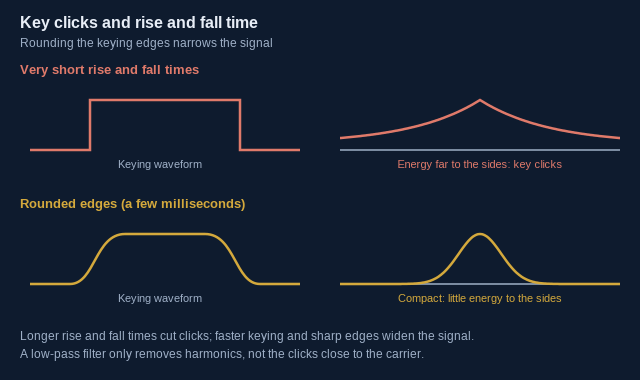
Square keying pulses make a wide spectrum with key clicks; rounded keying edges make a narrow spectrum.
Describe this graphic in words

Two rows each pair a keying waveform with its spectrum. The top row has a red square pulse with instant edges, and its spectrum, in red, spreads wide, which is heard as key clicks. The bottom row has a gold pulse with rounded rise and fall of a few milliseconds, and its spectrum is compact.

A sudden on-off edge is a very fast change, which contains a wide range of frequencies. These show up as clicks heard on nearby frequencies, well away from the signal. Under 47 CFR 97.307(b), emissions outside the necessary bandwidth must not cause splatter or keyclick interference to operations on adjacent frequencies.

It does not make the signal harder to copy or tune, and the splatter is not the same as harmonics.

Why the other choices are wrong

  • A. Short edges do not make it harder to copy on the main frequency.
  • B. Harmonics come from nonlinearity, not edge speed.
  • D. It does not make tuning harder.

References

  • FCC rule47 CFR § 97.307, Emission standards — Paragraph (b) says emissions outside the necessary bandwidth must not cause splatter or keyclick interference to operations on adjacent frequencies.

Rule text checked against the official source on November 17, 2026. This is a study aid; the linked rule is what governs.

E8D05

What is the most common method of reducing key clicks?

Show the answer and why

Answer A. Increase keying waveform rise and fall times

Increasing the keying waveform rise and fall times is the most common cure for key clicks.

Square keying pulses make a wide spectrum with key clicks; rounded keying edges make a narrow spectrum.
Describe this graphic in words

Two rows each pair a keying waveform with its spectrum. The top row has a red square pulse with instant edges, and its spectrum, in red, spreads wide, which is heard as key clicks. The bottom row has a gold pulse with rounded rise and fall of a few milliseconds, and its spectrum is compact.

Rounding the edges slows the change from off to on, so there is less energy at frequencies far from the carrier. Typical rise and fall times are a few milliseconds. This matters because 47 CFR 97.307(b) says keyclick interference to adjacent frequencies must not occur.

Shortening the edges makes clicks worse. A low-pass filter only removes harmonics, not the clicks near the carrier.

Why the other choices are wrong

  • B. A low-pass filter removes harmonics, but clicks are close to the carrier.
  • C. Reducing the times makes clicks worse.
  • D. A high-pass filter would not remove the click sidebands.

References

  • FCC rule47 CFR § 97.307, Emission standards — Paragraph (b) says emissions outside the necessary bandwidth must not cause splatter or keyclick interference to operations on adjacent frequencies.

Rule text checked against the official source on November 17, 2026. This is a study aid; the linked rule is what governs.
E8D06

What is the advantage of including parity bits in ASCII characters?

Show the answer and why

Answer D. Some types of errors can be detected

A parity bit lets some types of errors be detected.

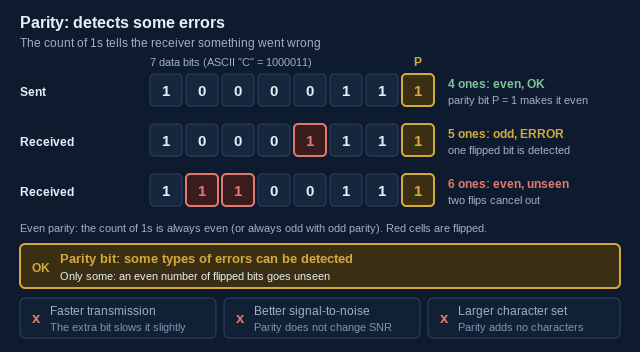
A character with an even parity bit, one flipped bit that is detected, and two flipped bits that go unseen.
Describe this graphic in words

Three rows of eight bit cells show the character C with its parity bit in gold, then a copy with one flipped bit giving an odd count of ones, which is detected, and a copy with two flipped bits giving an even count, which goes unseen. A gold bar says parity lets some types of errors be detected. Three dimmed boxes reject faster speed, better signal-to-noise and a larger character set.

This is a teaching note. A parity bit is added so the count of 1s in each character is always even (or always odd). If one bit is flipped in transit, the count is wrong and the receiver knows an error happened. Two flipped bits cancel out and go unseen, so only some errors are caught.

The extra bit slows the transmission slightly and does not improve signal-to-noise or the character set.

Why the other choices are wrong

  • A. The extra bit lowers speed slightly.
  • B. Parity does not change the signal-to-noise ratio.
  • C. Parity does not enlarge the character set.

Rule text checked against the official source on November 17, 2026. This is a study aid; the linked rule is what governs.

E8D07

What is a common cause of overmodulation of AFSK signals?

Show the answer and why

Answer D. Excessive transmit audio levels

Excessive transmit audio level is the common cause of overmodulation of AFSK.

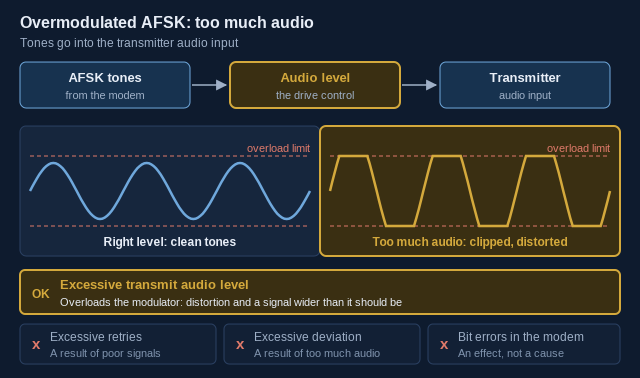
A clean AFSK tone at the right audio level beside a clipped tone from too much audio drive.
Describe this graphic in words

A chain from the modem tones through the audio level control to the transmitter audio input has the audio level highlighted. Two plots show a clean sine tone at the right level and a flat-topped clipped tone that exceeds the overload limit. A gold bar names excessive transmit audio level as the common cause. Three dimmed boxes reject retries, deviation and bit errors.

This is a teaching note. In AFSK the tones are fed into the transmitter's audio input. Too much audio drive overloads the modulator or amplifiers, and the result is distortion and a signal wider than it should be.

Retries, excess deviation and bit errors are results or other effects, not the usual cause.

Why the other choices are wrong

  • A. Retries are a result of poor signals, not a cause.
  • B. Deviation too high is a result of excess audio.
  • C. Bit errors are an effect, not a cause.

Rule text checked against the official source on November 17, 2026. This is a study aid; the linked rule is what governs.

E8D08

What parameter evaluates distortion of an AFSK signal caused by excessive input audio levels?

Show the answer and why

Answer D. Intermodulation Distortion (IMD)

Intermodulation distortion (IMD) evaluates distortion caused by excessive audio levels.

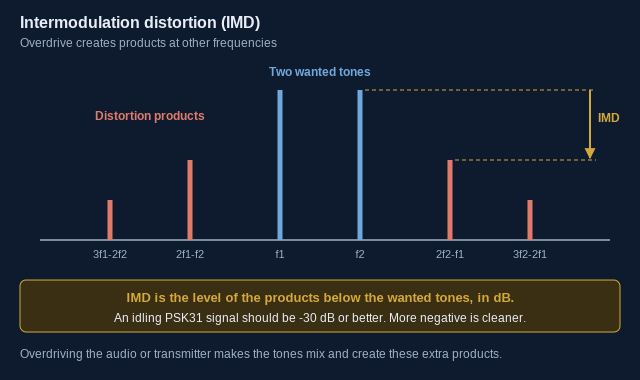
Spectrum of two wanted tones with lower distortion products on both sides, and IMD as their level below the tones.
Describe this graphic in words

A spectrum with two tall blue lines for the wanted tones. On each side are shorter red lines for the third-order and then fifth-order intermodulation products. A gold arrow marks the gap between the tones and the products, which is the IMD measurement. A note says an idling PSK31 signal should be at -30 dB or better.

This is a teaching note. When tones in an overdriven signal mix, they create extra products at other frequencies. Measuring those products against the wanted tones gives the IMD figure, so it is the way to see overdrive.

Signal-to-noise ratio, baud error rate and repeat request rate do not isolate this kind of distortion.

Why the other choices are wrong

  • A. S/N ratio measures noise, not distortion products.
  • B. Baud error rate is not a distortion measurement.
  • C. Repeat Request Rate is not a standard distortion measure.

Rule text checked against the official source on November 17, 2026. This is a study aid; the linked rule is what governs.

E8D09

What is considered an acceptable maximum IMD level for an idling PSK signal?

Show the answer and why

Answer D. -30 dB

An acceptable maximum IMD for an idling PSK signal is -30 dB.

Spectrum of two wanted tones with lower distortion products on both sides, and IMD as their level below the tones.
Describe this graphic in words

A spectrum with two tall blue lines for the wanted tones. On each side are shorter red lines for the third-order and then fifth-order intermodulation products. A gold arrow marks the gap between the tones and the products, which is the IMD measurement. A note says an idling PSK31 signal should be at -30 dB or better.

This is a teaching note. IMD is given in dB below the wanted signal, so more negative is better. The common guide is that an idling PSK31 signal should be -30 dB or better, which means that the distortion products are at least 30 dB lower. This is a rule of thumb, not a regulation.

Positive values would mean that the distortion was stronger than the signal.

Why the other choices are wrong

  • A. +5 dB would mean distortion stronger than the signal.
  • B. +10 dB would mean distortion much stronger than the signal.
  • C. +15 dB would also mean distortion stronger than the signal.

Rule text checked against the official source on November 17, 2026. This is a study aid; the linked rule is what governs.

E8D10

What are some of the differences between the Baudot digital code and ASCII?

Show the answer and why

Answer B. Baudot uses 5 data bits per character, ASCII uses 7 or 8; Baudot uses 2 characters as letters/figures shift codes, ASCII has no letters/figures shift code

Baudot has 5 data bits and 2 shift codes; ASCII uses 7 or 8 bits and has no letters/figures shift.

Comparison: Baudot has 5 bits and two shift characters; ASCII has 7 or 8 bits and no shift characters.
Describe this graphic in words

Two side-by-side cards. Baudot uses 5 bits per character, giving 32 codes, with two shift characters to switch between letters and figures. ASCII uses 7 data bits, giving 128 codes, or 8 bits extended, and has no shift characters because upper and lower case, digits and symbols all have their own codes.

This is a teaching note. Baudot has only 5 bits, giving 32 codes, so it uses two special shift characters (letters and figures) to switch between letter and number sets. ASCII has 7 data bits (128 codes), or 8 with extension, and holds upper and lower case, digits and symbols with no shifting.

The other choices give the wrong bit counts or invert which code has the shift characters.

Why the other choices are wrong

  • A. Baudot is 5 bits, not 4, and has two shifts, not one.
  • C. Baudot is not 6 bits and does have shift codes.
  • D. Baudot is not 7 bits and does have shift codes.

Rule text checked against the official source on November 17, 2026. This is a study aid; the linked rule is what governs.

E8D11

What is one advantage of using ASCII code for data communications?

Show the answer and why

Answer C. It is possible to transmit both uppercase and lowercase text

ASCII can send both uppercase and lowercase text.

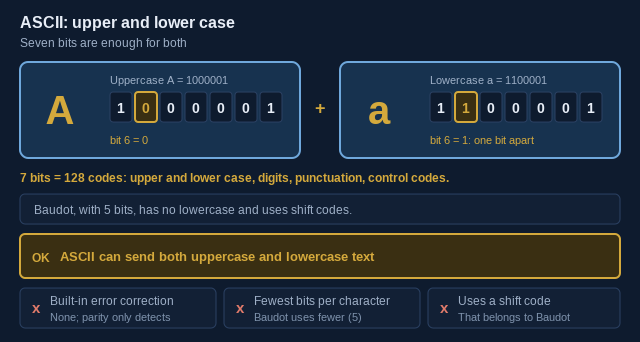
ASCII codes for uppercase A and lowercase a, which differ by one bit, with Baudot noted as having no lowercase.
Describe this graphic in words

Two cards show the 7-bit ASCII codes for uppercase A, 1000001, and lowercase a, 1100001, with the differing bit in gold. A line notes that 7 bits give 128 codes, enough for both cases, while 5-bit Baudot has no lowercase. A gold bar gives the keyed answer, and three dimmed boxes reject built-in error correction, fewest bits and shift codes.

This is a teaching note. With 7 bits ASCII has 128 codes, enough for upper and lower case letters, digits, punctuation and control codes. Baudot, with 5 bits, has no lowercase.

ASCII has no built-in error correction (parity is optional and only detects some errors), it has more bits per character than Baudot, and it needs no shift codes.

Why the other choices are wrong

  • A. ASCII has no built-in error correction.
  • B. ASCII uses more bits per character than Baudot.
  • D. Shift codes belong to Baudot, not ASCII.

Rule text checked against the official source on November 17, 2026. This is a study aid; the linked rule is what governs.