
ARSC Tech School

Amateur Extra E1D: Amateur Space and Earth stations

599 questions · pool July 1, 2024 to June 30, 2028 · the exam has 50 questions; 37 to pass

E1 · COMMISSION RULES

Amateur Space and Earth stations; telemetry and telecommand rules; identification of balloon transmissions; one-way communications

12 questions in group E1D

One question from this group appears on each exam.

E1D01FCC rule 97.3

What is the definition of telemetry?

Show the answer and why

Answer A. One-way transmission of measurements at a distance from the measuring instrument

FCC rule 97.3

Telemetry is a one-way transmission of measurements at a distance from the measuring instrument.
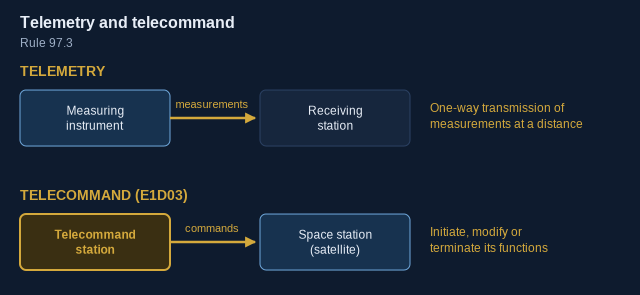
Telemetry sends measurements one way from an instrument; a telecommand station sends commands to a space station.
Describe this graphic in words

Two arrows in opposite roles. Top, telemetry: a measuring instrument sends measurements one way to a receiving station. Bottom, a telecommand station sends commands to a space station to initiate, modify or terminate its functions.

Rule 97.3 defines telemetry exactly that way. A weather station, a balloon sending altitude, or a model rocket sending temperature are common examples. The key points are that it is one-way and that it carries measurement data.

Telecommand is the opposite direction: a one-way transmission to start, change or stop a device at a distance.

Why the other choices are wrong

  • B. Distance and two-way operation are not part of the definition.
  • C. Telemetry is one-way, not two-way.
  • D. That is the definition of telecommand.

References

Rule text checked against the official source on November 17, 2026. This is a study aid; the linked rule is what governs.
E1D02FCC rule 97.211(b)

Which of the following may transmit encrypted messages?

Show the answer and why

Answer B. Telecommand signals from a space telecommand station

FCC rule 97.211(b)

A telecommand station sending commands to a space station may use special codes to obscure the meaning of the commands.

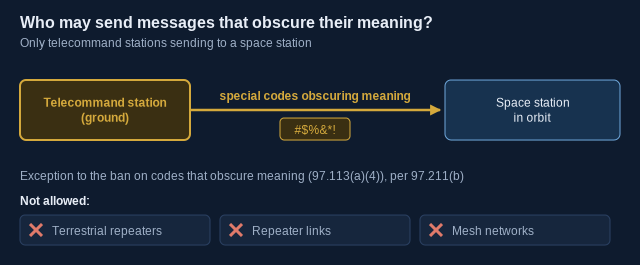
A telecommand station may send coded commands to a satellite, an exception to the ban on obscured messages.
Describe this graphic in words

A ground telecommand station sends specially coded commands, shown as scrambled symbols on a gold arrow, to a space station. Beneath, three dimmed items with red crosses, terrestrial repeaters, repeater links and mesh networks, cannot use this exception.

Amateurs are generally forbidden to send messages encoded to obscure their meaning (97.113(a)(4)), but rule 97.211(b) gives space telecommand stations an exception. They may transmit special codes intended to obscure the meaning of telecommand messages to the station in space, which protects a satellite from unauthorized commands.

The exception does not cover terrestrial repeaters, repeater links or mesh networks.

Why the other choices are wrong

  • A. Telecommand to terrestrial repeaters gets no encryption exception.
  • C. Repeater audio on auxiliary links may not be encrypted.
  • D. Mesh backbone nodes may not carry messages encoded to hide their meaning.

References

Rule text checked against the official source on November 17, 2026. This is a study aid; the linked rule is what governs.
E1D03FCC rule 97.3(a)(45)

What is a space telecommand station?

Show the answer and why

Answer B. An amateur station that transmits communications to initiate, modify, or terminate functions of a space station

FCC rule 97.3(a)(45)

A space telecommand station sends communications that initiate, modify, or terminate functions of a space station.

Telemetry sends measurements one way from an instrument; a telecommand station sends commands to a space station.
Describe this graphic in words

Two arrows in opposite roles. Top, telemetry: a measuring instrument sends measurements one way to a receiving station. Bottom, a telecommand station sends commands to a space station to initiate, modify or terminate its functions.

The rule in 97.3 defines a telecommand station as an amateur station that transmits communications to initiate, modify or terminate functions of a space station. A ground station that commands a satellite is the usual example.

The other descriptions are an Earth station, a space station, and a station receiving telemetry.

Why the other choices are wrong

  • A. That describes an Earth station.
  • C. That describes a space station (more than 50 km above the surface).
  • D. Receiving telemetry does not make a station a telecommand station.

References

Rule text checked against the official source on November 17, 2026. This is a study aid; the linked rule is what governs.
E1D04FCC rule 97.119(a)

Which of the following is required in the identification transmissions from a balloon-borne telemetry station?

Show the answer and why

Answer A. Call sign

FCC rule 97.119(a)

A balloon-borne telemetry station must identify with its call sign.

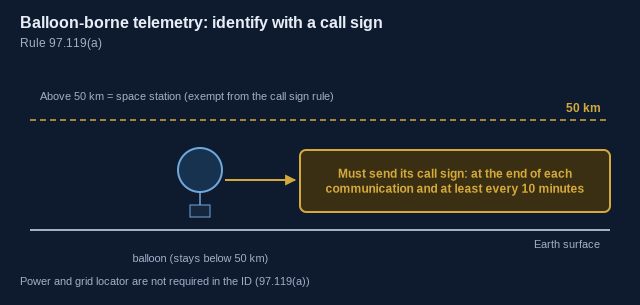
A balloon below the 50 km line must identify with its call sign every 10 minutes and at the end of a communication.
Describe this graphic in words

A horizontal dashed line at 50 km marks the lower edge of space stations. A balloon below it must transmit its call sign, shown in a gold box: at the end of each communication and at least every 10 minutes.

Rule 97.119(a) exempts only space stations and telecommand stations from the call sign rule. A space station is an amateur station more than 50 km above the Earth, and most amateur balloons stay below that, so they must identify like any other station: their assigned call sign at the end of each communication and at least every 10 minutes during one.

The rule does not require sending the transmitter power or a grid locator, so "all of these" is wrong.

Why the other choices are wrong

  • B. Output power is not a required part of identification.
  • C. A grid locator is not required in identification.
  • D. Only the call sign is required, so "all of these" fails.

References

Rule text checked against the official source on November 17, 2026. This is a study aid; the linked rule is what governs.
E1D05FCC rule 97.213(d)

What must be posted at the location of a station being operated by telecommand on or within 50 kilometers of the Earth’s surface?

Show the answer and why

Answer D. All these choices are correct

FCC rule 97.213(d)

A station under telecommand must post a license photocopy and a label with the licensee and control operator contact information.

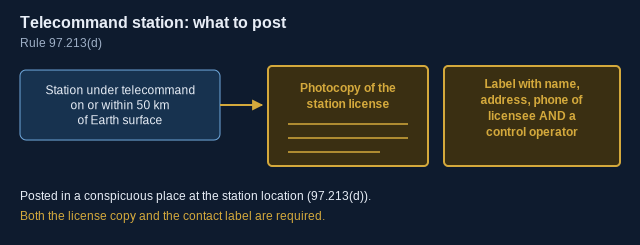
A telecommanded station must post a photocopy of the license and a contact label with licensee and control operator information.
Describe this graphic in words

A telecommand-operated station box with arrows to two gold cards: a photocopy of the station license, and a label with the name, address and telephone number of the licensee and at least one designated control operator. Both are posted in a conspicuous place.

Rule 97.213(d) requires a photocopy of the station license and a label with the name, address and telephone number of the station licensee and at least one designated control operator, posted in a conspicuous place at the station location. That gives the FCC or anyone with a problem a way to reach someone.

All three listed items are part of the requirement.

Why the other choices are wrong

  • A. Correct but incomplete: the label is required as well.
  • B. Correct but incomplete: the photocopy and control operator contact are also required.
  • C. Correct but incomplete: the photocopy and licensee label are also required.

References

Rule text checked against the official source on November 17, 2026. This is a study aid; the linked rule is what governs.
E1D06FCC rule 97.215(c)

What is the maximum permitted transmitter output power when operating a model craft by telecommand?

Show the answer and why

Answer A. 1 watt

FCC rule 97.215(c)

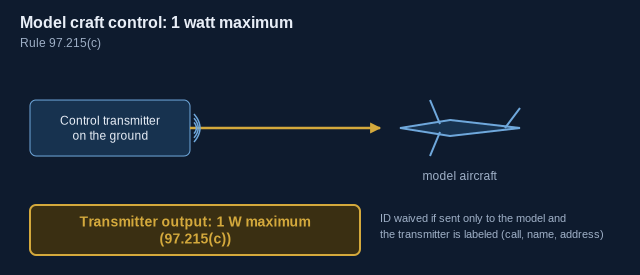
A model craft control transmitter may not exceed 1 watt.

A model aircraft controlled by a transmitter limited to 1 watt.
Describe this graphic in words

A ground control transmitter sends a signal to a model aircraft. A gold box says the maximum transmitter output power for model craft telecommand is 1 watt. A note says identification is waived for transmissions directed only to the model if the transmitter is labeled.

Rule 97.215(c) limits the transmitter power for model craft telecommand to 1 W. The same section waives station identification for transmissions directed only to the model, provided the transmitter has a label with call sign, name and address, and says control signals are not treated as codes or ciphers.

The higher choices are not the limit.

Why the other choices are wrong

  • B. 2 watts is above the 1 watt limit.
  • C. 5 watts is above the 1 watt limit.
  • D. 100 watts is above the 1 watt limit.

References

Rule text checked against the official source on November 17, 2026. This is a study aid; the linked rule is what governs.
E1D07FCC rule 97.207

Which of the following HF amateur bands include allocations for space stations?

Show the answer and why

Answer A. 40 meters, 20 meters, 15 meters, and 10 meters

FCC rule 97.207

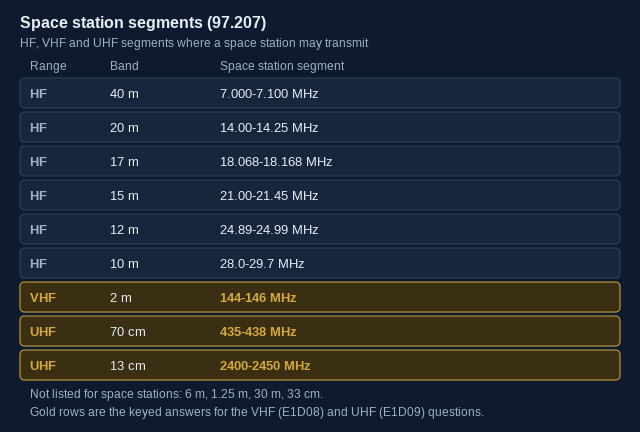
Space station allocations on HF include segments of 40 and 20 meters plus the 15 and 10 meter bands (and also 17 and 12 meters).

Table of amateur bands that include segments authorized for space stations.
Describe this graphic in words

A table lists the space station segments under rule 97.207(c). On HF these are 40 meters (7.000-7.100 MHz), 20 meters (14.00-14.25 MHz), and the 17, 15, 12 and 10 meter bands. On VHF only 2 meters (144-146 MHz) is listed, and on UHF and above 70 centimeters (435-438 MHz) and 13 centimeters (2400-2450 MHz) are listed.

Rule 97.207(c) authorizes space stations on the 17, 15, 12 and 10 meter bands and on the segments 7.0-7.1 MHz (40 m) and 14.00-14.25 MHz (20 m). The keyed answer names four of those six, so it is the best match, although it leaves out 17 and 12 meters.

Treat the key as a simplification. The other choices are clearly wrong: 30 meters is not on the list, 10 meters is not the only band, and satellites are not allowed on every HF band.

Why the other choices are wrong

  • B. 30 meters is not authorized for space stations.
  • C. More than 10 meters is authorized.
  • D. Satellite operation is not permitted on all HF bands; for example 80, 60, 30 and 160 meters are not listed.

References

Rule text checked against the official source on November 17, 2026. This is a study aid; the linked rule is what governs.

E1D08FCC rule 97.207

Which VHF amateur bands have frequencies authorized for space stations?

Show the answer and why

Answer D. 2 meters

FCC rule 97.207

The only VHF amateur segment authorized to space stations is 2 meters (144-146 MHz).

Table of amateur bands that include segments authorized for space stations.
Describe this graphic in words

A table lists the space station segments under rule 97.207(c). On HF these are 40 meters (7.000-7.100 MHz), 20 meters (14.00-14.25 MHz), and the 17, 15, 12 and 10 meter bands. On VHF only 2 meters (144-146 MHz) is listed, and on UHF and above 70 centimeters (435-438 MHz) and 13 centimeters (2400-2450 MHz) are listed.

Rule 97.207(c)(2) lists 144-146 MHz for space stations. It does not list 6 meters or 1.25 meters, so satellites cannot use those bands.

This is why satellite uplinks and downlinks on VHF appear in the 2 meter band, between 144 and 146 MHz.

Why the other choices are wrong

  • A. 6 meters is not authorized for space stations.
  • B. Neither 6 meters nor 1.25 meters is authorized for space stations.
  • C. 1.25 meters is not authorized for space stations.

References

Rule text checked against the official source on November 17, 2026. This is a study aid; the linked rule is what governs.

E1D09FCC rule 97.207

Which UHF amateur bands have frequencies authorized for space stations?

Show the answer and why

Answer B. 70 centimeters and 13 centimeters

FCC rule 97.207

Space stations may use 70 cm (435-438 MHz) and 13 cm (2400-2450 MHz).

Table of amateur bands that include segments authorized for space stations.
Describe this graphic in words

A table lists the space station segments under rule 97.207(c). On HF these are 40 meters (7.000-7.100 MHz), 20 meters (14.00-14.25 MHz), and the 17, 15, 12 and 10 meter bands. On VHF only 2 meters (144-146 MHz) is listed, and on UHF and above 70 centimeters (435-438 MHz) and 13 centimeters (2400-2450 MHz) are listed.

Rule 97.207(c)(2) lists 435-438 MHz and 2400-2450 MHz for space stations. The first is in the 70 cm band and the second in the 13 cm band. The 33 cm band is not authorized for space stations.

The segment at 1260-1270 MHz is listed for Earth stations and telecommand stations but not for space stations.

Why the other choices are wrong

  • A. 13 cm is also authorized, so 70 cm only is incomplete.
  • C. 33 cm is not authorized for space stations.
  • D. 33 cm is not authorized for space stations.

References

Rule text checked against the official source on November 17, 2026. This is a study aid; the linked rule is what governs.

E1D10FCC rule 97.211

Which amateur stations are eligible to be telecommand stations of space stations, subject to the privileges of the class of operator license held by the control operator of the station?

Show the answer and why

Answer B. Any amateur station so designated by the space station licensee

FCC rule 97.211

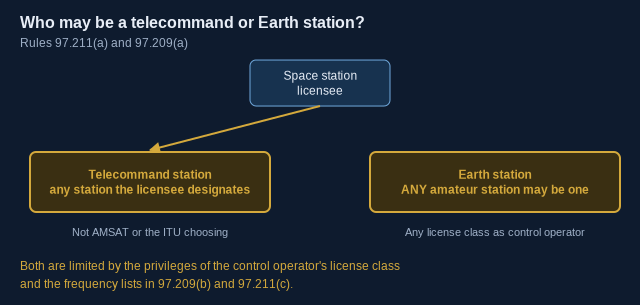
Any amateur station designated by the space station licensee can be a telecommand station.

Telecommand stations are those the space station licensee designates; any amateur station may be an Earth station.
Describe this graphic in words

A space station licensee box points to a gold telecommand station box, any station the licensee designates. A second gold box says any amateur station may be an Earth station. A note says both are limited by the control operator license privileges and the listed frequency segments.

Rule 97.211(a) says any amateur station designated by the licensee of a space station is eligible to transmit as its telecommand station, subject to the privileges of the control operator's license class. The licensee decides, not AMSAT or the ITU.

Telecommand stations are limited to the frequency segments listed in 97.211(c).

Why the other choices are wrong

  • A. AMSAT approval is not what the rule requires.
  • C. The ITU does not designate telecommand stations under this rule.
  • D. Only one choice is correct.

References

Rule text checked against the official source on November 17, 2026. This is a study aid; the linked rule is what governs.

E1D11FCC rule 97.209

Which amateur stations are eligible to operate as Earth stations?

Show the answer and why

Answer D. Any amateur station, subject to the privileges of the class of operator license held by the control operator

FCC rule 97.209

Any amateur station may be an Earth station, subject to the control operator's license privileges.

Telecommand stations are those the space station licensee designates; any amateur station may be an Earth station.
Describe this graphic in words

A space station licensee box points to a gold telecommand station box, any station the licensee designates. A second gold box says any amateur station may be an Earth station. A note says both are limited by the control operator license privileges and the listed frequency segments.

Rule 97.209(a) says any amateur station may be an Earth station, and a holder of any class of operator license may be its control operator, subject to that license class's privileges. No special course is required.

You would be limited to frequencies you are authorized to use and that appear in 97.209(b).

Why the other choices are wrong

  • A. No AMSAT course is required.
  • B. Technician class operators can also be Earth station control operators.
  • C. The rule does not limit it to Extra class operators.

References

Rule text checked against the official source on November 17, 2026. This is a study aid; the linked rule is what governs.

E1D12FCC rule 97.207(e), 97.203(g)

Which of the following amateur stations may transmit one-way communications?

Show the answer and why

Answer A. A space station, beacon station, or telecommand station

FCC rule 97.207(e), 97.203(g)

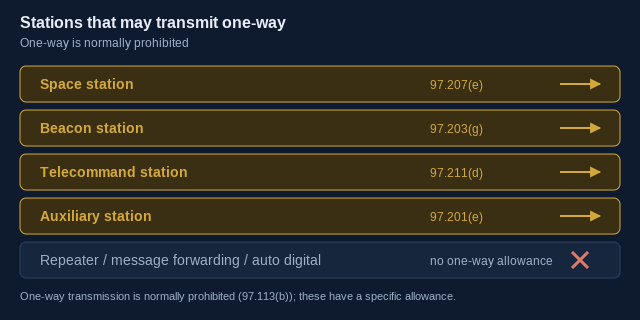
Space stations, beacon stations and telecommand stations are allowed to transmit one-way communications.

A list of stations allowed to transmit one-way: space, beacon, telecommand and auxiliary; repeaters and forwarding stations are not.
Describe this graphic in words

Four gold rows with one-way arrows: space station, beacon station, telecommand station and auxiliary station, each with its rule section. A dimmed fifth row, repeaters, message forwarding and automatic digital stations, has a red cross because Part 97 gives them no one-way allowance.

Normally one-way transmission is prohibited (97.113(b)), but each of these sections has a specific allowance: 97.207(e) for space stations, 97.203(g) for beacons, and 97.211(d) for telecommand stations. Auxiliary stations (97.201(e)) can also do so.

The other choices pair stations that have no one-way allowance in Part 97: repeaters retransmit signals received from other stations, and message forwarding and automatically controlled digital stations exchange traffic with others.

Why the other choices are wrong

  • B. Repeater and linked repeater stations have no one-way allowance in these sections.
  • C. Message forwarding and automatically controlled digital stations are not given a one-way allowance.
  • D. Since B and C are not correct, "all of these" fails.

References

Rule text checked against the official source on November 17, 2026. This is a study aid; the linked rule is what governs.