
ARSC Tech School

Amateur Extra E2D: Operating methods

599 questions · pool July 1, 2024 to June 30, 2028 · the exam has 50 questions; 37 to pass

E2 · OPERATING PROCEDURES

Operating methods: digital modes and procedures for VHF and UHF; APRS; EME procedures; meteor scatter procedures

11 questions in group E2D

One question from this group appears on each exam.

E2D01

Which of the following digital modes is designed for meteor scatter communications?

Show the answer and why

Answer B. MSK144

MSK144 is designed for meteor scatter.
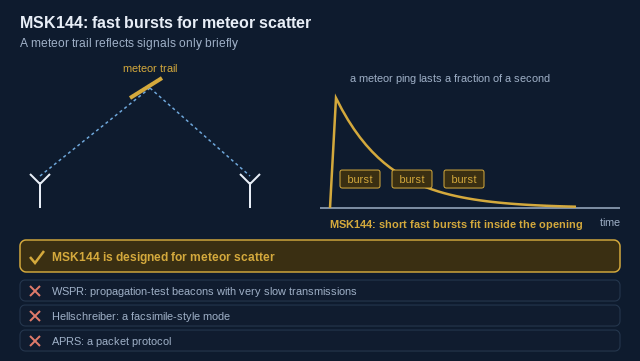
Two stations bouncing signals off a meteor trail, with short MSK144 bursts fitting inside the brief ping.
Describe this graphic in words

On the left two stations reflect a signal off a meteor trail. On the right a graph shows the ping rising sharply and then fading within a fraction of a second, with short gold MSK144 bursts fitted inside the opening.

This is a teaching note. A meteor trail reflects signals for a fraction of a second, so the mode must send data fast. MSK144 sends short, fast bursts that fit inside those brief openings, and software decodes them from the pings.

WSPR is for weak-signal propagation beacons, Hellschreiber is a facsimile-like mode, and APRS is a packet protocol.

Why the other choices are wrong

  • A. WSPR is for propagation testing with very slow transmissions.
  • C. Hellschreiber is a facsimile-style mode and not designed for meteor scatter.
  • D. APRS is a packet protocol.

Rule text checked against the official source on November 17, 2026. This is a study aid; the linked rule is what governs.
E2D02

What information replaces signal-to-noise ratio when using the FT8 or FT4 modes in a VHF contest?

Show the answer and why

Answer D. Grid square

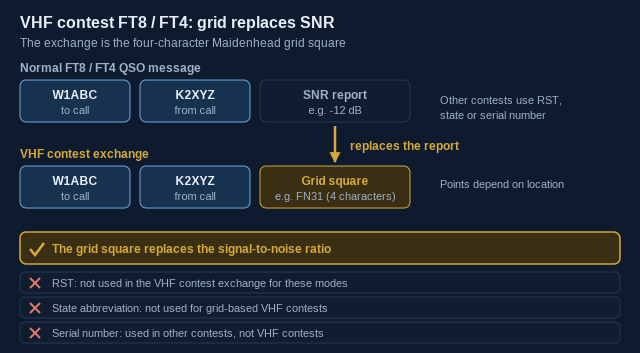
The grid square replaces signal-to-noise ratio in the FT8 or FT4 contest exchange.

An FT8 message with the signal report replaced by a four-character grid square in a VHF contest.
Describe this graphic in words

The top row shows a normal FT8 or FT4 message with two call signs and a signal-to-noise report. The bottom row shows the VHF contest message where a gold four-character grid square takes the place of the report.

This is a teaching note. In normal FT8 and FT4 QSOs, the exchange includes a signal report. In VHF contests, the exchange is the four-character Maidenhead grid square, because contest points depend on location.

RST, state abbreviation and serial number are used in other contests.

Why the other choices are wrong

  • A. RST is not used in the VHF contest exchange for these modes.
  • B. State abbreviations are not used for VHF grid-based contests.
  • C. Serial numbers are used in other contests, but not in VHF contests.

Rule text checked against the official source on November 17, 2026. This is a study aid; the linked rule is what governs.
E2D03

Which of the following digital modes is designed for EME communications?

Show the answer and why

Answer D. Q65

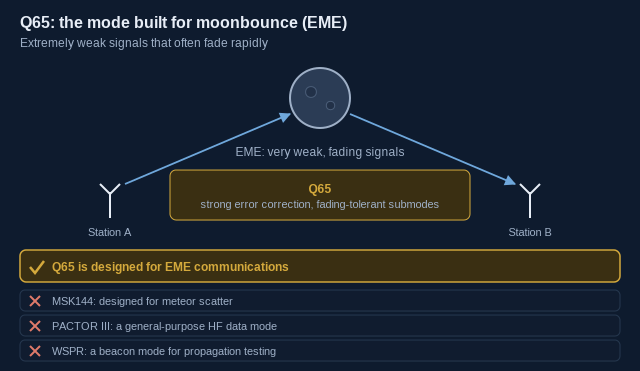
Q65 is designed for EME communications.

Two stations bouncing signals off the Moon, with Q65 highlighted as the mode built for those weak, fading signals.
Describe this graphic in words

Two stations send signals up to the Moon and the echo is received by the other station. A gold Q65 box notes strong error correction and several submodes for the different fading and Doppler spreads of moonbounce.

This is a teaching note. EME (moonbounce) signals are extremely weak and often fade rapidly. Q65 is built for those conditions, with strong error correction and several submodes that handle the different fading and Doppler spreads.

MSK144 is for meteor scatter, PACTOR III is a general-purpose HF mode, and WSPR is for propagation beacons.

Why the other choices are wrong

  • A. MSK144 is designed for meteor scatter.
  • B. PACTOR III is a general-purpose HF data mode.
  • C. WSPR is a beacon mode for propagation testing.

Rule text checked against the official source on November 17, 2026. This is a study aid; the linked rule is what governs.
E2D04

What technology is used for real-time tracking of balloons carrying amateur radio transmitters?

Show the answer and why

Answer C. APRS

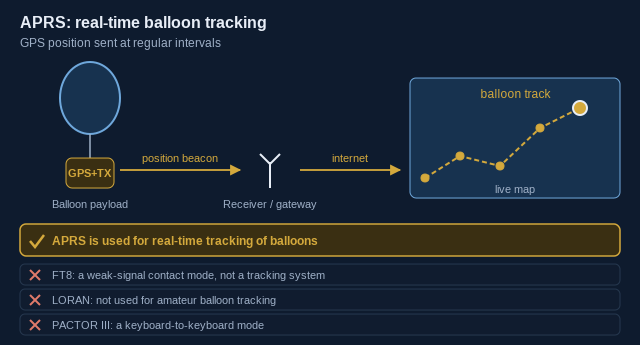
APRS is used for real-time tracking of balloons.

A balloon with a GPS and APRS transmitter sending its position to a gateway that plots its track on a map.
Describe this graphic in words

A balloon payload with a GPS and small APRS transmitter sends position beacons to a receiving station or internet gateway. The positions then appear as a moving track on a live map.

This is a teaching note. A balloon payload with a GPS and a small APRS transmitter sends its position at regular intervals. Receiving stations and internet gateways display it on a map as the balloon moves.

FT8 and PACTOR III do not carry real-time position data, and LORAN is a different navigation system.

Why the other choices are wrong

  • A. FT8 is a weak-signal contact mode, not a tracking system.
  • B. LORAN is not used for amateur balloon tracking.
  • D. PACTOR III is a keyboard-to-keyboard mode.

Rule text checked against the official source on November 17, 2026. This is a study aid; the linked rule is what governs.
E2D05

What is the characteristic of the JT65 mode?

Show the answer and why

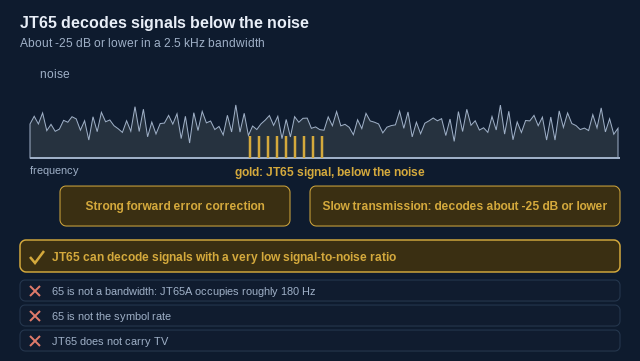
Answer B. Decodes signals with a very low signal-to-noise ratio

JT65 can decode signals that have a very low signal-to-noise ratio.

A JT65 signal drawn below the noise level, with strong error correction and slow transmission as the reasons it still decodes.
Describe this graphic in words

A spectrum shows a band of noise with a small gold cluster of tones sitting inside it, below the top of the noise. Two gold boxes explain why it can still be decoded: strong forward error correction and a slow transmission, about minus 25 dB or lower in a 2.5 kHz bandwidth.

This is a teaching note. JT65 uses strong forward error correction and a slow transmission, which allows decoding of signals far below the noise level (about -25 dB or lower in a 2.5 kHz bandwidth).

JT65 does not use only 65 Hz, the 65 is not a baud rate, and it has nothing to do with TV.

Why the other choices are wrong

  • A. The 65 is not a bandwidth; JT65A signals occupy roughly 180 Hz.
  • C. The 65 is not its symbol rate.
  • D. JT65 does not carry TV.

Rule text checked against the official source on November 17, 2026. This is a study aid; the linked rule is what governs.
E2D06

Which of the following is a method for establishing EME contacts?

Show the answer and why

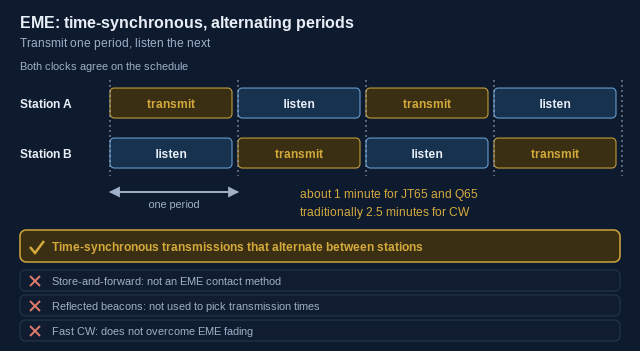
Answer A. Time-synchronous transmissions alternating between stations

EME contacts can be made with time-synchronous transmissions that alternate between stations.

Two stations alternating transmit and listen periods on a shared clock schedule.
Describe this graphic in words

Two timelines show station A transmitting while station B listens, then swapping, in equal periods lined up by dashed time marks. The period is about one minute for JT65 and Q65 and traditionally 2.5 minutes for CW.

This is a teaching note. EME stations work in agreed, clock-timed periods: they transmit for one period and listen for the next, with the period length set by the mode (about one minute for JT65 and Q65, and traditionally 2.5 minutes for CW). Both stations agree on the schedule, so each knows when to transmit and when to listen for the very weak return signal.

Store-and-forward and CW fast ID are not used, and timing is not judged from reflected beacons.

Why the other choices are wrong

  • B. Store-and-forward is not an EME contact method.
  • C. Beacons reflected from the moon are not used to pick transmission times.
  • D. Fast CW does not overcome EME fading.

Rule text checked against the official source on November 17, 2026. This is a study aid; the linked rule is what governs.
E2D07

What digital protocol is used by APRS?

Show the answer and why

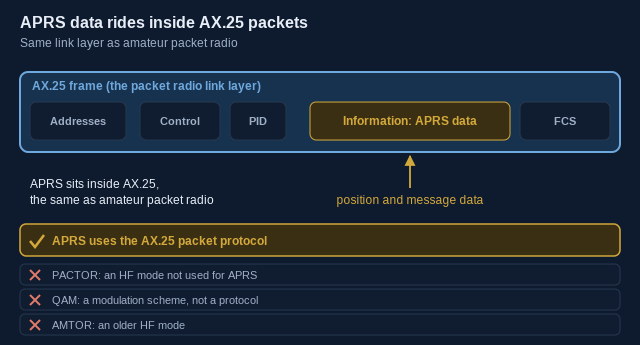
Answer C. AX.25

APRS uses the AX.25 packet protocol.

APRS position and message data carried inside an AX.25 packet frame.
Describe this graphic in words

A blue outer box represents an AX.25 frame with address, control, PID and check fields in dimmed boxes. The information field in gold holds the APRS position and message data, showing that APRS is carried in AX.25 packet frames.

This is a teaching note. APRS sends its data inside AX.25 frames, the same link layer used by amateur packet radio. The frames carry position and message data.

PACTOR and AMTOR are HF modes with different protocols, and QAM is a modulation, not a protocol.

Why the other choices are wrong

  • A. PACTOR is an HF mode not used for APRS.
  • B. QAM is a modulation scheme, not a protocol.
  • D. AMTOR is an older HF mode.

Rule text checked against the official source on November 17, 2026. This is a study aid; the linked rule is what governs.
E2D08

What type of packet frame is used to transmit APRS beacon data?

Show the answer and why

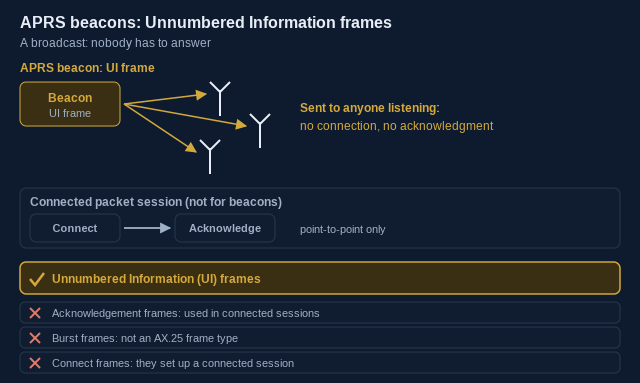
Answer C. Unnumbered Information

APRS beacons use Unnumbered Information (UI) frames.

An APRS beacon sent as a UI frame to anyone listening, contrasted with connected, acknowledged packet sessions.
Describe this graphic in words

A gold beacon box sends UI frames outward to several listening stations with no connection and no acknowledgment. A dimmed panel at the bottom shows connect and acknowledge frames, which belong to point-to-point connected sessions instead.

This is a teaching note. A UI frame is sent to anyone listening, with no connection and no acknowledgment required. That is ideal for position beacons, which are just broadcasts.

Connected and acknowledged frames are for point-to-point packet sessions, not for APRS beacons.

Why the other choices are wrong

  • A. Acknowledgement frames are used in connected sessions.
  • B. Burst is not an AX.25 frame type.
  • D. Connect frames set up a connected session.

Rule text checked against the official source on November 17, 2026. This is a study aid; the linked rule is what governs.
E2D09

What type of modulation is used by JT65?

Show the answer and why

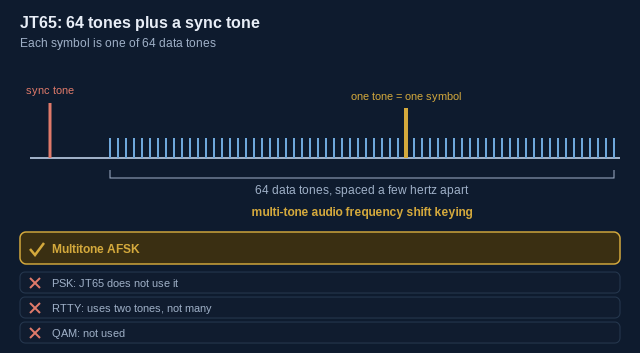
Answer A. Multitone AFSK

JT65 uses multitone AFSK.

A comb of 64 closely spaced data tones plus a sync tone, with one highlighted as the symbol being sent.
Describe this graphic in words

A frequency axis shows a separate synchronization tone at the left and a comb of 64 data tones spaced a few hertz apart. One tone is highlighted in gold, since each tone represents one symbol. This is multi-tone audio frequency shift keying.

This is a teaching note. JT65 sends its symbols as one of 64 data tones (plus a synchronization tone), spaced a few hertz apart across a narrow band, and each tone represents one symbol. This is a form of multi-tone audio frequency shift keying.

It is not PSK, RTTY or QAM.

Why the other choices are wrong

  • B. JT65 does not use PSK.
  • C. RTTY uses two tones, not multiple tones.
  • D. QAM is not used.

Rule text checked against the official source on November 17, 2026. This is a study aid; the linked rule is what governs.
E2D10

What does the packet path WIDE3-1 designate?

Show the answer and why

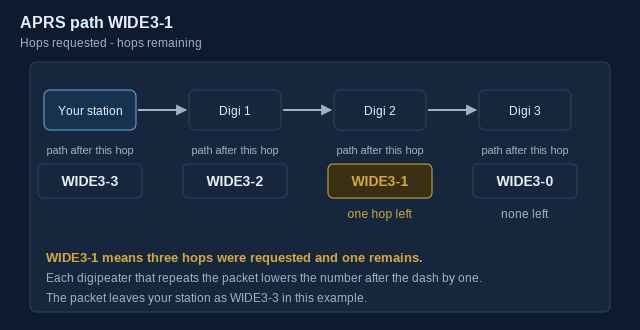
Answer C. Three digipeater hops are requested with one remaining

WIDE3-1 means three digipeater hops are requested with one remaining.

An APRS packet passes through three digipeaters and its WIDE3 path counter counts down from 3 to 0.
Describe this graphic in words

A chain of four boxes shows a station followed by three digipeaters with arrows between them. Under each box is the path as it would appear: WIDE3-3, WIDE3-2, WIDE3-1 and WIDE3-0. The WIDE3-1 box is highlighted in gold, meaning three hops were requested and one remains.

This is a teaching note. In an APRS path like WIDE3-1, the number before the dash is the number of hops requested and the number after it is how many hops remain. Each digipeater that repeats the packet reduces the second number by one.

So WIDE3-1 means three hops were requested originally and one is left to go.

Why the other choices are wrong

  • A. It has nothing to do with how many stations are on frequency.
  • B. It does not concern subcarriers.
  • D. It does not refer to internet gateways.

Rule text checked against the official source on November 17, 2026. This is a study aid; the linked rule is what governs.

E2D11

How do APRS stations relay data?

Show the answer and why

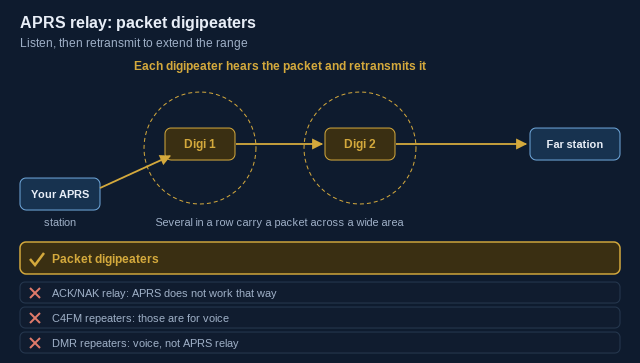
Answer D. By packet digipeaters

APRS stations relay data using packet digipeaters.

An APRS packet relayed by two digipeaters to a far station.
Describe this graphic in words

A packet leaves an APRS station, is heard and retransmitted by digipeater 1, then digipeater 2, and finally reaches a far station beyond the first coverage circle. Each gold circle is a digipeater range.

This is a teaching note. A digipeater listens for APRS packets and retransmits them, extending the range. Several digipeaters in a row can carry a packet across a wide area.

ACK/NAK relay, C4FM repeaters and DMR repeaters are not how APRS works.

Why the other choices are wrong

  • A. APRS does not use ACK/NAK relay.
  • B. C4FM repeaters are for voice.
  • C. DMR repeaters are for voice and are not used for APRS relay.

Rule text checked against the official source on November 17, 2026. This is a study aid; the linked rule is what governs.