Why is it not legal to transmit a 3 kHz bandwidth USB signal with a carrier frequency of 14.348 MHz?
Show the answer and why
Answer D. The upper 1 kHz of the signal is outside the 20-meter band
FCC rule 97.305, 97.307(b)
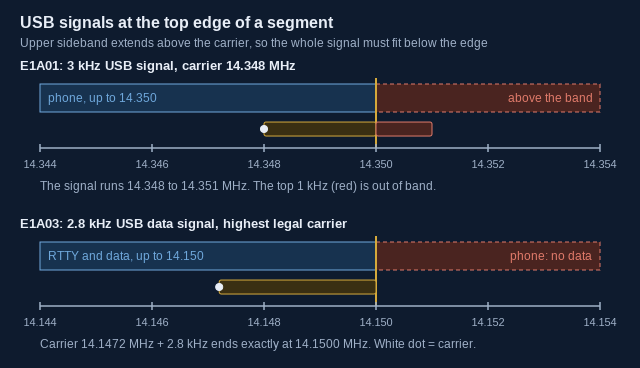
The signal runs from 14.348 to 14.351 MHz, so its top 1 kHz is above the 14.350 MHz band edge.
Describe this graphic in words
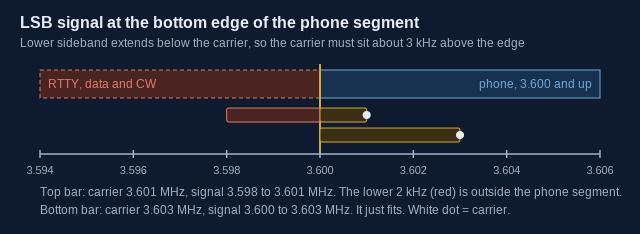
The upper chart zooms in on the top of the 20-meter phone segment at 14.350 MHz. A 3 kHz USB signal with its carrier at 14.348 MHz extends to 14.351 MHz, so its top 1 kHz is marked red as outside the band. The lower chart zooms in on the top of the data segment at 14.150 MHz, where a 2.8 kHz USB signal with carrier at 14.1472 MHz ends exactly on the edge.
With upper sideband the audio sits above the carrier, so a 3 kHz wide signal on a 14.348 MHz carrier occupies 14.348 to 14.351 MHz. The 20-meter phone segment ends at 14.350 MHz (14.15-14.35 MHz in the table), so the last 1 kHz falls outside the band.
Rule 97.307(b) says emissions resulting from modulation must be confined to the band or segment available to the control operator. The carrier itself is inside the band, but that is not enough: the whole signal must fit.
Why the other choices are wrong
- A. USB is the normal sideband on 20 meters and is allowed; the problem is where the signal ends, not the sideband.
- B. With USB nothing extends below the carrier, so the lower edge is not the problem.
- C. 14.348 MHz is inside the band; it is the sideband above it that crosses 14.350 MHz.
References
- FCC rule47 CFR § 97.305, Authorized emission types — The table lists 14.15-14.35 MHz as the 20-meter phone and image segment.
- FCC rule47 CFR § 97.307, Emission standards — Paragraph (b) requires modulation emissions to stay inside the band or segment available.
Rule text checked against the official source on November 17, 2026. This is a study aid; the linked rule is what governs.