
ARSC Tech School

Amateur Extra E0A: Safety

599 questions · pool July 1, 2024 to June 30, 2028 · the exam has 50 questions; 37 to pass

E0 · SAFETY -

Safety: RF radiation hazards; hazardous materials; grounding

12 questions in group E0A

One question from this group appears on each exam.

E0A01

What is the primary function of an external earth connection or ground rod?

Show the answer and why

Answer B. Lightning charge dissipation

An external earth connection or ground rod is there mainly to dissipate lightning charge.
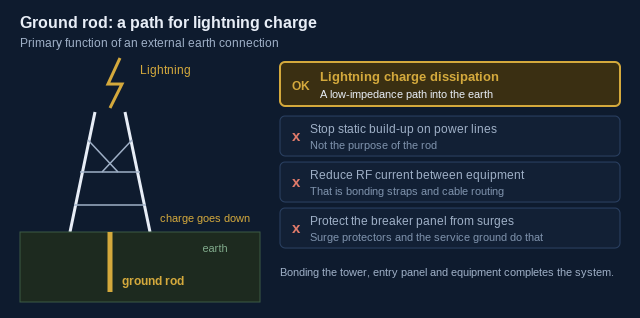
A lightning bolt hits a tower and the charge flows down into a ground rod in the earth.
Describe this graphic in words

A tower stands on the earth with a gold lightning bolt striking its top. A gold ground rod runs from the tower base into the earth, showing the charge path. On the right the keyed answer, lightning charge dissipation, is gold, and three wrong choices are dimmed with a short reason each.

This is a teaching note. A ground rod gives a direct strike, or the charge from a nearby one, a low-impedance path into the earth instead of through your equipment, your wiring or you. It is one part of a lightning protection system, along with bonding the tower, entry panel and equipment together.

It does not stop static building up on power lines, it does not control RF current between pieces of equipment (that is the job of short bonding straps and RF grounding at the equipment), and it does not protect the breaker panel from surges.

Why the other choices are wrong

  • A. Static on power lines is not the purpose of the rod.
  • C. RF current between pieces of equipment is controlled by bonding and cable routing, not by a distant rod.
  • D. Surge protection for the breaker panel is done with surge protectors and a proper service ground, not the antenna ground rod.

Rule text checked against the official source on November 17, 2026. This is a study aid; the linked rule is what governs.
E0A02

When evaluating RF exposure levels from your station at a neighbor’s home, what must you do?

Show the answer and why

Answer B. Ensure signals from your station are less than the uncontrolled maximum permissible exposure (MPE) limits

At a neighbor's home, your signals must be less than the uncontrolled maximum permissible exposure (MPE) limits.

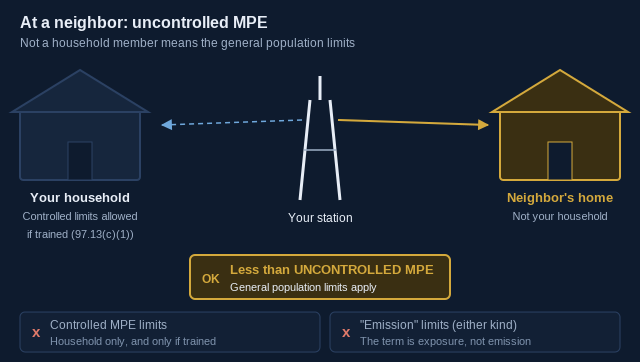
A station between your household and a neighbor, where the neighbor must be below the uncontrolled MPE limit.
Describe this graphic in words

A tower stands between two houses. Your own household on the left may be evaluated against the controlled limits if trained. The neighbor house on the right is gold, and the keyed answer says to stay below the uncontrolled maximum permissible exposure limits. Two dimmed boxes reject controlled limits and the word emission.

Section 97.13(c)(1) allows amateurs to evaluate their own household against the more generous occupational/controlled limits, provided they have had appropriate training and information. The same paragraph says "RF exposure of other nearby persons who are not members of the amateur licensee's household must be evaluated with respect to the general population/uncontrolled exposure limits."

A neighbor is not a member of your household, so that allowance does not cover them and the general population/uncontrolled limits apply. The limit is a "maximum permissible exposure", not a "maximum permissible emission".

Why the other choices are wrong

  • A. The controlled limits apply only to your own household, and only if training has been accessed.
  • C. The controlled limits do not apply to a neighbor, and the term is "exposure", not "emission".
  • D. The uncontrolled limits are correct, but the term is "exposure", not "emission".

References

Rule text checked against the official source on November 17, 2026. This is a study aid; the linked rule is what governs.
E0A03

Over what range of frequencies are the FCC human body RF exposure limits most restrictive?

Show the answer and why

Answer C. 30 - 300 MHz

The FCC human body RF exposure limits are most restrictive from 30 to 300 MHz.

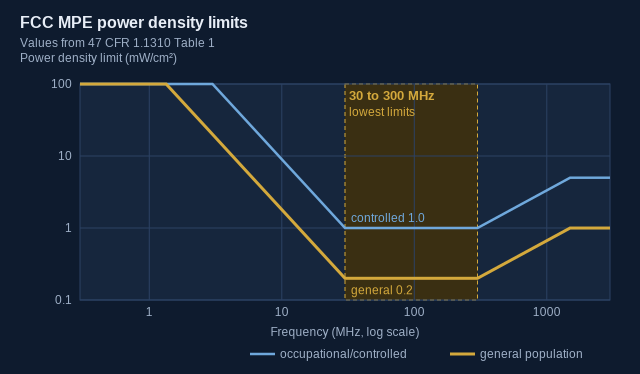
Graph of FCC power density exposure limits versus frequency with the lowest limits between 30 and 300 MHz.
Describe this graphic in words

A log-log chart plots the maximum permissible exposure power density in mW/cm² against frequency from 0.3 to 3,000 MHz. The general population line falls from 100 at low frequency to 0.2 at 30 MHz, stays flat at 0.2 to 300 MHz, then climbs to 1.0 at 1,500 MHz. The occupational line has the same shape with a flat 1.0 between 30 and 300 MHz. That 30 to 300 MHz span is shaded gold as the most restrictive range.

In Table 1 of 1.1310 the allowed field strength and power density are lowest in the 30 to 300 MHz range. For the general population the power density limit there is 0.2 mW/cm², and for the controlled limits it is 1.0 mW/cm². Below 30 MHz the limits rise as 1/f² (the general population value is 180/f² mW/cm², so 20 mW/cm² at 3 MHz, 0.2 at 30 MHz). Above 300 MHz they rise again with frequency: f/1500 mW/cm² for the general population (0.2 at 300 MHz up to 1.0 at 1,500 MHz) and f/300 for controlled exposure.

The reason is that the human body, standing or sitting, absorbs the most energy in this range, because its size is near a resonant fraction of a wavelength. The 6 meter and 2 meter bands, and the VHF TV and FM broadcast bands, are all inside it.

Why the other choices are wrong

  • A. The limits are far higher here (up to 100 mW/cm²), because the body absorbs much less at these frequencies.
  • B. The limits at 3 to 30 MHz are higher (less strict) than 0.2 mW/cm²; they only fall to that value at 30 MHz.
  • D. The limits between 300 and 3,000 MHz are no lower than 0.2 mW/cm² and rise with frequency.

References

Rule text checked against the official source on November 17, 2026. This is a study aid; the linked rule is what governs.
E0A04

When evaluating a site with multiple transmitters operating at the same time, the operators and licensees of which transmitters are responsible for mitigating over-exposure situations?

Show the answer and why

Answer C. Each transmitter that produces 5 percent or more of its MPE limit in areas where the total MPE limit is exceeded

Each transmitter that produces 5 percent or more of its MPE limit is responsible where the combined limit is exceeded.

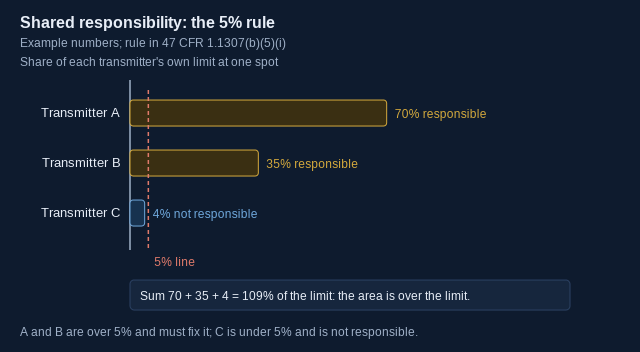
Bar chart of three transmitters where two exceed the 5 percent line and share responsibility.
Describe this graphic in words

Three horizontal bars show how much of its own exposure limit each transmitter produces at one spot: A is 70 percent, B is 35 percent and C is 4 percent. A dashed red line marks 5 percent. A and B are over it and are highlighted as responsible; C is under it and is not. The total of 109 percent exceeds the limit.

When more than one fixed transmitter contributes to an area where the exposure limit is exceeded, the fix is a shared job. Section 1.1307(b)(5)(i) makes every licensee whose source produces more than 5% of the applicable limit at that spot responsible for bringing it into compliance (or for preparing an environmental assessment). A small contributor below 5% is not. Field strengths are squared so the 5% is a share of power density.

Duty cycle alone is not the test, and 20 percent is not the threshold. The threshold is the fraction of the limit that each transmitter creates at the place in question.

Why the other choices are wrong

  • A. The threshold is 5 percent, not 20 percent.
  • B. Duty cycle is not the test in the rule.
  • D. Duty cycle is not the test in the rule.

References

Rule text checked against the official source on November 17, 2026. This is a study aid; the linked rule is what governs.
E0A05

What hazard is created by operating at microwave frequencies?

Show the answer and why

Answer B. The high gain antennas commonly used can result in high exposure levels

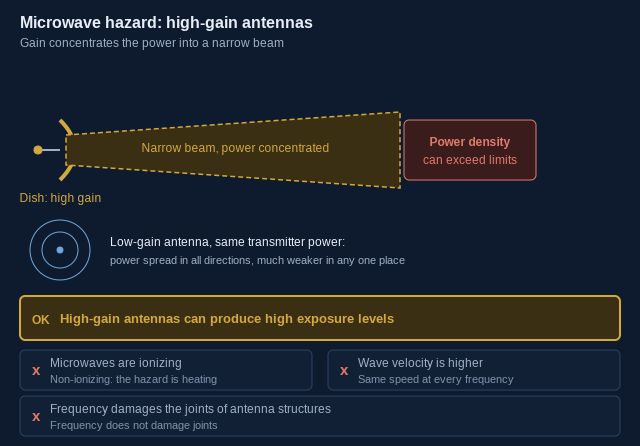
The high gain antennas commonly used at microwave frequencies can produce high exposure levels.

A high-gain dish sends a narrow beam with a hot zone, compared with a low-gain antenna spreading its power.
Describe this graphic in words

A dish at the left sends a narrow gold beam to a red zone marked power density can exceed limits. Below, a low-gain antenna spreads the same power into circles. The keyed answer, high-gain antennas can produce high exposure levels, is gold, and three dimmed wrong choices follow.

This is a teaching note. At microwaves the antennas are usually dishes and horns with very high gain, so they concentrate the power into a narrow beam. Even a modest transmitter can produce a power density in front of the antenna above the exposure limits. The power density in the main beam can be many times what you would find in front of a low-gain antenna with the same power.

Microwaves are non-ionizing, just like every amateur frequency, so the hazard is heating, not ionization. Wave velocity is the same at every frequency, and wavelength does not damage antenna joints.

Why the other choices are wrong

  • A. Microwaves are not ionizing radiation. The hazard is heating of tissue.
  • C. The speed of radio waves in free space is the same at all frequencies.
  • D. Frequency does not damage joints in antenna structures.

Rule text checked against the official source on November 17, 2026. This is a study aid; the linked rule is what governs.
E0A06

Why are there separate electric (E) and magnetic (H) MPE limits at frequencies below 300 MHz?

Show the answer and why

Answer D. All these choices are correct

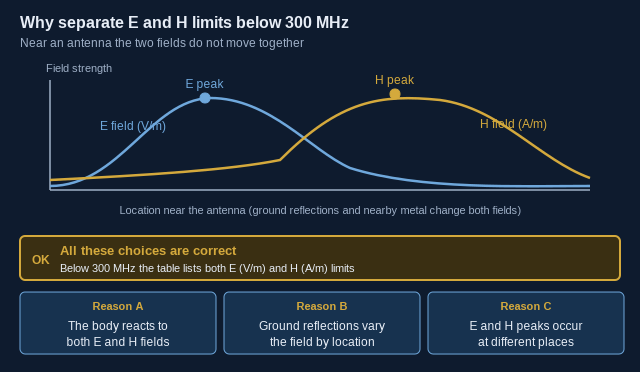
All of these choices are correct: separate E and H limits exist because the body reacts to both, ground reflections vary the fields, and the peaks can be at different places.

Two field strength curves with peaks at different places, and three true reasons for separate E and H limits.
Describe this graphic in words

A graph of field strength against location near an antenna shows a blue E field curve peaking at one place and a gold H field curve peaking at another. Below, a gold bar says all the choices are correct, with three boxes giving the three reasons: the body reacts to both, ground reflections vary the fields, and the peaks are at different places.

In 1.1310 the table gives both an electric field strength (V/m) and a magnetic field strength (A/m) limit below 300 MHz. Close to an antenna (the near field) the E and H fields do not have the simple fixed relationship they have in a plane wave far away. Reflection from the ground, and from nearby metal, can change both fields from one spot to the next, and the strongest E field and the strongest H field may be at different places.

The body can also respond to either one, so both must be checked. This is a teaching note about why the table has two columns.

Why the other choices are wrong

  • A. This is true, but not the only reason.
  • B. This is true, but not the only reason.
  • C. This is true, but not the only reason.

References

Rule text checked against the official source on November 17, 2026. This is a study aid; the linked rule is what governs.
E0A07

What is meant by “100% tie-off” regarding tower safety?

Show the answer and why

Answer B. At least one lanyard attached to the tower at all times

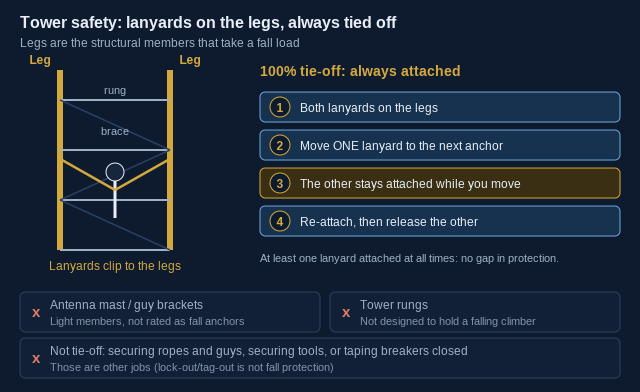
"100% tie-off" means at least one lanyard is attached to the tower at all times.

A climber with lanyards on the tower legs and the four-step 100 percent tie-off sequence.
Describe this graphic in words

A tower section has two gold legs, with rungs and braces drawn dim. A climber has a lanyard clipped to each leg. At the right, four numbered steps show one lanyard being moved while the other stays attached, which is 100 percent tie-off. Dimmed boxes reject the mast, guy brackets, rungs, and other meanings of tie-off.

It is climbing practice: there is always at least one point where you are attached, so there is no gap in your protection. When you move from one anchor to another you keep one lanyard attached while you move the other.

This is a teaching note. "100% tie-off" is a climbing-industry term and does not appear in 29 CFR 1910.140. That rule does require a personal fall arrest system to be rigged so a free fall cannot exceed 6 feet, which only helps if you are attached when you fall.

Why the other choices are wrong

  • A. Securing ropes and guys is a different job.
  • C. Tools are secured to prevent dropping them, not as tie-off.
  • D. This describes lock-out/tag-out, not fall protection.

References

Rule text checked against the official source on November 17, 2026. This is a study aid; the linked rule is what governs.
E0A08

What does SAR measure?

Show the answer and why

Answer C. The rate at which RF energy is absorbed by the body

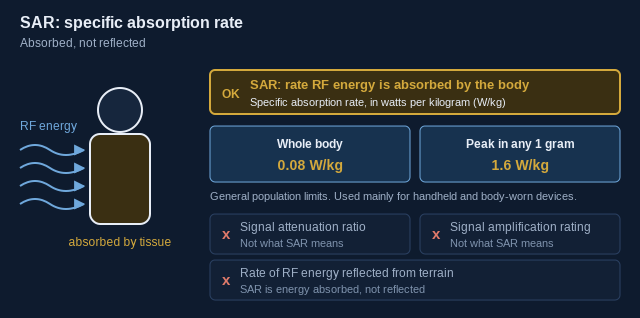
SAR measures the rate at which RF energy is absorbed by the body.

RF waves enter a body shape, with SAR defined as absorbed energy rate and its two limits in watts per kilogram.
Describe this graphic in words

Blue wave arrows enter a body outline shaded gold to show absorption. The keyed answer says SAR is the rate at which RF energy is absorbed by the body, measured in watts per kilogram. Two boxes give the general population limits of 0.08 W/kg whole body and 1.6 W/kg in any one gram. Three dimmed wrong choices follow.

SAR stands for specific absorption rate. Section 1.1310 states: "SAR is a measure of the rate of energy absorption due to exposure to RF electromagnetic energy." It is given in watts per kilogram of tissue. The limits for the general population are 0.08 W/kg over the whole body and 1.6 W/kg peak in any 1 gram of tissue.

SAR is used mainly for handheld and body-worn devices held close to the body, where the power density is not a good measure.

Why the other choices are wrong

  • A. This is not what SAR stands for.
  • B. This is not what SAR stands for.
  • D. SAR is about energy absorbed, not energy reflected.

References

Rule text checked against the official source on November 17, 2026. This is a study aid; the linked rule is what governs.
E0A09

Which of the following types of equipment are exempt from RF exposure evaluations?

Show the answer and why

Answer C. Hand-held transceivers sold before May 3, 2021

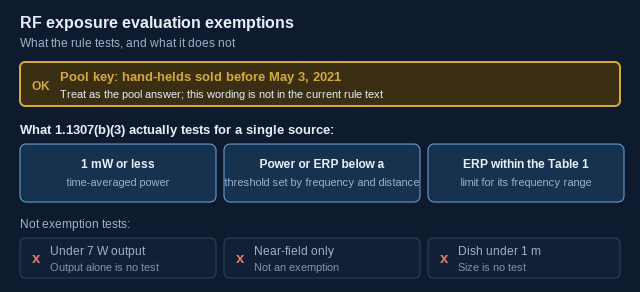
The pool keys hand-held transceivers sold before May 3, 2021 as exempt from RF exposure evaluation.

The pool keyed answer in gold above the three real exemption tests and three non-tests.
Describe this graphic in words

A gold bar shows the pool keyed answer, hand-held transceivers sold before May 3, 2021, with a note that the wording is not in the current rule text. Three blue boxes list the real tests in 1.1307(b)(3): 1 milliwatt, a frequency and distance threshold, and the Table 1 ERP limits. Three dimmed boxes reject 7 watts, near-field only, and dish size.

This is a teaching note. The keyed answer refers to equipment sold before May 3, 2021. That date, and a blanket exemption for such hand-helds, do not appear in the current text of 1.1307(b)(3), 2.1091, 2.1093 or 97.13. May 3, 2021 appears to be the date by which the revised RF exposure rules from the FCC's 2019 order had to be followed, so the question seems to be describing a transition (grandfathering) arrangement. We could not confirm that wording in the current rules, so treat it as the pool's answer.

What the current rule does say is that a source is exempt if it meets one of the tests in 1.1307(b)(3): 1 mW or less of time-averaged power, a power or ERP below a threshold that depends on frequency and distance, or the Table 1 ERP limits by frequency range. The other three choices are not exemption categories there: output power alone (such as 7 watts) is not the test, near-field operation is not an exemption, and nothing exempts a dish just for being under a meter in diameter.

Why the other choices are wrong

  • A. No seven watt threshold appears in the current exemption tests.
  • B. Near-field-only radiation is not an exemption.
  • D. No exemption is based on dish size.

References

Rule text checked against the official source on November 17, 2026. This is a study aid; the linked rule is what governs.
E0A10

When must an RF exposure evaluation be performed on an amateur station operating on 80 meters?

Show the answer and why

Answer A. An evaluation must always be performed

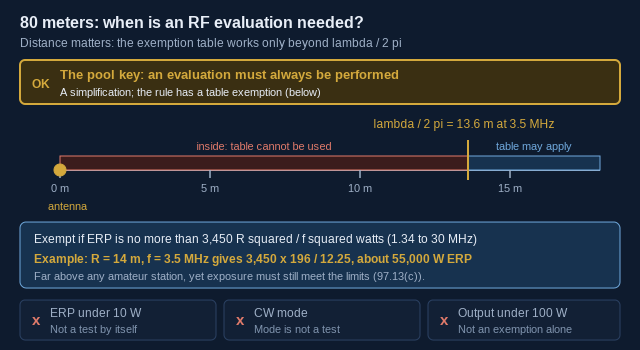
The pool keys that an RF exposure evaluation must always be performed for an 80 meter station.

A distance scale marking 13.6 meters for 80 meters and the 3,450 R squared over f squared exemption example.
Describe this graphic in words

The keyed answer in gold says an evaluation must always be performed, with a note that this simplifies the rule. A distance scale from the antenna marks lambda over 2 pi at 13.6 meters for 3.5 MHz, with the zone inside it shaded red. A worked example shows about 55,000 watts of ERP allowed at 14 meters. Three dimmed boxes reject ERP under 10 W, CW, and under 100 W.

This is a teaching note. The pool keys that an evaluation must always be performed. Read against the current rule that is a simplification, because 1.1307(b)(3)(i)(C) exempts a single source if its ERP is no more than the Table 1 value for its frequency, provided the person is at least λ/2π away. For 1.34 to 30 MHz the value is 3,450 R²/f² watts, with R the distance in meters and f the frequency in MHz.

At 3.5 MHz, λ/2π is about 13.6 meters. At R = 14 meters the limit works out to 3,450 × 196 / 12.25, about 55,000 watts of ERP, far above any amateur station. So a typical 80 meter station with the antenna 14 meters or more from people can claim an exemption. A station with people closer than λ/2π cannot use the table. Even an exempt station must still keep exposure within the limits (97.13(c)). The other three choices are not exemptions: ERP below 10 W, the CW mode, and output below 100 W are not tests in the rule.

Why the other choices are wrong

  • B. ERP under 10 W is not an exemption test by itself.
  • C. Operating mode is not itself an exemption test.
  • D. Power under 100 W is not by itself an exemption.

References

Rule text checked against the official source on November 17, 2026. This is a study aid; the linked rule is what governs.

E0A11

To what should lanyards be attached while climbing?

Show the answer and why

Answer D. Tower legs

Lanyards should be attached to the tower legs while climbing.

A climber with lanyards on the tower legs and the four-step 100 percent tie-off sequence.
Describe this graphic in words

A tower section has two gold legs, with rungs and braces drawn dim. A climber has a lanyard clipped to each leg. At the right, four numbered steps show one lanyard being moved while the other stays attached, which is 100 percent tie-off. Dimmed boxes reject the mast, guy brackets, rungs, and other meanings of tie-off.

The legs are the main structural members and are strong enough to take a fall load. Rungs, braces and small tower parts can bend or break, and a lanyard that slips off the rung could let you fall further. The mast and guy brackets are not made for the load of a falling person either. This is climbing practice, not a rule that names the tower legs.

The anchor must also be able to take a very large load. Under 29 CFR 1910.140(c)(7), D-rings, snaphooks and carabiners must sustain a minimum of 5,000 pounds, and (d)(1)(i) limits the arresting force on the climber to 1,800 pounds. A weak anchor makes the rest of the system useless.

Why the other choices are wrong

  • A. A mast is a light member and can bend or slip.
  • B. Guy brackets are not rated as fall anchors.
  • C. Rungs are not designed to hold a falling climber.

References

Rule text checked against the official source on November 17, 2026. This is a study aid; the linked rule is what governs.

E0A12

Where should a shock-absorbing lanyard be attached to a tower when working above ground?

Show the answer and why

Answer A. Above the climber’s head level

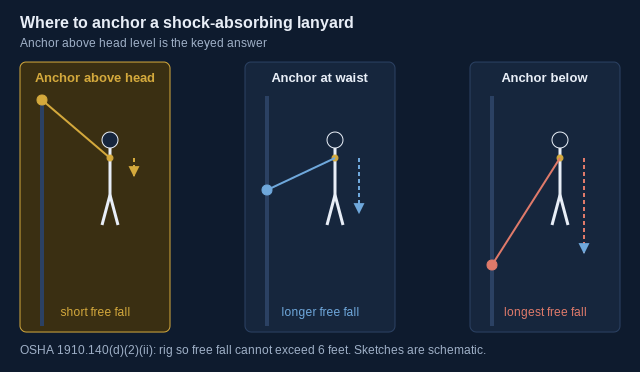
A shock-absorbing lanyard should be attached above the climber's head level.

Three climber sketches comparing a lanyard anchored above the head, at the waist and below.
Describe this graphic in words

Three panels each show a tower leg and a climber. In the first, highlighted in gold, the lanyard goes up to an anchor above the climber and the free fall is short. In the second the anchor is at waist height and the free fall is longer. In the third the anchor is below the climber and the free fall is longest. A note cites the 6 foot free fall limit.

Attach it high. If the anchor is above you, there is little slack, so a fall is short and the arresting force stays low. If the anchor is at your waist or below, the free fall can be several feet before the lanyard even goes tight, and the shock absorber then has to stop a faster fall.

29 CFR 1910.140(d)(2)(ii) says a personal fall arrest system must be rigged so you cannot free fall more than 6 feet or hit a lower level, unless the maker designed and tested it for more. Paragraph (d)(1)(i) limits the arresting force to 1,800 pounds.

Why the other choices are wrong

  • B. Attached to the belt of the harness is where the lanyard connects to you, not where it connects to the tower.
  • C. An anchor at the waist allows a longer free fall.
  • D. Attaching to the next lowest set of guys puts the anchor below you, and a fall would be long.

References

Rule text checked against the official source on November 17, 2026. This is a study aid; the linked rule is what governs.