
ARSC Tech School

Amateur Extra E7H: Oscillators and signal sources

599 questions · pool July 1, 2024 to June 30, 2028 · the exam has 50 questions; 37 to pass

E7 · PRACTICAL CIRCUITS

Oscillators and signal sources: types of oscillators; synthesizers and phase-locked loops; direct digital synthesizers; stabilizing thermal drift; microphonics; high-accuracy oscillators

13 questions in group E7H

One question from this group appears on each exam.

E7H01

What are three common oscillator circuits?

Show the answer and why

Answer D. Colpitts, Hartley, and Pierce

Colpitts, Hartley and Pierce are three common oscillator circuits.
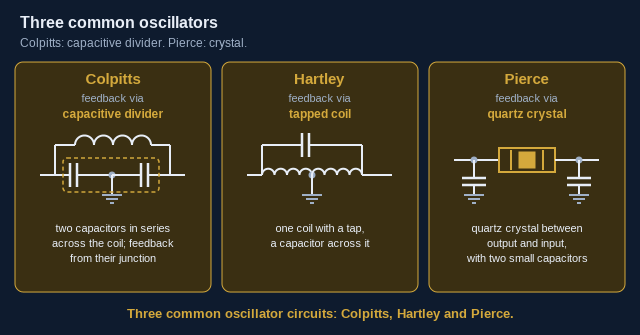
Colpitts, Hartley and Pierce oscillators and how each gets its feedback.
Describe this graphic in words

Three gold panels. The Colpitts oscillator gets positive feedback through a capacitive divider, two capacitors in series across a coil. The Hartley uses a tapped coil. The Pierce uses a quartz crystal between output and input with a small capacitor from each side to ground.

This is a teaching note. Colpitts uses a capacitive divider, Hartley uses a tapped coil, and Pierce uses a crystal.

The other names do not exist as oscillators.

Why the other choices are wrong

  • A. Taft is not an oscillator.
  • B. Fenner and Beane are not oscillators.
  • C. Taft is not an oscillator.

Rule text checked against the official source on November 17, 2026. This is a study aid; the linked rule is what governs.
E7H02

What is a microphonic?

Show the answer and why

Answer C. Changes in oscillator frequency caused by mechanical vibration

A microphonic is a change in oscillator frequency caused by mechanical vibration.

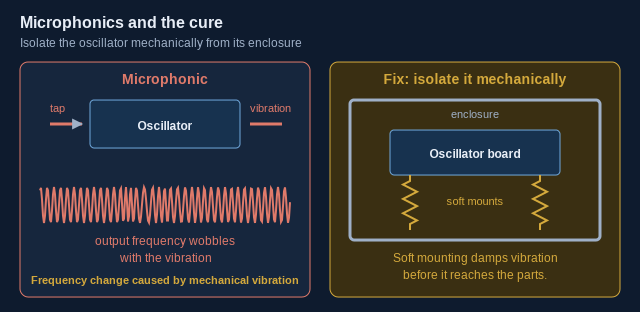
A microphonic is oscillator frequency change from vibration; soft mounting reduces it.
Describe this graphic in words

The left panel shows a tap or vibration on an oscillator and a red output waveform whose frequency wobbles, which is a microphonic. The right panel shows an oscillator board on soft mounts inside an enclosure, in gold, which damps vibration before it reaches the parts.

This is a teaching note. Vibration moves parts slightly and shifts frequency. It can show up as noise or tone in the signal.

It is not an IC or RF pickup.

Why the other choices are wrong

  • A. It is not an IC.
  • B. RF pickup is a different problem.
  • D. It is not loading.

Rule text checked against the official source on November 17, 2026. This is a study aid; the linked rule is what governs.
E7H03

What is a phase-locked loop?

Show the answer and why

Answer C. An electronic servo loop consisting of a phase detector, a low-pass filter, a voltage-controlled oscillator, and a stable reference oscillator

A PLL is a servo loop of a phase detector, a low-pass filter, a VCO and a stable reference.

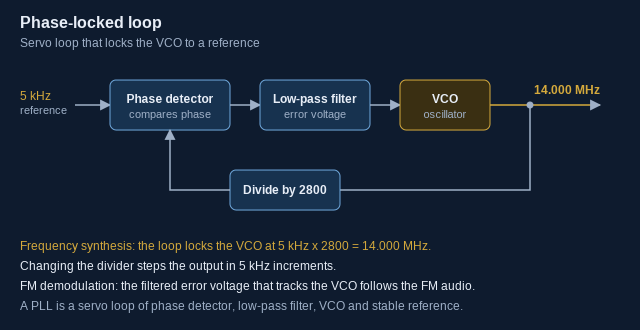
Block diagram of a phase-locked loop used as a 14 MHz frequency synthesizer.
Describe this graphic in words

A 5 kilohertz reference feeds a phase detector, then a low-pass filter, then a voltage-controlled oscillator whose output is 14.000 megahertz. The output also goes through a divide-by-2800 counter back to the phase detector, so the loop locks the oscillator at 5 kilohertz times 2800. Notes explain that changing the divider steps the frequency in 5 kilohertz increments and that the error voltage can demodulate FM.

This is a teaching note. The phase detector compares the VCO with the reference, and the filtered error voltage corrects the VCO.

It is not a monostable.

Why the other choices are wrong

  • A. A ratio detector and reactance modulator are not the parts.
  • B. A monostable is a different circuit.
  • D. It is not a push-pull amplifier.

Rule text checked against the official source on November 17, 2026. This is a study aid; the linked rule is what governs.
E7H04

How is positive feedback supplied in a Colpitts oscillator?

Show the answer and why

Answer C. Through a capacitive divider

A Colpitts oscillator gets feedback through a capacitive divider.

Colpitts, Hartley and Pierce oscillators and how each gets its feedback.
Describe this graphic in words

Three gold panels. The Colpitts oscillator gets positive feedback through a capacitive divider, two capacitors in series across a coil. The Hartley uses a tapped coil. The Pierce uses a quartz crystal between output and input with a small capacitor from each side to ground.

This is a teaching note. Two capacitors in series across the tank provide the feedback voltage. As an example, two 100 pF capacitors in series give 50 pF, and with a 1 microhenry coil the oscillator runs at 1 / (2 pi x sqrt(1e-6 x 50e-12)), about 22.5 MHz.

The Hartley uses a tapped coil.

Why the other choices are wrong

  • A. A tapped coil is Hartley.
  • B. Link coupling uses a small coupling coil, which is not how a Colpitts gets its feedback.
  • D. Neutralizing is a different technique.

Rule text checked against the official source on November 17, 2026. This is a study aid; the linked rule is what governs.
E7H05

How is positive feedback supplied in a Pierce oscillator?

Show the answer and why

Answer D. Through a quartz crystal

A Pierce oscillator gets feedback through a quartz crystal.

Colpitts, Hartley and Pierce oscillators and how each gets its feedback.
Describe this graphic in words

Three gold panels. The Colpitts oscillator gets positive feedback through a capacitive divider, two capacitors in series across a coil. The Hartley uses a tapped coil. The Pierce uses a quartz crystal between output and input with a small capacitor from each side to ground.

This is a teaching note. The crystal is the resonant element in the feedback path.

No tuned coil is needed in the feedback path. As an example, a 10 MHz crystal rated at 20 parts per million holds its frequency within about 200 Hz, far tighter than an LC tank.

Why the other choices are wrong

  • A. A tapped coil is Hartley.
  • B. Link coupling is not Pierce.
  • C. Neutralizing is for amplifiers.

Rule text checked against the official source on November 17, 2026. This is a study aid; the linked rule is what governs.
E7H06

Which of these functions can be performed by a phase-locked loop?

Show the answer and why

Answer B. Frequency synthesis and FM demodulation

A PLL can perform frequency synthesis and FM demodulation.

Block diagram of a phase-locked loop used as a 14 MHz frequency synthesizer.
Describe this graphic in words

A 5 kilohertz reference feeds a phase detector, then a low-pass filter, then a voltage-controlled oscillator whose output is 14.000 megahertz. The output also goes through a divide-by-2800 counter back to the phase detector, so the loop locks the oscillator at 5 kilohertz times 2800. Notes explain that changing the divider steps the frequency in 5 kilohertz increments and that the error voltage can demodulate FM.

This is a teaching note. It locks to a reference and can multiply it, and the control voltage follows an FM signal. For example, with a 5 kHz reference and a divide-by-2800 counter in the feedback path, the loop locks the VCO at 5 kHz x 2800 = 14.000 MHz, and changing the divider steps the frequency in 5 kHz increments.

It does not amplify power.

Why the other choices are wrong

  • A. It is not a power amplifier.
  • C. It is not photovoltaic.
  • D. Comparing digital inputs and counting pulses are logic jobs; they are not what a PLL is used for as a whole.

Rule text checked against the official source on November 17, 2026. This is a study aid; the linked rule is what governs.

E7H07

How can an oscillator’s microphonic responses be reduced?

Show the answer and why

Answer D. Mechanically isolate the oscillator circuitry from its enclosure

Mechanically isolating the oscillator from its enclosure reduces microphonic response.

A microphonic is oscillator frequency change from vibration; soft mounting reduces it.
Describe this graphic in words

The left panel shows a tap or vibration on an oscillator and a red output waveform whose frequency wobbles, which is a microphonic. The right panel shows an oscillator board on soft mounts inside an enclosure, in gold, which damps vibration before it reaches the parts.

This is a teaching note. Soft mounting damps vibration before it reaches the parts.

Capacitor type and supply noise address other issues.

Why the other choices are wrong

  • A. NP0 capacitors address thermal drift.
  • B. Supply noise is a different problem.
  • C. More gain does not help.

Rule text checked against the official source on November 17, 2026. This is a study aid; the linked rule is what governs.

E7H08

Which of the following components can be used to reduce thermal drift in crystal oscillators?

Show the answer and why

Answer A. NP0 capacitors

NP0 capacitors reduce thermal drift in crystal oscillators.

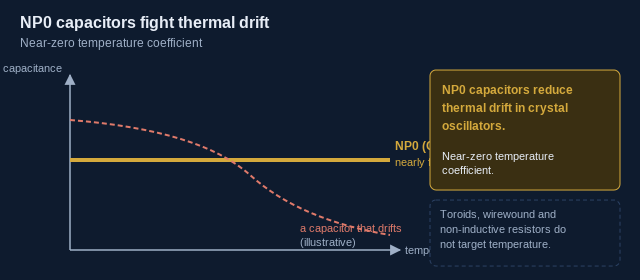
NP0 capacitors hold their capacitance steady as temperature changes, reducing drift in crystal oscillators.
Describe this graphic in words

A graph of capacitance against temperature. A gold NP0 line stays flat while a dashed red illustrative curve of a drifting capacitor slopes away. A gold box says NP0 capacitors reduce thermal drift in crystal oscillators.

This is a teaching note. NP0 (C0G) ceramics have nearly zero temperature coefficient, so capacitance stays steady as temperature changes.

The others do not target temperature.

Why the other choices are wrong

  • B. Toroids do not help.
  • C. Wirewound resistors do not.
  • D. Non-inductive resistors do not.

Rule text checked against the official source on November 17, 2026. This is a study aid; the linked rule is what governs.

E7H09

What type of frequency synthesizer circuit uses a phase accumulator, lookup table, digital-to-analog converter, and a low-pass anti-alias filter?

Show the answer and why

Answer A. A direct digital synthesizer

A direct digital synthesizer uses a phase accumulator, lookup table, DAC and low-pass filter.

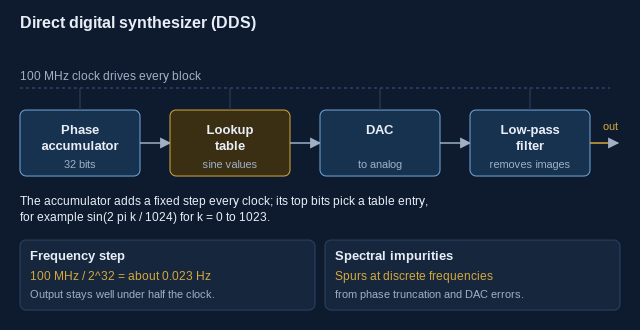
Block diagram of a direct digital synthesizer with a clock, phase accumulator, lookup table, DAC and low-pass filter.
Describe this graphic in words

Four blocks in a row run from a common 100 megahertz clock: a 32-bit phase accumulator, a lookup table of sine amplitude values, a digital-to-analog converter and a low-pass filter that removes images before the output. Cards below give the frequency step of 100 megahertz divided by 2 to the 32, about 0.023 hertz, and note that impurities are spurs at discrete frequencies from phase truncation and DAC errors.

This is a teaching note. The accumulator steps through phase, the table gives amplitude, the DAC makes the analog wave, and the filter removes alias images. For example, with a 100 MHz clock and a 32-bit accumulator the frequency step is 100 MHz / 2^32, about 0.023 Hz, and the output can be tuned from near zero up toward (but well under) half the clock rate.

PLLs use VCOs.

Why the other choices are wrong

  • B. Hybrid synthesizers combine methods.
  • C. PLL uses a VCO and phase detector.
  • D. Direct conversion is a receiver type.

Rule text checked against the official source on November 17, 2026. This is a study aid; the linked rule is what governs.

E7H10

What information is contained in the lookup table of a direct digital synthesizer (DDS)?

Show the answer and why

Answer B. Amplitude values that represent the desired waveform

The lookup table holds amplitude values that represent the desired waveform.

Block diagram of a direct digital synthesizer with a clock, phase accumulator, lookup table, DAC and low-pass filter.
Describe this graphic in words

Four blocks in a row run from a common 100 megahertz clock: a 32-bit phase accumulator, a lookup table of sine amplitude values, a digital-to-analog converter and a low-pass filter that removes images before the output. Cards below give the frequency step of 100 megahertz divided by 2 to the 32, about 0.023 hertz, and note that impurities are spurs at discrete frequencies from phase truncation and DAC errors.

This is a teaching note. For a sine wave, it holds sine values. The phase accumulator picks the entry. For example, a 1024-entry table might hold sin(2 pi k / 1024) for k = 0 to 1023, and the top bits of the accumulator choose which entry goes to the DAC.

It does not hold frequencies.

Why the other choices are wrong

  • A. It does not hold phase relationships.
  • C. No VCO is involved.
  • D. It does not hold frequently used frequencies.

Rule text checked against the official source on November 17, 2026. This is a study aid; the linked rule is what governs.

E7H11

What are the major spectral impurity components of direct digital synthesizers?

Show the answer and why

Answer C. Spurious signals at discrete frequencies

DDS spectral impurities are spurious signals at discrete frequencies.

Block diagram of a direct digital synthesizer with a clock, phase accumulator, lookup table, DAC and low-pass filter.
Describe this graphic in words

Four blocks in a row run from a common 100 megahertz clock: a 32-bit phase accumulator, a lookup table of sine amplitude values, a digital-to-analog converter and a low-pass filter that removes images before the output. Cards below give the frequency step of 100 megahertz divided by 2 to the 32, about 0.023 hertz, and note that impurities are spurs at discrete frequencies from phase truncation and DAC errors.

This is a teaching note. The phase accumulator is truncated before it addresses the table, and the DAC has finite resolution and non-linearity. Both errors repeat periodically, so they create spurs at specific frequencies rather than a smooth noise floor.

Broadband noise is smaller.

Why the other choices are wrong

  • A. Broadband noise is present but is not the characteristic impurity of a DDS; discrete spurs are.
  • B. Quantization from the DAC contributes to the spurs but 'digital conversion noise' is not the standard description.
  • D. A DDS has no local oscillator in this sense; its spurs come from truncation and DAC errors, plus clock-related images.

Rule text checked against the official source on November 17, 2026. This is a study aid; the linked rule is what governs.

E7H12

Which of the following ensures that a crystal oscillator operates on the frequency specified by the crystal manufacturer?

Show the answer and why

Answer B. Provide the crystal with a specified parallel capacitance

Providing the crystal with its specified parallel capacitance (load capacitance) ensures it oscillates on its rated frequency.

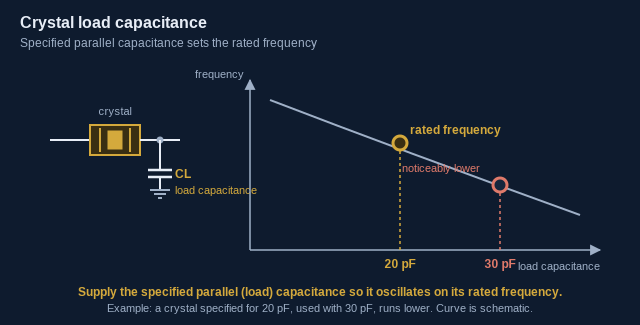
A crystal oscillates on its rated frequency only with its specified load capacitance.
Describe this graphic in words

A crystal with a shunt load capacitor CL is drawn on the left. On the right a schematic graph of frequency against load capacitance has a gold point at the specified 20 picofarads marked as the rated frequency, and a red point at 30 picofarads where the frequency is noticeably lower.

This is a teaching note. Parallel-resonant crystals are ground to the rated frequency with a given load capacitance. Different capacitance pulls the frequency. For example, a crystal specified at 20 pF load capacitance that is instead used with 30 pF will oscillate noticeably lower than its marked frequency.

It is not set by inductance or bias.

Why the other choices are wrong

  • A. Parallel inductance is not specified.
  • C. Voltage bias does not set frequency.
  • D. Current bias does not set frequency.

Rule text checked against the official source on November 17, 2026. This is a study aid; the linked rule is what governs.

E7H13

Which of the following is a technique for providing highly accurate and stable oscillators needed for microwave transmission and reception?

Show the answer and why

Answer D. All these choices are correct

All of these choices are correct: GPS, rubidium and temperature-controlled dielectric resonators are all used.

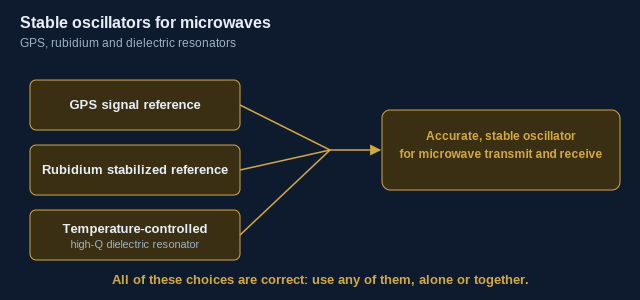
GPS, rubidium and temperature-controlled dielectric resonator references all give stable microwave oscillators.
Describe this graphic in words

Three gold boxes, a GPS signal reference, a rubidium stabilized reference and a temperature-controlled high-Q dielectric resonator, all feed a gold box for an accurate, stable microwave oscillator. A caption says all the choices are correct.

This is a teaching note. Microwave work needs stable references. GPS-disciplined oscillators, rubidium standards and dielectric resonator oscillators in temperature-controlled ovens are used.

Each can be used alone or together.

Why the other choices are wrong

  • A. True, but not the only one.
  • B. True, but not the only one.
  • C. True, but not the only one.

Rule text checked against the official source on November 17, 2026. This is a study aid; the linked rule is what governs.